Transforms
Fourier transform (Tag D-5LZQ4)
For \(f\in L^1(\RR^n)\), the Fourier transform of \(f\) is the function \(\widehat f\colon\RR^n\to\CC\) given by \[ \widehat f(\xi) \coloneqq \int_{\RR^n} f(x)e^{-2\pi i x\cdot\xi}\,dx, \qquad \xi\in\RR^n. \]
(Normalization)
With the normalization \[ \hat{f}(\xi) \coloneqq \int_\RR e^{-i\xi x} f(x)\dx = \mcl(f)(i\xi), \] where \(\mcl\) is the two-sided Laplace transform, the inversion formula reads \[ f(x) = {1\over 2\pi}\int_\RR e^{i\xi x} \hat{f}(\xi) \dxi. \]
The Gamma function
Gamma function (Tag D-Q3MYK)
For \(z\in\CC\) with \(\operatorname{Re}z>0\), the gamma function is \[ \Gamma(z)\coloneqq\int_0^\infty t^{z-1}e^{-t}\dt, \] where \(t^{z-1}\coloneqq e^{(z-1)\log t}\) for \(t>0\), with \(\log\) the real natural logarithm.
$\Gamma$ is holomorphic on the right half-plane (Tag PR-NLV6Q)
For \(\Re s>0\) the integral \[ \Gamma(s)=\int_0^\infty e^{-t}t^{s-1}\dt \] converges absolutely, and it defines a holomorphic function on the right half-plane \(\ts{s\in\CC\st\Re s>0}\).
For \(t>0\), \(\abs{t^{s-1}}=\abs{e^{(s-1)\ln t}}=t^{\Re s-1}\). For \(0<\varepsilon<1\) put \[ \Gamma_\varepsilon(s)\coloneqq\int_\varepsilon^{1/\varepsilon}e^{-t}t^{s-1}\dt. \] The integrand is continuous in \((t,s)\) and holomorphic in \(s\), and the interval is compact, so each \(\Gamma_\varepsilon\) is entire.
Fix \(n\ge1\) and the strip \(A_n\coloneqq\ts{s\st \frac1n<\Re s<n}\). For \(s\in A_n\), \[ \abs{\Gamma(s)-\Gamma_\varepsilon(s)}\le\int_0^\varepsilon t^{1/n-1}\dt+\int_{1/\varepsilon}^\infty e^{-t}t^{n-1}\dt, \] using \(t^{\Re s-1}\le t^{1/n-1}\) for \(t\le1\) and \(t^{\Re s-1}\le t^{n-1}\) for \(t\ge1\). Both integrals are finite (so the integral defining \(\Gamma\) converges absolutely) and tend to \(0\) as \(\varepsilon\to0\), independently of \(s\). Hence \(\Gamma_\varepsilon\to\Gamma\) uniformly on each \(A_n\). A uniform limit of holomorphic functions on an open set is holomorphic, so \(\Gamma\) is holomorphic on each \(A_n\), and the strips \(A_n\) cover the right half-plane.
Functional equation for $\Gamma$ (Tag PR-FBQ6F)
For \(s\in\CC\) with \(\Re(s)>0\), the Gamma function satisfies \[ \Gamma(s+1) = s\,\Gamma(s). \] Consequently \(\Gamma(n+1)=n!\) for every integer \(n\ge0\).
For \(0<\varepsilon<1\), integration by parts on \([\varepsilon,1/\varepsilon]\) gives \[ \int_\varepsilon^{1/\varepsilon}\frac{d}{dt}\qty{e^{-t}t^s}\dt=-\int_\varepsilon^{1/\varepsilon}e^{-t}t^s\dt+s\int_\varepsilon^{1/\varepsilon}e^{-t}t^{s-1}\dt. \] The left side equals \(e^{-1/\varepsilon}\varepsilon^{-s}-e^{-\varepsilon}\varepsilon^s\), which tends to \(0\) as \(\varepsilon\to0\) because \(\abs{\varepsilon^s}=\varepsilon^{\Re s}\to0\) and \(e^{-1/\varepsilon}\) decays faster than any power of \(\varepsilon\). The right side tends to \(-\Gamma(s+1)+s\Gamma(s)\), so \(\Gamma(s+1)=s\Gamma(s)\). Since \(\Gamma(1)=\int_0^\infty e^{-t}\dt=1\), induction on \(n\) gives \(\Gamma(n+1)=n\Gamma(n)=n!\).
Meromorphic continuation of $\Gamma$ (Tag PR-YQZI3)
The Gamma function, defined by \(\Gamma(s)=\int_0^\infty t^{s-1}e^{-t}\dt\) for \(\Re s>0\), extends to a meromorphic function on \(\CC\) whose only singularities are simple poles at \(s=0,-1,-2,\ldots\).
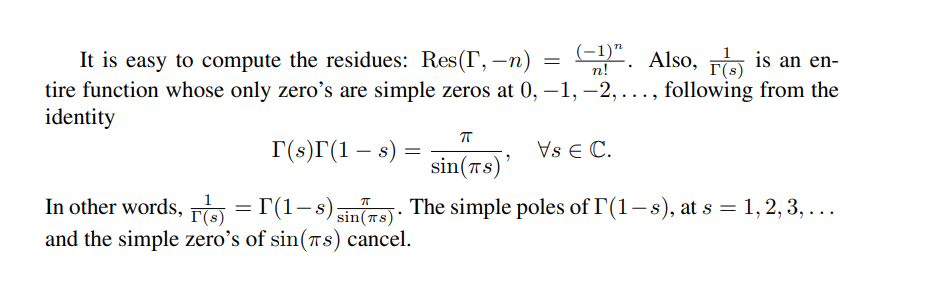
For \(\Re s>0\), integration by parts gives \(\Gamma(s+1)=s\Gamma(s)\), and \(\Gamma\) is holomorphic there by PR-NLV6Q. For \(n\ge1\) define, on \(\ts{s\st\Re s>-n}\), \[ \Gamma_n(s)\coloneqq\frac{\Gamma(s+n)}{s(s+1)\cdots(s+n-1)}. \] Since \(\Re(s+n)>0\), the numerator is holomorphic on this half-plane, so \(\Gamma_n\) is meromorphic there with at most simple poles at \(0,-1,\ldots,-(n-1)\). Iterating \(\Gamma(s+1)=s\Gamma(s)\) shows \(\Gamma_n=\Gamma\) on \(\Re s>0\), so by the identity theorem \(\Gamma_n\) and \(\Gamma_{n+1}\) agree on \(\ts{\Re s>-n}\) minus the poles. The functions \(\Gamma_n\) therefore define one meromorphic function on \(\CC\). At \(s=-k\) with \(0\le k\le n-1\), the numerator is \(\Gamma(n-k)=(n-k-1)!\neq0\) and exactly one factor of the denominator vanishes, simply, so \(-k\) is a simple pole.
The integral defines \(\Gamma\) on the right half-plane \(\Re z>0\), and the functional equation \(\Gamma(z+1) = z\Gamma(z)\), written as \(\Gamma(z) = \Gamma(z+n)/\qty{z(z+1)\cdots(z+n-1)}\), continues \(\Gamma\) meromorphically to \(\Re z > -n\) for each \(n\) and locates its poles.
(Properties of $\Gamma$)
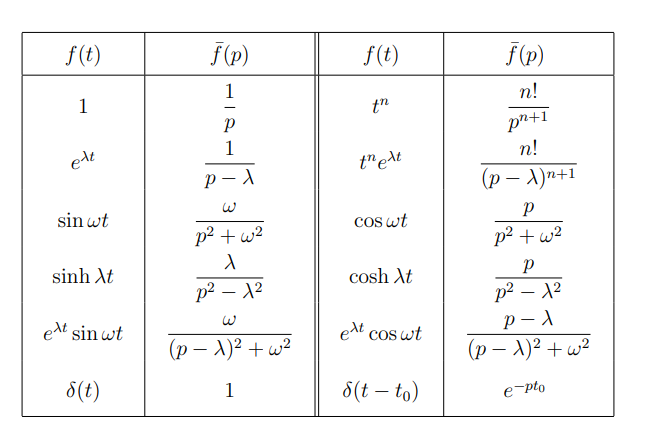
\(\Gamma\) has simple poles at \(z=0,-1,-2,\ldots\) with residues \(\Res_{z=-m} \Gamma(z) = (-1)^m/m!\), and no other poles. It has the product expansion \[ \Gamma(z) = {1 \over ze^{\gamma z} \prod_{n=1}^\infty \qty{1 + {z\over n}}e^{-z/n} }, \qquad \gamma \coloneqq \lim_{N\to\infty } \qty{\sum_{n=1}^N {1\over n} - \log(N)}, \] and satisfies the reflection formula \[ \Gamma(z) \Gamma(1-z) = {\pi \over \sin(\pi z)}, \] which together with the product expansion gives a product expansion of \(\sin(\pi z)\). In terms of the Laplace transform \(\mcl\), \(\mcl(t^{z-1})(1) = \Gamma(z)\) for \(\Re z>0\), and \(\mcl(t^n)(1) = \Gamma(n+1) = n!\).
The residues:
The Beta function
Beta function (Tag D-2WZLB)
For \(z,w\in\CC\) with \(\operatorname{Re}z>0\) and \(\operatorname{Re}w>0\), the beta function is \[ B(z,w)\coloneqq\int_0^1 t^{z-1}(1-t)^{w-1}\dt, \] where \(t^{s}\coloneqq e^{s\log t}\) for \(t>0\), with \(\log\) the real natural logarithm.
$B(z,w)=\frac{\Gamma(z)\Gamma(w)}{\Gamma(z+w)}$ (Tag E-I6CYR)
Show that \[ B(z, w) = {\Gamma(z) \Gamma(w) \over \Gamma(z+w)} .\]
Hint: find \(\mcl(t^{z-1})\) and \(\mcl(t^{z-1}\convolve t^{w-1})\).
Solution
Let \(\operatorname{Re}(z) > 0\) and \(\operatorname{Re}(w) > 0\), let \(s>0\), and define \(f(t) = t^{z-1}\) and \(g(t) = t^{w-1}\) for \(t > 0\). Recall \(B(z, w) = \int_0^1 u^{z-1} (1 - u)^{w-1}\,du\).
<1>1. \(\mathcal{L}\{f\}(s) = \frac{\Gamma(z)}{s^z}\) and \(\mathcal{L}\{g\}(s) = \frac{\Gamma(w)}{s^w}\).
Substituting \(u = st\), so \(t = u/s\) and \(dt = du/s\), \[\mathcal{L}\{f\}(s) = \int_0^\infty t^{z-1} e^{-st}\,dt = \int_0^\infty \left(\frac{u}{s}\right)^{z-1} e^{-u} \frac{du}{s} = \frac{1}{s^z} \int_0^\infty u^{z-1} e^{-u}\,du = \frac{\Gamma(z)}{s^z}.\] The same computation with \(w\) in place of \(z\) gives \(\mathcal{L}\{g\}\).
<1>2. \((f * g)(x) = x^{z+w-1} B(z, w)\) for \(x > 0\).
Substituting \(t = xu\), so \(dt = x\,du\), \[(f * g)(x) = \int_0^x t^{z-1} (x - t)^{w-1}\,dt = \int_0^1 (xu)^{z-1} (x - xu)^{w-1} x\,du = x^{z+w-1} \int_0^1 u^{z-1} (1 - u)^{w-1}\,du.\]
<1>3. \(B(z, w) \frac{\Gamma(z+w)}{s^{z+w}} = \frac{\Gamma(z)\Gamma(w)}{s^{z+w}}\).
By step <1>2 and step <1>1 with \(z+w\) in place of \(z\), \[\mathcal{L}\{f * g\}(s) = B(z, w) \int_0^\infty x^{z+w-1} e^{-sx}\,dx = B(z, w) \frac{\Gamma(z+w)}{s^{z+w}}.\] By the convolution theorem for Laplace transforms and step <1>1, \[\mathcal{L}\{f * g\}(s) = \mathcal{L}\{f\}(s) \cdot \mathcal{L}\{g\}(s) = \frac{\Gamma(z)\Gamma(w)}{s^{z+w}}.\]
<1>4. Q.E.D.
Multiply step <1>3 by \(s^{z+w}\) and divide by \(\Gamma(z+w)\), which has no zeros.
The Riemann zeta function
Riemann zeta function (Tag D-HJYH3)
For \(s\in\CC\) with \(\operatorname{Re}s>1\), the Riemann zeta function is \[ \zeta(s)\coloneqq\sum_{n=1}^{\infty}\frac{1}{n^{s}}, \] where \(n^{s}\coloneqq e^{s\log n}\) with the real logarithm. The series converges absolutely because \(\abs{n^{-s}}=n^{-\operatorname{Re}s}\).
(Euler product)
For \(\operatorname{Re}s>1\), \[ \zeta(s)=\prod_{p\text{ prime}}\frac{1}{1-p^{-s}}, \] where the product is over all prime numbers \(p\) and converges as the limit of its partial products over \(p\le N\).
Let \(\sigma\coloneqq\operatorname{Re}s>1\). For each prime \(p\), \(\abs{p^{-s}}=p^{-\sigma}<1\), so \(\frac{1}{1-p^{-s}}=\sum_{k\ge0}p^{-ks}\), an absolutely convergent series. Multiplying these finitely many series for the primes \(p\le N\) and using unique factorization in \(\ZZ\), \[ \prod_{p\le N}\frac{1}{1-p^{-s}}=\sum_{n\in S_N}n^{-s}, \] where \(S_N\) is the set of positive integers all of whose prime factors are at most \(N\). Every \(n\le N\) lies in \(S_N\), so \[ \abs{\zeta(s)-\prod_{p\le N}\frac{1}{1-p^{-s}}}\le\sum_{n>N}n^{-\sigma}\to0\qquad(N\to\infty). \]
Meromorphic continuation of $\zeta$ (Tag PR-K4KTF)
The Riemann zeta function \(\zeta(s)=\sum_{n\ge1}n^{-s}\), defined for \(\Re(s)>1\), extends to a meromorphic function on \(\CC\) whose only singularity is a simple pole at \(s=1\). The extension satisfies the functional equation \[ \zeta(s) = \pi^{s-1/2}\,\frac{\Gamma\qty{\frac{1-s}{2}}}{\Gamma\qty{\frac{s}{2}}}\,\zeta(1-s). \]
For \(t>0\) let \(\theta(t)\coloneqq\sum_{n\in\ZZ}e^{-\pi n^2t}\). By Poisson summation \(\theta(1/t)=t^{1/2}\theta(t)\), and \(\abs{\theta(t)-1}\le ce^{-\pi t}\) for \(t\ge1\). For \(\Re(s)>1\) put \[ \xi(s)\coloneqq\frac12\int_0^\infty r^{s/2-1}\qty{\theta(r)-1}\,dr. \] Integrating term by term, \(\int_0^\infty r^{s/2-1}e^{-\pi n^2r}\,dr=\pi^{-s/2}n^{-s}\Gamma(s/2)\), so \(\xi(s)=\pi^{-s/2}\Gamma(s/2)\zeta(s)\) for \(\Re(s)>1\). Splitting the integral at \(r=1\) and applying \(\theta(1/r)=r^{1/2}\theta(r)\) on \((0,1)\) gives \[ \xi(s)=\frac{1}{s-1}-\frac1s+\frac12\int_1^\infty\qty{r^{s/2-1}+r^{-s/2-1/2}}\qty{\theta(r)-1}\,dr, \] where the integral is entire in \(s\) by the exponential decay of \(\theta-1\). So \(\xi\) extends meromorphically to \(\CC\) with simple poles only at \(0\) and \(1\), and the right side is unchanged under \(s\mapsto1-s\), so \(\xi(s)=\xi(1-s)\). Since \(1/\Gamma\) is entire with a simple zero at \(s=0\), \(\zeta(s)=\pi^{s/2}\xi(s)/\Gamma(s/2)\) is meromorphic on \(\CC\); the pole of \(\xi\) at \(0\) cancels against the zero of \(1/\Gamma(s/2)\), leaving only the simple pole at \(s=1\). Writing \(\xi(s)=\xi(1-s)\) in terms of \(\zeta\) gives the functional equation.
Zeros of $\zeta$ outside the critical strip (Tag PR-QHFCK)
Let \(\zeta\) be the Riemann zeta function, continued meromorphically to \(\CC\). The only zeros of \(\zeta\) outside the critical strip \(\ts{s\st0\le\Re s\le1}\) are the simple zeros at \(s=-2,-4,-6,\ldots\). Moreover, \(\zeta\) has no zeros on the line \(\Re s=1\).
For \(\Re s>1\) the Euler product \(\zeta(s)=\prod_p(1-p^{-s})^{-1}\) converges absolutely, and an absolutely convergent product of nonzero factors is nonzero. For \(\Re s<0\) use the functional equation \[ \zeta(s)=\pi^{s-1/2}\,\frac{\Gamma\big(\frac{1-s}{2}\big)}{\Gamma\big(\frac s2\big)}\,\zeta(1-s). \] There \(\Re(1-s)>1\), so \(\zeta(1-s)\neq0\); \(\Gamma\big(\frac{1-s}{2}\big)\) is finite and nonzero because \(\Gamma\) has no zeros and its poles lie at \(0,-1,-2,\ldots\); and \(1/\Gamma(s/2)\) is entire with simple zeros exactly at \(s=0,-2,-4,\ldots\). So the zeros of \(\zeta\) with \(\Re s<0\) are the simple zeros at \(s=-2,-4,\ldots\). The nonvanishing of \(\zeta\) on \(\Re s=1\) is the theorem of Hadamard and de la Vallée Poussin.
The zeros at the negative even integers are the trivial zeros of \(\zeta\). The Riemann hypothesis is the conjecture that every zero of \(\zeta\) in the critical strip lies on the line \(\Re s=\frac12\).
The Dirichlet series and the Euler product for \(\zeta\) converge absolutely on \(\Re s>1\), and the Euler product shows \(\zeta(s)\neq 0\) there. The continuation extends \(\zeta\) meromorphically to \(\CC\), and the functional equation relates the values, and hence the zeros, at \(s\) and \(1-s\).
The Weierstrass \(\wp\)-function
The Weierstrass $\wp$ function (Tag D-LGP2Q)
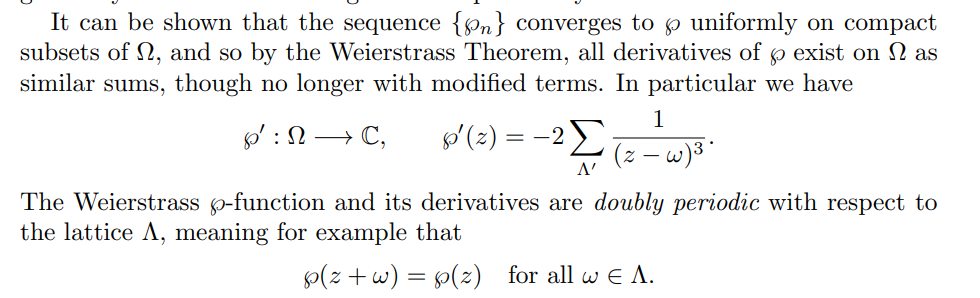
Let \(\omega_1,\omega_2\in\CC\) be linearly independent over \(\RR\), and let \(\Lambda\coloneqq\ZZ\omega_1+\ZZ\omega_2\). The Weierstrass \(\wp\) function of \(\Lambda\) is \[ \wp(z)\coloneqq\frac{1}{z^2}+\sum_{\omega\in\Lambda\setminus\{0\}}\qty{\frac{1}{(z-\omega)^2}-\frac{1}{\omega^2}},\qquad z\in\CC\setminus\Lambda. \]
The series defining \(\wp\) converges absolutely and uniformly on compact subsets of \(\CC\setminus\Lambda\), and \(\wp\) is meromorphic on \(\CC\) with a pole of order $2$ at each point of \(\Lambda\) and no other poles.
The number of \(\omega\in\Lambda\) with \(k\le\abs{\omega}<k+1\) is at most \(Ck\) for a constant \(C\) depending on \(\Lambda\), so \(\sum_{\omega\in\Lambda\setminus\{0\}}\abs{\omega}^{-3}<\infty\). Fix \(R>0\). For \(\abs{z}\le R\) and \(\abs{\omega}\ge2R\), \[ \abs{\frac{1}{(z-\omega)^2}-\frac{1}{\omega^2}}=\frac{\abs{z}\,\abs{2\omega-z}}{\abs{\omega}^2\abs{z-\omega}^2}\le\frac{R\cdot\frac52\abs{\omega}}{\abs{\omega}^2\cdot\frac14\abs{\omega}^2}=\frac{10R}{\abs{\omega}^3}, \] so by the Weierstrass \(M\)-test the terms with \(\abs{\omega}\ge2R\) converge absolutely and uniformly on \(\abs{z}\le R\) to a holomorphic function. The finitely many remaining terms are holomorphic on \(\abs{z}<R\) away from \(\Lambda\), and the term \((z-\omega)^{-2}\) (or \(z^{-2}\) for \(\omega=0\)) gives a pole of order \(2\) at each \(\omega\in\Lambda\) with \(\abs{\omega}<R\), all other terms being holomorphic near \(\omega\).
Elliptic functions
Recall that for a lattice \(\Lambda=\omega_1\ZZ+\omega_2\ZZ\) with \(\omega_1/\omega_2\notin\RR\), an elliptic function is a meromorphic function \(f\) on \(\CC\) with \(f(z+\omega)=f(z)\) for every \(\omega\in\Lambda\). The Weierstrass \(\wp\)-function is elliptic, with a double pole at each lattice point and no other poles.
An entire elliptic function is constant.
It is continuous on the compact closed fundamental parallelogram, so bounded there, and by periodicity bounded on \(\CC\); apply Liouville's theorem.
Entire doubly periodic functions are constant (Tag E-4NGIV)
Show that an entire doubly periodic function is constant.
Solution
Let \(\omega_1,\omega_2\) be two real-linearly independent periods of the entire function \(f\). Consider the closed fundamental parallelogram \[ P=\{t_1\omega_1+t_2\omega_2:0\le t_1,t_2\le1\}. \] It is compact, so continuity of \(f\) gives \[ M=\max_{z\in P}|f(z)|<\infty. \]
Every \(z\in\mathbb C\) can be written \[ z=z_0+m\omega_1+n\omega_2 \] with \(m,n\in\mathbb Z\) and \(z_0\in P\). By periodicity, \[ f(z)=f(z_0), \] so \(|f(z)|\le M\) for all \(z\in\mathbb C\). Thus \(f\) is bounded and entire; Liouville’s theorem implies that \(f\) is constant.
A nonconstant elliptic function has at least two poles, counted with multiplicity, in each fundamental parallelogram.
Translate the parallelogram \(P\) so that \(f\) has no poles on \(\bd P\). By periodicity the integrals of \(f\) over opposite sides of \(\bd P\) cancel, so the sum of the residues of \(f\) in \(P\) is \(0\). A nonconstant elliptic function has a pole in \(P\), since an entire elliptic function is constant. If it had only one pole counted with multiplicity, that pole would be simple with nonzero residue, a contradiction.
Poles of elliptic functions (Tag E-WXHMJ)
Let \(f\) be an elliptic function and \(P\) be its fundamental parallelogram. Suppose that \(f\) is nonconstant. Show that \(f\) has at least two poles in \(P\), counted with multiplicity.
Solution
Write the period lattice as \(\Lambda=\omega_1\ZZ+\omega_2\ZZ\), and translate the fundamental parallelogram if necessary so that \(f\) has no poles on \(\bd P\).
If \(f\) had no poles, periodicity would make it an entire bounded function: it is bounded on the compact closure of \(P\), hence bounded on all of \(\CC\) by translation through \(\Lambda\). Liouville’s theorem would then force \(f\) to be constant. Thus \(f\) has at least one pole.
Suppose, toward a contradiction, that \(f\) has only one pole counted with multiplicity. Then it is a single simple pole \(z_0\in P\), so \[ \Res_{z=z_0}f\neq0. \]
Write \(\bd P = \sum_{1\leq k \leq 4} \gamma_k\) where the \(\gamma_k\) are the edges traversed counterclockwise. By periodicity, opposite edges contribute equal integrals with opposite orientations, so \[ \int_{\bd P}f(z)\,dz=0. \] But the residue theorem gives \[ 0=\int_{\bd P}f(z)\,dz =2\pi i\Res_{z=z_0}f(z), \] contradicting the simplicity of the pole.
More generally, the same boundary cancellation always shows \[ \sum_{z_k\in P}\Res_{z=z_k}f(z)=0 \] for every elliptic function whose fundamental parallelogram has no poles on its boundary.
Infinite series and products
(Infinite products)

Weierstrass factorization (Tag T-IEJFA)
Let \(D\subseteq\CC\) be a simply connected connected open set and let \(f\) be meromorphic on \(D\) and not identically zero. Then there are holomorphic functions \(g\), \(h_1\), \(h_2\) on \(D\) such that \[ f(z)=e^{g(z)}\frac{h_1(z)}{h_2(z)}, \] where the zeros of \(h_1\) are the zeros of \(f\), with the same multiplicities, and the zeros of \(h_2\) are the poles of \(f\), with multiplicities equal to their orders.
Hadamard factorization (Tag T-2WJ4U)
For an integer \(p\ge0\), let \(E_p\) be the canonical factor \[ E_0(z)=1-z,\qquad E_p(z)=(1-z)\exp\Big(z+\frac{z^2}{2}+\cdots+\frac{z^p}{p}\Big)\quad(p\ge1). \] Let \(f\) be an entire function of order \(\rho<\infty\), where \[ \rho\coloneqq\inf\ts{\sigma\ge0\st\text{there is }R>0\text{ with }\abs{f(z)}\le e^{\abs z^\sigma}\text{ for all }\abs z>R}, \] and let \(p\coloneqq\lfloor\rho\rfloor\). Suppose \(f\) is not identically zero, has a zero of order \(m\ge0\) at \(0\), and let \((z_k)_{k\ge1}\) be its nonzero zeros, repeated with multiplicity. Then there is a polynomial \(g\) of degree at most \(p\) such that \[ f(z)=z^me^{g(z)}\prod_{k\ge1}E_p\Big(\frac{z}{z_k}\Big), \] where the product converges uniformly on compact subsets of \(\CC\).
The Weierstrass factorization theorem gives an entire function with prescribed zeros as a convergent product of elementary factors, unique up to multiplication by \(e^{g}\) with \(g\) entire. For an entire function of finite order \(\rho\), the Hadamard factorization theorem uses elementary factors of degree at most \(\lfloor\rho\rfloor\) and restricts \(g\) to a polynomial of degree at most \(\rho\).
Hadamard expansion of $\sin$ (Tag E-DR5LY)
Find a Hadamard expansion of \(\sin(\pi z)\).
Solution
\(\sin(\pi z)\) has order 1, and its zero set is \(z_k = k\) for \(k\in \ZZ\). So one can write \[ \sin(\pi z) = ze^{az+b} \prod_{k\in \ZZ\smz} \qty{1 - {z\over k}}e^{z\over k} = ze^{az+b} \prod_{k\geq 1}\qty{1 - {z^2\over k^2}} .\] Determine \(e^b = \pi\) by considering \(\sin(\pi z)/z\) as \(z\to 0\), and use that \(\sin(\pi z)\) is odd and the product factor is even to conclude \(e^{az}\) is even and thus equal to 1. This yields \[ \sin(\pi z) = \pi z \prod_{k\geq 1}\qty{1- {z^2\over k^2}} .\]
(Summing series by residues)
Let \(f\) be meromorphic on \(\CC\) with finitely many poles, none at the points where the series below are sampled, and suppose \(\abs{z^2 f(z)}\) is bounded for \(\abs z\) large. Then, with each sum on the right taken over the poles of \(f\), \[ \begin{aligned} \sum_{n=-\infty}^{\infty} f(n) &= -\sum \Res\qty{\pi \cot (\pi z) f(z)}, \\ \sum_{n=-\infty}^{\infty}(-1)^{n} f(n) &= -\sum \Res\qty{\pi \csc (\pi z) f(z)}, \\ \sum_{n=-\infty}^{\infty} f\qty{\frac{2 n+1}{2}} &= \sum \Res\qty{\pi \tan (\pi z) f(z)}, \\ \sum_{n=-\infty}^{\infty}(-1)^{n} f\qty{\frac{2 n+1}{2}} &= \sum \Res\qty{\pi \sec (\pi z) f(z)}. \end{aligned} \]
For the first identity, \(\pi\cot(\pi z)\) has a simple pole with residue \(1\) at each integer, so \(\Res_{z=n}\pi\cot(\pi z)f(z) = f(n)\). On the squares \(C_N\) with vertices \(\qty{N+\tfrac12}(\pm1\pm i)\), \(\abs{\pi\cot(\pi z)}\) is bounded independently of \(N\), and the bound on \(z^2f(z)\) gives \(\oint_{C_N}\pi\cot(\pi z)f(z)\dz\to 0\). By the residue theorem the sum of all residues of \(\pi\cot(\pi z)f(z)\) is therefore \(0\). The other identities follow in the same way, since \(\pi\csc(\pi z)\) has residue \((-1)^n\) at \(n\), \(\pi\tan(\pi z)\) has residue \(-1\) at \(\frac{2n+1}{2}\), and \(\pi\sec(\pi z)\) has residue \(-(-1)^n\) at \(\frac{2n+1}{2}\); for the last two, use the squares with vertices \(N(\pm1\pm i)\).
$\sum_{k\in\ZZ}(z-k)^{-2}=\pi^2/\sin^2(\pi z)$ (Tag E-2GYXM)
Show that \[ \sum_{k\in \mathbb{Z}}{1\over (z-k)^2} = (\pi \csc(\pi z))^2 = \frac{\pi^2}{\sin^2(\pi z)} .\]
Solution
Fix \(z\notin\mathbb Z\) and consider, as a function of \(w\), \[ F(w)=\frac{\pi\cot(\pi w)}{(w-z)^2}. \] Integrate over the square \(\Gamma_N\) with vertices \((N+\tfrac12)(\pm1\pm i)\). On \(\Gamma_N\), \(|\cot(\pi w)|\) is bounded independently of \(N\), while \(|w-z|\gg N\), so \[ \int_{\Gamma_N}F(w)\,dw\longrightarrow0. \]
<1>1. At each integer \(k\), \[ \operatorname{Res}(F,k)=\frac1{(k-z)^2}=\frac1{(z-k)^2}. \] At the double pole \(w=z\), writing \(h(w)=\pi\cot(\pi w)\) gives \[ \operatorname{Res}(F,z)=h'(z)=-\pi^2\csc^2(\pi z). \]
<1>2. For \(N\) sufficiently large, \(\Gamma_N\) encloses \(z\) and the integers \(-N,\ldots,N\). The residue theorem therefore yields \[ \frac1{2\pi i}\int_{\Gamma_N}F(w)\,dw =\sum_{k=-N}^N\frac1{(z-k)^2}-\pi^2\csc^2(\pi z). \] Letting \(N\to\infty\) gives \[ \sum_{k\in\mathbb Z}\frac1{(z-k)^2} =\pi^2\csc^2(\pi z). \]
Sum formulas: $1/n^2$ (Tag E-NTKTA)
Show \[ \sum_{n \geq 1} \frac{1}{n^{2}}=\frac{\pi^{2}}{6} \] by integrating \(\pi \cot(\pi z)z^{-2}\).
Solution
<1>1. Let \(f(z) = \pi \cot(\pi z) z^{-2}\).
definition.
<1>2. \(f\) has a pole of order \(3\) at \(z = 0\) and simple poles at each nonzero integer \(z = n\).
\(\cot(\pi z)\) has simple poles at the integers with residue \(1/\pi\), and \(z^{-2}\) adds a pole of order \(2\) at \(0\).
<1>3. \(\operatorname{Res}(f, n) = 1/n^2\) for \(n \neq 0\).
\(\pi \cot(\pi z)\) has residue \(1\) at \(z = n\), so \(f\) has residue \(1 \cdot n^{-2}\).
<1>4. \(\operatorname{Res}(f, 0) = -\pi^2/3\).
\(\pi \cot(\pi z) = \frac{1}{z} - \frac{\pi^2 z}{3} - \frac{\pi^4 z^3}{45} - \cdots\), so \(f(z) = \frac{1}{z^3} - \frac{\pi^2}{3z} - \frac{\pi^4 z}{45} - \cdots\), and the coefficient of \(z^{-1}\) is \(-\pi^2/3\).
<1>5. Let \(\gamma_N\) be the square with vertices \((\pm (N + \tfrac12), \pm (N + \tfrac12))\).
choose a contour enclosing the poles \(-N, \ldots, N\).
<1>6. \(\int_{\gamma_N} f(z)\,dz = 2\pi i \left( \sum_{n=-N, n \neq 0}^{N} \frac{1}{n^2} - \frac{\pi^2}{3} \right) = 2\pi i \left( 2 \sum_{n=1}^{N} \frac{1}{n^2} - \frac{\pi^2}{3} \right)\).
residue theorem, using <1>3 and <1>4.
<1>7. \(\int_{\gamma_N} f(z)\,dz \to 0\) as \(N \to \infty\).
\(|\cot(\pi z)|\) is bounded on \(\gamma_N\) (the contour avoids the poles), \(|z^{-2}| \le C/N^2\), and the perimeter is \(O(N)\), so the integral is \(O(1/N)\).
<1>8. Hence \(0 = 2\pi i \left( 2 \sum_{n=1}^{\infty} \frac{1}{n^2} - \frac{\pi^2}{3} \right)\).
<1>6 and <1>7, taking the limit.
<1>9. Therefore \(\sum_{n=1}^{\infty} \frac{1}{n^2} = \frac{\pi^2}{6}\).
<1>8, solving for the sum.
<1>10. Q.E.D.
<1>9.
$\sum_{k\in\ZZ}\frac{1}{k^2+a^2}=\frac{\pi\coth(\pi a)}{a}$ for $a>0$ (Tag E-ARVUV)
Show that \[ \sum_{k\in \ZZ} {1\over k^2 + a^2} = {\pi \coth(\pi a) \over a} \qquad\text{for } a>0 .\]
Solution
Let \(f(z) = \frac{\pi \cot(\pi z)}{z^2 + a^2}\), and for \(N>a\) let \(\gamma_N\) be the positively oriented square with vertices \((\pm (N + \tfrac12), \pm (N + \tfrac12))\). It encloses the poles \(-N, \ldots, N\) and \(\pm ia\).
<1>1. \(f\) has simple poles at each integer \(z = k\) and at \(z = \pm i a\).
\(\cot(\pi z)\) has simple poles at the integers, and \(z^2 + a^2 = (z - ia)(z + ia)\) gives simple poles at \(\pm ia\).
<1>2. \(\operatorname{Res}(f, k) = \frac{1}{k^2 + a^2}\) for each integer \(k\).
\(\pi \cot(\pi z)\) has residue \(1\) at \(z = k\), so \(f\) has residue \(\frac{1}{k^2 + a^2}\).
<1>3. \(\operatorname{Res}(f, ia) = \frac{\pi \cot(\pi i a)}{2ia} = -\frac{\pi \coth(\pi a)}{2a}\).
\(\cot(i\pi a) = -i\coth(\pi a)\), so \(\pi \cot(\pi i a) = -i\pi \coth(\pi a)\), and dividing by \(2ia\) gives \(-\frac{\pi \coth(\pi a)}{2a}\).
<1>4. \(\operatorname{Res}(f, -ia) = \frac{\pi \cot(-\pi i a)}{-2ia} = -\frac{\pi \coth(\pi a)}{2a}\).
\(\cot(-\pi i a) = i\coth(\pi a)\), so \(\pi \cot(-\pi i a) = i\pi \coth(\pi a)\), and dividing by \(-2ia\) gives \(-\frac{\pi \coth(\pi a)}{2a}\).
<1>5. \(\oint_{\gamma_N} f(z)\,dz = 2\pi i \left( \sum_{k=-N}^{N} \frac{1}{k^2 + a^2} - \frac{\pi \coth(\pi a)}{a} \right)\).
This is the residue theorem with the residues of steps <1>2 to <1>4.
<1>6. \(\oint_{\gamma_N} f(z)\,dz \to 0\) as \(N \to \infty\).
\(|\cot(\pi z)|\) is bounded on \(\gamma_N\) independently of \(N\), and \(|z^2 + a^2| \ge (N+\tfrac12)^2-a^2\) there, so \(|f(z)| \le C/N^2\) on \(\gamma_N\). The perimeter is \(O(N)\), so the integral is \(O(1/N)\).
<1>7. Q.E.D.
Letting \(N\to\infty\) in step <1>5 and using step <1>6 gives \(\sum_{k \in \ZZ} \frac{1}{k^2 + a^2} = \frac{\pi \coth(\pi a)}{a}\).
$\sum_{k\geq 1}\frac{1}{k^2+a^2}=\frac{\pi\coth(\pi a)}{2a}-\frac{1}{2a^2}$ for $a>0$ (Tag E-4WFQM)
Show that \[ \sum_{k\geq 1}{1\over k^2 + a^2} = {1\over 2}{\pi \coth(\pi a)\over a} - {1\over 2a^2} \qquad a>0 .\]
Solution
Fix \(a>0\) and set \[ F(z)=\frac{\pi\cot(\pi z)}{z^2+a^2}. \] For \(N>a\), integrate over the square \(\Gamma_N\) with vertices \((N+\tfrac12)(\pm1\pm i)\). On these contours \(|\cot(\pi z)|\) is bounded independently of \(N\), while \(|z^2+a^2|\gg N^2\) and \(\operatorname{length}(\Gamma_N)=O(N)\). Hence \[ \int_{\Gamma_N}F(z)\,dz\longrightarrow0. \]
<1>1. At each integer \(k\), \[ \operatorname{Res}(F,k)=\frac1{k^2+a^2}. \] At \(z=ia\) and \(z=-ia\), \[ \operatorname{Res}(F,ia)=\operatorname{Res}(F,-ia) =-\frac{\pi}{2a}\coth(\pi a), \] using \(\cot(iu)=-i\coth u\).
<1>2. The residue theorem therefore gives, after \(N\to\infty\), \[ \sum_{k\in\mathbb Z}\frac1{k^2+a^2} =\frac{\pi}{a}\coth(\pi a). \] Since \[ \sum_{k\in\mathbb Z}\frac1{k^2+a^2} =\frac1{a^2}+2\sum_{k=1}^\infty\frac1{k^2+a^2}, \] we obtain \[ \sum_{k=1}^\infty\frac1{k^2+a^2} =\frac{\pi\coth(\pi a)}{2a}-\frac1{2a^2}. \]
$\sum_{k\in\mathbb{Z}}\frac{1}{(k-1/2)^2}=\pi^2$ (Tag E-6XPQW)
Show that \[ \sum_{k\in \ZZ} {1\over \qty{ k - {1\over 2}}^2 } = \pi^2 .\]
Solution
For \(N\ge1\), let \(Q_N\) be the positively oriented square \[ |\Re z|\le N+\tfrac12, \qquad |\Im z|\le N+\tfrac12, \] and consider \[ F(z)=\frac{\pi\cot(\pi z)}{(z-\tfrac12)^2}. \]
<1>1. On \(\partial Q_N\), \(|\cot(\pi z)|\) is bounded by a constant independent of \(N\). <2>1. On the vertical sides, \(\Re z\) is a half-integer, so \(|\cot(\pi z)|=|\tanh(\pi\Im z)|\le1\). <2>2. On the horizontal sides, \(|\Im z|=N+1/2\). For real \(x\) and \(y\neq0\), \(\abs{\cot(x+iy)}^2=\frac{\cos^2x+\sinh^2y}{\sin^2x+\sinh^2y}\le\coth^2y\), so \(\abs{\cot(\pi z)}\le\coth(\pi(N+\tfrac12))\le\coth(\pi/2)\). <2>3. Also \(|z-1/2|\ge N\) on \(\partial Q_N\), while the perimeter is \(O(N)\). Hence \[ \oint_{\partial Q_N}F(z)\,dz\longrightarrow0. \]
<1>2. The poles inside \(Q_N\) are the integers \(k=-N,\dots,N\) and \(z=1/2\). <2>1. Since \(\pi\cot(\pi z)\) has residue \(1\) at every integer, \[ \operatorname{Res}(F;k)=\frac1{(k-1/2)^2}. \] <2>2. Writing \(w=z-1/2\), \[ \pi\cot(\pi z)=-\pi\tan(\pi w)=-\pi^2w+O(w^3), \] so \[ F(z)=-\frac{\pi^2}{w}+O(w), \] and therefore \[ \operatorname{Res}(F;1/2)=-\pi^2. \]
<1>3. The residue theorem gives \[ \frac1{2\pi i}\oint_{\partial Q_N}F(z)\,dz =\sum_{k=-N}^N\frac1{(k-1/2)^2}-\pi^2. \] Letting \(N\to\infty\) yields \[ \sum_{k\in\mathbb Z}\frac1{(k-1/2)^2}=\pi^2. \]
$\sum_{k\in\mathbb{Z}}\frac{(-1)^k}{(k+a)^2}=\pi^2\cos(\pi a)\csc^2(\pi a)$ for $a\in\mathbb{R}\setminus\mathbb{Z}$ (Tag E-26QQP)
Show that \[ \sum_{k\in \mathbb{Z}} { (-1)^k \over (k+a)^2} = \pi^2 \cos(\pi a)\csc^2(\pi a) \quad \text{for } a\in \mathbb{R}\setminus\mathbb{Z} .\]
Solution
Fix \(a\in\mathbb R\setminus\mathbb Z\) and set \[ F(z)=\frac{\pi\csc(\pi z)}{(z+a)^2}. \] Integrate over the squares \(\Gamma_N\) with vertices \((N+\tfrac12)(\pm1\pm i)\). On \(\Gamma_N\), \(|\csc(\pi z)|\) is uniformly bounded, while \(|z+a|\gg N\) and the contour length is \(O(N)\), so \[ \int_{\Gamma_N}F(z)\,dz\to0. \]
<1>1. At an integer \(k\), \[ \operatorname{Res}(F,k)=\frac{(-1)^k}{(k+a)^2}. \] At the double pole \(z=-a\), \[ \operatorname{Res}(F,-a) =\left.\frac{d}{dz}(\pi\csc(\pi z))\right|_{z=-a} =-\pi^2\csc(\pi a)\cot(\pi a) =-\pi^2\cos(\pi a)\csc^2(\pi a). \]
<1>2. For large \(N\), the residue theorem gives \[ \frac1{2\pi i}\int_{\Gamma_N}F(z)\,dz =\sum_{k=-N}^N\frac{(-1)^k}{(k+a)^2} -\pi^2\cos(\pi a)\csc^2(\pi a). \] Letting \(N\to\infty\) yields \[ \sum_{k\in\mathbb Z}\frac{(-1)^k}{(k+a)^2} =\pi^2\cos(\pi a)\csc^2(\pi a). \]
Computing $\zeta(2)$ by integration (Tag E-VA3OK)
By computing \[ {1\over 2\pi i}\oint {\cot(\pi z)\over z^2}\dz ,\] say using a large rectangle, show that \[ \zeta(2) = \sum_{k\geq 0} {1\over k^2} = {\pi^2\over 6} .\]
Solution
<1>1. Let \(f(z) = \frac{\cot(\pi z)}{z^2}\).
definition.
<1>2. \(f\) has a pole of order \(3\) at \(z = 0\) and simple poles at each nonzero integer \(z = k\).
\(\cot(\pi z)\) has simple poles at the integers with residue \(1/\pi\), and \(z^{-2}\) adds a pole of order \(2\) at \(0\).
<1>3. \(\operatorname{Res}(f, k) = \frac{1}{\pi k^2}\) for \(k \neq 0\).
\(\cot(\pi z)\) has residue \(1/\pi\) at \(z = k\), so \(f\) has residue \(\frac{1}{\pi} \cdot k^{-2}\).
<1>4. \(\operatorname{Res}(f, 0) = -\frac{\pi}{3}\).
\(\cot(\pi z) = \frac{1}{\pi z} - \frac{\pi z}{3} - \frac{\pi^3 z^3}{45} - \cdots\), so \(f(z) = \frac{1}{\pi z^3} - \frac{\pi}{3z} - \frac{\pi^3 z}{45} - \cdots\), and the coefficient of \(z^{-1}\) is \(-\pi/3\).
<1>5. Let \(\gamma_N\) be the rectangle with vertices \((\pm (N + \tfrac12), \pm (N + \tfrac12))\).
choose a contour enclosing the poles \(-N, \ldots, N\).
<1>6. \(\frac{1}{2\pi i}\oint_{\gamma_N} f(z)\,dz = \sum_{k=-N, k \neq 0}^{N} \frac{1}{\pi k^2} - \frac{\pi}{3} = \frac{2}{\pi}\sum_{k=1}^{N} \frac{1}{k^2} - \frac{\pi}{3}\).
residue theorem, using <1>3 and <1>4.
<1>7. \(\oint_{\gamma_N} f(z)\,dz \to 0\) as \(N \to \infty\).
\(|\cot(\pi z)|\) is bounded on \(\gamma_N\) (the contour avoids the poles), \(|z^{-2}| \le C/N^2\), and the perimeter is \(O(N)\), so the integral is \(O(1/N)\).
<1>8. Hence \(0 = \frac{2}{\pi}\sum_{k=1}^{\infty} \frac{1}{k^2} - \frac{\pi}{3}\).
<1>6 and <1>7, taking the limit.
<1>9. Therefore \(\zeta(2) = \sum_{k=1}^{\infty} \frac{1}{k^2} = \frac{\pi^2}{6}\).
<1>8, solving for the sum.
<1>10. Q.E.D.
<1>9.