(Diagonalizable over $\CC$ and not over $\RR$)
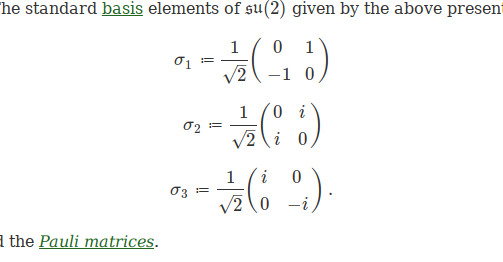
The matrix \[ M = \left(\begin{array}{rr} 0 & 1 \\ -1 & 0 \end{array}\right) \] has \(\min_M(x) = \chi_M(x) = x^2 + 1\), which has no roots in \(\RR\) and the distinct roots \(\pm i\) in \(\CC\). So \(M\) has no real eigenvalues and is not diagonalizable over \(\RR\), and over \(\CC\) \[ M \sim \left(\begin{array}{rr} -i & 0 \\ 0 & i \end{array}\right). \]
(Not diagonalizable over $\CC$)
The matrix \[ M = \left(\begin{array}{rr} 1 & 1 \\ 0 & 1 \end{array}\right) \] has the repeated eigenvalue \(1\) and \(\min_M(x) = \chi_M(x) = (x-1)^2\), which does not have distinct roots, so \(M\) is not diagonalizable over any field. It is a Jordan block \(J_2(1)\).
(Equal characteristic polynomials, not similar)
The matrices \[ A = \left(\begin{array}{ll} 0 & 0 \\ 0 & 0 \end{array}\right) \quad\text{and}\quad B = \left(\begin{array}{ll} 0 & 1 \\ 0 & 0 \end{array}\right) \] satisfy \(\chi_A(x) = \chi_B(x) = x^2\), and they are not similar: both are in Jordan form, with different Jordan blocks, and \(\min_A(x)=x\) while \(\min_B(x)=x^2\).
(Invertible and not diagonalizable)
The matrix \[ \left( \begin{array}{ccc} 1 & 1 & 0 \\ 0 & 1 & 1 \\ 0 & 0 & 1 \end{array} \right) \] has determinant \(1\), so it is invertible, and it is the Jordan block \(J_3(1)\), so it is not diagonalizable.
Roots of matrices
(Distinct square roots of $-I$)
The matrices \[ M_1 \da \matt 0 {-1} 1 0, \qquad M_2 \da \matt 0 1 {-1} 0 \] are distinct and satisfy \(M_1^2 = M_2^2 = -I\). Hence \(A^n = B^n\) does not imply \(A=B\) for real \(2\times 2\) matrices, and \(M_1\) and \(M_2\) are the images of \(i\) and \(-i\) under the ring embedding \(\CC\to\Mat(2\times 2;\RR)\), \(a+bi\mapsto\matt a{-b}ba\).
$A^n = B^n$ does not imply $A = B$ for matrices (Tag FF-VKYM3)
For square matrices \(A,B\) and \(n\ge2\), \(A^n=B^n\) does not imply \(A=B\). In \(\Mat_2(\RR)\), let \[ A=\begin{bmatrix}0&1\\-1&0\end{bmatrix}. \] Then \[ A^2=\begin{bmatrix}-1&0\\0&-1\end{bmatrix}=(-A)^2, \] but \(A\ne-A\).
$A^n = B^n$ does not imply $A = B$ for matrices (Tag FE-W56LS)
For square matrices \(A,B\) and \(n\ge2\), \(A^n=B^n\) does not imply \(A=B\). In \(\Mat_2(\RR)\), the matrix \(M=\matt 0 1 1 0\) satisfies \(M^2=I_2=I_2^2\), and \(M\ne I_2\).
$A^n = B^n$ does not imply $A = B$ for matrices (Tag FE-ISVDM)
For square matrices \(A,B\) and \(n\ge2\), \(A^n=B^n\) does not imply \(A=B\). In \(\Mat_2(\RR)\), let \[ M=\matt 0 1 1 0 . \] Then \(M^2=I=I^2\), but \(M\ne I\).