The values of a holomorphic function inside a curve are determined by its values on the curve.
Cauchy integral formula (Tag T-LA2UI)
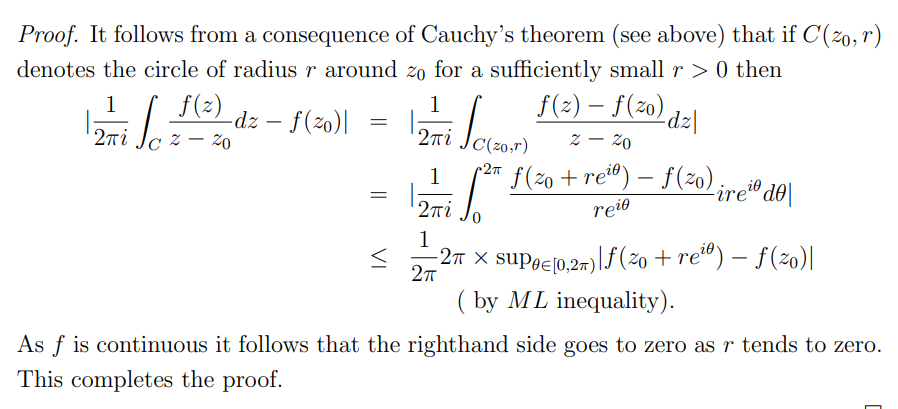
Let \(\Omega\subseteq\CC\) be open, let \(f\) be holomorphic on \(\Omega\), and let \(z_0\in\Omega\) and \(R>0\) satisfy \(\overline{D_R(z_0)}\subseteq\Omega\). Let \(\gamma\coloneqq\partial D_R(z_0)\), oriented counterclockwise. Then for every \(n\geq0\), \[ f^{(n)}(z_0)=\frac{n!}{2\pi i}\int_\gamma\frac{f(\xi)}{(\xi-z_0)^{n+1}}\dxi, \] and in particular \(f(z_0)=\frac{1}{2\pi i}\int_\gamma\frac{f(\xi)}{\xi-z_0}\dxi\). Consequently, the coefficients of the Taylor expansion \(f(z)=\sum_{k\geq0}c_k(z-z_0)^k\) at \(z_0\) are \[ c_k=\frac{f^{(k)}(z_0)}{k!}=\frac{1}{2\pi i}\int_\gamma\frac{f(\xi)}{(\xi-z_0)^{k+1}}\dxi. \]
Cauchy integral formula on a disc (Tag FT-5V4M2)
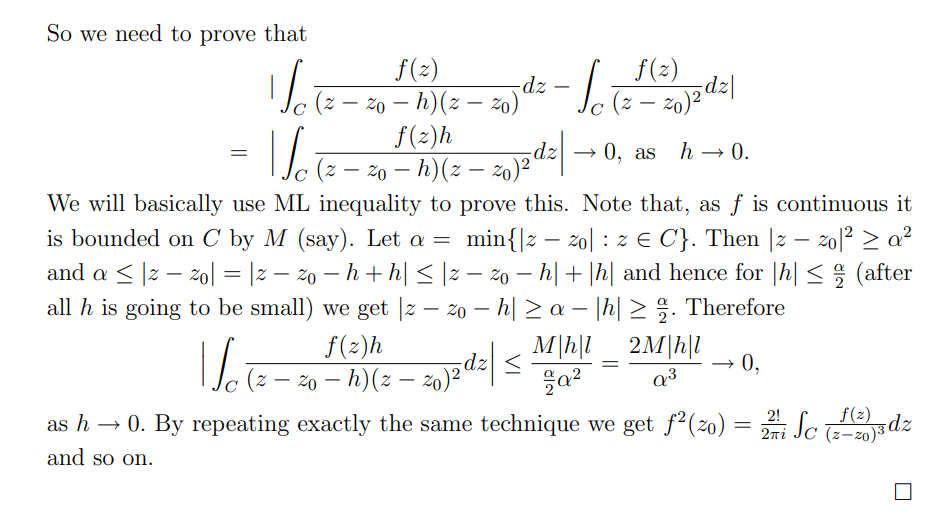
Let \(D\subseteq\CC\) be an open disc, let \(U\) be an open set containing its closure \(\overline D\), and let \(f\) be holomorphic on \(U\). Then for every \(z\in D\), \[ f(z) = {1 \over 2\pi i} \int_{\bd D} {f(\xi) \over \xi - z} \,d\xi, \] where the circle \(\bd D\) is oriented counterclockwise.
Cauchy integral formula for derivatives (Tag FT-AK34G)
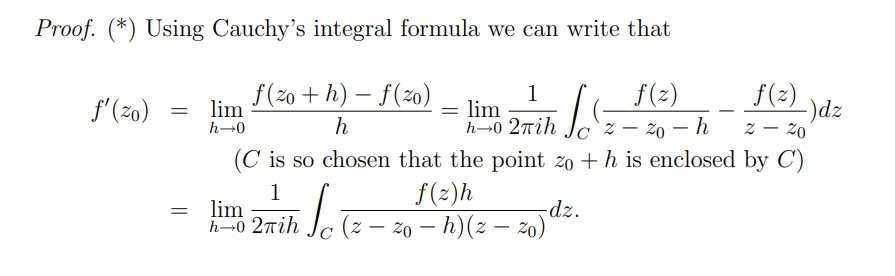
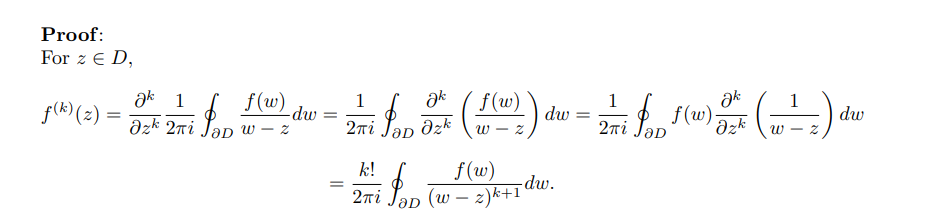
Let \(U\subseteq\CC\) be open, let \(f\) be holomorphic on \(U\), and let \(C\) be a counterclockwise circle whose closed disc lies in \(U\); write \(C^\circ\) for the open disc bounded by \(C\). Then for every \(z\in C^\circ\) and every integer \(n\ge0\), \[ f^{(n)}(z)=\frac{n !}{2 \pi i} \int_{C} \frac{f(\zeta)}{(\zeta-z)^{n+1}} \dzeta. \]
(Alternative)
The mean value property
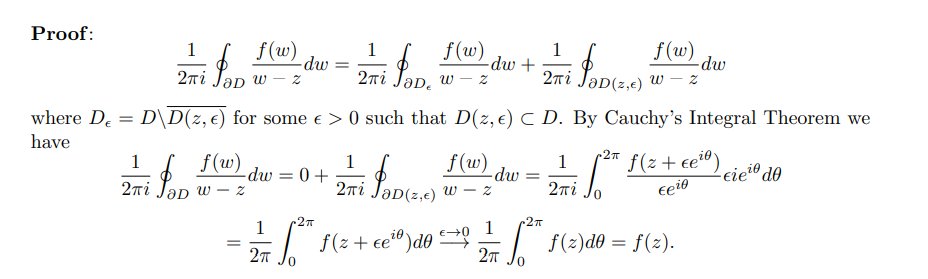
For a circle centered at the point, the integral formula expresses \(f\) at the center as the average of \(f\) over the circle.
Mean value property for holomorphic functions (Tag T-5BLYU)
Let \(f\) be holomorphic on an open set containing the closed disc \(\overline{D_r(z_0)}\). Then \[ f(z_0)=\frac{1}{2\pi}\int_0^{2\pi}f(z_0+re^{i\theta})\dtheta=\frac{1}{\pi r^2}\iint_{D_r(z_0)}f(z)\dA. \] The same identities hold for \(u=\Re f\) in place of \(f\), by taking real parts.
The Cauchy integral formula on the circle \(z=z_0+\rho e^{i\theta}\), \(0<\rho\le r\), gives \[ f(z_0)=\frac{1}{2\pi i}\int_0^{2\pi}\frac{f(z_0+\rho e^{i\theta})}{\rho e^{i\theta}}\,i\rho e^{i\theta}\dtheta=\frac{1}{2\pi}\int_0^{2\pi}f(z_0+\rho e^{i\theta})\dtheta. \] Multiplying by \(\rho\) and integrating over \(0\le\rho\le r\) in polar coordinates gives \(\frac{r^2}{2}f(z_0)=\frac{1}{2\pi}\iint_{D_r(z_0)}f\dA\).
(Circle and area means)
Parameterize \(\abs{z-z_0}=r\) by \(z=z_0+re^{i\theta}\). The integral formula gives \[ f(z_0) = \frac{1}{2\pi i}\int_{\abs{z-z_0}=r}\frac{f(z)}{z-z_0}\,\dz = \frac{1}{2\pi i}\int_0^{2\pi}\frac{f(z_0+re^{i\theta})}{re^{i\theta}}\, r i e^{i\theta}\,\dtheta = \frac{1}{2\pi}\int_0^{2\pi} f(z_0+re^{i\theta})\,\dtheta .\] For the area mean, multiply the circle identity for radius \(\rho\in(0,r)\) by \(\rho\) and integrate over \(\rho\): \[ \int_0^r \int_0^{2\pi} f(z_0+\rho e^{i\theta})\,\rho\,\dtheta\,\drho = \int_0^r 2\pi f(z_0)\,\rho\,\drho = \pi r^2 f(z_0) ,\] so \(f(z_0)=\frac{1}{\pi r^2}\iint_{D_r(z_0)} f(z)\,dA\). The real-part claim is the same identity applied to \(u=\Re f\).
(Mean value property and the maximum principle)
If \(\abs f\) has a local maximum at \(z_0\), then for small \(r\) \[ \abs{f(z_0)} \leq \frac{1}{2\pi}\int_0^{2\pi}\abs{f(z_0+re^{i\theta})}\dtheta \leq \abs{f(z_0)} ,\] and since \(\abs f\) is continuous, \(\abs f = \abs{f(z_0)}\) on every small circle about \(z_0\). This is the argument for the maximum modulus principle, and the same argument, with the mean value property of a real harmonic function \(u\) in place of that of \(f\), proves the maximum principle for \(u\).
Exercises
$\int_{\partial\DD}\frac{e^z}{z^2}\,dz$ (Tag E-4F5TF)
Compute \[ \int_{\bd\DD} {e^z\over z^2}\dz .\]
Solution
By Cauchy’s integral formula for the derivative, with \(f(z)=e^z\), \[ \int {f(z) \over (z-0)^2}\dz = 2\pi i f^{(1)}(0) = 2\pi i .\]
Integral computation (Tag E-RLHXB)
Without using the residue formula, compute \[ \int_\RR f(x) \dx && f(x) \da {1\over x^4 + 16} .\]
Solution
Use a semicircular contour, noting the poles are at \(\pm \sqrt 2 \pm i\sqrt 2\). Write
- \(f_1(z) \da (\sqrt 2 + i\sqrt 2)f(z)\)
- \(f_2(z) \da (-\sqrt 2 + i\sqrt 2) f(z)\).
Break the curve up into two integrals \(I_1, I_2\) enclosing the poles, by Cauchy one gets
- For the loop around the right pole: \(I_1 = 2\pi i f_1(\sqrt 2 + i\sqrt 2) = {\pi \sqrt{2}(1-i) \over 32}\)
- For the loop around the left pole: \(I_2 = 2\pi i f_2(\sqrt 2 - i\sqrt 2) = {\pi \sqrt 2(1+i) \over 32}\).
Now show that \(\int_{C_R}\) vanishes: parameterize as \(\gamma(t) = Re^{it}\) and use the reverse triangle inequality: \[ \abs{ \int_{C_R} f} \leq \int_0^\pi {1\over R^4 - 16} = {\pi R \over R^4-16}\to 0 .\]
Equality of different integrals (Tag E-VGNUI)
Suppose \(f\) is holomorphic on \(\Omega\), a simply connected region, and suppose \(\gamma \subseteq \Omega\). Using the Cauchy integral formula, show that \[ \int_\gamma {f'(z) \over z-a}\dz = \int_\gamma {f(z) \over (z-a)^2 }\dz .\] Also prove this when \(\Omega\) is not simply connected.
Solution
Use the integral formula directly: \[ \int_\gamma {f'(z) \over z-a}\dz = 2\pi i f'(a) .\]
On the other hand, use Cauchy’s formula for derivatives: \[ \int_\gamma {f(z) \over (z-a)^2}\dz = 2\pi i f^{(1)}(a) ,\] and these values are equal.
If \(\Omega\) is not simply connected, note that by the quotient rule \[ \dd{}{z} {f(z) \over z-a} = {f'(z)\over z-a} - {f(z) \over (z-a)^2} .\]
Thus \[ \int_\gamma {f'(z) \over z-a} - \int_\gamma {f(z) \over (z-a)^2}\dz &= \int_\gamma \qty{ {f'(z) \over z-a} - {f(z) \over (z-a)^2} }\dz \\ &= \int_\gamma \dd{}{z} {f(z) \over z-a} \dz \\ &= G(\gamma(1)) - G(\gamma(0)) \\ &= G(p) - G(p) \\ &= 0 ,\] where \(G(z) \da {f(z) \over z-a}\) is a primitive for the integrand by definition.
Integrals over circles by Cauchy's integral formula (Tag E-3B2YA)
Evaluate the following integrals using Cauchy’s integral formula:
\[ \int_{S^1} {\cos(z) \over z} \dz&\\ \int_{S^1} {\sin(z) \over z}\dz&\\ \int_{\abs z = 2} {z^2\over z-1} \dz &\\ \int_{S^1} {e^z \over z^2} \dz &\\ \int_{\abs z = 2} {z^2 - 1 \over z^2 + 1}\dz &\\ \int_{\abs z = 2} {1\over z^2 + z + 1}\dz & .\]
Solution
\[ \int_{S^1} {\cos(z) \over z} \dz &= 2\pi i \cos(0) \\ &= 2\pi i \\ \\ \int_{S^1} {\sin(z) \over z}\dz &= 2\pi i \sin(0) \\ &= 0 \\ \\ \int_{\abs z = 2} {z^2\over z-1} \dz &= 2\pi i z^2\evalfrom_{z=1} \\ &= 2\pi i \\ \\ \int_{S^1} {e^z \over z^2} \dz &= 2\pi i \dd{}{z} e^z\evalfrom_{z=0} \\ &= 2\pi i \\ \\ \int_{\abs z = 2} {z^2 - 1 \over z^2 + 1}\dz &= \int_{\DD + i} {(z^2 -1)/(z+i) \over z-i}\dz + \int_{\DD - i} {(z^2-1)/(z-i) \over z+i} \dz \\ &= 2\pi i \qty{z^2-1\over z+i}\evalfrom_{z=i} + 2\pi i \qty{z^2-1 \over z-i}\evalfrom_{z=-i} \\ &= 2\pi i \qty{-2\over 2i} + 2\pi i \qty{-2\over -2i} \\ &= 0 \\ \\ \int_{\abs z = 2} {1\over z^2 + z + 1}\dz &= \int {1\over (z-\zeta_3) (z- \bar{\zeta_3} )} \dz \\ &= \int_{\DD + \bar{ \zeta_3} } {1/(z-\zeta_3) \over (z- \bar{\zeta_3} )} \dz + \int_{\DD + {\zeta_3} } {1/(z- \bar{ \zeta_3} ) \over (z- {\zeta_3} )} \dz \\ &= 2\pi i \qty{1\over z-\zeta_3}\evalfrom_{z=\bar{\zeta_3}} + 2\pi i \qty{1\over z-\bar{\zeta_3}}\evalfrom_{z=\zeta_3} \\ &= 2\pi i \qty{ {1\over \bar{\zeta_3} - \zeta_3 } + {1\over \zeta_3 - \bar{\zeta_3}} }\\ &= 2\pi i \qty{ {1\over \bar{\zeta_3} - \zeta_3 } - {1\over \bar{\zeta_3} - {\zeta_3}} } \\ &= 0 ,\] where \[ \zeta_3=e^{2\pi i/3}=-{1\over2}+i{\sqrt3\over2}, \qquad \zeta_3+\bar\zeta_3=-1, \qquad \zeta_3\bar\zeta_3=1, \] so \(z^2+z+1=(z-\zeta_3)(z-\bar\zeta_3)\).
Primitives imply vanishing integral (Tag E-ZVO5P)
Show that if \(f\) has a primitive \(F\) on \(\Omega\) then \(\displaystyle\int_\gamma f = 0\) for every closed curve \(\gamma \subseteq \Omega\).
Solution
Let \(F\) be a primitive of \(f\), so \(\dd{}{z}F = f\). Then \[ \int_\gamma f(z) \dz = F(\gamma(1)) - F(\gamma(0)) = F(p) - F(p) = 0 .\] More explicitly, let \(z(t): [a, b]\to \CC\) be any parameterization of \(\gamma\), then \[ \int_\gamma f(z) \dz &= \int_a^b f(z(t)) z'(t)\dt \\ &= \int_a^b F'(z(t))z'(t) \dt \\ &= \int_a^b \tilde F'(t)\dt && \text{ where } \tilde F(t) \da F(z(t)) \text{ by the chain rule} \\ &= F(z(b)) - F(z(a)) && \text{ by FTC} \\ &= 0 ,\] since \(z(b) = z(a)\) for a closed curve.
Locally uniform limits of holomorphic functions are holomorphic (Tag E-5AKU5)
Show that if \(f_n\to f\) locally uniformly and each \(f_n\) is holomorphic then \(f\) is holomorphic.
Solution
Let \(\Omega\) be the open set on which the \(f_n\) are holomorphic.
<1>1. \(f\) is continuous on \(\Omega\).
Each point of \(\Omega\) has a compact neighbourhood in \(\Omega\), on which \(f\) is a uniform limit of continuous functions.
<1>2. \(\int_{\partial T}f=0\) for every closed triangle \(T\subset\Omega\).
By Goursat’s theorem \(\int_{\partial T}f_n=0\). The boundary \(\partial T\) is compact, so \(f_n\to f\) uniformly on it, and \(\int_{\partial T}f=\lim_n\int_{\partial T}f_n=0\).
<1>3. Q.E.D.
Every point of \(\Omega\) has a disc in \(\Omega\) around it, and on that disc steps <1>1 and <1>2 are the hypotheses of Morera’s theorem [@SS03, Chapter 2, Theorem 5.2]. So \(f\) is holomorphic near every point of \(\Omega\).
(Variations)
If \(f_n\to f\) uniformly on all of \(\Omega\), the hypothesis holds a fortiori, since uniform convergence on \(\Omega\) is uniform convergence on each compact subset; the proof above applies unchanged.
An entire function with $f(z)/z\to0$ is constant (Tag E-AZSMO)
Suppose that \(f\) is entire and \(f\) has sublinear growth in the following sense: \[ \abs{f(z)\over z}\to 0 \text{ as } \abs{z}\to \infty .\] Show that \(f\) must be constant.
Solution: Direct bound
Define \[ g(z) \da \begin{cases} {f(z) - f(0) \over z-0} & z\neq 0 \\ f'(0) & z=0. \end{cases} .\] Note that for \(z\neq 0\), \[ \abs{g(z)} \da \abs{f(z) - f(0)\over z} \leq \abs{f(z) \over z} + \abs{f(0)\over z} \convergesto{\abs{z} \to \infty }0 ,\] where we’ve used the assumption in the last step. The function \(g\) is entire, since \(f(z)-f(0)\) vanishes at \(0\). Given \(\eps>0\), there is \(R_\eps\) with \(\abs{g(z)} < \eps\) for \(\abs{z}\geq R_\eps\). Fix \(z\in\CC\) and let \(R\geq\max(R_\eps,\abs z)\). Then \(\abs{g}<\eps\) on the circle of radius \(R\), so by the maximum modulus principle \(\abs{g(z)} < \eps\). Since \(\eps\) is arbitrary, \(g(z) = 0\) for all \(z\in \CC\), so \(f(z) = f(0)\) is a constant for all \(z\).
Solution: Cauchy bound
Claim: \(f'(z) \equiv 0\). Fix \(z\) and \(\eps>0\). Choose \(R \geq 2\abs z\) so that \(\abs{f(\xi)} \leq \eps \abs{\xi}\) for \(\abs{\xi} \geq R\), and apply Cauchy’s formula: \[ \abs{f'(z)} &= \abs{{1\over 2\pi i } \int_{\abs \xi = R} { f(\xi) \over (\xi - z)^2 }\dxi } \\ &\leq {1\over 2\pi} \int_{\abs \xi = R} { \abs{ f(\xi) } \over \abs{\xi - z}^2 } \abs{\dxi} \\ &\leq {1\over 2\pi} \int_{\abs \xi = R} { \eps \abs{\xi} \over \qty{R - \abs{z}}^2 } \abs{\dxi} \\ &= {1\over 2\pi} \qty{\eps R\over \qty{R-\abs{z}}^2 } \cdot 2\pi R \\ &\leq 4\eps ,\] using \(R-\abs z\geq R/2\). Since \(\eps\) is arbitrary, \(f'(z)=0\); as \(z\) is arbitrary, \(f\) is constant.
An entire function with $\abs{f(z)}\le M\abs z^n$ for large $\abs z$ is a polynomial of degree at most $n$ (Tag E-DDKSS)
Suppose that \(f\) is entire and has polynomial growth in the following sense: \[ \abs{f(z)\over z^n} \leq M \text{ for }\abs{z} \geq R ,\] for some constants \(k\) and \(R\). Show that \(f\) is a polynomial of degree at most \(n\).
Solution
Since \(f\) is entire, it equals its Taylor expansion about \(z_0 = 0\), so for every \(\rho>0\) \[ f(z) = \sum_{k\geq 0} c_k z^k, && c_k = {f^{(k)}(0)\over k! } = {1\over 2\pi i}\int_{\abs{\xi} = \rho} {f(\xi) \over \xi^{k+1}}\dxi .\] For \(\rho\geq R\), a direct estimate yields \[ \abs{c_k} &\leq {1\over 2\pi} \int_{\abs{\xi} = \rho} {\abs{f(\xi)} \over \abs{\xi}^{k+1} }\abs{\dxi}\\ &\leq {1\over 2\pi} \int_{\abs{\xi} = \rho} {M \abs{\xi}^n \over \abs{\xi}^{k+1} }\abs{\dxi} \\ &= {M\over 2\pi} \rho^{n-k-1} \cdot 2\pi \rho \\ &= M\rho^{n-k} ,\] which converges to \(0\) as \(\rho\to \infty\) provided \(k>n\). So \(c_k=0\) for \(k>n\), and \(f\) is a polynomial of degree at most \(n\).