(Standard surfaces)
the sphere \(\SS ^2\);
the torus \(\TT^2 \coloneqq S^1\cross S^1\);
the real projective plane \(\RP^2\);
the Klein bottle \(\KK\);
the Möbius band \(\bbm\);
the closed orientable surface of genus \(g\), \(\Sigma_g \coloneqq \#_{i=1}^g \TT^2\).
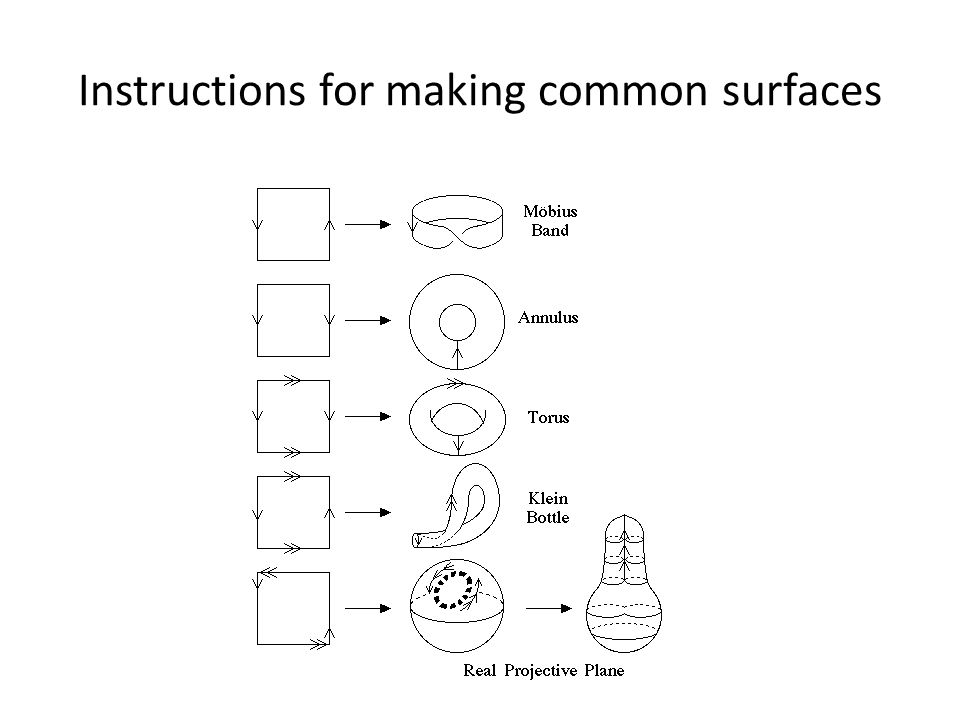
The Möbius band, the annulus \(S^1\cross I\), \(\TT^2\), \(\KK\), and \(\RP^2\) are quotients of a square by the edge identifications in these pasting diagrams:
Classification of surfaces
The classification theorem
Classification of compact surfaces (Tag T-NBARV)
Let \(X\) be a compact connected surface and let \(b\) be the number of boundary components. Then exactly one of the following holds:
\(X\) is orientable and is homeomorphic to the connected sum of \(g\geq 0\) tori with the interiors of \(b\) disjoint discs removed;
\(X\) is nonorientable and is homeomorphic to the connected sum of \(k\geq 1\) copies of \(\RP^2\) with the interiors of \(b\) disjoint discs removed.
The Euler characteristic is \[ \chi(X)= \begin{cases} 2-2g-b & \text{if $X$ is orientable}, \\ 2-k-b & \text{if $X$ is nonorientable}. \end{cases} \]
Thus compact connected surfaces are classified up to homeomorphism by orientability, the number \(b\) of boundary components, and \(\chi(X)\); equivalently, by \((g,b)\) in the orientable case and \((k,b)\) in the nonorientable case. For closed surfaces (\(b=0\)), orientability and Euler characteristic alone determine the homeomorphism type [@Mun00]; [@Hat02].
A compact connected surface is therefore determined up to homeomorphism by its orientability, its number \(b\) of boundary components, and its Euler characteristic. A polygon model computes these: the edge word of a polygon with identifications reduces to a normal form \(a_1b_1\inverseof{a_1} \inverseof{b_1}\cdots a_gb_g\inverseof{a_g} \inverseof{b_g}\) or \(a_1a_1\cdots a_ka_k\), together with the unpaired boundary edges. For example, the torus and the annulus both have Euler characteristic \(0\) and are not homeomorphic, since \(b=0\) for the torus and \(b=2\) for the annulus.
Classification of closed surfaces (Tag FF-GBHJL)
Every connected closed surface is homeomorphic to exactly one of: the sphere \(S^2\); the connected sum \(\Sigma_g = \#_{i=1}^g T^2\) of \(g\geq 1\) tori; or the connected sum \(N_k = \#_{i=1}^k \RP^2\) of \(k\geq 1\) projective planes [@Mun00]; [@Hat02]. The surfaces \(\Sigma_g\) are orientable and the surfaces \(N_k\) are not.
Under connected sum, homeomorphism classes of connected closed surfaces form a commutative monoid with identity \(S^2\), generated by \(T = T^2\) and \(P = \RP^2\) subject to the relation \(T\# P \cong P\# P\# P\); the Klein bottle is \(K\cong P\# P\) [@Mun00].
Orientable standard manifolds (Tag FF-D5Q4S)
The following closed manifolds are orientable: the spheres \(S^n\) and tori \(T^n\) for \(n\geq 1\), the closed orientable surfaces \(\Sigma_g\), the real projective spaces \(\RP^n\) for \(n\) odd, and the lens spaces [@Hat02].
Nonorientable standard manifolds (Tag FF-WDTKX)
The following manifolds are not orientable: the real projective spaces \(\RP^n\) for \(n\geq 2\) even [@Hat02], the Klein bottle and more generally the closed nonorientable surfaces \(N_k\) [@Hat02], and the open Möbius band.
Polygon models for surfaces (Tag PR-JL5JP)
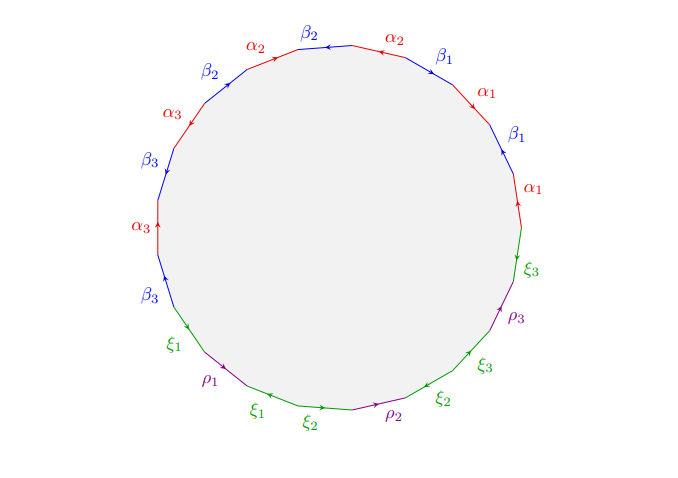
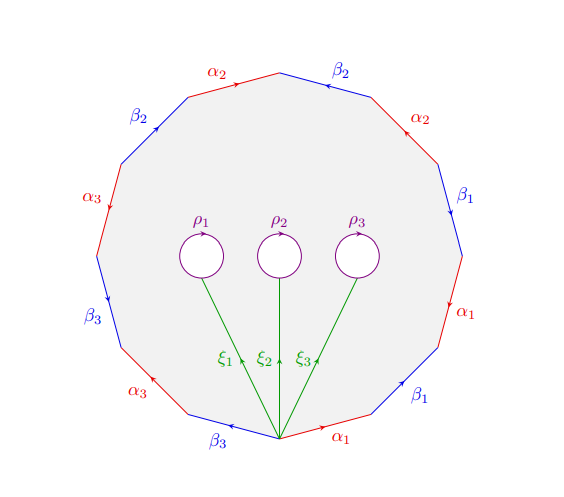
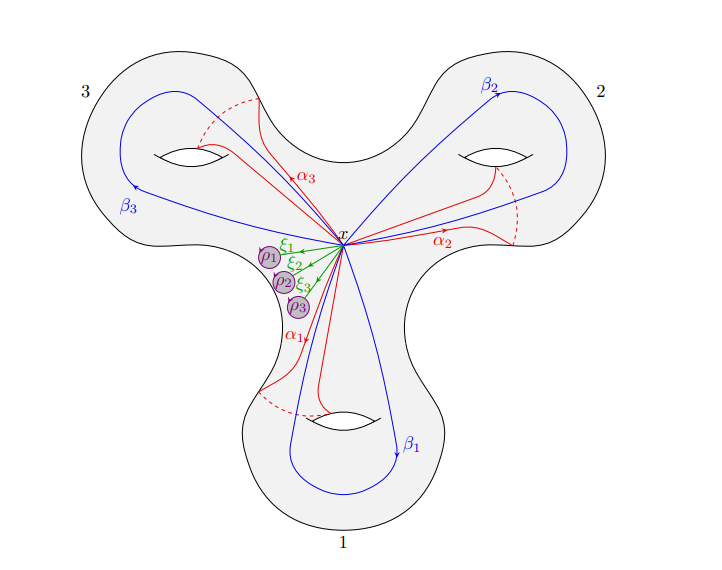
Every connected closed surface is homeomorphic to the quotient of a polygon whose edges are identified in pairs according to one of the words \(a_1a_1^{-1}\), \(a_1b_1a_1^{-1}b_1^{-1}\cdots a_gb_ga_g^{-1}b_g^{-1}\) (\(g\geq 1\)), or \(a_1a_1\cdots a_ka_k\) (\(k\geq 1\)) [@Mun00]. For compact surfaces with boundary, the orientable surface of genus \(g\) with \(b\) boundary circles is obtained from the word \(\alpha_1\beta_1\alpha_1^{-1}\beta_1^{-1}\cdots\alpha_g\beta_g\alpha_g^{-1}\beta_g^{-1}\,\xi_1\rho_1\xi_1^{-1}\cdots\xi_b\rho_b\xi_b^{-1}\), in which the edges \(\rho_j\) are left unidentified and become the boundary circles.
Euler characteristic
Euler characteristic in terms of genus (Tag FF-IEHB2)
Let \(g\geq 0\) and \(k\geq 1\). The closed orientable surface \(\Sigma_g\) of genus \(g\) and the closed nonorientable surface \(N_k\) of genus \(k\) have Euler characteristics \[ \chi(\Sigma_g) = 2-2g, \qquad \chi(N_k) = 2-k \] [@Hat02]. Removing the interiors of \(b\) disjoint closed discs from a closed surface lowers \(\chi\) by \(b\).
Euler characteristics of spheres, surfaces and the Klein bottle (Tag FF-W3AIU)
The Euler characteristics of the following spaces are \[ \chi(S^n) = 1 + (-1)^n \quad (n\geq 0),\qquad \chi(\Sigma_g) = 2-2g \quad (g\geq 0),\qquad \chi(\RP^2) = 1,\qquad \chi(K) = 0, \] where \(\Sigma_g\) is the closed orientable surface of genus \(g\) and \(K\) is the Klein bottle [@Hat02]. In particular \(\chi(S^1) = 0\), \(\chi(S^2) = 2\), \(\chi(\Sigma_1) = 0\), \(\chi(\Sigma_2) = -2\) and \(\chi(\Sigma_3) = -4\).
(Closed surfaces by Euler characteristic)
The closed orientable surface \(\Sigma_g\) has \(\chi = 2-2g\), and the closed nonorientable surface \(N_k \coloneqq \#_{i=1}^k\RP^2\) has \(\chi = 2-k\). Removing the interiors of \(b\) disjoint discs lowers \(\chi\) by \(b\).
| Orientable | \(-4\) | \(-3\) | \(-2\) | \(-1\) | \(0\) | \(1\) | \(2\) |
|---|---|---|---|---|---|---|---|
| Yes | \(\Sigma_3\) | none | \(\Sigma_2\) | none | \(\TT^2\) | none | \(\SS^2\) |
| No | \(N_6\) | \(N_5\) | \(N_4\) | \(N_3\) | \(\KK\) | \(\RP^2\) | none |
With boundary, \(\chi=0\) also includes the annulus \(S^1\cross I\) and the Möbius band \(\bbm\), and \(\chi=1\) includes the disc \(\DD^2\).
Closed surfaces with Euler characteristic 2 (Tag FF-23V5J)
Let \(\Sigma\) be a connected closed surface with Euler characteristic \(\chi(\Sigma) = 2\). Then \(\Sigma\) is orientable of genus \(0\), and \(\Sigma \cong S^2\) [@Mun00]; [@Hat02].
Compact surfaces with Euler characteristic 0 (Tag FF-SM63J)
Let \(\Sigma\) be a compact connected surface with Euler characteristic \(\chi(\Sigma) = 0\). If \(\Sigma\) is closed, then \(\Sigma\) is homeomorphic to the torus \(T^2\) or to the Klein bottle \(K\) [@Mun00]; [@Hat02]. If \(\Sigma\) has nonempty boundary, then \(\Sigma\) is homeomorphic to the annulus \(S^1\times I\) or to the Möbius band.
Closed surfaces with Euler characteristic $-2$ (Tag FF-BOIT5)
Let \(\Sigma\) be a connected closed surface with Euler characteristic \(\chi(\Sigma) = -2\). If \(\Sigma\) is orientable, then \(\Sigma\) is homeomorphic to the orientable surface \(\Sigma_2\) of genus \(2\); otherwise \(\Sigma\) is homeomorphic to the nonorientable surface \(N_4 = \#_{i=1}^4\RP^2\) [@Mun00]; [@Hat02].
Inclusion-exclusion for Euler characteristic (Tag PR-QV4U5)
Let \(X\) be a finite CW complex and \(U, V\subseteq X\) subcomplexes with \(X = U\cup V\). Then \[ \chi(X) = \chi(U) + \chi(V) - \chi (U\cap V) .\]
This follows by counting cells, since the Euler characteristic of a finite CW complex is the alternating sum of its numbers of cells [@Hat02].
(Inclusion-exclusion for $\chi$)
Let \(U,V\subseteq X\) be open with \(X=U\cup V\), and assume \(U\), \(V\), \(U\cap V\), and \(X\) have finitely generated total homology, so that their Euler characteristics are defined. The Mayer–Vietoris sequence \[ \cdots \to H_n(U\cap V) \to H_n(U)\oplus H_n(V) \to H_n(X) \to H_{n-1}(U\cap V) \to \cdots \] is a finite long exact sequence of finitely generated abelian groups, so the alternating sum of the ranks of its terms vanishes: \[ \chi(U\cap V) - \bigl(\chi(U)+\chi(V)\bigr) + \chi(X) = 0. \]
Euler characteristic of a connected sum (Tag FF-AE7ID)
Let \(A\) and \(B\) be connected closed surfaces. The Euler characteristic of their connected sum is \[ \chi(A\# B) = \chi(A) + \chi(B) - 2 \] [@Hat02].
Euler characteristic of a connected sum of surfaces (Tag C-CT2NX)
Let \(A\) and \(B\) be closed surfaces, and let \(A \# B\) be their connected sum. Then the Euler characteristics satisfy \[ \chi(A \# B) = \chi(A) + \chi(B) - 2 .\]
Let \(A\) and \(B\) be closed surfaces, and let \(A'\) and \(B'\) be \(A\) and \(B\) with the interior of a closed disc removed, so that \(A\# B = A'\union_{S^1} B'\). Gluing a disc back along a circle and applying inclusion-exclusion gives \(\chi(A) = \chi(A') + \chi(\DD^2) - \chi(S^1) = \chi(A')+1\), and likewise \(\chi(B)=\chi(B')+1\). Applying inclusion-exclusion to open neighborhoods \(U\homotopic A'\) and \(V\homotopic B'\) with \(U\cap V\homotopic S^1\), \[ \chi(A\# B)=\chi(A')+\chi(B')-\chi(S^1)=\chi(A)+\chi(B)-2. \]
Connected sums and polygon decompositions
Decomposing $\RP^2$ (Tag PR-GKRFP)
The real projective plane is obtained from a Möbius band \(\bbm\) and a closed disc \(D^2\) by identifying the boundary circle of \(\bbm\) with \(\partial D^2\) by a homeomorphism: \[ \RP^2 \cong \bbm \union_{\partial} D^2 .\]
Gluing two Möbius bands along their boundary circles gives the Klein bottle [@Hat02].
Decomposing a Klein bottle (Tag PR-LIXWH)
The Klein bottle is a connected sum of two projective planes, \[ \KK \cong \RP^2 \# \RP^2 .\] Equivalently, \(\KK\) is the union of two Möbius bands glued along their boundary circles [@Hat02].
(Klein bottle as two projective planes)
Removing an open disc from \(\RP^2\) leaves a Möbius band, since \(\RP^2\) is a Möbius band with a disc glued along its boundary circle. The connected sum \(\RP^2\#\RP^2\) is therefore two Möbius bands glued along their boundary circles, which is the Klein bottle: cutting \(\KK\) along a circle parallel to the boundary edges of its square model decomposes it into two Möbius bands.
Rewriting a Klein bottle summand (Tag PR-BDH3V)
There is a homeomorphism \[ \RP^2 \# \KK \cong \RP^2 \# \TT^2 ,\] and both surfaces are homeomorphic to \(\RP^2\#\RP^2\#\RP^2\) [@Mun00].
(Crosscap plus Klein bottle versus crosscap plus torus)
The classification theorem Classification of compact surfaces gives \(\RP^2\#\RP^2\#\RP^2 \cong \RP^2 \# \TT^2\), since both are closed and nonorientable with \(\chi = -1\). By Decomposing a Klein bottle, \(\KK\cong \RP^2\#\RP^2\), so \[ \RP^2 \# \KK \cong \RP^2 \# \RP^2 \# \RP^2 \cong \RP^2 \# \TT^2. \]
Manifolds
(Local homology)
If \(M\) is an \(n\)-manifold and \(x\in M\) is an interior point, then by excision \(H_k(M, M\sm\ts x) \cong H_k(\RR^n,\RR^n\sm\ts 0) \cong \tilde H_{k-1}(S^{n-1})\), which is \(\ZZ\) for \(k=n\) and \(0\) otherwise. A space with a point at which these local homology groups differ from those of every \(\RR^n\) is not a manifold near that point.
Vanishing of homology and cohomology above the dimension (Tag PR-ZCPDD)
Let \(M\) be a closed connected \(n\)-manifold. Then \(H_i(M;R) = 0\) for \(i > n\) and every coefficient ring \(R\) [@Hat02], and \(H^i(M;\ZZ) = 0\) for \(i>n\) by the universal coefficient theorem [@Hat02], since \(H_n(M;\ZZ)\) is free.
In degree \(n\), \(H^n(M;\ZZ)\cong\ZZ\) if \(M\) is orientable and \(H^n(M;\ZZ)\cong\ZZ/2\) otherwise, by the universal coefficient theorem applied to \(H_n(M;\ZZ)\) and the torsion subgroup of \(H_{n-1}(M;\ZZ)\) [@Hat02].
Top homology of closed manifolds (Tag PR-LR35S)
Let \(M\) be a closed connected \(n\)-manifold. Then \[ H_n(M;\ZZ) \cong \begin{cases} \ZZ & M \text{ orientable},\\ 0 & \text{otherwise}, \end{cases} \qquad H_i(M;\ZZ) = 0 \text{ for } i > n \] [@Hat02], and the torsion subgroup of \(H_{n-1}(M;\ZZ)\) is trivial if \(M\) is orientable and \(\ZZ/2\) otherwise [@Hat02].
Poincaré duality for closed manifolds (Tag PR-4X6G2)
Let \(M\) be a closed orientable \(n\)-manifold and \(R\) a commutative ring; for example \(R = \ZZ\) or \(R\) a field. Then cap product with the fundamental class gives isomorphisms \[ H^{k}(M; R) \xrightarrow{\ \sim\ } H_{n-k}(M; R) \] for all \(k\) [@Hat02].
For \(n\geq 1\), the orientable manifold \(\RR^n\) is not closed, and \(H^0(\RR^n;\ZZ)\cong\ZZ\) while \(H_n(\RR^n;\ZZ) = 0\). The closed manifold \(\RP^2\) is not orientable, and \(H^0(\RP^2;\ZZ)\cong\ZZ\) while \(H_2(\RP^2;\ZZ) = 0\). For a field \(F\) of characteristic \(2\), every closed manifold is \(F\)-orientable, so the duality holds for all closed manifolds with \(\ZZ/2\) coefficients.
Lefschetz duality (Tag T-QNYSB)
Let \(M\) be a compact \(R\dash\)orientable \(n\dash\)manifold whose boundary is decomposed as \(\del M = A \union B\) with \(A, B\) compact \((n-1)\dash\)manifolds meeting in \(\del A = \del B = A \intersect B\). Then cap product with a fundamental class \([M]\in H_n(M, \del M; R)\) gives isomorphisms \[ D_M: H^k(M, A; R) \mapsvia{\sim} H_{n-k}(M, B; R) \] for all \(k\). The cases \(A = \del M\), \(B = \emptyset\) and \(A = \emptyset\), \(B = \del M\) give the isomorphisms \[ H^k(M, \del M; R) \cong H_{n-k}(M; R), \qquad H^k(M; R)\cong H_{n-k}(M, \del M; R) \] [@Hat02].
For \(\del M = \emptyset\) this is Poincaré duality.
Closed odd-dimensional manifolds have Euler characteristic zero (Tag PR-TU4G5)
Let \(M\) be a closed manifold of odd dimension. Then \(\chi(M) = 0\) [@Hat02].
(Odd-dimensional closed manifolds)
Let \(M\) be a closed \(n\)-manifold and work with \(\FF_2\) coefficients, for which Poincaré duality holds without an orientability hypothesis: \(H^k(M;\FF_2)\cong H_{n-k}(M;\FF_2)\). Since \(H^k(M;\FF_2)\cong\Hom(H_k(M;\FF_2),\FF_2)\), the Betti numbers \(b_k\coloneqq\dim_{\FF_2} H_k(M;\FF_2)\) satisfy \(b_k=b_{n-k}\), and \(\chi(M)=\sum_k(-1)^kb_k\) for any field of coefficients. Then \[ \chi(M) = \sum_{k=0}^n (-1)^k b_{n-k} = (-1)^n \sum_{j=0}^n (-1)^{j} b_{j} = (-1)^n \chi(M), \] so if \(n\) is odd then \(\chi(M)=0\).
Nonsingular cup product pairing (Tag PR-3FB24)
Let \(M\) be a closed orientable \(n\)-manifold. The cup product pairing \[ H^k(M;\ZZ)/\mathrm{torsion}\times H^{n-k}(M;\ZZ)/\mathrm{torsion}\to\ZZ,\qquad (a,b)\mapsto\langle a\smile b, [M]\rangle \] is nonsingular, and for a field \(F\) the pairing \(H^k(M;F)\times H^{n-k}(M;F)\to F\) is nonsingular for every closed \(F\)-orientable \(n\)-manifold \(M\) [@Hat02]. Under Poincaré duality this is the intersection pairing on \(H_{n-k}(M)\times H_k(M)\) modulo torsion.
Orientation double cover (Tag PR-BQKHS)
Every \(n\)-manifold \(M\) has an orientable two-sheeted covering space \(\tilde M\to M\), the orientation double cover [@Hat02]. If \(M\) is connected, then \(M\) is orientable if and only if \(\tilde M\) has two components; in particular, \(M\) is orientable if \(\pi_1(M)\) has no subgroup of index two [@Hat02].
3-manifolds and knot complements
Every complex manifold is canonically oriented by its complex structure.
Homology of closed 3-manifolds (Tag PR-UL3KL)
Let \(M\) be a closed connected \(3\)-manifold and write \(H_1(M;\ZZ) \cong \ZZ^r \oplus F\) with \(F\) finite. Then \[ H_*(M;\ZZ) \cong \begin{cases} \qty{ \ZZ,\; \ZZ^r \oplus F,\; \ZZ^r,\; \ZZ } & M \text{ orientable},\\ \qty{ \ZZ,\; \ZZ^r \oplus F,\; \ZZ^{r-1} \oplus \ZZ/2,\; 0 } & M \text{ nonorientable}, \end{cases} \] in degrees \(0, 1, 2, 3\), with all higher groups zero; in the nonorientable case \(r \geq 1\) [@Hat02].
\(H_1\) can have torsion: the lens space \(L_p(1,1)\) has \(H_1\cong\ZZ/p\).
Homotopy type of knot complements (Tag PR-6HORN)
Let \(K\subseteq S^3\) be a knot. Then \(S^3\sm K\) is a \(K(\pi, 1)\) [@Hat02], and \(\RR^3 \sm K \homotopic S^2 \vee \qty{S^3 \sm K}\). If \(X\) is an orientable \(3\)-manifold and \(K\subseteq X\) is a nullhomologous tame knot with tubular neighborhood \(\nu(K)\), then \[ H_1\qty{X\sm \nu(K)} \cong H_1(X) \oplus \ZZ ,\] the \(\ZZ\) summand generated by a meridian of \(K\).
(Knot complements)
By Alexander’s theorem, \(S^3\sm K\) is irreducible, and its fundamental group is infinite since its abelianization \(H_1(S^3\sm K)\cong\ZZ\). By the sphere theorem, an irreducible orientable \(3\)-manifold has \(\pi_2=0\); its universal cover is then a noncompact simply connected \(3\)-manifold with \(H_2=H_3=0\), hence contractible by the Hurewicz and Whitehead theorems. So \(\pi_j(S^3\sm K)=0\) for \(j\geq 2\), and \(S^3\sm K\) is a \(K(\pi,1)\).
For the wedge, \(\RR^3\sm K \cong (S^3\sm K)\sm\ts{\infty}\). The space \(S^3\sm K\) deformation retracts onto the compact manifold \(C\coloneqq S^3\sm\nu(K)\) with torus boundary, and a compact \(3\)-manifold with nonempty boundary deformation retracts onto a \(2\)-dimensional spine missing a chosen interior point. Removing that point therefore gives a space deformation retracting onto the spine together with a small sphere around the point and an arc joining them, so \[ \RR^3\sm K \homotopic (S^3\sm K) \vee S^2. \]
For the homology statement, assume \(X\) is orientable and let \(K\subseteq X\) be nullhomologous, with tubular neighborhood \(\nu(K)\), complement \(C\coloneqq X\sm\nu(K)\), meridian \(\mu\), and a longitude \(\lambda\) on \(\del\nu(K)\cong T^2\) bounding a Seifert surface \(S\) for \(K\). Intersection number with \(S\) gives a homomorphism \(\varphi\colon H_1(C)\to\ZZ\) with \(\varphi(\mu)=1\), so \(H_1(C)\cong\ZZ\mu\oplus\ker\varphi\), and \(\lambda=0\) in \(H_1(C)\). In the Mayer–Vietoris sequence for \(X = C\cup\nu(K)\), \[ H_1(T^2)\to H_1(C)\oplus H_1(\nu(K))\to H_1(X)\to 0, \] the first map sends \(\mu\mapsto(\mu,0)\) and \(\lambda\mapsto(0,1)\), so \(H_1(X)\cong H_1(C)/\ZZ\mu\cong\ker\varphi\), and \[ H_1\bigl(X\sm\nu(K)\bigr) \cong H_1(X)\oplus\ZZ. \]
Homology of knot complements in $S^3$ (Tag PR-WCHFF)
Let \(K\subseteq S^3\) be a tame knot, for example a smooth or polygonal one. Then \[ H_i(S^3 \sm K;\ZZ) \cong \begin{cases} \ZZ & i = 0, 1,\\ 0 & \text{otherwise} \end{cases} \] [@Hat02].
\(S^3\sm K\) is path connected, so \(H_0\cong\ZZ\), and \(H_1\cong\ZZ\) by Homotopy type of knot complements with \(X=S^3\). In the Mayer–Vietoris sequence for \(S^3 = \nu(K) \cup C\) with \(C\coloneqq S^3\sm\nu(K)\homotopic S^3\sm K\), \(\nu(K) \homotopic S^1\), and \(C\cap\nu(K)\homotopic T^2\), \[ H_3(S^3)\to H_2(T^2)\to H_2(C)\oplus H_2(\nu(K))\to H_2(S^3)=0, \] the map \(H_3(S^3)\cong\ZZ\to H_2(T^2)\cong\ZZ\) is an isomorphism, so \(H_2(C)=0\). Since \(S^3\sm K\) is a connected noncompact \(3\)-manifold, \(H_k(S^3\sm K)=0\) for \(k\geq 3\).