Measure
Monotonicity and countable subadditivity of measures (Tag T-7LQ7X)
Let \((X, \mcm, \mu)\) be a measure space.
(Monotonicity) If \(E,F\in\mcm\) and \(E \subseteq F\), then \(\mu(E) \leq \mu(F)\).
(Countable subadditivity) If \(E_k\in\mcm\) for \(k\geq1\), then \[ \mu\qty{\bigcup_{k\geq 1} E_k} \leq \sum_{k\geq 1} \mu(E_k). \]
Existence of a non-measurable subset of $\RR$ (Tag T-KZNWM)
There exists a set \(A\subseteq \RR\) that is not Lebesgue measurable.
Borel--Cantelli lemma (Tag T-OTR5M)
Let \((E_k)_{k\geq1}\) be a sequence of Lebesgue measurable subsets of \(\RR^n\) with \[ \sum_{k=1}^\infty m(E_k) < \infty . \] Then \(m\qty{\limsup_{k\to\infty} E_k} = 0\), where \(\limsup_k E_k\) is the limit superior of the sets \(E_k\); equivalently, almost every \(x\in\RR^n\) lies in only finitely many of the sets \(E_k\).
The same statement holds for a sequence of measurable sets in any measure space. For a probability measure \(P\) and events \(E_k\) with \(\sum_k P(E_k)<\infty\), it says that with probability \(0\) infinitely many of the events \(E_k\) occur.
Chapter: Measure.
Integration
$p$-tests for series and integrals (Tag PR-6OHTJ)
Let \(p\in\RR\), let \(\varepsilon>0\), let \(n\geq1\), and let \(B \coloneqq \theset{x\in \RR^n \suchthat \abs{x} \leq 1}\) be the closed unit ball for the Euclidean norm. Then \[ \begin{aligned} \sum_{k=1}^\infty \frac 1 {k^p} < \infty &\iff p>1, \\ \int_\varepsilon^\infty \frac {dx} {x^p} < \infty &\iff p>1, \\ \int_0^1 \frac {dx} {x^p} < \infty &\iff p<1, \\ \int_B \frac{dx}{\abs{x}^p} < \infty &\iff p < n, \\ \int_{\RR^n\setminus B} \frac{dx}{\abs{x}^p} < \infty &\iff p > n . \end{aligned} \]
Monotone convergence theorem (Tag T-5K3IO)
Let \((X,\mcm,\mu)\) be a measure space, and let \(f_n\) for \(n\geq1\) and \(f\) be functions in $L^+(X,\mcm)$ such that, for almost every \(x\in X\), \(f_n(x)\leq f_{n+1}(x)\) for all \(n\) and \(f_n(x)\to f(x)\). Then \[ \lim_{n\to\infty} \int_X f_n\dmu = \int_X f\dmu . \]
Dominated convergence theorem (Tag T-IJQQG)
Let \((X,\mcm,\mu)\) be a measure space, and let \(f_n\colon X\to\CC\) for \(n\geq1\) and \(f\colon X\to\CC\) be measurable with \(f_n\to f\) almost everywhere. Suppose there is an integrable \(g\colon X\to[0,\infty)\) with \(\abs{f_n} \leq g\) almost everywhere for every \(n\). Then \(f\) is integrable and \[ \lim_{n\to\infty}\int_X \abs{f_n - f}\dmu = 0 ; \] consequently \[ \lim_{n\to\infty} \int_X f_n\dmu = \int_X f\dmu . \]
The functions \(f_n\) may be complex-valued and of arbitrary sign; the only sign condition is \(g\geq0\) on the dominating function.
Fatou's lemma and reverse Fatou's lemma (Tag T-LDJNS)
Let \((X,\mcm,\mu)\) be a measure space and let \(f_n\colon X\to[0,\infty]\) be measurable for \(n\geq1\).
(Fatou’s lemma [@Fol13]) \[ \liminf_{n\to\infty} \int_X f_n\dmu \geq \int_X \liminf_{n\to\infty} f_n\dmu . \]
(Reverse Fatou’s lemma) If moreover there is an integrable \(g\colon X\to[0,\infty)\) with \(f_n\leq g\) for all \(n\), then \[ \limsup_{n\to\infty} \int_X f_n\dmu \leq \int_X \limsup_{n\to\infty} f_n\dmu . \]
The domination hypothesis in (2) cannot be dropped. On \(\RR\) with Lebesgue measure, \(f_n\coloneqq\chi_{[n,n+1]}\) satisfies \(\int f_n=1\) for all \(n\), while \(\limsup_n f_n=0\) pointwise, so \(\limsup_n\int f_n=1>0=\int\limsup_n f_n\).
Generalized dominated convergence theorem (Tag T-WYX24)
Let \((X,\mcm,\mu)\) be a measure space, and let \(f_n\colon X\to\CC\) and \(g_n\colon X\to[0,\infty)\) for \(n\geq1\), \(f\colon X\to\CC\), and \(g\colon X\to[0,\infty)\) be measurable. Suppose that
\(f_n\to f\) almost everywhere;
\(g_n\in L^1(X,\mu)\) and \(\abs{f_n}\leq g_n\) almost everywhere, for every \(n\);
\(g_n\to g\) almost everywhere, \(g\in L^1(X,\mu)\), and \(\lim_{n\to\infty}\int_X g_n\dmu=\int_X g\dmu\).
Then \(f\in L^1(X,\mu)\) and \[ \lim_{n\to\infty}\int_X f_n\dmu=\int_X f\dmu. \]
The dominated convergence theorem is the case \(g_n=g\) for all \(n\): the single dominating function \(g\) is replaced by dominating functions \(g_n\) that converge to \(g\) almost everywhere and in integral.
Interchanging sums and integrals for absolutely summable series (Tag T-MN6WQ)
Let \((X,\mcm,\mu)\) be a measure space and let \(f_n\colon X\to\CC\) be integrable for \(n\geq1\). The two quantities \[ \sum_{n=1}^\infty \int_X \abs{f_n}\dmu \quad\text{and}\quad \int_X\sum_{n=1}^\infty \abs{f_n}\dmu \] are equal, and if they are finite, then \(\sum_{n}f_n(x)\) converges absolutely for almost every \(x\), its sum is integrable, and \[ \int_X\sum_{n=1}^\infty f_n\dmu = \sum_{n=1}^\infty \int_X f_n\dmu . \]
Small tails of $L^1(\RR^d)$ functions (Tag T-RIY2P)
Let \(d\geq1\), let \(m\) be Lebesgue measure on \(\RR^d\), and let \(f\colon\RR^d\to\CC\) be integrable with respect to \(m\). For \(r>0\), let \(B_r(0)\coloneqq\theset{x\in\RR^d\suchthat\abs{x}<r}\). Then \[ \lim_{r\to\infty}\int_{\RR^d\setminus B_r(0)}\abs{f}\,dm=0. \] Equivalently, for every \(\varepsilon>0\) there exists \(r>0\) such that \[ \int_{\RR^d\setminus B_r(0)}\abs{f}\,dm<\varepsilon. \]
Continuity of translation in $L^1$ (Tag T-BFOJT)
For \(h\in\RR^n\) and \(f\in L^1(\RR^n)\) let \((\tau_hf)(x)\coloneqq f(x-h)\). For every \(f\in L^1(\RR^n)\), \[ \lim_{h\to 0}\norm{\tau_h f - f}_1 = 0 . \]
Each \(\tau_h\) is a linear isometry of \(L^1(\RR^n)\), so the family \(\theset{\tau_h\suchthat h\in\RR^n}\) is equicontinuous as a family of maps \(L^1(\RR^n)\to L^1(\RR^n)\). Together with the pointwise convergence \(\tau_hf\to f\) of the theorem, this makes the convergence uniform on compact subsets \(K\subseteq L^1(\RR^n)\): \[ \lim_{h\to0}\sup_{f\in K}\norm{\tau_hf-f}_1=0 . \]
Chapter: Integration.
Fubini and Tonelli
Tonelli's theorem for nonnegative measurable functions (Tag T-6PRW3)
Let \(f\colon\RR^n\times\RR^m\to[0,\infty]\) be Lebesgue measurable on \(\RR^{n+m}\). For \(x\in\RR^n\) let \(f_x\colon\RR^m\to[0,\infty]\) be the slice \(f_x(y)\coloneqq f(x,y)\). Then:
for almost every \(x\in\RR^n\), the slice \(f_x\) is Lebesgue measurable on \(\RR^m\);
the function \(F(x)\coloneqq\int_{\RR^m} f(x,y)\,dy\in[0,\infty]\), defined for almost every \(x\), is Lebesgue measurable on \(\RR^n\);
\[ \int_{\RR^{n+m}} f = \int_{\RR^n} F(x)\,dx = \int_{\RR^n}\qty{\int_{\RR^m} f(x,y)\,dy}dx \in[0,\infty], \] and the same holds with the roles of \(x\) and \(y\) exchanged [@Fol13].
Moreover, if \(E\subseteq\RR^{n}\times\RR^m\) is Lebesgue measurable, then for almost every \(x\in\RR^n\) the slice \(E_x\coloneqq\theset{y\in\RR^m \suchthat (x, y) \in E}\) is Lebesgue measurable.
Fubini's theorem for integrable functions (Tag T-4GPEF)
Let \(f\colon\RR^n\times\RR^m\to\CC\) be integrable with respect to Lebesgue measure on \(\RR^{n+m}\). For \(x\in\RR^n\) let \(f_x\colon\RR^m\to\CC\) be the slice \(f_x(y)\coloneqq f(x,y)\). Then:
for almost every \(x\in\RR^n\), the slice \(f_x\) is integrable on \(\RR^m\);
the function \(F(x)\coloneqq\int_{\RR^m} f(x,y)\,dy\), defined for almost every \(x\), is integrable on \(\RR^n\);
\[ \int_{\RR^{n+m}} f = \int_{\RR^n}\qty{\int_{\RR^m} f(x,y)\,dy}dx , \] and the same holds with the roles of \(x\) and \(y\) exchanged.
Moreover, if \(E\subseteq\RR^{n}\times\RR^m\) is Lebesgue measurable, then for almost every \(x\in\RR^n\) the slice \(E_x\coloneqq\theset{y\in\RR^m \suchthat (x, y) \in E}\) is Lebesgue measurable.
The hypothesis is \(f\) integrable on \(\RR^{n+m}\); \(f\) may take values of both signs. Tonelli's theorem instead assumes \(f\geq0\) measurable, with no integrability hypothesis.
Fubini--Tonelli theorem (Tag T-X7XZX)
Let \((X,\mcm,\mu)\) and \((Y,\mcn,\nu)\) be \(\sigma\)-finite measure spaces, and let \(f\colon X\times Y\to\CC\) be \(\mcm\otimes\mcn\)-measurable. Suppose that one of the iterated integrals of \(\abs{f}\) is finite: \[ \int_X\qty{\int_Y\abs{f(x,y)}\,d\nu(y)}d\mu(x)<\infty\quad\text{or}\quad\int_Y\qty{\int_X\abs{f(x,y)}\,d\mu(x)}d\nu(y)<\infty. \] Then \(f\in L^1(X\times Y,\mu\times\nu)\), and \[ \int_{X\times Y}f\,d(\mu\times\nu)=\int_X\qty{\int_Y f(x,y)\,d\nu(y)}d\mu(x)=\int_Y\qty{\int_X f(x,y)\,d\mu(x)}d\nu(y), \] where the inner integrals exist for almost every value of the outer variable.
Chapter: Fubini and Tonelli.
\(L^p\)
$L^p$ norms approach $\norm{f}_\infty$ on finite measure spaces (Tag T-4KKSH)
Let \((X,\mcm,\mu)\) be a measure space with \(\mu(X)<\infty\), and let \(f\colon X\to\CC\) be measurable. Then, in \([0,\infty]\), \[ \lim_{p\to\infty} \norm{f}_p = \norm{f}_\infty , \] where \(\norm{f}_\infty\) is the essential supremum of \(\abs{f}\).
Duals of $L^p$ spaces (Tag T-5BFVS)
Let \((X,\mcm,\mu)\) be a measure space, let \(1\leq p<\infty\), and let \(q\in(1,\infty]\) satisfy \(\frac1p+\frac1q=1\). If \(p=1\), assume that \(\mu\) is $\sigma$-finite. Then the map \[ L^q(X,\mu)\to \dualof{L^p(X,\mu)},\qquad g\mapsto\qty{f\mapsto\int_X fg\dmu}, \] is an isometric isomorphism onto the space \(\dualof{L^p(X,\mu)}\) of continuous linear functionals on \(L^p(X,\mu)\) with the dual norm [@Fol13].
Lebesgue differentiation theorem (Tag T-S3C3S)
Let \(d\geq1\) and let \(f\colon\RR^d\to\CC\) be Lebesgue integrable. Then for almost every \(x\in\RR^d\), \[ \lim_{\substack{m(B)\to0\\ x\in B}}\frac{1}{m(B)}\int_B f(y)\,dy=f(x), \] where the limit is taken over open balls \(B\subseteq\RR^d\) containing \(x\) as their Lebesgue measure \(m(B)\) tends to \(0\) [@SS05].
Let \(f\colon\RR\to\CC\) be Lebesgue integrable, and for \(h>0\) define \(A_h f\colon\RR\to\CC\) by \[ A_h f(x)\coloneqq\frac{1}{2h}\int_{x-h}^{x+h}f(y)\,dy. \] Then \(A_h f(x)\to f(x)\) as \(h\to0^+\) for almost every \(x\in\RR\), and \(\norm{A_h f-f}_{L^1(\RR)}\to0\) as \(h\to0^+\) [@SS05].
Chapter: $L^p$ spaces.
Fourier
Fourier inversion (Tag T-DTXIA)
Let \(f\in L^1(\RR^n)\), and suppose its Fourier transform \(\widehat f(\xi)=\int_{\RR^n}f(x)e^{-2\pi i x\cdot\xi}\,dx\) also lies in \(L^1(\RR^n)\). Then \[ F(x)\coloneqq\int_{\RR^n}\widehat f(\xi)e^{2\pi i x\cdot\xi}\,d\xi \] defines a bounded continuous function \(F\colon\RR^n\to\CC\), and \(F(x)=f(x)\) for almost every \(x\in\RR^n\). More precisely, \(F(x)=f(x)\) at every Lebesgue point \(x\) of \(f\), that is, every \(x\) with \[ \lim_{r\to0^+}\frac{1}{m(B_r(x))}\int_{B_r(x)}\abs{f(y)-f(x)}\,dy=0 ; \] in particular, \(F(x)=f(x)\) at every point \(x\) at which \(f\) is continuous.
Since \(\abs{\widehat f(\xi)e^{2\pi ix\cdot\xi}}=\abs{\widehat f(\xi)}\) and \(\widehat f\in L^1\), the bound \(\abs{F(x)}\leq\norm{\widehat f}_1\) holds and dominated convergence shows that \(F\) is continuous.
For \(t>0\), set \[ G_t(x)\coloneqq t^{-n}e^{-\pi \abs{x}^2/t^2}. \] Its Fourier transform is \[ \widehat{G_t}(\xi)=e^{-\pi t^2\abs{\xi}^2}. \] Indeed, in one dimension the function \[ H(\xi)\coloneqq\int_{\RR}e^{-\pi x^2}e^{-2\pi i x\xi}\,dx \] satisfies, by differentiation under the integral sign and integration by parts, \[ H'(\xi)=-2\pi\xi H(\xi), \qquad H(0)=1, \] so \(H(\xi)=e^{-\pi\xi^2}\). The \(n\)-dimensional identity follows by Fubini’s theorem, since \(e^{-\pi\abs{x}^2}=\prod_{j=1}^ne^{-\pi x_j^2}\), and the formula for \(G_t\) follows by the substitution \(x=ty\). Since \(G_t\) is even, the same computation gives \(\int_{\RR^n}e^{2\pi i w\cdot\xi}e^{-\pi t^2\abs{\xi}^2}\,d\xi=G_t(w)\) for \(w\in\RR^n\).
Fix \(x\in\RR^n\). By Fubini’s theorem T-4GPEF, \[ \begin{aligned} \int_{\RR^n}\widehat f(\xi) e^{2\pi i x\cdot\xi}e^{-\pi t^2\abs{\xi}^2}\,d\xi &=\int_{\RR^n}f(y) \qty{\int_{\RR^n}e^{2\pi i(x-y)\cdot\xi} e^{-\pi t^2\abs{\xi}^2}\,d\xi}dy\\ &=\int_{\RR^n}f(y)G_t(x-y)\,dy\\ &=(f*G_t)(x). \end{aligned} \] Fubini’s theorem applies because \[ \int_{\RR^n}\int_{\RR^n} \abs{f(y)}e^{-\pi t^2\abs{\xi}^2}\,d\xi\,dy=\norm{f}_1\,t^{-n}<\infty. \]
As \(t\to0^+\), dominated convergence on the left, with dominating function \(\abs{\widehat f}\), gives \[ \int_{\RR^n}\widehat f(\xi)e^{2\pi i x\cdot\xi}e^{-\pi t^2\abs{\xi}^2}\,d\xi \longrightarrow F(x). \] On the right, \(G_t(y)=t^{-n}G_1(y/t)\), where \(G_1\geq0\) has \(\int G_1=1\) and is radial and decreasing in \(\abs{y}\), so \((G_t)_{t>0}\) is an approximate identity with a radially decreasing integrable majorant. For such a family, \((f*G_t)(x)\to f(x)\) as \(t\to0^+\) at every Lebesgue point \(x\) of \(f\). Therefore \(F(x)=f(x)\) at every Lebesgue point of \(f\). By the Lebesgue differentiation theorem, almost every point of \(\RR^n\) is a Lebesgue point of \(f\), and every point of continuity of \(f\) is a Lebesgue point.
Convolution with an approximate identity converges in $L^1$ (Tag T-HHFGB)
Let \(\phi\in L^1(\RR^n)\) with \(\int_{\RR^n}\phi=1\), let \(\phi_t(x)\coloneqq t^{-n}\phi(\inverseof{t} x)\) for \(t>0\) be the corresponding approximate identity, and let \(f\in L^1(\RR^n)\). Then \[ \lim_{t\to 0^+}\norm{f * \phi_{t} - f}_1 = 0 . \]
Convolutions of bounded integrable functions vanish at infinity (Tag T-3UXK7)
Let \(f,g\in L^1(\RR^n)\) be essentially bounded. Then the convolution \(f*g\) is defined at every \(x\in\RR^n\) and \[ \lim_{\abs{x}\to\infty}(f*g)(x)=0 . \]
Bessel's inequality (Tag T-4BDE3)
Let \(\mch\) be a Hilbert space, let \((u_n)_{n\geq1}\) be an orthonormal sequence in \(\mch\), and let \(x\in\mch\). For every \(N\geq1\), \[ \norm{x-\sum_{n=1}^{N}\inner{x}{u_n}u_n}^{2}=\norm{x}^{2}-\sum_{n=1}^{N}\abs{\inner{x}{u_n}}^{2}, \] and consequently \[ \sum_{n=1}^{\infty}\abs{\inner{x}{u_n}}^{2} \leq\norm{x}^{2}. \]
Fix \(N\geq 1\) and put \(s_N\coloneqq\sum_{k=1}^{N}\inner{x}{u_k}u_k\). By orthonormality, \(\inner{x}{s_N} = \inner{s_N}{s_N} = \sum_{k=1}^{N}\abs{\inner{x}{u_k}}^2\), so \[ 0\leq\norm{x - s_N}^2 = \norm{x}^2 - 2\operatorname{Re}\inner{x}{s_N} + \norm{s_N}^2 = \norm{x}^2 - \sum_{k=1}^{N}\abs{\inner{x}{u_k}}^2. \] Letting \(N\to\infty\) gives the inequality.
The inequality extends to an orthonormal family \((u_i)_{i\in I}\) indexed by an arbitrary, possibly uncountable, set \(I\): for every \(x\in\mch\), \[ \sum_{i\in I}\abs{\inner{x}{u_i}}^2\coloneqq\sup_{\substack{F\subseteq I\\ F\text{ finite}}}\sum_{i\in F}\abs{\inner{x}{u_i}}^2\leq\norm{x}^2 . \] Consequently, for each \(x\) only countably many of the coefficients \(\inner{x}{u_i}\) are nonzero [@Fol13].
Chapter: Fourier.
Functional analysis
Parseval's theorem for orthonormal families (Tag T-5AALA)
Let \(\mch\) be a Hilbert space and let \((u_n)_{n\in A}\) be a family in \(\mch\), indexed by a set \(A\), with \(\inner{u_n}{u_m}=0\) for \(n\neq m\) and \(\norm{u_n}=1\) for all \(n\). For each \(x\in\mch\) only countably many \(\inner{x}{u_n}\) are nonzero (T-4BDE3), and sums over \(A\) below are taken over those indices. The following are equivalent:
(Completeness) If \(x\in\mch\) and \(\inner{x}{u_n}=0\) for all \(n\in A\), then \(x=0\).
(Parseval’s identity) For every \(x\in\mch\), \[ \sum_{n\in A} \abs{ \inner{x}{u_n} }^2 = \norm{x}^2 . \]
(Expansion) For every \(x\in\mch\), \[ x = \sum_{n\in A} \inner{x}{u_n}u_n , \] with the series converging in norm in any enumeration of its nonzero terms; and if \(x=\sum_{n\in A}c_nu_n\) for scalars \(c_n\), only countably many nonzero, then \(c_n=\inner{x}{u_n}\) for all \(n\).
Riesz representation theorem for Hilbert spaces (Tag T-LDCZB)
Let \(H\) be a Hilbert space and let \(\Lambda\in \dualof{H}\) be a continuous linear functional on \(H\). Then there exists a unique \(y \in H\) such that \[ \Lambda(x) = \inner{x}{y} \quad\text{for all } x\in H . \]
Riesz--Fischer theorem (Tag T-J3AN3)
Let \(\mathcal H\) be a Hilbert space, let \(U = (u_n)_{n\geq1}\) be an orthonormal sequence in \(\mathcal H\), and let \(\mathcal H_U\subseteq\mathcal H\) be the closure of the linear span of \(\theset{u_n\suchthat n\geq1}\). Then the coefficient map \[ \begin{aligned} \mathcal H_U &\longrightarrow \ell^2(\NN) \\ x &\longmapsto (\inner{x}{u_n})_{n\geq1} \end{aligned} \] is an isometric isomorphism. Equivalently, for every \((a_n)_{n\geq1}\in\ell^2(\NN)\) there is a unique \(x\in\mathcal H_U\) such that \[ a_n=\inner{x}{u_n}\quad\text{for all }n, \qquad\text{and then}\qquad \norm{x}^2=\sum_{n=1}^\infty\abs{a_n}^2. \]
In particular, if \(U\) is complete, so that \(\mathcal H_U=\mathcal H\), then the coefficient map \(\mathcal H\to\ell^2(\NN)\) is an isometric isomorphism.
For \(a=(a_n)\in\ell^2(\NN)\), set \[ x_N\coloneqq\sum_{n=1}^N a_nu_n. \] Orthonormality gives, for \(M<N\), \[ \norm{x_N-x_M}^2=\sum_{n=M+1}^N\abs{a_n}^2, \] so \((x_N)\) is Cauchy and converges, by completeness of \(\mathcal H\), to some \(x\), which lies in \(\mathcal H_U\) because each \(x_N\) lies in the span of \(U\). Continuity of the inner product yields \(\inner{x}{u_n}=a_n\) for every \(n\), and taking limits in \(\norm{x_N}^2=\sum_{n=1}^N\abs{a_n}^2\) gives \[ \norm{x}^2=\sum_{n=1}^\infty\abs{a_n}^2. \]
Conversely, let \(x\in\mathcal H_U\) and put \(a_n\coloneqq\inner{x}{u_n}\). Bessel’s inequality T-4BDE3 gives \(a\in\ell^2(\NN)\). Applying the construction above produces \(y\in\mathcal H_U\) with the same coefficients. Then \(x-y\in\mathcal H_U\) is orthogonal to every \(u_n\), hence to the span of \(U\) and therefore to its closure \(\mathcal H_U\); in particular \(x-y\) is orthogonal to itself, so \(x=y\). This proves bijectivity and the norm identity.
Linear functionals are continuous if and only if bounded (Tag T-5IWCG)
Let \((X,\norm{\cdot})\) be a normed vector space over \(\CC\) and let \(L\colon X \to \CC\) be a linear functional. The following are equivalent:
\(L\) is continuous.
\(L\) is continuous at \(0\).
\(L\) is bounded: there exists \(c\geq 0\) such that \(\abs{L(x)} \leq c \norm{x}\) for all \(x\in X\).
The operator norm is a norm on the dual of a Hilbert space (Tag T-QBTWN)
Let \(H\neq\theset{0}\) be a Hilbert space over \(\CC\), and let \(\dualof{H}\) be its dual. Then the operator norm \(\norm{L}_{\mathrm{op}}\coloneqq\sup_{\norm{x}=1}\abs{L(x)}\) is a norm on the vector space \(\dualof{H}\).
The dual space $\dualof{X}$ with the operator norm is a Banach space (Tag T-W5SDY)
Let \(X\) be a normed vector space over \(\mathbb K\in\theset{\RR,\CC}\), and let \(\dualof{X}\) be the vector space of continuous linear functionals \(X\to\mathbb K\) with the operator norm \(\norm{L}_{\text{op}}\coloneqq\sup_{x\in X,\ \norm{x}\leq1}\abs{L(x)}\). Then \((\dualof{X},\norm{\cdot}_{\text{op}})\) is a Banach space.
Chapter: Functional analysis.
Undergraduate
Mean value theorem and Cauchy's mean value theorem (Tag T-OXNTU)
Let \(a<b\) and let \(f\colon [a, b] \to \RR\) be continuous on \([a,b]\) and differentiable on \((a, b)\).
There exists \(\xi \in (a, b)\) such that \[ f(b) - f(a) = f'(\xi)(b-a). \]
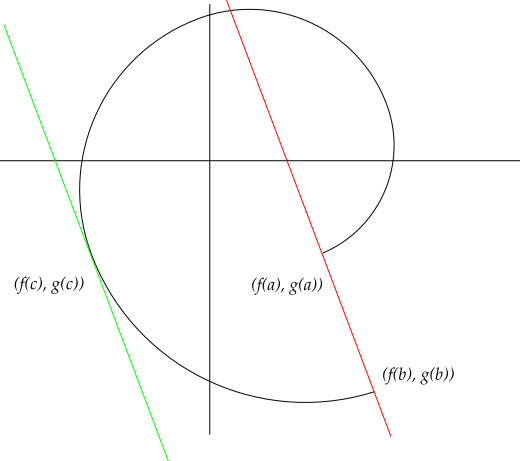
If \(g\colon [a,b]\to \RR\) is also continuous on \([a, b]\) and differentiable on \((a, b)\), then there exists \(\xi\in(a,b)\) such that \[ \qty{ f(b) - f(a) } g'(\xi) = \qty{g(b) - g(a)} f'(\xi). \] [@Rud76].
Geometrically, (2) says that the plane curve \(t\mapsto(f(t),g(t))\), \(t\in[a,b]\), has a tangent vector \((f'(\xi),g'(\xi))\) at some interior parameter \(\xi\) that is parallel to the chord from \((f(a),g(a))\) to \((f(b),g(b))\).
Term-by-term differentiation of a series of functions (Tag T-TR526)
Let \(a<b\), let \(A\coloneqq[a,b]\), and let \(f_n\colon A\to\RR\) for \(n\geq1\) be differentiable on \(A\). Suppose that \(\sum_{n=1}^\infty f_n'\) converges uniformly on \(A\) to a function \(g\colon A\to\RR\), and that \(\sum_{n=1}^\infty f_n(x_0)\) converges for some \(x_0\in A\). Then \(\sum_{n=1}^\infty f_n\) converges uniformly on \(A\) to a function \(f\colon A\to\RR\), \(f\) is differentiable on \(A\), and \(f'=g\) on \(A\) [@Abb16].
Heine--Cantor theorem (Tag T-O4UD3)
Let \(X\) and \(Y\) be metric spaces with \(X\) compact. Every continuous function \(f\colon X\to Y\) is uniformly continuous [@Mun00]; [@Rud76].
Let \(U\subseteq\RR^n\) and let \(f\colon U\to \RR\) be continuous. For every compact \(K \subseteq U\), the restriction \(\ro{f}{K}\) is uniformly continuous.
Chapter: Undergraduate analysis.
Hypotheses and counterexamples
Which convergence theorem?, Which one applies?, and Which inequality? compare the hypotheses of these theorems. Counterexamples gives examples in which one of these theorems fails when a hypothesis is removed.