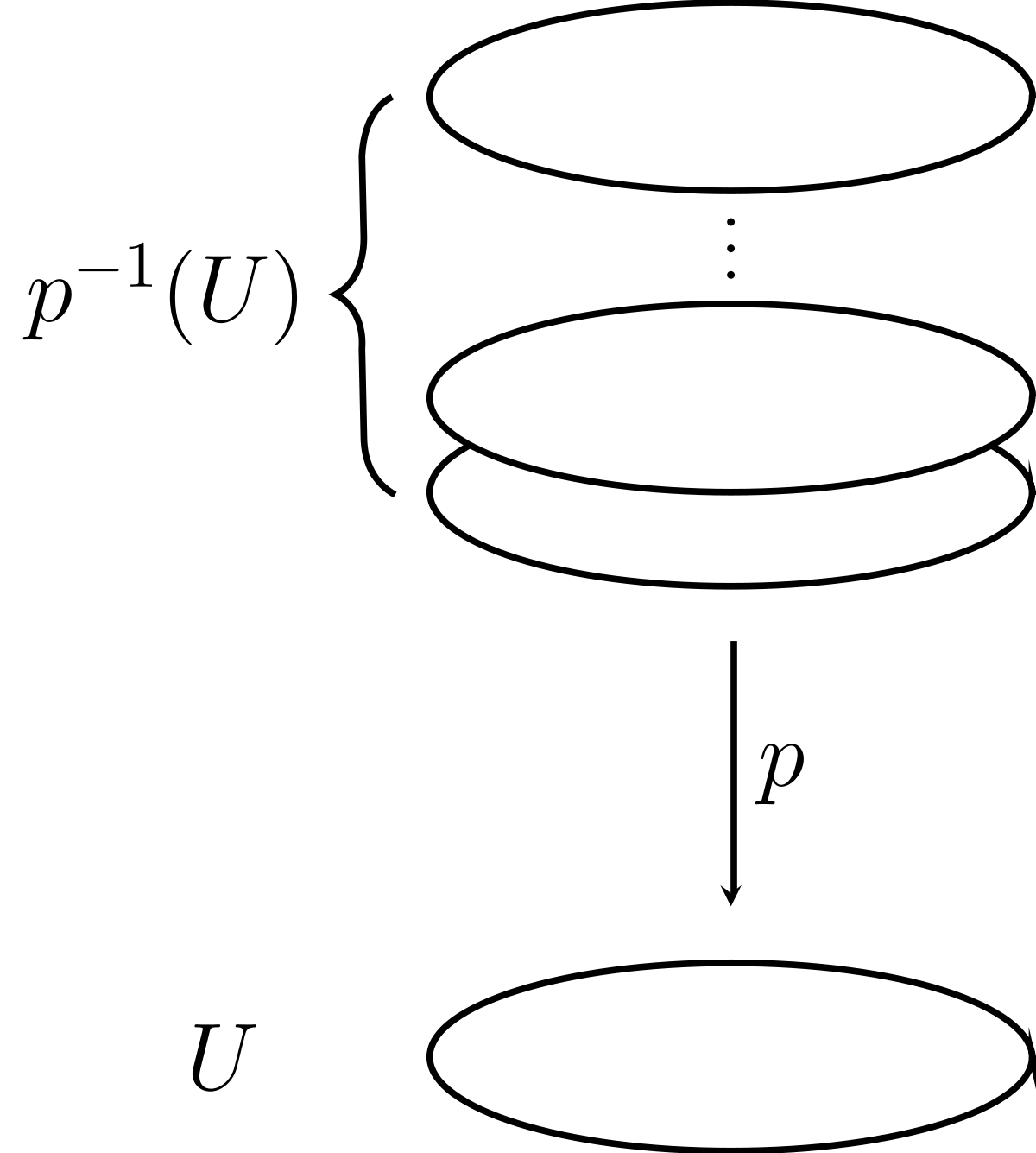
Basic properties
(Euler characteristics are multiplicative on covering spaces)
For a finite CW complex \(B\) and an \(n\)-sheeted covering map \(p\colon A \to B\) with \(n\) finite, \[ \chi(A) = n\, \chi(B). \]
A covering space of an orientable manifold is an orientable manifold.
If \(B\) is a manifold with boundary and \(p\colon A\to B\) is a covering map, then \(A\) is a manifold with boundary and \(p^{-1}(\bd B)=\bd A\).
For a path-connected covering space \(\tilde X\) of a path-connected, locally path-connected space \(X\), the deck group acts freely on each fiber, and it acts transitively on each fiber if and only if the cover is normal, which holds if and only if \(p_*\pi_1(\tilde X,\tilde x_0)\) is a normal subgroup of \(\pi_1(X,x_0)\).
Universal covers
Galois, normal, and regular covering spaces (Tag D-MWD2L)
Let \(p\colon\tilde X\to X\) be a covering space, let \(x_0\in X\), and let \(\Deck(\tilde X)\) be its group of deck transformations. The covering \(p\) is Galois, also called normal or regular, over \(x_0\) if \(\Deck(\tilde X)\) acts transitively on the fiber \(\inverseof{p}(x_0)\): for all \(\tilde x_1,\tilde x_2\in \inverseof{p}(x_0)\) there is \(\psi\in\Deck(\tilde X)\) with \(\psi(\tilde x_1)=\tilde x_2\).
Universal cover and deck groups (Tag PR-UBJ6P)
Let \(X\) be path-connected, locally path-connected and semilocally simply connected. Then \(X\) has a universal cover \(p\colon\hat X \to X\) [@Hat02]. If \(q\colon C\to X\) is a covering map with \(C\) path-connected, then there is a covering map \(\tilde p\colon \hat{X} \to C\) with \(q\circ\tilde p = p\) [@Hat02]:
In particular, \(\hat X\) is unique up to isomorphism of covering spaces.
The deck transformation group of the universal cover is isomorphic to \(\pi_1(X)\). More generally, for a covering map \(q\colon C\to X\) with \(C\) path-connected and \(H\coloneqq q_*\pi_1(C)\leq\pi_1(X)\), the deck transformation group of \(q\) is isomorphic to $N_{\pi_1(X)}(H)/H$ [@Hat02].
A Galois cover \(\tilde X\to X\) with \(\Deck(\tilde X) = G\) is equivalently a principal \(G\dash\)bundle for a discrete \(G\):
Homotopy lifting property for covering spaces (Tag T-SKJB2)
Let \(p\colon\tilde X \to X\) be a covering space, \(F\colon Y \cross I \to X\) a homotopy, and \(\tilde F_0\colon Y\to \tilde X\) a lift of \(F_0 = F(\wait, 0)\). Then there is a unique homotopy \(\tilde F\colon Y\cross I\to \tilde X\) with \(\tilde F(y, 0) = \tilde F_0(y)\) for all \(y\in Y\) and \(p\circ\tilde F = F\) [@Hat02]:
Lifting criterion for covering spaces (Tag T-EF5IX)
Let \(p\colon(\tilde X, \tilde x_0)\to(X, x_0)\) be a covering space and \(f\colon(Y, y_0)\to(X, x_0)\) a map with \(Y\) path-connected and locally path-connected. Then a lift \(\tilde f\colon(Y, y_0)\to(\tilde X, \tilde x_0)\) with \(p\circ\tilde f = f\) exists if and only if \(f_*(\pi_1(Y, y_0)) \subseteq p_*(\pi_1 (\tilde X, \tilde x_0))\) [@Hat02]:
If \(Y\) is connected, two lifts of \(f\) that agree at one point are equal [@Hat02].
(Lifts from simply connected spaces)
If \(Y\) is simply connected, path-connected, and locally path-connected, then \(f_*(\pi_1(Y))\) is trivial, so every map \(f\colon Y\to X\) lifts to \(\tilde X\).
Covering spaces induce injections on $\pi_1$ (Tag PR-R5EN3)
Let \(p\colon(\tilde X, \tilde x_0)\to(X, x_0)\) be a covering space. The induced map \(p_*\colon \pi_1(\tilde X, \tilde x_0) \to \pi_1(X, x_0)\) is injective, and its image consists of the classes of loops at \(x_0\) whose lifts to \(\tilde X\) starting at \(\tilde x_0\) are loops [@Hat02].
Deck transformations and normal covering spaces (Tag T-F4PQY)
Let \(p\colon(\tilde X, \tilde x_0)\to(X, x_0)\) be a covering space with \(\tilde X\) path-connected and \(X\) path-connected and locally path-connected. Let \(G\coloneqq\pi_1(X, x_0)\) and \(H\coloneqq p_*\pi_1(\tilde X, \tilde x_0)\), and let \(G(\tilde X)\) be the group of deck transformations. Then
\(\tilde X\) is normal if and only if \(H\normal G\);
\(G(\tilde X) \cong N_G(H)/H\), where \(N_G(H)\) is the normalizer of \(H\) in \(G\).
In particular, \(G(\tilde X) \cong G/H\) if \(\tilde X\) is normal, and \(G(\hat X) \cong G\) for the universal cover \(\hat X\) [@Hat02].
(Classification of covering spaces)
Let \(X\) be path-connected, locally path-connected, and semilocally simply connected, with basepoint \(x_0\). Sending a connected covering space \(p\colon(\tilde X,\tilde x_0)\to(X,x_0)\) to \(p_*\pi_1(\tilde X,\tilde x_0)\) gives bijections \[ \begin{aligned} \correspond{\text{connected based covering spaces } (\tilde X,\tilde x_0)\to(X,x_0)}/\text{based isomorphism} &\mapstofrom \correspond{\text{subgroups } H\leq\pi_1(X,x_0)}, \\ \correspond{\text{connected covering spaces } \tilde X\to X}/\text{isomorphism over } X &\mapstofrom \correspond{\text{subgroups } H\leq\pi_1(X,x_0)}/\text{conjugacy}, \end{aligned} \] under which normal covering spaces correspond to normal subgroups \(H\normal\pi_1(X,x_0)\).
Number of sheets of a covering space (Tag PR-BHJGY)
Let \(p\colon(\tilde X, \tilde x_0)\to(X, x_0)\) be a covering space with \(X\) and \(\tilde X\) path-connected. The number of sheets of \(p\), that is, the cardinality of \(p^{-1}(x_0)\), equals the index \[ [\pi_1(X, x_0) : p_*(\pi_1(\tilde X, \tilde x_0))] \] [@Hat02].
Examples
(Common covering spaces)
In each diagram the group on the left is the deck group of the covering map on the right.
Any subgroup \(H \leq \pi_1(S^1; 1) = \ZZ\) is of the form \(H = n\ZZ\), and the corresponding cover is \(\RR/2\pi n\ZZ \cong S^1\to \RR/2\pi\ZZ\cong S^1\), a quotient of the universal cover:
where the universal cover is the \(2n\)-valent Cayley graph of the free group \(F_n\cong\ZZ^{\ast n}\) with respect to its free generators.
where \(S^3\subseteq\CC^2\) and the generator of \(\ZZ/p\) acts by \((z, w) \mapsto (e^{2\pi i/p} z, e^{2\pi i q/p} w)\) for \(q\) coprime to \(p\).
The torus double covers the Klein bottle, \(T^2 \mapsvia{\times 2} \KK\).
(The circle $S^1$)
With \(S^1 \subseteq \CC\), for \(n\geq 1\) the map \(p_n\colon S^1 \to S^1\), \(z\mapsto z^n\), is an \(n\)-sheeted covering map. With \(\omega_k(t)\coloneqq e^{2\pi i k t}\), the induced map on fundamental groups is \[ \begin{aligned} (p_n)_*\colon \pi_1(S^1) &\to \pi_1(S^1), \\ [\omega_1] &\mapsto [\omega_n] = n[\omega_1], \end{aligned} \] so its image is \(n\ZZ\), and the deck group is \[ \Deck(p_n) \cong \pi_1(S^1)/(p_n)_*\pi_1(S^1) \cong \ZZ/n, \] generated by rotation by \(2\pi/n\). The universal cover of \(S^1\) is \(\RR\), with countably infinite fibers.
(Projective $n\dash$space $\RP^n$)
For \(n\geq 2\), the universal cover of \(\RP^n\) is \(S^n\), a two-sheeted cover whose fibers are pairs of antipodal points.
(The torus $S^1 \cross S^1$)
The universal cover of \(T = S^1 \cross S^1\) is \(\RR \cross \RR\to T\), \((s,t)\mapsto(e^{2\pi i s},e^{2\pi i t})\). The fiber over the base point is the integer lattice \(\ZZ \cross \ZZ\), and \(\Deck(\RR^2\to T)\cong\ZZ\cross\ZZ\cong \pi_1(T)\) acts by translations.
Universal covers of wedge sums (Tag PR-BXAA5)
Let \(X = X_1\vee\cdots\vee X_n\), where each \(X_i\) is path-connected, locally path-connected and semilocally simply connected, and each basepoint is a deformation retract of an open neighborhood. The universal cover \(\tilde X\) is a union of copies of the universal covers \(\tilde X_i\), glued at lifts of the basepoint, such that the graph with one vertex for each copy, one vertex for each lift of the basepoint, and an edge whenever a copy contains a lift, is a tree. For example, the universal cover of \(\RP^2\vee\RP^2\) is an infinite chain of \(2\)-spheres, each tangent to its two neighbors [@Hat02].
(Wedge of circles)
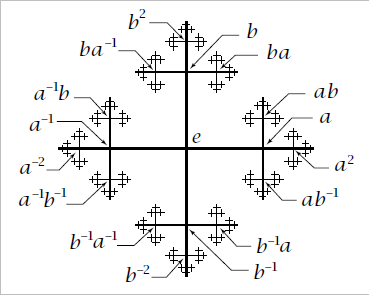
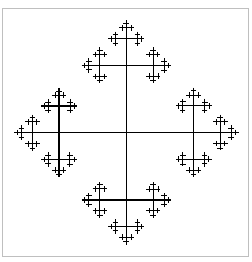
The fundamental group of \(S^1 \vee S^1\) is \(\ZZ \ast \ZZ\) by van Kampen’s theorem, and the universal cover is the \(4\)-valent Cayley graph of \(\ZZ\ast\ZZ\):
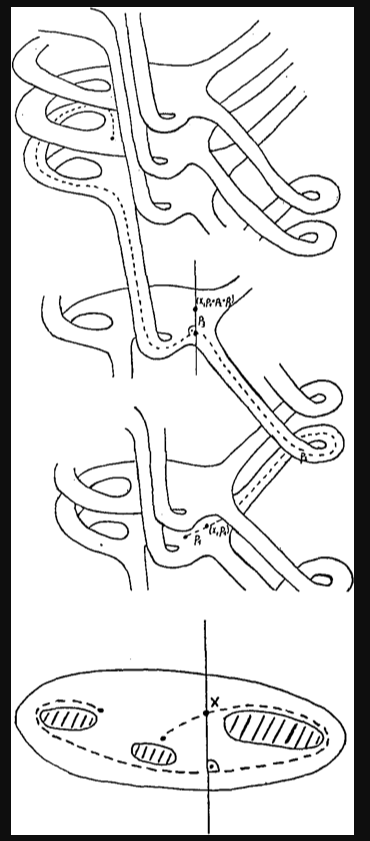
[Hatc02] draws further covering spaces of \(S^1\vee S^1\).
Every subgroup of a free group is free (Tag C-ILVEB)
Let \(F\) be a free group and let \(H \leq F\) be a subgroup. Then \(H\) is free.
[@Hat02].
(Wedge of projective spaces)
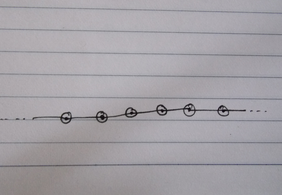
The fundamental group of \(\RP^2 \vee \RP^2\) is \(\ZZ/2 \ast \ZZ/2\), and the universal cover is an infinite chain of copies of \(S^2\), each attached to its two neighbors at antipodal points:
($\RP^2 \wedgeprod T^2$)
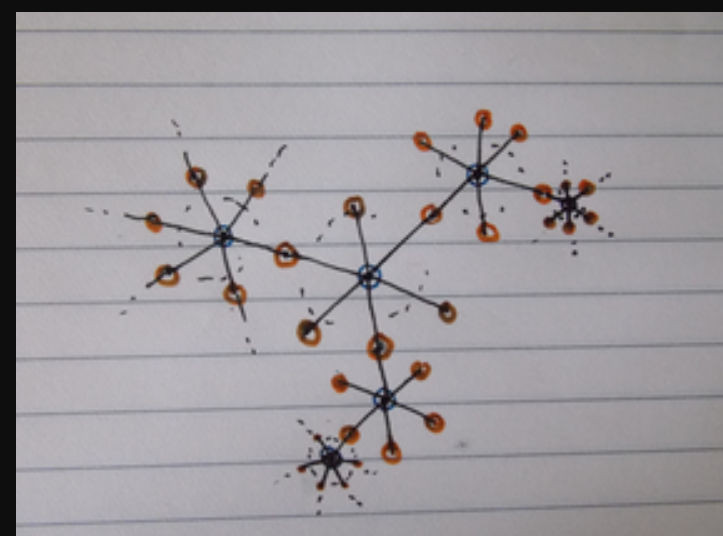
The fundamental group of \(\RP^2 \vee T^2\) is \(\ZZ/2 \ast \ZZ^2\). In the tree describing the universal cover, each red vertex is a copy of \(S^2\) covering \(\RP^2\) and has \(2\) neighbors, and each blue vertex is a copy of \(\RR^2\) covering \(\TT^2\) and has countably many neighbors, one for each point of \(\ZZ^2\).
Applications
Maps into contractible spaces are nullhomotopic (Tag T-TQ4J3)
Let \(X\) be a contractible space and \(Y\) any space. Then every continuous map \(f\colon Y \to X\) is nullhomotopic.
If \(X\) is contractible, there is a homotopy \(H\colon X\cross I \to X\) from \(\id_X\) to the constant map \(c\colon x \mapsto x_0\). Define \(H'\colon Y\cross I \to X\) by \(H'(y,t)\coloneqq H(f(y),t)\). Then \(H'(y,0)=f(y)\) and \(H'(y,1)=x_0\), so \(H'\) is a homotopy from \(f\) to a constant map.
Factoring through a contractible space implies nullhomotopic (Tag C-GJRYO)
Let \(X\), \(Y\) and \(Z\) be topological spaces with \(Z\) contractible, and let \(\tilde f\colon X\to Z\) and \(p\colon Z\to Y\) be continuous maps. Then \(f \coloneqq p\circ \tilde f\colon X\to Y\) is nullhomotopic.
Suppose \(f = p \circ \tilde f\) with \(\tilde f\colon X\to Z\), \(p\colon Z\to Y\), and \(Z\) contractible:
By Maps into contractible spaces are nullhomotopic, there is a homotopy \(\tilde H\colon X\cross I \to Z\) from \(\tilde f\) to a constant map \(x\mapsto z_0\). Then \(p\circ \tilde H\colon X \cross I \to Y\) is a homotopy from \(f\) to the constant map \(x\mapsto p(z_0)\).
No covering map from $\RP^2$ to the torus (Tag PR-TRSHQ)
There is no covering map \(p\colon \RP^2 \to \TT^2\).
A covering map induces an injection on fundamental groups [@Hat02], and \(\pi_1(\RP^2)\cong\ZZ/2\) does not embed in the torsion-free group \(\pi_1(\TT^2)\cong\ZZ^2\).
Suppose \(p\colon\RP^2\to\TT^2\) is a covering map. By Covering spaces induce injections on $\pi_1$, \(p_*\colon\pi_1(\RP^2)\to\pi_1(\TT^2)\) is injective. But \(\pi_1(\RP^2)\cong\ZZ/2\) has an element of order \(2\), and \(\pi_1(\TT^2)\cong\ZZ^2\) is torsion-free, a contradiction.
Covering space actions and their quotients (Tag T-O44GI)
Let a group \(G\) act on a space \(Y\) such that each \(y\in Y\) has a neighborhood \(U\) with \(g_1U\cap g_2U = \emptyset\) whenever \(g_1\neq g_2\) in \(G\). Then
the quotient map \(p\colon Y \to Y/G\), \(p(y) = Gy\), is a normal covering space;
if \(Y\) is path-connected, then \(G\) is the group of deck transformations of \(p\);
if \(Y\) is path-connected and locally path-connected, then \(G\cong \pi_1(Y/G) / p_*(\pi_1(Y))\)
[@Hat02].
A one-sheeted covering map \(f\colon X\to Y\) is a homeomorphism: it is a bijective local homeomorphism, hence an open continuous bijection.