Evaluating a real integral by a closed contour requires the integral over the added arc to tend to a known limit. The ML estimate bounds an integral by the length of the curve times the supremum of the integrand; on a semicircle, Jordan’s lemma improves this bound for integrands with a factor \(e^{i\alpha z}\).
The ML estimate
$ML$ estimate for contour integrals (Tag T-SFXI7)
Let \(\gamma\) be a piecewise smooth curve in \(\CC\) of length \(L\coloneqq\length(\gamma)\), and let \(f\) be continuous on the image of \(\gamma\). Then, with \(M\coloneqq\sup_{\xi\in\gamma}\abs{f(\xi)}\), \[ \abs{\int_\gamma f(z)\dz}\leq ML. \]
\[ \begin{aligned} \abs{ \int_\gamma f(z) \dz } &\leq \int_\gamma \abs{f(z)} \abs{\dz} \\ &\leq \int_\gamma \sup_{\xi\in \gamma} \abs{f(\xi)} \abs{\dz} \\ &= M \cdot \length(\gamma) \end{aligned}.\]
(Circular arcs)
If \(C_R\) is a circular arc of radius \(R\) subtending an angle \(\theta\), then \(\length(C_R) = R\theta\) and \[ \abs{\int_{C_R} f\,} \leq MR\theta .\] So the arc integral tends to \(0\) as \(R\to\infty\) when \(M = \bigo\qty{1 / R^{1+\varepsilon}}\) for some \(\varepsilon>0\), while \(M = \bigo(1/R)\) gives only a bounded integral. For a rational function \(p/q\) with \(\deg q\geq \deg p + 2\), \(M = \bigo(1/R^2)\); for \(\deg q = \deg p + 1\), \(M = \bigo(1/R)\), and Jordan’s lemma applies when the integrand also has a factor \(e^{i\alpha z}\) with \(\alpha > 0\) on the upper semicircle.
Jordan’s lemma
Jordan's lemma (Tag T-ZO5UU)
For \(R>0\) let \(C_R\) be the upper semicircle \(t\mapsto Re^{it}\), \(t\in[0,\pi]\).
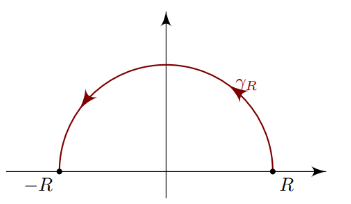
Let \(\alpha>0\), let \(g\) be continuous on \(C_R\), and let \(M_R\coloneqq\sup_{z\in C_R}\abs{g(z)}\). Then \[ \abs{\int_{C_R}e^{i\alpha z}g(z)\dz}\leq\frac{\pi}{\alpha}M_R. \] In particular, if \(g\) is continuous on \(\{z : \operatorname{Im}z\geq0,\ \abs{z}\geq R_0\}\) for some \(R_0\) and \(M_R\to0\) as \(R\to\infty\), then \(\int_{C_R}e^{i\alpha z}g(z)\dz\to0\).
For \(\alpha<0\) the same statements hold with \(C_R\) replaced by the lower semicircle \(t\mapsto Re^{-it}\), \(t\in[0,\pi]\), and \(\pi/\alpha\) replaced by \(\pi/\abs{\alpha}\).
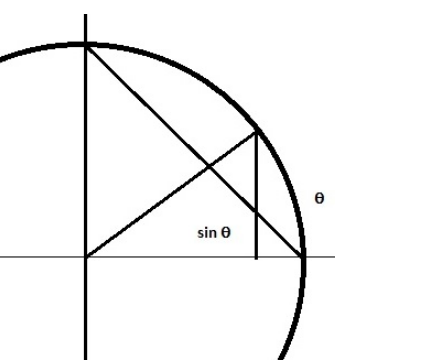
For \(\alpha>0\) and \(z=Re^{it}\), \(\abs{e^{i\alpha z}}=e^{-\alpha R\sin t}\) and \(\abs{\dz}=R\,dt\), so \[ \abs{\int_{C_R}e^{i\alpha z}g(z)\dz}\leq M_R\int_0^\pi e^{-\alpha R\sin t}R\,dt=2M_R\int_0^{\pi/2}e^{-\alpha R\sin t}R\,dt. \] Since \(\sin t\geq 2t/\pi\) for \(t\in[0,\pi/2]\), \[ \int_0^{\pi/2}e^{-\alpha R\sin t}R\,dt\leq\int_0^{\pi/2}e^{-2\alpha Rt/\pi}R\,dt\leq\frac{\pi}{2\alpha}, \] which gives the bound. For \(\alpha<0\) and \(z=Re^{-it}\) with \(t\in[0,\pi]\), \(\abs{e^{i\alpha z}}=e^{\alpha R\sin t}=e^{-\abs{\alpha}R\sin t}\), and the same estimate applies with \(\abs{\alpha}\) in place of \(\alpha\).
(Jordan's lemma with $g(z) = 1/(z^2+1)$)
On the upper semicircle \(C_R\) with \(R>1\), with \(\alpha = 1\), \[ \abs{ \int_{C_R} { e^{iz} \over z^2 + 1 } \dz } \leq \pi \sup_{z\in C_R} \abs{1\over z^2 +1} \leq {\pi \over R^2 - 1}\to 0 ,\] using only the bound on \(1/(z^2+1)\). On \(C_R\), \(\abs{e^{iz}} = e^{-\Im z} \leq 1\), while \(\abs{\cos z}\) and \(\abs{\sin z}\) reach \(\cosh R\) and \(\sinh R\) at \(z = iR\); so an integrand \(g(x)\cos x\) on \(\RR\) is written as \(\Re\bigl(g(x)e^{ix}\bigr)\) for real-valued \(g\) before closing in \(\HH\).
(Jordan's lemma)
\[ \begin{aligned} \abs{ \int_{C_R} f(z)\dz } &= \abs{ \int_{C_R} e^{iaz}g(z) \dz} \\ &= \abs{ \int_{[0, \pi]} e^{ia\qty{Re^{it}}}g(Re^{it}) iRe^{it} \dt} \\ &\leq \int_{[0, \pi]} \abs{ e^{ia\qty{Re^{it}}}g(Re^{it}) iRe^{it}} \dt \\ &=R \int_{[0, \pi]} \abs{ e^{ia\qty{Re^{it}}}g(Re^{it})} \dt \\ &\leq R M_R \int_{[0, \pi]} \abs{ e^{ia\qty{Re^{it}}}} \dt \\ &= R M_R \int_{[0, \pi]} e^{\Re\qty{iaRe^{it}}} \dt \\ &= R M_R \int_{[0, \pi]} e^{\Re\qty{iaR\qty{\cos(t) + i\sin(t) } }} \dt \\ &= R M_R \int_{[0, \pi]} e^{-aR\sin(t) } \dt \\ &= 2 R M_R \int_{[0, \pi/2]} e^{-aR\sin(t) } \dt \\ &\leq 2R M_R \int_{[0, \pi/2]} e^{-aR\qty{2t\over \pi} } \dt \\ &= 2RM_R \qty{\pi \over 2aR}\qty{1-e^{-aR}} \\ &\leq {\pi M_R \over a} \end{aligned}.\]
Here \(a = \alpha\), the equality \(\int_0^\pi = 2\int_0^{\pi/2}\) uses \(\sin(\pi - t) = \sin t\), and the inequality \(2t/\pi \leq \sin(t)\) on \([0, \pi/2]\) holds because \(\sin\) is concave there and agrees with \(2t/\pi\) at \(t=0\) and \(t=\pi/2\).
Small arcs about a simple pole
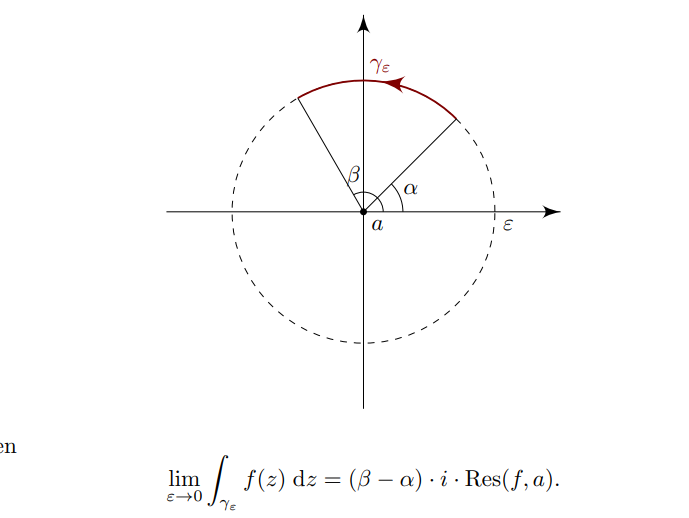
The integral over an arc of angle \(\theta\) about a simple pole \(z_0\), traversed counterclockwise, tends to \(i\theta\Res_{z=z_0} f\) as the radius tends to \(0\).
Fractional residue theorem for a simple pole (Tag T-SSNLT)
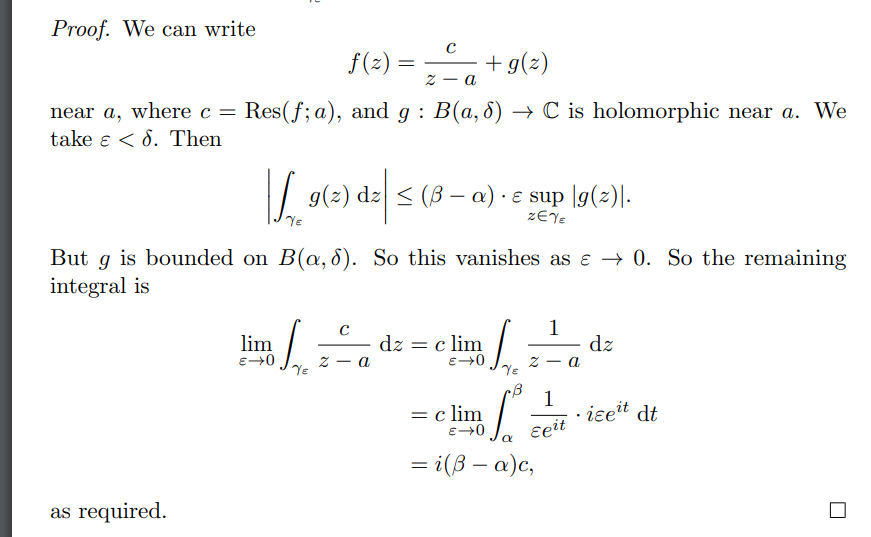
Let \(f\) be holomorphic on a punctured disc about \(z_0\in\CC\) with a simple pole at \(z_0\). For real numbers \(\alpha<\beta\) and \(\varepsilon>0\), let \(\gamma_\varepsilon\) be the arc \(t\mapsto z_0+\varepsilon e^{it}\), \(t\in[\alpha,\beta]\), of the circle \(\{z : \abs{z-z_0}=\varepsilon\}\). Then \[ \lim_{\varepsilon\to0}\int_{\gamma_\varepsilon}f(z)\dz=i(\beta-\alpha)\Res_{z=z_0}f. \]
A half-circle of radius \(\varepsilon\) above a simple pole on \(\RR\), traversed clockwise from \(z_0-\varepsilon\) to \(z_0+\varepsilon\), contributes \(-i\pi \Res_{z=z_0} f\) in the limit; these terms give the half-residues in principal-value integrals.
Summary
Integrand \(\bigo(1/R^{2})\) on large arcs: the ML estimate.
Integrand \(e^{i\alpha z}g(z)\) with \(\alpha>0\) and \(g = \bigo(1/R)\) on the upper semicircle: Jordan’s lemma.
Arcs of radius \(\varepsilon\to 0\) about a simple pole: Fractional residue theorem for a simple pole, with limit \(i\theta\Res\).
Exercises
$\int_\RR\frac{\cos x}{x^2+1}\,dx$ by a semicircular contour (Tag E-IQQAF)
Use a semicircular contour and the residue theorem to evaluate \[ I = \int_\RR {\cos(x) \over x^2 + 1 }\dx .\]
Solution
Write \[ I = \Re \int_\RR f(x) \dx && f(z) \da {e^{iz} \over z^2 + 1} .\] Define contours \(C_1 = [-R, R]\), \(C_2 = \ts{Re^{it} \st t\in [0, \pi]}\), and \(\Gamma = C_1 + C_2\). Then noting that \(z_0 = i\) is the only pole of \(f\) in \(\HH\), by the residue theorem \[ \int_\Gamma f(z) \dz = 2\pi i \Res_{z=i} f(z) = \qty{\int_{C_1} + \int_{C_2}} f .\] Note also that \[ I = \Re \lim_{R\to\infty} \int_{C_1} f .\]
By the ML estimate, \[ \abs{\int_{C_2} f(z)\dz } &\leq \pi R \sup_{z\in C_2} \abs{f(z)} \\ &= \pi R \sup_{z\in C_2} \abs{e^{iz}\over z^2 + 1} \\ &\leq \pi R \sup_{z\in C_2} {1 \over \abs{ z^2 + 1} } \text{ since } \abs{e^{iz}}=e^{-\Im z}\le1 \text{ on } \HH\\ &\leq \pi R\sup_{z\in C_2} {1 \over \abs{z}^2 - 1 } \text{ by the reverse triangle ineq.}\\ &= {\pi R\over R^2-1} \\ &= \bigo(R^{-1}) \\ &\convergesto{R\to\infty}0 .\]
For the residue, \(z=i\) is at worst an order 1 pole, and remains order 1 since \(i\) is not a zero of the numerator. \[ \Res_{z=i} f(z) &= \Res_{z=i} {e^{iz} \over (z+i)(z-i)} \\ &= { e^{iz} \over z+i}\evalfrom_{z=i} \\ &= {1\over 2ei} .\] Thus \[ \lim_{R\to\infty}\int_{C_1} f = 2\pi i \Res_{z=i} f = {2\pi i \over 2ei} = {\pi \over e} \\ \implies I = \Re\qty{\pi \over e} = {\pi \over e} .\]
Note that this also shows that \[ \int_\RR { \sin(z) \over z^2 + 1} \dz = 0 .\]
$\int_\RR\frac{\sin x}{x}\,dx$ by an indented semicircle and Jordan's lemma (Tag E-3ZAVQ)
Compute \[ \int_\RR {\sin(x) \over x}\dx .\]
Solution
Note that the ML bound is not sufficient to bound a semicircular contour: \[ \abs{\int_{C_R} { e^{iz} \over z}\dz } \leq \pi R \sup_{z\in C_R} \abs{1\over z} = \pi \not\to 0 .\] Jordan’s lemma on this contour yields \[ \abs{\int_{C_R} {e^{iz} \over z} \dz } \leq \pi \sup_{z\in C_R}\abs{1\over z} = {\pi \over R} \to 0 .\]
To compute the full integral, use an indented semicircular contour:
- \(C_+ \da [\eps, R]\)
- \(C_- \da [-R, -\eps]\)
- \(C_\eps \da \eps e^{it}\) with \(t\in [0, \pi]\)
- \(C_R \da R e^{it}\) with \(t\in [0, \pi]\)
- \(\Gamma \da C_+ + C_R + C_- - C_\eps\), where \(C_\eps\) is taken with reversed orientation.
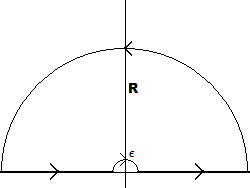
Write \(I\) for the original integral, and \[ f(z) \da { e^{iz} \over z} \implies I = \Im \lim_{\eps\to 0}\lim_{R\to \infty} \qty{\int_{C_-} + \int_{C_+}}f .\] By the residue theorem \[ \int_\gamma f(z) \dz &= 2\pi i \sum_{z_k \in \HH} \Res_{z=z_k} f(z) = 0 \\ &= \qty{\int_{C_+} + \int_{C_R} + \int_{C_-} - \int_{C_\eps} }f \\ &= \tilde I + \qty{\int_{C_R} - \int_{C_\eps}}f ,\] where \(\Im(\tilde I) = I\) is the original integral, so \[ \tilde I = -\qty{\int_{C_R} - \int_{C_\eps}}f .\]
Since \(\int_{C_R}f \to 0\), it just remains to compute \(\int_{C_\eps}\). By the fractional residue formula, \[ \lim_{\eps \to 0} \int_{C_\eps}{e^{iz} \over z}\dz = i\pi \Res_{z=0} {e^{iz} \over z} = i\pi .\] Thus \[ I = \Im(i\pi) = \pi .\]