Calculus and series
Mean value theorem and Cauchy's mean value theorem (Tag T-OXNTU)
Let \(a<b\) and let \(f\colon [a, b] \to \RR\) be continuous on \([a,b]\) and differentiable on \((a, b)\).
There exists \(\xi \in (a, b)\) such that \[ f(b) - f(a) = f'(\xi)(b-a). \]
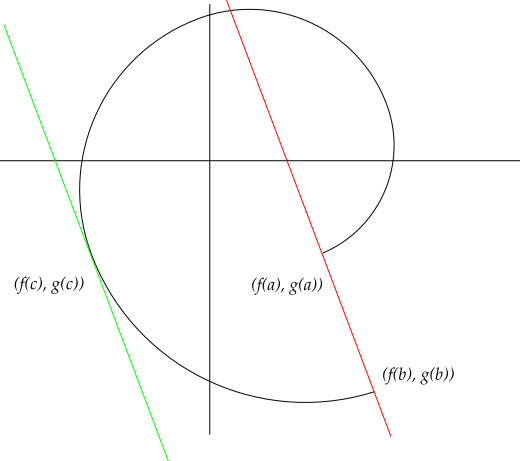
If \(g\colon [a,b]\to \RR\) is also continuous on \([a, b]\) and differentiable on \((a, b)\), then there exists \(\xi\in(a,b)\) such that \[ \qty{ f(b) - f(a) } g'(\xi) = \qty{g(b) - g(a)} f'(\xi). \] [@Rud76].
Geometrically, (2) says that the plane curve \(t\mapsto(f(t),g(t))\), \(t\in[a,b]\), has a tangent vector \((f'(\xi),g'(\xi))\) at some interior parameter \(\xi\) that is parallel to the chord from \((f(a),g(a))\) to \((f(b),g(b))\).
Taylor remainders in Lagrange, Cauchy, and integral form (Tag T-2R7PC)
Let \(n\geq1\), \(p\in\RR\), \(\delta>0\), and let \(f\colon(p-\delta,p+\delta)\to\RR\) be \(n\) times differentiable. For \(x\in(p-\delta,p+\delta)\) put \[ R_n(x)\coloneqq f(x)-\sum_{k=0}^{n-1} \frac{f^{(k)}(p)}{k!}(x-p)^k . \] Let \(x\in(p-\delta,p+\delta)\) with \(x\neq p\).
(Lagrange form) There exists \(\xi\) strictly between \(p\) and \(x\) such that \[ R_n(x)=\frac{f^{(n)}(\xi)}{n!}(x-p)^n . \]
(Cauchy form) There exists \(\eta\) strictly between \(p\) and \(x\) such that \[ R_n(x)=\frac{f^{(n)}(\eta)}{(n-1)!}(x-\eta)^{n-1}(x-p) . \]
(Integral form) If moreover \(f^{(n)}\) is continuous on \((p-\delta,p+\delta)\), then \[ R_n(x)=\int_p^x \frac{f^{(n)}(t)}{(n-1)!}(x-t)^{n-1}\,dt . \]
Part 1 is in [@Rud76].
A Taylor series converges to $f$ when $\abs{f^{(n)}}\leq M^n$ (Tag PR-H4CYN)
Let \(c\in\RR\), \(\varepsilon>0\), and \(f\in C^\infty((c-\varepsilon,c+\varepsilon))\) with values in \(\RR\). Suppose there exists \(M\geq0\) such that \[ \abs{f^{(n)}(x)} \leq M^n \quad\text{for all } n\geq0 \text{ and all } x\in(c-\varepsilon,c+\varepsilon). \] Then for every \(x\in(c-\varepsilon,c+\varepsilon)\), \[ f(x)=\sum_{n=0}^\infty\frac{f^{(n)}(c)}{n!}(x-c)^n . \]
Topology of metric spaces
Characterizations of compact subsets of a metric space (Tag T-YOZX6)
Let \((X,d)\) be a metric space and let \(E\subseteq X\), with the metric induced by \(d\). The following are equivalent [@Fol13]:
\(E\) is complete and totally bounded: for every \(\varepsilon>0\), \(E\) is covered by finitely many balls of radius \(\varepsilon\).
\(E\) is sequentially compact: every sequence in \(E\) has a subsequence that converges to a point of \(E\).
\(E\) is compact: every cover of \(E\) by open subsets of \(X\) has a finite subcover.
If \(X\) is complete, then \(E\) is complete if and only if \(E\) is closed in \(X\). In \(\RR^n\) with the Euclidean metric, \(E\) is totally bounded if and only if \(E\) is bounded; combined with the theorem, this gives the Heine–Borel theorem. In a general metric space, a closed bounded subset need not be compact: in an infinite set with the discrete metric \(d(x,y)=1\) for \(x\neq y\), the whole space is closed and bounded but not totally bounded.
Heine--Cantor theorem (Tag T-O4UD3)
Let \(X\) and \(Y\) be metric spaces with \(X\) compact. Every continuous function \(f\colon X\to Y\) is uniformly continuous [@Mun00]; [@Rud76].
Let \(U\subseteq\RR^n\) and let \(f\colon U\to \RR\) be continuous. For every compact \(K \subseteq U\), the restriction \(\ro{f}{K}\) is uniformly continuous.
Compact if and only if sequentially compact for metric spaces (Tag PR-25GM2)
A metric space \((X,d)\) is compact if and only if it is sequentially compact: every sequence in \(X\) has a subsequence that converges in \(X\).
The closed unit ball of $C([0,1])$ is not compact (Tag PR-FKJCO)
Let \(C([0,1])\) be the space of continuous functions \([0,1]\to\RR\) with the norm \(\norm{f}_\infty\coloneqq\sup_{x\in[0,1]}\abs{f(x)}\). The closed unit ball \(B\coloneqq\theset{f\in C([0,1]) : \norm{f}_\infty\leq1}\) is not compact.
Heine--Borel theorem (Tag T-QPTHZ)
A subset \(X\subseteq \RR^n\) is compact if and only if \(X\) is closed and bounded.
Geometric series (Tag PR-6C3GQ)
Let \(x\in\CC\). The series \(\sum_{k=0}^\infty x^k\) converges if and only if \(\abs{x} < 1\), and in that case \[ \sum_{k=0}^\infty x^k = \frac 1 {1-x} . \]
The geometric series $\sum_{k=1}^\infty 2^{-k}$ sums to one (Tag C-WR7YV)
\[ \sum_{k=1}^\infty \frac{1}{2^k} = 1. \]
The partial sums are \(\sum_{k=1}^N 2^{-k} = 1-2^{-N}\), which converge to \(1\) as \(N\to\infty\).
The Cantor set is closed and has empty interior (Tag PR-JTFMW)
Let \(C_0\coloneqq[0,1]\), and let \(C_{k+1}\) be obtained from \(C_k\) by removing the open middle third of each of the \(2^k\) disjoint closed intervals of length \(3^{-k}\) whose union is \(C_k\). The Cantor set \(C\coloneqq\bigcap_{k\geq 0}C_k\) is a closed subset of \(\RR\) with empty interior.
The Cantor set is nowhere dense (Tag C-44LL4)
Let \(C_0\coloneqq[0,1]\), and let \(C_{k+1}\) be obtained from \(C_k\) by removing the open middle third of each of the \(2^k\) disjoint closed intervals of length \(3^{-k}\) whose union is \(C_k\). The Cantor set \(C\coloneqq\bigcap_{k\geq 0}C_k\) is nowhere dense in \(\RR\).
Each \(C_k\) is closed, so \(C\) is closed and equals its closure. If \(C\) contained an open interval \(I\) of length \(\ell>0\), then \(I\subseteq C_k\) for every \(k\); since \(I\) is connected, it would lie in one of the intervals of length \(3^{-k}\) making up \(C_k\), so \(\ell\leq 3^{-k}\) for every \(k\), which is impossible. Hence the closure of \(C\) has empty interior.
Singletons in $\RR$ are closed, so $\QQ$ is $F_\sigma$ (Tag PR-OGEEA)
Every singleton \(\theset{x}\subseteq\RR\) is closed, and \(\QQ=\bigcup_{q\in\QQ}\theset{q}\) is a countable union of closed sets, hence an $F_\sigma$ set in \(\RR\).
$\RR$ is not a countable union of nowhere dense sets (Tag T-7FJFK)
\(\RR\) is a Baire space. In particular, \(\RR\) is not a countable union of nowhere dense subsets of \(\RR\).
Bounded nonempty sets have a supremum and infimum (Tag L-JBMRH)
Let \(A\subseteq\RR\) be nonempty. If \(A\) is bounded above, then \(A\) has a supremum \(\sup A\in\RR\); if \(A\) is bounded below, then \(A\) has an infimum \(\inf A\in\RR\).
Proofs of the Heine–Cantor theorem, the equivalence of compactness and sequential compactness, the non-compactness of the unit ball of \(C([0,1])\), and the properties of the Cantor set are on Continuity and Sets and compactness.
Functions
Existence of nonzero smooth compactly supported functions (Tag PR-HRAOC)
Let \(f\colon\RR\to\RR\) be given by \(f(x)\coloneqq e^{-1/x^2}\) for \(x>0\) and \(f(x)\coloneqq0\) for \(x\leq0\). Then \(f\in C^\infty(\RR)\), and \(\psi(x)\coloneqq f(x)\,f(1-x)\) is a \(C^\infty\) function on \(\RR\) with \(\psi>0\) on \((0,1)\) and \(\psi=0\) outside \((0,1)\). For \(n\geq1\), \(\phi(x)\coloneqq f\big(1-\abs{x}^2\big)\) is a \(C^\infty\) function on \(\RR^n\) with \(\supp\phi=\theset{x : \abs{x}\leq1}\) [@Fol13].
Littlewood’s principles
Egorov's theorem (Tag FT-OGS76)
Let \(m\) be Lebesgue measure on \(\RR^n\), let \(E\subseteq \RR^n\) be Lebesgue measurable with \(m(E) < \infty\), and let \(f_n\colon E\to\RR\) for \(n\geq1\) and \(f\colon E\to\RR\) be measurable with \(f_n \to f\) almost everywhere on \(E\). Then for every \(\varepsilon > 0\) there exists a closed set \(F\subseteq E\) such that \(m(E\setminus F)<\varepsilon\) and \(f_n\to f\) uniformly on \(F\).
Lusin's theorem (Tag T-CGFCU)
Let \(E\subseteq\RR^n\) be Lebesgue measurable with \(m(E)<\infty\), and let \(f\colon E\to\RR\) be measurable. For every \(\varepsilon>0\) there exists a closed set \(F_\varepsilon\subseteq\RR^n\) with \[ F_\varepsilon \subseteq E \quad\text{and}\quad m(E \setminus F_\varepsilon) \leq \varepsilon \] such that the restriction \(\ro{f}{F_\varepsilon}\colon F_\varepsilon\to\RR\) is continuous.
Continuity of the restriction \(\ro{f}{F_\varepsilon}\) does not make \(f\) continuous at points of \(F_\varepsilon\). Let \(E=[0,1]\) and \(f=\chi_{\QQ\cap[0,1]}\), which is discontinuous at every point of \([0,1]\). Enumerate \(\QQ\cap[0,1]=\theset{q_1,q_2,\ldots}\) and put \(F_\varepsilon\coloneqq[0,1]\setminus\bigcup_{k\geq1}(q_k-\varepsilon2^{-k-1},q_k+\varepsilon2^{-k-1})\). Then \(F_\varepsilon\) is closed, \(F_\varepsilon\subseteq E\), \(m(E\setminus F_\varepsilon)\leq\varepsilon\), and \(\ro{f}{F_\varepsilon}=0\) is continuous.
Proofs of Egorov’s and Lusin’s theorems are on Littlewood's principles: proofs.
Continuity
Lipschitz maps are uniformly continuous (Tag PR-SX6NO)
Let \((X,d_X)\) and \((Y,d_Y)\) be metric spaces and let \(f\colon X\to Y\) be Lipschitz: there is \(C>0\) with \(d_Y(f(x),f(y))\leq C\,d_X(x,y)\) for all \(x,y\in X\). Then \(f\) is uniformly continuous.
Given \(\varepsilon>0\), take \(\delta\coloneqq\varepsilon/C\). If \(d_X(x,y)<\delta\), then \[ d_Y(f(x),f(y)) \leq C\,d_X(x,y) < C\delta = \varepsilon . \]
Baire category
Finite unions of nowhere dense sets are nowhere dense (Tag PR-CZS5F)
Let \(X\) be a topological space and let \(S_1,\ldots,S_k\subseteq X\) be nowhere dense. Then \(S_1\cup\cdots\cup S_k\) is nowhere dense.
By induction it suffices to treat \(k=2\). Since \(\overline{S_1\cup S_2}=\overline{S_1}\cup\overline{S_2}\), it suffices to show that a union of two closed sets \(F_1,F_2\) with empty interior has empty interior. Let \(U\subseteq F_1\cup F_2\) be open. Then \(U\setminus F_1\) is open and contained in \(F_2\), so \(U\setminus F_1=\emptyset\) and \(U\subseteq F_1\); hence \(U=\emptyset\).
The statement fails for countable unions: \(\QQ=\bigcup_{q\in\QQ}\theset{q}\) is a countable union of nowhere dense subsets of \(\RR\), but \(\QQ\) is dense in \(\RR\).
Continuous functions of a real variable
Equivalent characterizations of continuity (Tag T-RA-WORKSHOP-D4-3-1)
Let \(E\subseteq\RR^n\) and let \(f\colon E\to\RR^m\). The following are equivalent:
\(f\) is continuous on \(E\), with the subspace topology on \(E\).
For every \(x\in E\) and every \(\varepsilon>0\) there exists \(\delta>0\) such that \(\norm{f(y)-f(x)}<\varepsilon\) for all \(y\in E\) with \(\norm{x-y}<\delta\).
For every sequence \((x_n)_{n\geq1}\) in \(E\) converging to a point \(x\in E\), \(\lim_{n\to\infty}f(x_n)=f(x)\).
For every open set \(G\subseteq\RR^m\), the set \(\inverseof{f}(G)\) is open in \(E\) with the subspace topology. [@Rud76].
Continuous images of compact sets and the extreme value theorem (Tag T-RA-WORKSHOP-D4-3-2)
Let \(K\subseteq\RR^n\) be compact and let \(f\colon K\to\RR^m\) be continuous. Then \(f(K)\) is compact. In particular, if \(a<b\) and \(f\colon[a,b]\to\RR\) is continuous, then there exist \(p,q\in[a,b]\) such that \[ f(p)=\sup_{x\in[a,b]}f(x)\qquad\text{and}\qquad f(q)=\inf_{x\in[a,b]}f(x). \] [@Rud76].
Continuous functions on compact sets are uniformly continuous (Tag T-RA-WORKSHOP-D4-3-3)
Let \(K\subseteq\RR^n\) be compact and let \(f\colon K\to\RR^m\) be continuous. Then \(f\) is uniformly continuous on \(K\). [@Rud76].
Intermediate value theorem (Tag T-RA-WORKSHOP-D4-3-4)
Let \(a<b\) and let \(f\colon[a,b]\to\RR\) be continuous with \(f(a)<f(b)\). For every \(y\in\RR\) with \(f(a)<y<f(b)\) there exists \(c\in(a,b)\) such that \(f(c)=y\). [@Rud76].
Discontinuities of monotone functions (Tag T-RA-WORKSHOP-D4-3-5)
Let \(a<b\) and let \(f\colon(a,b)\to\RR\) be monotone. Then the set \(E\subseteq(a,b)\) of points at which \(f\) is discontinuous is at most countable. Moreover, every \(x\in E\) is a jump discontinuity: the one-sided limits \[ f(x-)\coloneqq\lim_{t\to x^-}f(t)\qquad\text{and}\qquad f(x+)\coloneqq\lim_{t\to x^+}f(t) \] both exist. [@Rud76].
Derivatives
Fermat's stationary-point theorem (Tag T-RA-WORKSHOP-D5-4-1)
Let \(a<b\), let \(f\colon[a,b]\to\RR\), and let \(c\in(a,b)\). If \(f\) has a local maximum or a local minimum at \(c\) and \(f\) is differentiable at \(c\), then \(f'(c)=0\). [@Rud76].
Mean value theorem (Tag T-RA-WORKSHOP-D5-4-2)
Let \(a<b\) and let \(f\colon[a,b]\to\RR\) be continuous on \([a,b]\) and differentiable on \((a,b)\). Then there exists \(\xi\in(a,b)\) such that \[ \frac{f(b)-f(a)}{b-a}=f'(\xi). \] [@Rud76].
Taylor's theorem with Lagrange remainder (Tag T-RA-WORKSHOP-D5-4-3)
Let \(a<b\), \(n\geq0\), and \(c\in[a,b]\). Suppose \(f\colon[a,b]\to\RR\) is \(n\) times continuously differentiable on \([a,b]\) and \(f^{(n+1)}\) exists on \((a,b)\). Let \[ P_n(x)\coloneqq\sum_{k=0}^{n}\frac{f^{(k)}(c)}{k!}(x-c)^k =f(c)+f'(c)(x-c)+\cdots+\frac{f^{(n)}(c)}{n!}(x-c)^n . \] Then for every \(x\in[a,b]\) with \(x\neq c\) there exists \(\xi\) strictly between \(c\) and \(x\) such that \[ f(x)=P_n(x)+\frac{f^{(n+1)}(\xi)}{(n+1)!}(x-c)^{n+1}. \] In particular, if \(M\geq0\) and \(\abs{f^{(n+1)}(t)}\leq M\) for all \(t\in(a,b)\), then \[ \abs{f(x)-P_n(x)}\leq\frac{M\abs{x-c}^{n+1}}{(n+1)!}\quad\text{for all } x\in[a,b]. \] [@Rud76].
Riemann–Stieltjes integration
Riemann's condition for Riemann--Stieltjes integrability (Tag T-RA-WORKSHOP-D6-5-1)
Let \(a<b\), let \(\alpha\colon[a,b]\to\RR\) be monotonically increasing, and let \(f\colon[a,b]\to\RR\) be bounded. For a partition \(P=\theset{a=x_0<x_1<\cdots<x_k=b}\) of \([a,b]\), put \(\Delta\alpha_i\coloneqq\alpha(x_i)-\alpha(x_{i-1})\) and \[ U(P,f,\alpha)\coloneqq\sum_{i=1}^k\qty{\sup_{[x_{i-1},x_i]}f}\Delta\alpha_i,\qquad L(P,f,\alpha)\coloneqq\sum_{i=1}^k\qty{\inf_{[x_{i-1},x_i]}f}\Delta\alpha_i . \] Then \(f\in\mathcal R(\alpha)\), that is, \(f\) is Riemann–Stieltjes integrable with respect to \(\alpha\) on \([a,b]\), if and only if for every \(\varepsilon>0\) there exists a partition \(P\) of \([a,b]\) such that \[ U(P,f,\alpha)-L(P,f,\alpha)<\varepsilon. \] [@Rud76].
Riemann--Stieltjes integration by parts (Tag T-RA-WORKSHOP-D6-5-2)
Let \(a<b\) and let \(f,\alpha\colon[a,b]\to\RR\). Write \(f\in\mathcal R(\alpha)\) if there is \(A\in\RR\) such that for every \(\varepsilon>0\) there is a partition \(P_\varepsilon\) of \([a,b]\) with \[ \abs{\sum_{i=1}^k f(t_i)\qty{\alpha(x_i)-\alpha(x_{i-1})}-A}<\varepsilon \] for every partition \(P=\theset{a=x_0<\cdots<x_k=b}\) refining \(P_\varepsilon\) and every choice of \(t_i\in[x_{i-1},x_i]\); then \(\int_a^b f\,d\alpha\coloneqq A\). If \(f\in\mathcal R(\alpha)\) on \([a,b]\), then \(\alpha\in\mathcal R(f)\) on \([a,b]\) and \[ \int_a^b f\,d\alpha=f(b)\alpha(b)-f(a)\alpha(a)-\int_a^b\alpha\,df. \] [@Apo74].
Reduction of a Stieltjes integral to a Riemann integral (Tag T-RA-WORKSHOP-D6-5-3)
Let \(a<b\), let \(\alpha\colon[a,b]\to\RR\) be monotonically increasing and differentiable with \(\alpha'\) Riemann integrable on \([a,b]\), and let \(f\colon[a,b]\to\RR\) be bounded. Then \(f\in\mathcal R(\alpha)\) on \([a,b]\) if and only if \(f\alpha'\) is Riemann integrable on \([a,b]\), and in that case \[ \int_a^b f\,d\alpha=\int_a^b f(x)\alpha'(x)\,dx. \] [@Rud76].
First fundamental theorem of calculus (Tag T-RA-WORKSHOP-D6-5-4)
Let \(a<b\), let \(f\colon[a,b]\to\RR\) be Riemann integrable on \([a,b]\), and define \(F\colon[a,b]\to\RR\) by \[ F(x)\coloneqq\int_a^x f(t)\,dt. \] Then \(F\) is continuous on \([a,b]\). If \(f\) is continuous at \(x_0\in[a,b]\), then \(F\) is differentiable at \(x_0\), one-sidedly if \(x_0\in\theset{a,b}\), and \(F'(x_0)=f(x_0)\). [@Rud76].
Mean value theorem for integrals (Tag T-RA-WORKSHOP-D6-5-5)
Let \(a<b\) and let \(f\colon[a,b]\to\RR\) be continuous. Then there exists \(c\in(a,b)\) such that \[ \frac{1}{b-a}\int_a^b f(x)\,dx=f(c). \] [@Apo74].
Sequences and series of functions
Pointwise and uniform convergence of function sequences and series (Tag D-RA-WORKSHOP-D7-CONVERGENCE)
Let \(E\) be a set, and let \(f_n\colon E\to\RR\) for \(n\geq 1\) and \(f\colon E\to\RR\) be functions.
\(f_n\to f\) pointwise on \(E\) if \(\lim_{n\to\infty}f_n(x)=f(x)\) for each \(x\in E\).
\(f_n\to f\) uniformly on \(E\) if for every \(\varepsilon>0\) there exists \(N\in\NN\) such that \(\abs{f_n(x)-f(x)}<\varepsilon\) for all \(n\geq N\) and all \(x\in E\).
\(\sum_{n=1}^{\infty}f_n=f\) pointwise on \(E\) if the partial sums \(\sum_{n=1}^{N}f_n\) converge pointwise to \(f\) as \(N\to\infty\).
\(\sum_{n=1}^{\infty}f_n=f\) uniformly on \(E\) if the partial sums \(\sum_{n=1}^{N}f_n\) converge uniformly to \(f\) as \(N\to\infty\).
With the supremum norm \(\norm{g}_\infty\coloneqq\sup_{x\in E}\abs{g(x)}\) for \(g\colon E\to\RR\), condition (2) holds if and only if \(\norm{f_n-f}_\infty\to 0\).
Uniform limits of continuous functions are continuous (Tag T-RA-WORKSHOP-D7-6-1)
Let \(E\) be a metric space, and let \(f_n\colon E\to\RR\) for \(n\geq1\) and \(f\colon E\to\RR\) be functions. If each \(f_n\) is continuous on \(E\) and \(f_n\to f\) uniformly on \(E\), then \(f\) is continuous on \(E\). [@Rud76].
Weierstrass M-test (Tag T-RA-WORKSHOP-D7-6-2)
Let \(E\) be a set, let \(f_n\colon E\to\RR\) for \(n\geq1\), and let \((M_n)_{n\geq1}\) be a sequence of real numbers such that \(\abs{f_n(x)}\leq M_n\) for all \(n\geq1\) and all \(x\in E\). If \(\sum_{n=1}^{\infty}M_n\) converges, then \(\sum_{n=1}^{\infty}f_n\) converges uniformly on \(E\). [@Rud76].
Uniform limits of Riemann--Stieltjes integrable functions (Tag T-RA-WORKSHOP-D7-6-3)
Let \(a<b\), let \(\alpha\colon[a,b]\to\RR\) be monotonically increasing, and let \(\mathcal R(\alpha)\) denote the set of bounded functions \([a,b]\to\RR\) that are Riemann–Stieltjes integrable with respect to \(\alpha\) on \([a,b]\). Let \(f_n\in\mathcal R(\alpha)\) for \(n\geq1\), and let \(f\colon[a,b]\to\RR\). If \(f_n\to f\) uniformly on \([a,b]\), then \(f\in\mathcal R(\alpha)\), the limit \(\lim_{n\to\infty}\int_a^b f_n\,d\alpha\) exists, and \[ \lim_{n\to\infty}\int_a^b f_n\,d\alpha=\int_a^b f\,d\alpha. \] [@Rud76].
Uniform convergence of derivatives and differentiability of the limit (Tag T-RA-WORKSHOP-D7-6-4)
Let \(a<b\), and let \(f_n\colon[a,b]\to\RR\) for \(n\geq1\) be differentiable on \([a,b]\). Suppose that \(\{f_n(x_0)\}\) converges for some \(x_0\in[a,b]\) and that \(\{f_n'\}\) converges uniformly on \([a,b]\). Then \(\{f_n\}\) converges uniformly on \([a,b]\) to a function \(f\colon[a,b]\to\RR\), \(f\) is differentiable on \([a,b]\), and \[ f'(x)=\lim_{n\to\infty}f_n'(x)\qquad\text{for all }x\in[a,b]. \] [@Rud76].
Arzelà--Ascoli theorem for $C(K,\RR^m)$ (Tag T-RA-WORKSHOP-D7-6-5)
Let \(n,m\geq1\), let \(K\subseteq\RR^n\) be compact, and equip \(C(K,\RR^m)\) with the metric \(d(f,g)\coloneqq\sup_{x\in K}\norm{f(x)-g(x)}\). A subset \(\mathcal F\subseteq C(K,\RR^m)\) is compact if and only if \(\mathcal F\) is closed, bounded, and equicontinuous at every point of \(K\), that is, \[ \forall x\in K\quad\forall\varepsilon>0\quad\exists\delta>0\quad\forall y\in K\quad\forall f\in\mathcal F:\quad\norm{x-y}<\delta\implies\norm{f(x)-f(y)}<\varepsilon. \] [@Mun00].
Weierstrass approximation and Stone--Weierstrass theorems (Tag T-RA-WORKSHOP-D7-6-7)
Let \(a<b\) and let \(f\colon[a,b]\to\CC\) be continuous. Then there exist polynomials \(P_n\) with complex coefficients such that \(P_n\to f\) uniformly on \([a,b]\). If \(f\) is real-valued, the \(P_n\) may be taken with real coefficients.
Let \(K\) be a compact metric space, let \(C(K)\) be the algebra of continuous functions \(K\to\CC\), and let \(\mathcal A\subseteq C(K)\) be a subalgebra, that is, a complex vector subspace closed under pointwise multiplication. Suppose that
\(\mathcal A\) is self-adjoint: \(\bar g\in\mathcal A\) for every \(g\in\mathcal A\);
\(\mathcal A\) separates points of \(K\): for all \(x\neq y\) in \(K\) there exists \(g\in\mathcal A\) with \(g(x)\neq g(y)\);
\(\mathcal A\) vanishes at no point of \(K\): for every \(x\in K\) there exists \(g\in\mathcal A\) with \(g(x)\neq0\).
Then for every \(f\in C(K)\) there exist \(f_n\in\mathcal A\) such that \(f_n\to f\) uniformly on \(K\). [@Rud76].