Near an essential singularity, a holomorphic function takes values dense in \(\CC\) (Casorati–Weierstrass), and all values of \(\CC\) with at most one exception (Picard’s great theorem).
Casorati–Weierstrass
Casorati--Weierstrass theorem (Tag T-C5VEI)
Let \(\Omega\subseteq\CC\) be open, \(z_0\in\Omega\), and let \(f\) be holomorphic on \(\Omega\sm\ts{z_0}\) with an essential singularity at \(z_0\). Then for every punctured neighborhood \(V=D_\varepsilon(z_0)\sm\ts{z_0}\subseteq\Omega\) of \(z_0\), the image \(f(V)\) is dense in \(\CC\).
Equivalently, for every \(w_0\in\CC\) there is a sequence \(z_n\to z_0\), \(z_n\neq z_0\), with \(f(z_n)\to w_0\).
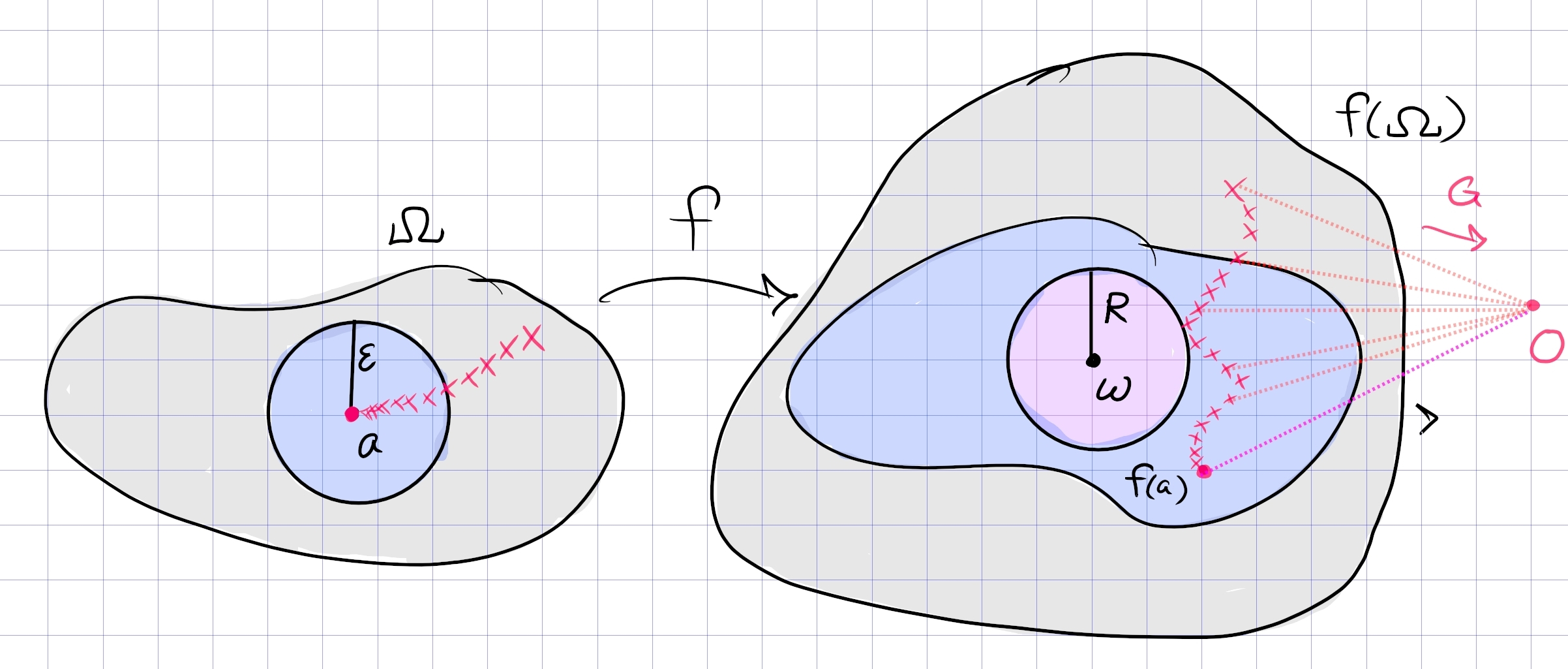
Suppose instead that for some \(\varepsilon>0\) and some \(w\in\CC\) and \(R>0\), the disc \(D_R(w)\) does not meet \(f(V)\), where \(V=D_\varepsilon(z_0)\sm\ts{z_0}\). Then \(g(z)\coloneqq\frac{1}{f(z)-w}\) is holomorphic on \(V\) and \(\abs{g}\le1/R\), so by Riemann’s removable singularity theorem \(g\) extends holomorphically to \(D_\varepsilon(z_0)\). If \(g(z_0)\neq0\), then \(f=w+1/g\) extends holomorphically over \(z_0\); if \(g(z_0)=0\), then since \(g\) is not identically zero, \(f=w+1/g\) has a pole at \(z_0\). Either case contradicts that \(z_0\) is essential.
Casorati--Weierstrass theorem (Tag FT-2N57U)
Let \(\Omega\subseteq\CC\) be open, let \(z_0\in\Omega\), and let \(f\) be holomorphic on \(\Omega\setminus\theset{z_0}\) with an essential singularity at \(z_0\). Then for every open set \(V\subseteq\Omega\) containing \(z_0\), the image \(f(V\setminus\theset{z_0})\) is dense in \(\CC\).
If \(f\) is a nonconstant entire function, then \(f(\CC)\) is dense in \(\CP^1\).
The image of a punctured disc at an essential singularity is dense in \(\CC\).
(Casorati–Weierstrass theorem)
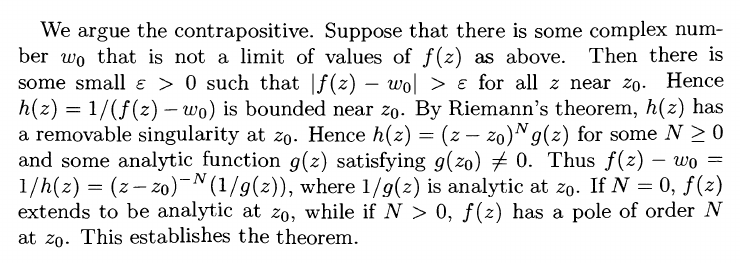
Let \(f\) have an essential singularity at \(z_0\), and suppose toward a contradiction that there is a punctured neighborhood \(\Omega\) of \(z_0\), a point \(w\in\CC\), and \(\varepsilon>0\) with \(f(\Omega) \intersect \DD_\varepsilon(w)\) empty, so that \(\abs{f(z) - w} \geq \varepsilon\) on \(\Omega\).
Define \[ g(z) \coloneqq {1\over f(z) - w} ,\] which is holomorphic on \(\Omega\) and bounded there by \(\inverseof{\varepsilon}\), and not identically zero. By Riemann’s removable singularity theorem \(g\) extends holomorphically across \(z_0\).
Now \(f(z) = {1\over g(z)} + w\). If \(g(z_0) = 0\) then \(z_0\) is a zero of finite order for \(g\), hence a pole of finite order for \(f\), contradicting that \(z_0\) is essential. If \(g(z_0) \neq 0\) then \(1/g + w\) is holomorphic near \(z_0\) and equals \(f\) off \(z_0\), so \(z_0\) is removable, again a contradiction.
(Casorati–Weierstrass theorem, from Gamelin)
Picard
Picard’s theorems replace density of the image by omission of at most one value of \(\CC\).
Picard's big theorem (Tag T-DDOWW)
Let \(z_0\in\CC\), let \(\delta>0\), and let \(f\) be meromorphic on the punctured disc \(\{z : 0<\abs{z-z_0}<\delta\}\). If there are three distinct points of \(\CC\cup\{\infty\}\) that \(f\) does not take on this punctured disc, then \(f\) extends to a meromorphic function on the disc \(\{z : \abs{z-z_0}<\delta\}\).
Picard's little theorem (Tag T-HWBWI)
Let \(f\) be a nonconstant entire function. Then \(f\) takes every value in \(\CC\) with at most one exception. Equivalently, an entire function that omits two distinct values of \(\CC\) is constant.
(Little Picard theorem, by uniformization)
Let \(f\) be entire and omit two values \(a\neq b\). Replacing \(f\) by \((f-a)/(b-a)\), \(f\) is a holomorphic map \(\CC\to X\coloneqq \CC\sm\ts{0,1}\). The universal covering space of \(X\) is biholomorphic to \(\HH\), and since \(\CC\) is simply connected, \(f\) lifts to a holomorphic map \(\tilde f\colon\CC\to\HH\). Composing with the Cayley map gives a bounded entire function, which is constant by Liouville’s theorem, so \(\tilde f\) and \(f\) are constant.
Exercises
An entire function whose image misses a disk is constant (Tag E-HEJJK)
Show that if \(f\) is entire and there exists a disc \(\DD_r(a)\) not intersecting \(f(\CC)\), then \(f\) must be constant.
Solution
Let \(g(z)\da f(z)-a\). Then \(\DD_r(0)\) does not intersect \(g(\CC)\), so \(\abs{g(z)} \geq r\) for all \(z\in\CC\). In particular \(g\) has no zeros, so \(G(z) \da {1\over g(z)}\) is entire, and \(\abs{G(z)} \leq \inverseof{r}\) for all \(z\). By Liouville, \(G\) is constant, so \(g\) and hence \(f\) are constant.
Entire functions with $\abs{f(z)}\ge e^{\abs z}$ (Tag E-3ZHRE)
Find all entire functions \(f\) that satisfy \[ \abs{f(z)} \geq e^{\abs{z}} && \forall z\in \CC .\]
Solution
Claim: there are no such functions. Consider \(g(z) \da f(z)/e^z\), which is entire since \(e^z\) is nonvanishing. Now \(g\) is entire and \(\abs{g} \geq 1\) everywhere, so \(\im(g) \intersect \DD\) is empty. This contradicts Casorati-Weierstrass, which requires that \(\im g\) be dense in \(\CC\).
Alternatively, note \(f\neq 0\) by the inequality, so \(1/f\) is bounded and entire and thus constant. However, \(f(z) = c\) contradicts the inequality, since \(e^{\abs{z}}\to \infty\) as \(\abs{z}\to \infty\).
Alternatively, note that \(e^{\abs{z}} \geq 1\) for all \(z\), so \(\im(f) \intersect \DD\) is empty, again contradicting Casorati-Weierstrass.
An entire function with $\min_{\abs z=r}\abs{f(z)}$ tending to a finite positive limit is constant (Tag E-27X7K)
Let \(f\) be entire and define a function \[ m: [0, \infty) &\to \mathbb{R} \\ r &\mapsto \min_{\abs{z} = r} \abs{f(z)} .\] Suppose \(\tilde m := \lim_{r\to \infty}m(r)\) exists and is a finite positive real number, and show that \(f\) is constant.
Hint: consider \(g(z) := f(1/z)\).
Solution
Let \[ m(r)=\min_{|z|=r}|f(z)|, \qquad m(r)\longrightarrow \widetilde m\in(0,\infty). \]
<1>1. Since \(m(r)\to\widetilde m>0\), there is \(R>0\) such that \[ |f(z)|\ge \widetilde m/2 \qquad(|z|\ge R). \] Thus \[ g(w):=f(1/w) \] is holomorphic on \(0<|w|<1/R\) and bounded away from \(0\) there.
<1>2. The singularity of \(g\) at \(0\) is not essential. Indeed, Casorati–Weierstrass would force values of \(g\) arbitrarily close to \(0\), contradicting the lower bound.
<1>3. The singularity is not a pole either. If \(g\) had a pole of order \(k\ge1\), then \[ w^k g(w)\longrightarrow a\ne0 \qquad(w\to0). \] Hence uniformly on \(|w|=1/r\), \[ |g(w)|\sim |a|r^k, \] so \[ m(r)=\min_{|w|=1/r}|g(w)|\longrightarrow\infty, \] contrary to the assumed finite limit.
<1>4. Therefore \(0\) is removable for \(g\). After extending \(g\) holomorphically across \(0\), it is bounded on a small closed disk about \(0\). Translating back, \(f\) is bounded for all sufficiently large \(|z|\). It is also bounded on the remaining compact disk, so \(f\) is bounded on \(\mathbb C\).
By Liouville’s theorem, \(f\) is constant.
$\sin z=z$ has infinitely many solutions in $\CC$ (Tag E-XZWER)
Show that \(\sin(z) = z\) has infinitely many solutions in \(\CC\).
Solution
Let \(f(z) = \sin(z)-z\) and apply Big Picard: \(f\) takes on every value in \(\CC\), except possibly for some single \(z_0\), infinitely many times. So there is at most one \(z_0\) such that there are finitely many solutions to \(\sin(z) - z = z_0\). If \(z_0\neq 0\), we’re done, so suppose such an exception \(z_0\) does exist whose fiber has finitely many points. Since \(z_0+2\pi \neq z_0\), there must then be infinitely many solutions to \(f(z) = z_0 + 2\pi\). But then \[ f(z+2\pi) = \sin(z+2\pi) - z - 2\pi = \sin(z) - z - 2\pi = (z_0 + 2\pi)-2\pi = z_0 ,\] so we can produce infinitely many points in the fiber over \(w_0\), contradicting finiteness. So no exception \(z_0\) exists, and in particular, \(z_0=0\) is not an exception so \(f(z) = 0\) has infinitely many solutions.
Entire functions satisfying $g(1-z)=1-g(z)$ are surjective (Tag E-3LIG3)
Suppose that \(g\) is entire and satisfies the functional equation \(g(1-z) = 1-g(z)\). Show that \(g(\CC) = \CC\).
Solution
Assume \(g\) is nonconstant; the remark treats constant \(g\). Suppose \(g\) omits a value \(a\). Setting \(z=1/2\) in the functional equation gives \(g(1/2)=1-g(1/2)\), so \(g(1/2)=1/2\) and \(a\neq 1/2\). The value \(1-a\) is also omitted: if \(g(z)=1-a\), then \(g(1-z)=1-g(z)=a\). Since \(a\ne1/2\), the values \(a\) and \(1-a\) are distinct, so the nonconstant entire function \(g\) omits two values, contradicting Picard’s little theorem.
The only constant solution of \(g(1-z)=1-g(z)\) is \(g\equiv1/2\), which is not surjective. The conclusion holds for every nonconstant solution.