The cellular chain complex of a CW complex \(X\) has differentials lowering degree: \[ C_*(X) = \qty{0 \leftarrow C_0 \xleftarrow{\ \del_1\ } C_1 \xleftarrow{\ \del_2\ } C_2 \leftarrow \cdots }. \]
Product CW structure (Tag PR-QJZDT)
Let \(X\) and \(Y\) be CW complexes such that \(X\cross Y\) with the product topology is a CW complex with cells \(e^i_\alpha\cross e^j_\beta\); this holds if \(X\) or \(Y\) is locally compact, or if both have countably many cells [@Hat02]. Then the cellular chain complexes satisfy \[ C_n(X \cross Y) \cong \bigoplus_{i+j=n} C_i(X) \tensor_\ZZ C_j(Y), \qquad e^i\cross e^j\mapsto e^i\tensor e^j ,\] with boundary \[ d(e^i\cross e^j) = de^i\cross e^j + (-1)^{i} e^i\cross de^j \] [@Hat02]. In particular, if \(X\) and \(Y\) have finitely many cells in each dimension and \(p_X(t) = \sum_n a_n t^n\), \(p_Y(t)\) count their \(n\)-cells, then \(p_{X\cross Y}(t) = p_X(t)\,p_Y(t)\).
For singular chains the corresponding statement is the Eilenberg–Zilber theorem: \(C_*(X\cross Y)\) is naturally chain homotopy equivalent to \(C_*(X)\tensor_\ZZ C_*(Y)\).
Let \(X= S^a \cross S^b\) with \(a,b\geq 1\) and the product of the CW structures \(e^0\union e^a\) and \(e^0\union e^b\). Then \(p_{S^a}(t) = 1 + t^a\) and \(p_{S^b}(t) = 1 + t^b\), so \(p_X(t) = 1 + t^a + t^b + t^{a+b}\), and \(X\) has one \(0\)-cell, one \(a\)-cell, one \(b\)-cell, and one \((a+b)\)-cell.
Homology of product of spheres (Tag E-GTNVU)
Compute all of the possible cases for \(H_*(S^a\cross S^b)\), where \(a, b\geq 0\) are not necessarily distinct.
Solution
<1>1. For \(a,b>0\), Künneth gives \[H_k(S^a\times S^b;\mathbb Z)\cong\bigoplus_{i+j=k}H_i(S^a)\otimes H_j(S^b),\] with no Tor terms.
All homology groups of spheres are free abelian.
<1>2. If \(a,b>0\) and \(a\ne b\), then \[\boxed{H_k\cong\begin{cases}\mathbb Z,&k=0,a,b,a+b,\\0,&\text{otherwise.}\end{cases}}\]
The four tensor products from degrees \((0,0),(a,0),(0,b),(a,b)\) occur in distinct total degrees.
<1>3. If \(a=b>0\), then \[\boxed{H_k\cong\begin{cases}\mathbb Z,&k=0,2a,\\\mathbb Z^2,&k=a,\\0,&\text{otherwise.}\end{cases}}\]
The two middle tensor products now occur in the same degree \(a\).
<1>4. Since \(S^0\) is two points, if exactly one of \(a,b\) is zero then \(S^a\times S^b\) is a disjoint union of two copies of the positive-dimensional sphere; if \(a=b=0\) it is four points.
Products with a finite discrete set are disjoint unions indexed by that set. Thus for, say, \(a=0<b\), \(H_0\cong H_b\cong\mathbb Z^2\) and all other groups vanish; for \(a=b=0\), \(H_0\cong\mathbb Z^4\).
CW structures on common spaces
(Spheres)
For \(n\geq 1\), \(S^n = e^0 \union e^n\), a \(0\)-cell and an \(n\)-cell attached by the constant map \(\del D^n\to e^0\). Another CW structure on \(S^n\) has two \(k\)-cells for each \(0\leq k \leq n\), the \(k\)-skeleton being \(S^k\) and the two \(k\)-cells its hemispheres.
(Real projective space)
\(\RP^n = e^0\union e^1 \union e^2 \union \cdots \union e^n\), one cell in each dimension \(0,\ldots,n\), with \(e^k\) attached by the double cover \(S^{k-1}\to\RP^{k-1}\).
(Complex projective space)
\(\CP^n = e^0\union e^2 \union e^4 \union \cdots \union e^{2n}\), with \(e^{2k}\) attached by the quotient map \(S^{2k-1}\to\CP^{k-1}\).
(Surfaces)
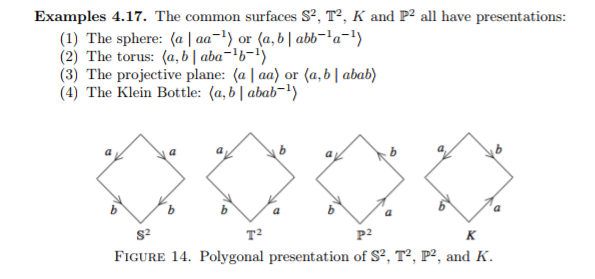
A closed surface given by a polygon with edge identifications has one \(2\)-cell, one \(1\)-cell for each edge pair, and one \(0\)-cell for each vertex class.
Simplicial complexes
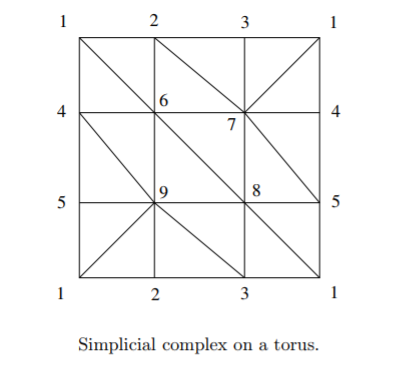
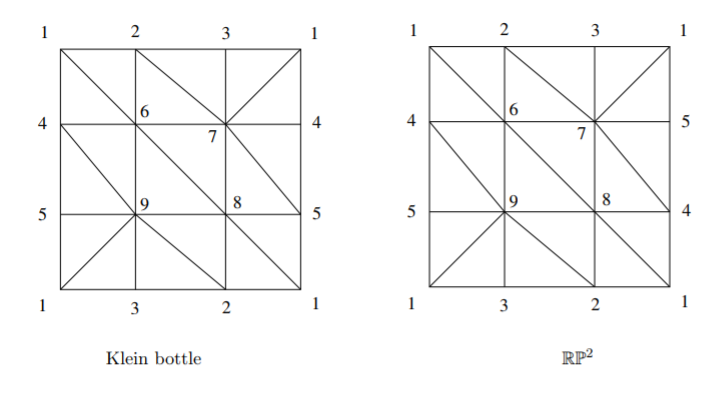
With the vertices labelled by integers, a simplicial complex is determined by its list of simplices, each \(n\)-simplex being recorded as the set of the \(n+1\) labels of its vertices.
(Torus)
(Klein bottle and $\RP^2$)
(A labelling of the torus that is not a triangulation)
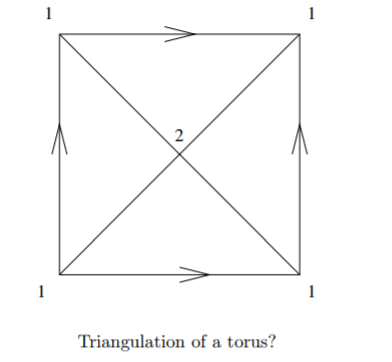
In this picture a triangle has two vertices with the same label \(1\), so the vertex set \(\ts{1,2}\) does not determine a unique triangle, and the picture is not a simplicial complex.
Cellular homology
(Computing cellular homology)
Let \(X\) be a CW complex with finitely many cells in each dimension.
The cellular chain group \(C_n\) is free abelian on the \(n\)-cells \(e^n_\alpha\).
The differential is \[ \del_n(e_{\alpha}^n) = \sum_{\beta} d_{\alpha\beta}\, e_{\beta}^{n-1}, \] where \(d_{\alpha\beta}\) is the degree of the composite \(S^{n-1} \to X^{(n-1)} \to X^{(n-1)}/\qty{X^{(n-1)}\sm e^{n-1}_\beta}\cong S^{n-1}\) of the attaching map of \(e^n_\alpha\) with the map collapsing the complement of \(e^{n-1}_\beta\). For a smooth map \(S^{n-1}\to S^{n-1}\) and a regular value \(y\), the degree is the number of points of the preimage of \(y\) counted with sign \(+1\) where the map preserves orientation and \(-1\) where it reverses it.
If \(X\) has a single \(0\)-cell, then \(\del_1 = 0\). If \(X\) has no \(n\)-cells, then \(H_n(X) = 0\).
With bases of cells, \(\del_n\colon \ZZ^{m} \to \ZZ^{k}\) is a \(k\times m\) integer matrix, and \(H_n(X) = \ker\del_n/\im\del_{n+1}\).
If the Smith normal form of \(\del_{n+1}\) has nonzero diagonal entries \(d_1,\ldots,d_r\), and \(\ker\del_n\) has rank \(s\), then \[ H_n(X)\cong \ZZ^{s-r}\oplus\bigoplus_{i=1}^r \ZZ/d_i. \]
(A kernel from reduced row echelon form)
The integer matrix with reduced row echelon form \[ \begin{pmatrix} 1&2&0&2\\0&0&1&-1\\0&0&0&0 \end{pmatrix}, \] viewed as a map \(\ZZ^4\to\ZZ^3\) on coordinates \((x_1,x_2,x_3,x_4)\), has kernel given by \(x_1=-2x_2-2x_4\) and \(x_3=x_4\), with basis \[ \ker = \gens{(2,-1,0,0),\ (2,0,-1,-1)}. \] Its rows span the image of the transpose, \(\gens{(1,2,0,2),(0,0,1,-1)}\subseteq\ZZ^4\).
Constructing a CW complex with prescribed homology
For finitely generated abelian groups \(G_1, G_2, \ldots\), there is a connected CW complex \(X\) with \(H_n(X)\cong G_n\) for all \(n\geq 1\).
By the structure theorem for finitely generated abelian groups, each \(G_n\) is a finite direct sum of copies of \(\ZZ\) and \(\ZZ/d\). Attaching an \(n\)-cell to a point gives \(S^n\) with \(\tilde H_n = \ZZ\) and no other reduced homology. Attaching an \((n+1)\)-cell to \(S^n\) along a map of degree \(d\) gives a space with \(\tilde H_n = \ZZ/d\) and no other reduced homology. For good pointed spaces \(X_i\), \(\tilde H_n(\bigvee_i X_i) \cong \bigoplus_i \tilde H_n(X_i)\), so the wedge of these spaces over all summands of all \(G_n\) has the required homology.
Exercises
$\pi_1$ and $H^*$ of $S^1$ with $2$-cells attached via $z^3$ and $z^5$; not homeomorphic to $S^2$ (Tag P-EJKY7)
Let \(X\) be \(S^1\) with two 2-cells attached via \(z\mapsto z^5\) and \(z\mapsto z^3\).
Compute \(\pi_1(X)\) and \(H^*(X)\) as a ring.
Show that \(X\) is not homeomorphic to \(S^2\).
Solution
\(X\) is path-connected, so \(H_0(X) = \ZZ\).
\(X\) is a CW complex with only one 1-cell, so \(\pi_1(X^{(1)}) = \ZZ\) for the 1-skeleton.
- Use that \(3\ZZ + 5\ZZ = 1\ZZ\) as a ring, so the attached cells kill off all 1-homotopy and \(\pi_1(X) = 1\).
By Hurewicz, \(H_1(X) = 1\).
By UCT, \(H^1(X) = \dualof{H_1(X)} = \Hom_\ZZ(1, \ZZ) = 1\)
By UCT, \(H^2(X) = \dualof{H_2(X)}\)
We can compute \(H_2\) directly: \[ C^*(X) = (0 \to C_2(X) \mapsvia{d_2} C_1(X) \mapsvia{d_1} C_0(X) ) = (0 \to \ZZ\adjoin{e_1, e_2} \mapsvia{\substack{e_1\mapsto 3e \\ e_2 \mapsto 5e} } \ZZ\adjoin{e} \mapsvia{d_1} \ZZ\adjoin{\pt} ) .\]
\(\ker d_2 = \gens{ 5e_1, -3e_2 }\), so \(H_2 = \ZZ\).
Thus \(H^*(X) = \Extalgebra_\ZZ(x)\) where \(\abs{x} = 2\).
\(X\not\cong S^2\): delete a point \(p\) in the interior of the 2-cell corresponding to \(z^3\), then use that \(S^2\sm\ts{\pt} \cong \RR^2\) is contractible but \(\pi_1 X\sm\ts{\pt} = \ZZ/5\).