Point-set
Compact if and only if complete and totally bounded (Tag T-HH3YP)
A metric space is compact if and only if it is complete and totally bounded [@Mun00].
Sequentially compact if and only if complete and totally bounded (Tag T-4RLPQ)
A metric space \(X\) is sequentially compact if and only if it is complete and totally bounded.
For metric spaces, sequential compactness is equivalent to compactness [@Mun00], and compactness is equivalent to being complete and totally bounded [@Mun00].
The tube lemma (Tag T-G4GO4)
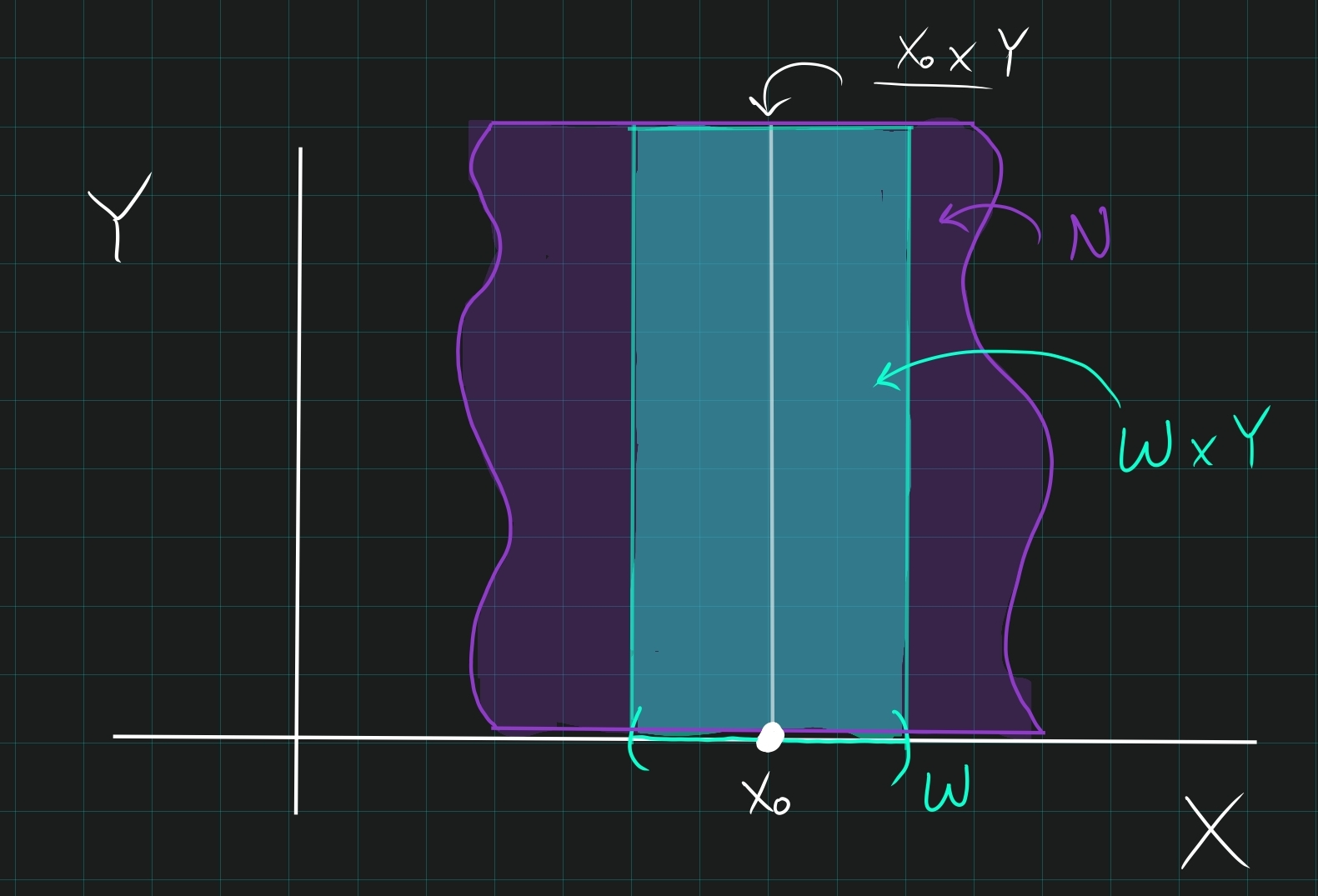
Let \(X, Y\) be topological spaces with \(Y\) compact, and let \(x_0\in X\). If \(N\subseteq X\cross Y\) is an open set containing the slice \(\theset{x_0} \cross Y\), then there is a neighborhood \(W\) of \(x_0\) in \(X\) with \(W\cross Y\subseteq N\) [@Mun00].
Urysohn's lemma (Tag FT-52GNK)
Let \(X\) be a topological space. Then \(X\) is normal if and only if for every pair of disjoint closed subsets \(A, B \subseteq X\) there is a continuous function \(f\colon X\to [0,1]\) with \(f(a) = 0\) for all \(a\in A\) and \(f(b) = 1\) for all \(b\in B\) [@Mun00].
The forward direction is Urysohn’s lemma; the converse follows by taking the disjoint open sets \(f^{-1}([0,1/2))\) and \(f^{-1}((1/2,1])\).
Baire category theorem (Tag FT-6WPJI)
If \(X\) is a complete metric space or a locally compact Hausdorff space, then \(X\) is a Baire space: the intersection of countably many dense open subsets of \(X\) is dense in \(X\) [@Mun00].
A nonempty complete metric space is not a countable union of nowhere dense subsets.
Let \(X\) be a nonempty complete metric space and suppose \(X=\bigcup_{k\geq1}S_k\) with each \(S_k\) nowhere dense. Each \(U_k\coloneqq X\setminus\overline{S_k}\) is open, and it is dense because \(\overline{S_k}\) has empty interior. By the theorem, \(\bigcap_k U_k\) is dense in \(X\), hence nonempty since \(X\neq\emptyset\). But \(\bigcap_k U_k\subseteq X\setminus\bigcup_k S_k=\emptyset\), a contradiction.
Point-set topology proves the tube lemma.
Fundamental group
Maps into a convex set are homotopic (Tag T-2YTCZ)
Let \(X\) be a topological space and \(C\subseteq\RR^n\) a convex subset. Any two continuous maps \(f, g\colon X\to C\) are homotopic, via the linear homotopy \(F(x,t) = (1-t)f(x) + t\,g(x)\), which lies in \(C\) by convexity. For \(X = [0,1]\) and paths with common endpoints, the linear homotopy is a homotopy rel endpoints [@Hat02].
Seifert--van Kampen theorem (Tag T-BTPU4)
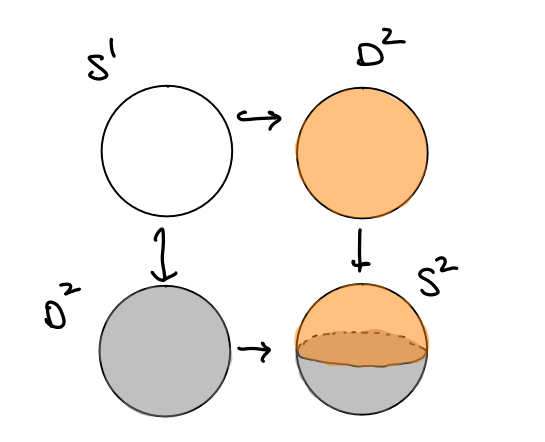
Let \(X = U_{1} \union U_{2}\), where \(U_1\), \(U_2\) and \(U_1\intersect U_2\) are open, path-connected and nonempty, and let \(x_0 \in U_1\intersect U_2\). Let \(\iota_k\colon \pi_1(U_1\intersect U_2, x_0)\to\pi_1(U_k, x_0)\), \(k = 1, 2\), be induced by the inclusions. Then the inclusions \(U_1, U_2\injects X\) induce an isomorphism \[ \pi_{1}(U_1, x_0) \ast_{\pi_{1}(U_1 \intersect U_2, x_0)} \pi_{1}(U_2, x_0) \xrightarrow{\ \sim\ } \pi_{1}(X, x_0) \] onto \(\pi_1(X, x_0)\) from the free product with amalgamation, which is the pushout of \(\pi_1(U_1, x_0)\xleftarrow{\iota_1}\pi_1(U_1\intersect U_2, x_0)\xrightarrow{\iota_2}\pi_1(U_2, x_0)\) in the category of groups [@Hat02].
Let \(X = U_1\union U_2\), where \(U_1\), \(U_2\) and \(U_1\intersect U_2\) are open, path-connected and nonempty, let \(x_0\in U_1\intersect U_2\), and let \(\iota_k\colon \pi_1(U_1\intersect U_2, x_0)\to\pi_1(U_k, x_0)\), \(k = 1, 2\), be induced by the inclusions. Suppose \[ \pi_{1}(U_1, x_0) = \left\langle u_{1}, \ldots, u_{k} \suchthat \alpha_{1}, \ldots, \alpha_{l}\right\rangle, \qquad \pi_{1}(U_2, x_0) = \left\langle v_{1}, \ldots, v_{m} \suchthat \beta_{1}, \ldots, \beta_{n}\right\rangle, \] and that \(w_1, \ldots, w_p\) generate \(\pi_1(U_1\intersect U_2, x_0)\). Then \[ \pi_{1}(X, x_0) \cong \left\langle u_{1}, \ldots, u_{k}, v_{1}, \ldots, v_{m} \suchthat \alpha_{1}, \ldots, \alpha_{l},\ \beta_{1}, \ldots, \beta_{n},\ \iota_1(w_{1}) \iota_2(w_{1})^{-1}, \ldots, \iota_1(w_{p}) \iota_2(w_{p})^{-1} \right\rangle \] [@Hat02].
The hypothesis that \(U_1 \intersect U_2\) is path-connected is necessary: for \(S^1\) covered by two open arcs, the intersection has two components, both arcs are simply connected, and \(\pi_1(S^1)\cong\ZZ\).
Whitehead's theorem (Tag T-SDEOY)
Let \(f\colon X\to Y\) be a map of connected CW complexes that induces isomorphisms \(f_*\colon\pi_n(X)\to\pi_n(Y)\) for all \(n\), that is, a weak homotopy equivalence. Then \(f\) is a homotopy equivalence [@Hat02].
Hurewicz theorem (Tag T-GL7E6)
Let \(n\geq 2\) and let \(X\) be an \((n-1)\)-connected space. Then \(\tilde H_i(X) = 0\) for \(i < n\), and the Hurewicz map \(\pi_n(X)\to H_n(X)\) is an isomorphism [@Hat02]. For \(n = 1\) and \(X\) path-connected, the Hurewicz map \(\pi_1(X)\to H_1(X)\) induces an isomorphism from the abelianization of \(\pi_1(X)\) onto \(H_1(X)\) [@Hat02].
Cellular approximation theorem (Tag T-I2X3M)
Every map \(f\colon X\to Y\) of CW complexes is homotopic to a cellular map. If \(f\) is already cellular on a subcomplex \(A\subseteq X\), the homotopy may be taken to be stationary on \(A\) [@Hat02].
Freudenthal suspension theorem (Tag T-HZUM7)
The suspension map \[ \pi_i(S^n) \to \pi_{i+1}(S^{n+1}) \] is an isomorphism for \(i < 2n-1\) and a surjection for \(i = 2n-1\). More generally, for an \((n-1)\)-connected CW complex \(X\), the suspension map \(\pi_i(X)\to\pi_{i+1}(SX)\) is an isomorphism for \(i < 2n-1\) and a surjection for \(i = 2n-1\) [@Hat02].
In particular, \(\pi_{n+k}(S^n)\) is independent of \(n\) for \(n > k+1\); this common value is the \(k\)th stable homotopy group of spheres.
Fundamental groups from covering space actions (Tag PR-HQE2T)
Let \(G\) act on a simply connected, locally path-connected space \(Y\) such that every \(y\in Y\) has a neighborhood \(U\) with \(gU\cap U = \emptyset\) for all \(g\neq 1\) in \(G\). Then \(Y\to Y/G\) is a universal cover and \(\pi_1(Y/G)\cong G\) [@Hat02].
Skeleta and homotopy groups (Tag PR-FG4DK)
Let \(X\) be a CW complex and \(k\geq 1\). The inclusion \(X^{k+1}\injects X\) of the \((k+1)\)-skeleton induces an isomorphism \(\pi_k(X^{k+1})\cong\pi_k(X)\) [@Hat02]. In particular, \(\pi_1(X)\) depends only on the \(2\)-skeleton [@Hat02], and attaching cells of dimension \(k+2\) or higher does not change \(\pi_k\).
$\pi_1$ of a wedge sum (Tag PR-3APOT)
Let \((X, x_0)\) and \((Y, y_0)\) be path-connected pointed spaces such that \(x_0\) and \(y_0\) are deformation retracts of open neighborhoods in \(X\) and \(Y\) respectively. Then the inclusions induce an isomorphism \[ \pi_1(X)\ast\pi_1(Y)\xrightarrow{\ \sim\ }\pi_1(X \vee Y) \] [@Hat02].
$\pi_1$ of a product (Tag PR-OO3DH)
Let \(X\) and \(Y\) be path-connected spaces. Then the projections induce an isomorphism \[ \pi_1 (X \cross Y) \xrightarrow{\ \sim\ } \pi_1(X) \cross \pi_1(Y) \] [@Hat02].
$\pi_1$ detects simple connectivity (Tag PR-EWJMJ)
Let \(X\) be a path-connected space. Then \(X\) is simply connected if and only if \(\pi_1(X, x_0) = 1\) for some, equivalently every, basepoint \(x_0\in X\) [@Hat02].
Theorems: algebraic topology proves that maps into a convex set are homotopic, computes $\pi_1$ of a wedge sum, and proves that $\pi_1$ detects simple connectivity; it sketches the proofs of the Seifert--van Kampen theorem and of the formula for $\pi_1$ of a product.
Homology
Excision (Tag T-FBMYQ)
Given subspaces \(Z \subseteq A \subseteq X\) with \(\cl_X(Z) \subseteq \interiorof{A}\), the inclusion of pairs induces isomorphisms \[ H_n(X\sm Z,\, A\sm Z) \mapsvia{\sim} H_n(X, A) \qquad \text{for all } n .\] Equivalently, for subspaces \(A, B\subseteq X\) with \(X = \interiorof{A} \union \interiorof{B}\), the inclusion \((B, A\intersect B)\injects (X, A)\) induces isomorphisms \(H_n(B, A\intersect B)\mapsvia{\sim} H_n(X,A)\) for all \(n\). The two forms are related by \(B = X\sm Z\) [@Hat02].
Mayer--Vietoris sequence (Tag D-FAIJX)
Let \(X\) be a topological space and \(A, B\subseteq X\) subspaces with \(X = A^\circ\cup B^\circ\). Let \(i\colon A\cap B\hookrightarrow A\), \(j\colon A\cap B\hookrightarrow B\), \(k\colon A\hookrightarrow X\), and \(l\colon B\hookrightarrow X\) be the inclusions, and let \(H_n\) denote singular homology with integer coefficients. Define \[ \Phi\colon H_n(A\cap B)\to H_n(A)\oplus H_n(B),\quad \Phi(x) = (i_*x, -j_*x), \qquad \Psi\colon H_n(A)\oplus H_n(B)\to H_n(X),\quad \Psi(a, b) = k_*a + l_*b, \] and \(\del\colon H_n(X)\to H_{n-1}(A\cap B)\) as follows: every \(\alpha\in H_n(X)\) is represented by a cycle \(z = x + y\) with \(x\) an \(n\)-chain in \(A\) and \(y\) an \(n\)-chain in \(B\), and \(\del\alpha\coloneqq[\del x]\). The Mayer–Vietoris sequence of \((A, B)\) is \[ \cdots\to H_n(A\cap B)\xrightarrow{\Phi} H_n(A)\oplus H_n(B)\xrightarrow{\Psi} H_n(X)\xrightarrow{\del} H_{n-1}(A\cap B)\to\cdots\to H_0(X)\to 0. \]
Let \(X\) be a topological space and \(A, B\subseteq X\) subspaces with \(X = A^\circ\cup B^\circ\). Then \(\del\colon H_n(X)\to H_{n-1}(A\cap B)\) is well defined and the Mayer–Vietoris sequence of \((A, B)\) is exact [@Hat02].
Let \(C_n(A+B)\subseteq C_n(X)\) be the subgroup of sums of an \(n\)-chain in \(A\) and an \(n\)-chain in \(B\). Since \(X = A^\circ\cup B^\circ\), the inclusion \(C_\bullet(A+B)\hookrightarrow C_\bullet(X)\) induces isomorphisms on homology. The Mayer–Vietoris sequence is the long exact homology sequence of the short exact sequence of chain complexes \[ 0\to C_n(A\cap B)\xrightarrow{x\mapsto(x, -x)} C_n(A)\oplus C_n(B)\xrightarrow{(x, y)\mapsto x+y} C_n(A+B)\to 0, \] and \(\del\) is its connecting homomorphism; since \(\del z = 0\), the chain \(\del x = -\del y\) lies in \(A\cap B\) and is a cycle there.
When \(A\cap B\neq\emptyset\) there is an exact sequence of the same form in reduced homology, and there is an exact sequence for singular cohomology with the arrows reversed.
Künneth formula for homology (Tag T-TZ3X7)
Let \(X, Y\) be CW complexes and \(R\) a principal ideal domain. For each \(k\) there is a natural short exact sequence \[ 0 \to \bigoplus_{i+j=k} H_{i}(X; R) \tensor_{R} H_{j}(Y; R) \to H_{k}(X\cross Y; R) \to \bigoplus_{i+j=k-1} \Tor^R_1\qty{H_{i}(X; R), H_{j}(Y; R)} \to 0 ,\] and it splits, though not naturally: \[ H_{k}(X\cross Y; R) \cong \qty{ \bigoplus_{i+j = k} H_{i}(X;R) \tensor_R H_{j}(Y;R) } \oplus \bigoplus_{i+j = k-1}\Tor^R_1\qty{H_{i}(X;R), H_{j}(Y;R)} \] [@Hat02].
Universal coefficient theorems (Tag T-2W5WN)
Let \(X\) be a topological space and \(G\) an abelian group. For each \(i\) there are natural short exact sequences \[ 0 \to H_i(X;\ZZ)\tensor G \to H_i(X; G) \to \Tor(H_{i-1}(X;\ZZ), G) \to 0 \] [@Hat02] and \[ 0 \to \Ext(H_{i-1}(X;\ZZ), G) \to H^i(X;G) \to \Hom(H_i(X;\ZZ), G) \to 0 \] [@Hat02]. Both sequences split, though not naturally, so \[ H_i(X;G) \cong \qty{H_i(X;\ZZ)\tensor G} \oplus \Tor(H_{i-1}(X;\ZZ), G), \qquad H^i(X;G) \cong \Hom(H_i(X;\ZZ), G) \oplus \Ext(H_{i-1}(X;\ZZ), G) .\]
If \(H_i(X;\ZZ)\) and \(H_{i-1}(X;\ZZ)\) are finitely generated with torsion subgroups \(T_i\) and \(T_{i-1}\), then \[ H^i(X;\ZZ) \cong \qty{H_i(X;\ZZ)/T_i} \oplus T_{i-1} \] [@Hat02]. If \(F\) is a field, then \(H^i(X;F) \cong \Hom_F(H_i(X;F), F)\) [@Hat02].
Reduced homology of a wedge sum (Tag PR-B6BB2)
Let \((X_\alpha, x_\alpha)\) be pointed spaces such that each \((X_\alpha, \theset{x_\alpha})\) is a good pair. Then the inclusions \(X_\alpha\injects\bigvee_\alpha X_\alpha\) induce an isomorphism \[ \bigoplus_\alpha \tilde H_n(X_\alpha) \xrightarrow{\ \sim\ } \tilde H_n\qty{\bigvee_\alpha X_\alpha} \] for every \(n\) [@Hat02].
The wedge sum \(\bigvee_\alpha X_\alpha\) is the coproduct in the category of pointed topological spaces.
Suspension isomorphism for the cohomology of spheres (Tag PR-6PENU)
For \(n\geq 1\) and all \(i\), the reduced cohomology groups of spheres satisfy \[ \tilde H^i(S^n) \cong \tilde H^{i-1}(S^{n-1}) \] [@Hat02].
The statement fails for unreduced cohomology: for \(n\geq 2\), \(H^1(S^n) = 0\) while \(H^0(S^{n-1})\cong\ZZ\).
Homology theory and computations computes the reduced homology of a wedge sum and proves the suspension isomorphism for the cohomology of spheres.
The standard computations
The fundamental groups and homology groups of spheres, tori, projective spaces, surfaces, and wedges of spheres are tabulated on The standard spaces.
Counterexamples
Counterexamples gives, for statements that fail without a hypothesis, a space or map witnessing the failure.