Homotopy groups of classical groups
(Bott periodicity in the stable range)
For \(k\) in the stable range (\(k\leq 2n-1\) for \(U(n)\), \(k\leq n-2\) for \(O(n)\), \(k\leq 4n\) for \(Sp(n)\)), \[ \begin{aligned} \pi_k(U(n)) &\cong \begin{cases} \ZZ & k \text{ odd}, \\ 0 & k \text{ even}, \end{cases} \\ \pi_k(O(n)) &\cong \begin{cases} \ZZ/2 & k\equiv 0,1 \pmod 8, \\ \ZZ & k\equiv 3,7 \pmod 8, \\ 0 & \text{otherwise}, \end{cases} \\ \pi_k(Sp(n)) &\cong \begin{cases} \ZZ & k\equiv 3,7 \pmod 8, \\ \ZZ/2 & k\equiv 4,5 \pmod 8, \\ 0 & \text{otherwise}. \end{cases} \end{aligned} \] The inclusion \(SU(n)\injects U(n)\) induces isomorphisms on \(\pi_k\) for \(k\geq 2\), and \(\pi_1(U(n))\cong\ZZ\) via the determinant while \(\pi_1(SU(n))=1\).
(Groups and group actions)
For a discrete topological group \(G\), \(\pi_0(G) = G\) as sets.
For a closed subgroup \(H\) of a Lie group \(G\), the fibration \(H\to G\to G/H\) gives \(\pi_k(G/H)\cong\pi_k(G)\) whenever \(\pi_k(H) = \pi_{k-1}(H) = 0\).
If \(X\) is simply connected and a discrete group \(G\) acts on \(X\) freely and properly discontinuously, then \(\pi_1(X/G)\cong G\).
Cup and cap products
(Cup and cap products)
For a space \(X\), a ring \(R\), cochains \(\varphi\in C^p(X;R)\) and \(\psi\in C^q(X;R)\), and a singular simplex \(\sigma\colon\Delta^{p+q}\to X\), the cup product \(\varphi\cup\psi\in C^{p+q}(X;R)\) is \[ (\varphi \cup \psi)(\sigma) \coloneqq \varphi\bigl(\sigma|_{[v_0,\ldots,v_p]}\bigr)\, \psi\bigl(\sigma|_{[v_p,\ldots,v_{p+q}]}\bigr), \] the product of \(\varphi\) on the front \(p\)-face and \(\psi\) on the back \(q\)-face. For \(\sigma\colon\Delta^{k}\to X\) with \(k\geq p\), the cap product \(\sigma\cap\varphi\in C_{k-p}(X;R)\) is \[ \sigma \cap \varphi \coloneqq \varphi\bigl(\sigma|_{[v_0,\ldots,v_p]}\bigr)\, \sigma|_{[v_p,\ldots,v_k]}. \]
\(\delta(\varphi\cup\psi) = \delta\varphi\cup\psi + (-1)^p\,\varphi\cup\delta\psi\), so \(\cup\) induces \(H^p(X;R)\times H^q(X;R)\to H^{p+q}(X;R)\), and \(\cap\) induces \(H_k(X;R)\times H^p(X;R)\to H_{k-p}(X;R)\).
For continuous \(f\colon X\to Y\), \(f^*(a\cup b) = f^*a \cup f^*b\).
For \(\varphi\in C^p\), \(\psi\in C^q\), and \(\sigma\colon\Delta^{p+q}\to X\), \(\psi(\sigma \cap \varphi) = (\varphi \cup \psi)(\sigma)\), that is, \(\inner{\varphi\cup \psi}{\sigma} = \inner{\psi}{\sigma \cap \varphi}\).
(Cup product is dual to transverse intersection)
Let \(M\) be a closed oriented smooth \(n\)-manifold, and let \(A, B \subseteq M\) be closed oriented submanifolds of codimensions \(i\) and \(j\) that intersect transversely: for every \(p\in A\intersect B\), the map \(T_pA \oplus T_p B \to T_p M\) is surjective. Then \(A\intersect B\) is a submanifold of codimension \(i+j\), oriented by the exact sequence \[ 0 \to T_p(A\intersect B) \to T_p A \oplus T_p B \to T_p M \to 0. \] Let \([A]\in H_{n-i}(M)\), \([B]\in H_{n-j}(M)\), and \([A\intersect B]\in H_{n-i-j}(M)\) be the images of the fundamental classes under inclusion, and \(\dualof{[A]}\in H^i(M)\), \(\dualof{[B]}\in H^j(M)\), \(\dualof{[A\intersect B]}\in H^{i+j}(M)\) their Poincaré duals. Then \[ \dualof{[A]} \cup \dualof{[B]} = \dualof{[A\intersect B]}. \]
($\CP^n$)
For \(0\leq i\leq n\), \(H^{2i}(\CP^n)\cong\ZZ\) is generated by the Poincaré dual \(\alpha_i\) of a linear subspace \(\CP^{n-i}\) of complex codimension \(i\). Generic linear subspaces of codimensions \(i\) and \(j\) meet transversely in a linear subspace of codimension \(i+j\), so \(\alpha_i \cup \alpha_j = \alpha_{i+j}\) for \(i+j \leq n\).
($T^2$)
\(H_1(T^2) \cong\ZZ^2\) is generated by the classes \([A], [B]\) of a longitude and a meridian, and \(H_0(T^2) \cong \ZZ\) by the class \([p]\) of a point. \(A\) and \(B\) meet transversely in one point, with sign determined by the orientations, so \(\dualof{[A]} \cup \dualof{[B]} = \dualof{\pm[p]}\) and \(\dualof{[B]} \cup \dualof{[A]} = -\dualof{[A]} \cup \dualof{[B]}\).
The long exact sequence of a pair
For a space \(A\) and a subspace \(B\subseteq A\), the short exact sequence of chain complexes \(0\to C_*(B)\to C_*(A)\to C_*(A,B)\to 0\) induces a long exact sequence \[ \cdots \to H_n(B) \to H_n(A) \to H_n(A,B) \xrightarrow{\ \del\ } H_{n-1}(B) \to \cdots. \]
Tables
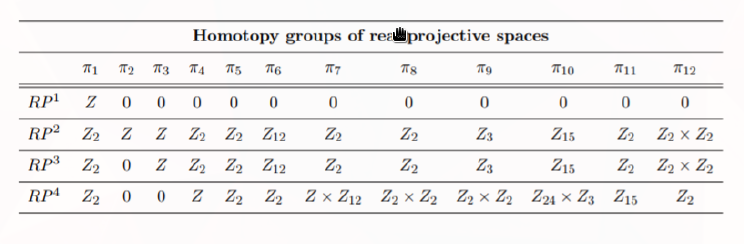
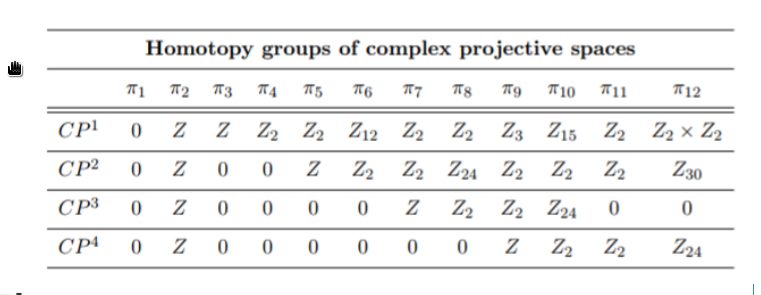
Higher homotopy
For \(n \geq 2\), \(\pi_n(X)\) is abelian.
\(\Sigma S^n \cong S^{n+1}\).
For pointed spaces, \([\Sigma X, Y]_* \cong [X, \Omega Y]_*\), hence \([\Sigma^n X, Y]_* \cong [X, \Omega^n Y]_*\).
\(\pi_n(\Omega X) \cong \pi_{n+1}(X)\), and \(\pi_n(X) \cong \pi_0(\Omega^n X)\).
For \(n\geq 2\), \(\pi_n(S^1) = 0\), since the universal cover \(\RR\) is contractible.
For \(k < n\), \(\pi_k(S^n) = 0\).
A map \(f\colon S^n \to X\) extends to \(D^{n+1}\) if and only if \(f\) is homotopic to a constant map.
Hurewicz. If \(X\) is path connected and \(\pi_k(X)=0\) for all \(k<n\), with \(n\geq 2\), then \(\tilde H_k(X)=0\) for \(k<n\) and \(\pi_n(X) \cong H_n(X)\); for \(n=1\), \(H_1(X)\) is the abelianization of \(\pi_1(X)\).
Freudenthal suspension. For \(k \leq 2n-2\), suspension induces an isomorphism \(\pi_k(S^n) \cong \pi_{k+1}(S^{n+1})\), and a surjection for \(k=2n-1\); the common value of \(\pi_{n+m}(S^n)\) for \(n>m+1\) is the stable homotopy group \(\pi_m^s\).
A fibration \(F\to E \to B\) with \(B\) path connected yields a long exact sequence \(\cdots\to\pi_n(F) \to \pi_n(E) \to \pi_n(B) \to \pi_{n-1}(F) \to \cdots\).
Applying \(\Omega\) to a fibration \(F\to E\to B\) gives a fibration \(\Omega F\to\Omega E\to\Omega B\).
Homotopy groups of spheres
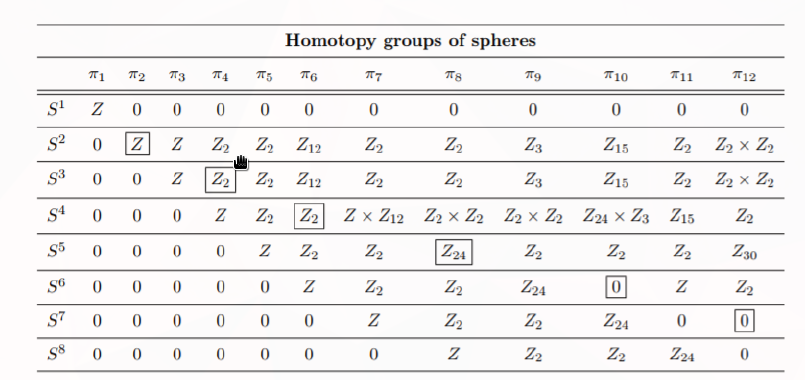
\(\pi_n(S^n) \cong \ZZ\) for \(n\geq 1\).
\(\pi_3(S^2) \cong \ZZ\), and \(\pi_k(S^2) \cong \pi_k(S^3)\) for \(k\geq 3\) by the Hopf fibration.
\(\pi_{n+1}(S^n) \cong \ZZ/2\) for \(n \geq 3\), and \(\pi_4(S^2)\cong\ZZ/2\).
\(\pi_{n+2}(S^n) \cong \ZZ/2\) for \(n\geq 2\).
\(\pi_{n+3}(S^n) \cong \ZZ/24\) for \(n\geq 5\), \(\pi_6(S^3)\cong\ZZ/12\), and \(\pi_7(S^4) \cong \ZZ \oplus \ZZ/12\).
Building a Moore space
For \(n\geq 1\) and \(p\geq 2\), attaching an \((n+1)\)-cell to \(S^n\) along a map \(\del D^{n+1}\to S^n\) of degree \(p\) gives a Moore space \(M(\ZZ/p, n)\). For finitely many abelian groups \(G_i\) with Moore spaces \(X_i=M(G_i,n)\), the wedge \(\bigvee_i X_i\) is an \(M(\bigoplus_i G_i, n)\). By the Mayer–Vietoris sequence, \(\tilde H_{n+1}(\Sigma X) \cong \tilde H_n(X)\), so \(\Sigma M(G,n)\) is an \(M(G,n+1)\).