Conformal maps
Conformal maps and biholomorphisms (Tag D-TM4TE)
Let \(\Omega\subseteq\CC\) be open. A map \(f\colon\Omega\to\CC\) is conformal on \(\Omega\) if \(f\) is holomorphic on \(\Omega\) and \(f'(z)\neq0\) for every \(z\in\Omega\).
Let \(U,V\subseteq\CC\) be open. A bijective conformal map \(f\colon U\to V\) is a biholomorphism, and \(U\) and \(V\) are biholomorphic, or conformally equivalent, if a biholomorphism \(U\to V\) exists.
A conformal map preserves signed angles between \(C^1\) curves with nonzero tangent vectors, because its derivative at each point is multiplication by a nonzero complex number; see the proposition on D-PCDNH.
Conformal map (Tag FD-GK7JE)
Let \(\Omega\subseteq\CC\) be open. A map \(f\colon\Omega\to\CC\) is conformal if \(f\) is holomorphic on \(\Omega\) and \(f'(z)\neq0\) for every \(z\in\Omega\).
A conformal map \(f\colon\Omega\to\CC\) is locally injective: every \(z_0\in\Omega\) has an open neighborhood on which \(f\) is injective.
Since \(f'(z_0)\neq0\), the holomorphic inverse function theorem gives an open neighborhood \(V\) of \(z_0\) such that \(f|_V\) is a bijection onto an open set with holomorphic inverse; in particular \(f|_V\) is injective.
$e^z$ is conformal on $\CC$ but not injective (Tag FE-O47RH)
A conformal map need not be injective. The map \(f\colon\CC\to\CC\), \(f(z)=e^z\), is holomorphic with \(f'(z)=e^z\neq0\) for all \(z\), so it is conformal on \(\CC\). It is not injective because it is periodic: \(e^{z+2\pi i}=e^z\). It is also not surjective, since \(e^z\neq0\) for all \(z\in\CC\).
(Holomorphic with nonvanishing derivative is conformal)
Let \(f\) be holomorphic at \(z_0\) with \(f'(z_0)\neq 0\), and let \(\gamma\) be a smooth curve with \(\gamma(0)=z_0\) and \(\gamma'(0)\neq 0\). By the chain rule \((f\circ\gamma)'(0) = f'(z_0)\,\gamma'(0)\), so \(f\) multiplies every tangent vector at \(z_0\) by the same nonzero complex number \(f'(z_0)\): it rotates by \(\arg f'(z_0)\) and scales by \(\abs{f'(z_0)}\). Hence the signed angle between two curves through \(z_0\) equals the signed angle between their images.
(Checking conformality)
A function \(f\) holomorphic at \(p\) with \(f'(p)\neq 0\) is conformal at \(p\).
(Complex conjugation)
The map \(f(z)=\bar z\) has invertible real Jacobian \(\operatorname{diag}(1,-1)\) at every point, but it fails the Cauchy–Riemann equations, so it has no complex derivative. It reverses signed angles and is not conformal.
(Inverses)
An injective holomorphic map \(f\) on an open set \(U\) has \(f'\neq 0\) on \(U\), and \(\inverseof{f}\colon f(U)\to U\) is holomorphic (Injective holomorphic maps have nonvanishing derivative). The biholomorphisms of an open set \(\Omega\) onto itself therefore form a group \(\Aut_\CC(\Omega)\), computed for the disc on Blaschke factors and automorphisms.
The transformations
Möbius transformation (Tag D-FRVBV)
Let \(a,b,c,d\in\CC\) with \(ad-bc\neq0\). The map \[ T(z)\coloneqq\frac{az+b}{cz+d}, \] defined for \(z\in\CC\) with \(cz+d\neq0\), is a linear fractional transformation, or Möbius transformation.
Let \(T(z)=(az+b)/(cz+d)\) with \(ad-bc\neq0\).
\(T\) is a bijection from \(\{z\in\CC:cz+d\neq0\}\) onto \(\{w\in\CC:-cw+a\neq0\}\), with inverse \[ T^{-1}(w)=\frac{dw-b}{-cw+a}. \]
\(T\) is holomorphic on \(\{z\in\CC:cz+d\neq0\}\), with \[ T'(z)=\frac{ad-bc}{(cz+d)^2}\neq0, \] so \(T\) is conformal there.
For \(cz+d\neq0\), \(-c\,T(z)+a=(ad-bc)/(cz+d)\neq0\), and \[ \frac{d\,T(z)-b}{-c\,T(z)+a}=\frac{d(az+b)-b(cz+d)}{-c(az+b)+a(cz+d)}=\frac{(ad-bc)z}{ad-bc}=z. \] The map \(w\mapsto(dw-b)/(-cw+a)\) has coefficients with \(da-bc\neq0\), and the same computation shows that \(T\) inverts it on \(\{w:-cw+a\neq0\}\).
By the quotient rule, \[ T'(z)=\frac{a(cz+d)-c(az+b)}{(cz+d)^2}=\frac{ad-bc}{(cz+d)^2}, \] which is nonzero because \(ad-bc\neq0\).
(As projective linear automorphisms)
Since \(\Aut(\CP^1) \cong \PGL_2(\CC)\), acting on projective coordinates gives a matrix representation: \[ \matt a b c d \cdot \tv{z: 1}^t = \tv{ {az+b \over cz + d }: 1} = \tv{f(z): 1} .\] Nonzero scalar multiples of a matrix give the same transformation, so the inverse transformation is given by the adjugate matrix: \[ {az + b\over cz+ d} \leadsto \matt a b c \inverseof{d} = \matt d {-b} {-c} a \leadsto {dw-b \over -cw + a} .\]
A Möbius transformation \(z\mapsto (az+b)/(cz+d)\) fixing three distinct points of \(\CC\) is the identity: its fixed points in \(\CC\) are the roots of \(cz^2 + (d-a)z - b = 0\), and a polynomial of degree at most \(2\) with three roots is zero, so \(c=b=0\) and \(a=d\). This gives the uniqueness in Three points determine a Möbius transformation.
Three points determine a Möbius transformation (Tag PR-74KHY)
Let \(z_1, z_2, z_3\in\CC\) be distinct. The Möbius transformation \[ T(z) \coloneqq { (z-z_1) (z_2-z_3) \over (z-z_3) (z_2 - z_1)} \] satisfies \(T(z_1)=0\), \(T(z_2)=1\), and \(T(z_3)=\infty\), and it is the unique Möbius transformation with these values. It is denoted \((z; z_1, z_2, z_3)\).
Consequently, for distinct \(w_1,w_2,w_3\in\CC\), the map \[ S\inverseof{\coloneqq(\,\cdot\,; w_1, w_2, w_3)} \circ (\,\cdot\,; z_1,z_2, z_3) \] is the unique Möbius transformation with \(S(z_j)=w_j\) for \(j=1,2,3\).
Substituting \(z_1\), \(z_2\), \(z_3\) into \(T\) gives \(0\), \(1\), \(\infty\). If \(T'\) is another Möbius transformation with the same values, then \(R\coloneqq T'\circ \inverseof{T}\) fixes \(0\), \(1\), and \(\infty\). Fixing \(\infty\) forces \(R(z)=az+b\); fixing \(0\) forces \(b=0\); fixing \(1\) forces \(a=1\); so \(R=\id\) and \(T'=T\). The map \(S\) is a composite of Möbius transformations, and it sends \(z_1,z_2,z_3\) to \(0,1,\infty\) and then to \(w_1,w_2,w_3\). If \(S'\) is another Möbius transformation with \(S'(z_j)=w_j\) for \(j=1,2,3\), then \((\,\cdot\,;w_1,w_2,w_3)\circ S'\inverseof{\circ(\,\cdot\,;z_1,z_2,z_3)}\) fixes \(0\), \(1\), and \(\infty\), so it is the identity by the same argument, and \(S'=S\).
In [@Ahl79, Chapter 3, Section 3.2, Definition 12], the cross ratio \((z_1,z_2,z_3,z_4)\) has four arguments: it is the image of \(z_1\) under the Möbius transformation carrying \(z_2, z_3, z_4\) to \(1, 0, \infty\). In that notation, \((z;z_1,z_2,z_3)=(z,z_2,z_1,z_3)\).
The cross ratio
Cross-ratio construction of conformal maps (Tag PR-AQ6YR)
For \(z_1\in\CC\) and distinct \(z_2,z_3,z_4\in\CC\), write \[ (z_1, z_2, z_3, z_4) \coloneqq {z_1 - z_3\over z_1-z_4}\cdot{z_2 - z_4 \over z_2 - z_3}. \]
For distinct \(a,b,c\in\CC\), the map \[ R(z) \coloneqq (z, a,b,c) = {z - b\over z-c}\cdot{a - c\over a - b} \] is a Möbius transformation with \(R(a)=1\), \(R(b)=0\), and \(R(c)=\infty\).
If one of \(a,b,c\) is \(\infty\), the factors containing it are deleted, and the resulting Möbius transformation has the same three values: \[ (z,\infty,b,c)={z-b\over z-c},\qquad (z,a,\infty,c)={a-c\over z-c},\qquad (z,a,b,\infty)={z-b\over a-b}. \]
For distinct \(z_1,z_2,z_3\) and distinct \(w_1,w_2,w_3\) in \(\CC\cup\theset{\infty}\), let \(R_z(z)\coloneqq(z,z_1,z_2,z_3)\) and \(R_w(w)\coloneqq(w,w_1,w_2,w_3)\). Then \(T\coloneqq \inverseof{R_w}\circ R_z\) is a Möbius transformation with \(T(z_j)=w_j\) for \(j=1,2,3\).
Parts (a) and (b) follow by substituting \(a\), \(b\), \(c\) into each formula; each formula is a quotient of affine functions of \(z\) with nonzero determinant because \(a,b,c\) are distinct. For (c), \(R_z\) sends \(z_1,z_2,z_3\) to \(1,0,\infty\), and \(\inverseof{R_w}\) sends \(1,0,\infty\) to \(w_1,w_2,w_3\); a composite of Möbius transformations is a Möbius transformation.
Cross-ratio map (Tag FF-W4FFF)
Let \(z_2,z_3,z_4\in\CC\) be distinct. The cross-ratio map is the Möbius transformation \[ R(z) \coloneqq (z, z_2, z_3, z_4) \coloneqq {z - z_3\over z-z_4}\cdot{z_2 - z_4 \over z_2 - z_3}. \] It satisfies \(R(z_2)=1\), \(R(z_3)=0\), and \(R(z_4)=\infty\).
(Maps given by cross ratios)
\(z\mapsto(z, i, 1, -1)\) maps \(\DD\) onto \(\HH\).
\(z\mapsto(z, 0, -1, 1)\) maps \(\DD \intersect \HH\) onto the first quadrant \(Q_1\).
Classification and standard images
Möbius transformations map generalized circles to generalized circles, and hence map discs and half-planes onto discs and half-planes. A branch of \(z\mapsto z^\alpha\) on a sector of opening \(\theta\) at \(0\), with \(\alpha\theta\leq 2\pi\), maps it onto a sector of opening \(\alpha\theta\). A branch of \(\log\) maps the sector \(\ts{\theta_1<\arg z<\theta_2}\) onto the strip \(\ts{\theta_1<\Im w<\theta_2}\), and \(\exp\) is its inverse.
The Cayley transform maps \(\HH\) onto \(\DD\). Any two biholomorphisms of an open set onto \(\DD\) differ by an automorphism of \(\DD\), and the Riemann mapping theorem gives the existence of one for every simply connected open \(\Omega\subsetneq\CC\).
Cayley transform $\frac{i-z}{i+z}$ between the upper half-plane and the disc (Tag T-77SHB)
The fractional linear transformation \[ G(w)=i\,\frac{1-w}{1+w} \] maps the unit disc \(\DD\) biholomorphically onto the upper half-plane \(\HH=\ts{z\st\Im z>0}\). Its inverse is \[ F(z)=\frac{i-z}{i+z}, \] which maps \(\HH\) biholomorphically onto \(\DD\).
For \(w\in\DD\), \(w\neq-1\) and \[ \Im G(w)=\Re\frac{1-w}{1+w}=\frac{\Re\big((1-w)(1+\bar w)\big)}{\abs{1+w}^2}=\frac{1-\abs w^2}{\abs{1+w}^2}>0. \] For \(z\in\HH\), \(z\) is closer to \(i\) than to \(-i\), so \(\abs{F(z)}<1\). Solving \(z=i\frac{1-w}{1+w}\) gives \(z+zw=i-iw\), so \(w(z+i)=i-z\) and \(w=F(z)\); hence \(F\) and \(G\) are mutually inverse holomorphic maps.
Automorphisms of the unit disc as rotated Blaschke factors (Tag T-W26VL)
For \(a\in\DD\) let \(\psi_a(z)\coloneqq\dfrac{a-z}{1-\overline{a}z}\) be the Blaschke factor at \(a\). The group \(\Aut_\CC(\DD)\) of biholomorphisms \(\DD\to\DD\) is \[ \Aut_\CC(\DD)=\{\lambda\psi_a : a\in\DD,\ \lambda\in S^1\}, \] so every automorphism of \(\DD\) is a Blaschke factor followed by a rotation [@SS03].
Riemann mapping theorem (Tag T-55MPA)
Let \(\Omega\subsetneq\CC\) be a nonempty simply connected open set. Then for every \(z_0\in\Omega\) there exists a unique biholomorphism \(F\colon\Omega\to\DD\) such that \(F(z_0)=0\) and \(F'(z_0)>0\). In particular, any two nonempty simply connected open sets \(\Omega_1,\Omega_2\subsetneq\CC\) are biholomorphic.
Standard conformal maps between half-planes, sectors, strips and discs (Tag T-2KGOX)
Write \(\HH=\ts{\Im z>0}\) for the upper half-plane, \(\DD^+=\ts{\abs z<1,\ \Im z>0}\) for the upper half-disc, \(Q_1=\ts{\Re z>0,\ \Im z>0}\) for the first quadrant, \(S_\beta=\ts{re^{i\theta}\st r>0,\ 0<\theta<\beta}\) for the sector of opening \(\beta\), \(\Sigma=\ts{0<\Im z<\pi}\) for the horizontal strip, and \(\Log\) for the principal branch of the logarithm. Each of the following maps is a biholomorphism from the stated domain onto the stated target.
| Domain | Target | Map |
|---|---|---|
| \(\CC\) | \(\CC\) | translation \(z\mapsto z+h\), \(h\in\CC\) |
| \(\CC\) | \(\CC\) | dilation \(z\mapsto cz\), \(c>0\) |
| \(\CC\) | \(\CC\) | rotation \(z\mapsto e^{i\theta}z\), \(\theta\in\RR\) |
| \(S_{\pi/n}\), \(n\ge1\) | \(\HH\) | \(z\mapsto z^n\) (PR-PDYJC) |
| \(\DD^+\) | \(Q_1\) | \(z\mapsto\frac{1+z}{1-z}\) (PR-PW4Z6) |
| \(\HH\) | \(\Sigma\) | \(z\mapsto\Log z\) (PR-XCDL5) |
| \(\DD^+\) | \(\ts{\Re w<0,\ 0<\Im w<\pi}\) | \(z\mapsto\Log z\) (PR-PELLF) |
| \(\ts{0<\Re z<\pi,\ \Im z>0}\) | \(\DD^+\) | \(z\mapsto e^{iz}\) |
| \(\DD^+\) | \(\HH\) | \(z\mapsto-\frac12\big(z+\frac1z\big)\) (PR-OTMIR) |
| \(\ts{-\frac\pi2<\Re z<\frac\pi2,\ \Im z>0}\) | \(\HH\) | \(z\mapsto\sin z\) (PR-3LBLV) |
Half-plane to disc (Tag PR-FL6T7)
The Möbius transformation \[ \begin{aligned} F\colon \HH=\ts{z\st \Im(z) > 0 } &\to \DD=\ts{w\st \abs{w} < 1 }, \\ z &\mapsto {i-z \over i+z} \end{aligned} \] is a biholomorphism with inverse \(w\mapsto i \qty{1-w \over 1+w}\).
For \(z\in\HH\), the point \(z\) is closer to \(i\) than to \(-i\), so \(\abs{i-z}<\abs{i+z}\) and \(F(z)\in\DD\). Solving \(w(i+z)=i-z\) for \(z\) gives \(z=i\frac{1-w}{1+w}\), and for \(w\in\DD\), \[ \Im\qty{i\frac{1-w}{1+w}}=\frac{1-\abs{w}^2}{\abs{1+w}^2}>0, \] so the inverse maps \(\DD\) into \(\HH\). Both maps are holomorphic on these sets and mutually inverse.
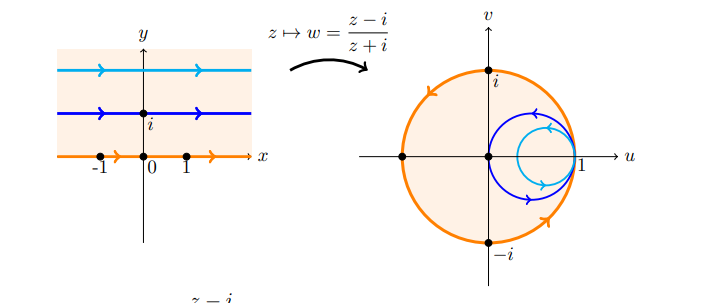
\(F\) extends to a homeomorphism from \(\RR\cup\theset{\infty}\) onto the unit circle, with \(F(\infty) = -1\), \(F(-1)=-i\), and \(F(0)=1\). As \(x\) increases from \(-\infty\) to \(\infty\) along \(\RR\), \(F(x)\) travels counterclockwise around the circle, starting at \(-1\) and passing through the lower half first.
A sector of opening \(\theta\) is mapped onto a half-plane by a power map with \(\alpha = \pi/\theta\), and then onto \(\DD\) by the Cayley transform; it is mapped onto a strip by a branch of \(\log\) whose argument interval is that of the sector.
The map \(z\mapsto {z-i\over z+i}\) is also used as the Cayley transform; it is the composition of \(F(z) = (i-z)/(i+z)\) from Cayley transform $\frac{i-z}{i+z}$ between the upper half-plane and the disc with \(w\mapsto -w\): \[ - {i-z \over i + z} = {z-i \over i+z} = {z-i \over z+i} .\]
Biholomorphism from the right half-plane onto the unit disc (Tag PR-L5UH3)
Let \(\HH_R\coloneqq\ts{z\in\CC \st \Re z>0}\) be the right half-plane and \(\DD\coloneqq\ts{w\in\CC \st \abs{w}<1}\) the unit disc. The map \[ \varphi\colon\HH_R\to\DD,\qquad \varphi(z)=\frac{1-z}{1+z}, \] is a biholomorphism, with inverse \(\varphi^{-1}\colon\DD\to\HH_R\), \(\varphi^{-1}(w)=\frac{1-w}{1+w}\).
For \(z\in\HH_R\) we have \(1+z\neq0\), and \[ \abs{1-z}^2-\abs{1+z}^2=-4\Re z<0, \] so \(z\) is closer to \(1\) than to \(-1\) and \(\abs{\varphi(z)}<1\). Hence \(\varphi\) is a holomorphic map \(\HH_R\to\DD\). The same map is the composite of the rotation \(z\mapsto iz\), which maps \(\HH_R\) onto the upper half-plane \(\HH=\ts{u\in\CC\st\Im u>0}\), with the Cayley map \(u\mapsto\frac{i-u}{i+u}\) from \(\HH\) onto \(\DD\): \[ \frac{i-iz}{i+iz}=\frac{1-z}{1+z}. \]
For \(w\in\DD\) we have \(w\neq-1\), so \(\psi(w)\coloneqq\frac{1-w}{1+w}\) is holomorphic on \(\DD\), and \[ \Re\psi(w)=\frac{\Re\big((1-w)(1+\bar w)\big)}{\abs{1+w}^2}=\frac{1-\abs{w}^2}{\abs{1+w}^2}>0, \] so \(\psi\) maps \(\DD\) into \(\HH_R\). If \(w=\varphi(z)\), then \(w+wz=1-z\), so \(z(1+w)=1-w\) and \(z=\psi(w)\); thus \(\psi\circ\varphi=\id_{\HH_R}\). The same computation with the roles of \(z\) and \(w\) exchanged gives \(\varphi\circ\psi=\id_{\DD}\).
The formula \(\frac{1-z}{1+z}\) also maps the imaginary axis into the unit circle: for \(t\in\RR\), the numbers \(1-it\) and \(1+it\) are complex conjugates, so \(\abs{\frac{1-it}{1+it}}=1\).
Power maps between sectors (Tag PR-PDYJC)
For \(0<\beta\le2\pi\) let \(S_\beta\coloneqq\ts{re^{i\theta}\st r>0,\ 0<\theta<\beta}\) be the open sector of opening \(\beta\), so that \(S_\pi=\HH\). Let \(0<\alpha<2\), and on \(S_{2\pi}=\CC\sm[0,\infty)\) define \(z^\alpha\coloneqq r^\alpha e^{i\alpha\theta}\) for \(z=re^{i\theta}\), \(0<\theta<2\pi\). Then \[ F_\alpha\colon\HH\to S_{\alpha\pi},\qquad F_\alpha(z)=z^\alpha, \] is a biholomorphism, with inverse \(w\mapsto w^{1/\alpha}\) defined by the same choice of argument in \((0,2\pi)\). Equivalently, for \(0<\beta<2\pi\) the map \(z\mapsto z^{\pi/\beta}\) is a biholomorphism \(S_\beta\to\HH\).
With the argument taken in \((0,2\pi)\), \(z\mapsto z^\alpha=e^{\alpha(\ln r+i\theta)}\) is holomorphic on \(S_{2\pi}\). It maps \(re^{i\theta}\) with \(0<\theta<\pi\) to \(r^\alpha e^{i\alpha\theta}\) with \(0<\alpha\theta<\alpha\pi<2\pi\); since \(r\mapsto r^\alpha\) is a bijection of \((0,\infty)\) and \(\theta\mapsto\alpha\theta\) is a bijection \((0,\pi)\to(0,\alpha\pi)\), the map is a bijection \(\HH\to S_{\alpha\pi}\) with inverse \(\rho e^{i\varphi}\mapsto\rho^{1/\alpha}e^{i\varphi/\alpha}\), which is also holomorphic. The second statement is the first with \(\alpha=\beta/\pi\), inverted.
The formula \(z^\alpha\) extends continuously to the boundary of \(\HH\). As \(x\) increases from \(0\) to \(\infty\) along the positive real axis, \(x^\alpha\) increases from \(0\) to \(\infty\) along the positive real axis. As \(x\) increases from \(-\infty\) to \(0\) along the negative real axis, \(x^\alpha=\abs{x}^\alpha e^{i\alpha\pi}\) moves from \(\infty\) to \(0\) along the ray \(\ts{te^{i\alpha\pi}\st t>0}\).
Sector to disc (Tag PR-BPP7D)
For \(0<\alpha\le2\pi\), let \(S_\alpha\coloneqq\ts{ z \st 0 < \arg(z) < \alpha }\), with \(\arg z\in(0,\alpha)\) as in PR-AQFRA. Then \[ \begin{aligned} F\colon S_{\alpha} &\to \DD, \\ z &\mapsto {z^{\pi/\alpha} - i \over z^{\pi/\alpha} + i} \end{aligned} \] is a biholomorphism.
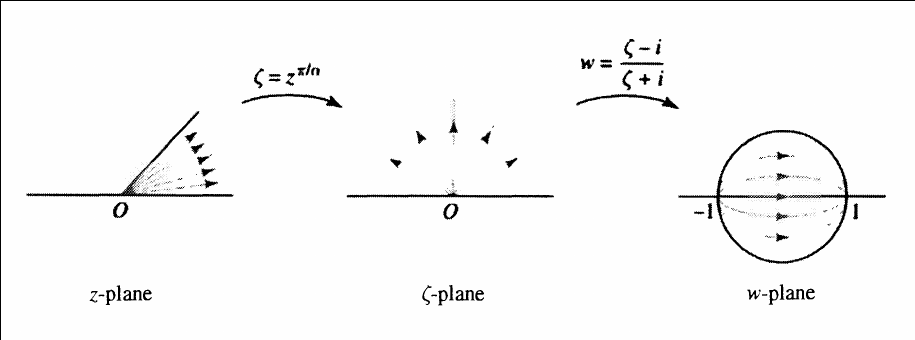
\(F\) is the composite \[ S_{\alpha} \xrightarrow{\ z\mapsto z^{\pi/\alpha}\ } S_{\pi} = \HH \xrightarrow{\ u\mapsto \frac{u-i}{u+i}\ } \DD. \] The first map is a biholomorphism by PR-AQFRA. The second is a Möbius transformation; for \(u\in\HH\) the point \(u\) is closer to \(i\) than to \(-i\), so \(\abs{u-i}<\abs{u+i}\) and the image lies in \(\DD\), and its inverse \(w\mapsto i\frac{1+w}{1-w}\) maps \(\DD\) into \(\HH\), since \(\Im\qty{i\frac{1+w}{1-w}}=\frac{1-\abs{w}^2}{\abs{1-w}^2}>0\). A composite of biholomorphisms is a biholomorphism.
Möbius map from the upper half-disc to the first quadrant (Tag PR-PW4Z6)
The map \[ f\colon\ts{z\st\abs{z}<1,\ \Im z>0}\to\ts{w\st\Re w>0,\ \Im w>0},\qquad f(z)=\frac{1+z}{1-z}, \] is a biholomorphism from the upper half-disc onto the first quadrant, with inverse \(f^{-1}(w)=\frac{w-1}{w+1}\).
For \(z=x+iy\) with \(x^2+y^2<1\) and \(y>0\), multiplying numerator and denominator by \(1-\bar z\) gives \[ f(z)=\frac{(1+z)(1-\bar z)}{\abs{1-z}^2}=\frac{1-(x^2+y^2)}{(1-x)^2+y^2}+i\,\frac{2y}{(1-x)^2+y^2}, \] and both parts are positive, so \(f(z)\) lies in the first quadrant.
For \(w=u+iv\) with \(u,v>0\), the point \(w\) is closer to \(1\) than to \(-1\) because \(u>0\), so \(\abs{\frac{w-1}{w+1}}<1\). Moreover \[ \frac{w-1}{w+1}=\frac{(u-1+iv)(u+1-iv)}{(u+1)^2+v^2}=\frac{u^2+v^2-1}{(u+1)^2+v^2}+i\,\frac{2v}{(u+1)^2+v^2}, \] whose imaginary part is positive. So \(w\mapsto\frac{w-1}{w+1}\) maps the first quadrant into the upper half-disc, and solving \(w=\frac{1+z}{1-z}\) for \(z\) shows that the two maps are mutually inverse.
On the upper unit semicircle, for \(z=e^{i\theta}\) with \(0<\theta<\pi\), \[ f(e^{i\theta})=\frac{e^{-i\theta/2}+e^{i\theta/2}}{e^{-i\theta/2}-e^{i\theta/2}}=\frac{2\cos(\theta/2)}{-2i\sin(\theta/2)}=i\cot(\theta/2), \] so as \(\theta\) increases from \(0\) to \(\pi\), \(f(e^{i\theta})\) moves from \(i\infty\) to \(0\) along the positive imaginary axis. As \(x\) increases from \(-1\) to \(1\), \(f(x)=\frac{1+x}{1-x}\) increases from \(0\) to \(\infty\) along the positive real axis, with \(f(0)=1\).
Logarithm from the upper half-plane to a horizontal strip (Tag PR-XCDL5)
Let \(\Log\) be the principal branch of the logarithm. The map \[ F\colon\HH=\ts{z\st\Im z>0}\to\ts{w\st0<\Im w<\pi},\qquad F(z)=\Log z, \] is a biholomorphism, with inverse \(w\mapsto e^w\).
For \(z\in\HH\) write \(z=re^{i\theta}\) with \(r>0\) and \(\theta\in(0,\pi)\); then \(\Log z=\ln r+i\theta\). Since \(r\mapsto\ln r\) is a bijection \((0,\infty)\to\RR\), \(F\) is a bijection onto the strip, and \(e^{\ln r+i\theta}=re^{i\theta}\) gives the holomorphic inverse.
The map extends continuously to the boundary of \(\HH\) minus \(0\), with the argument \(\pi\) on the negative real axis. As \(x\) increases from \(-\infty\) to \(0\), \(F(x)=\ln\abs x+i\pi\) moves from \(+\infty+i\pi\) to \(-\infty+i\pi\) along the line \(\Im w=\pi\). As \(x\) increases from \(0\) to \(\infty\), \(F(x)=\ln x\) moves from \(-\infty\) to \(+\infty\) along \(\RR\).
(The logarithm)
The principal branch \(\Log\) maps \(\CC\sm\RR^{\leq 0}\) onto \(\RR \cross (-\pi, \pi)\): the part of the circle of radius \(R\) in the slit plane maps to the open vertical segment from \(\ln R - i\pi\) to \(\ln R + i\pi\), and rays from \(0\) map to horizontal lines.
It also maps \[ \begin{aligned} \ts{ z \st \abs{z} < 1,\, \Im(z) > 0 } &\mapstofrom \RR^{<0} \cross (0, \pi ) \\ \ts{ z \st \abs{z} > 1,\, \Im(z) > 0 } &\mapstofrom \RR^{>0} \cross (0, \pi ) \end{aligned}.\] On the boundary of the upper half disc: as \(x\) runs from \(0\) to \(1\) in \(\RR\), \(\Log x\) runs from \(-\infty\) to \(0\); as \(z\) runs from \(1\) to \(-1\) along \(S^1\intersect\overline\HH\), \(\Log z\) runs from \(0\) to \(i\pi\) vertically; as \(x\) runs from \(-1\) to \(0\), \(\Log x\), extended continuously from \(\HH\), runs from \(i\pi\) to \(-\infty + i\pi\).
Exponential map from a vertical half-strip to a half-disc (Tag PR-TQDIL)
The map \[ F\colon\ts{z\st\abs{\Re z}<\tfrac\pi2,\ \Im z>0}\to\ts{w\st\abs{w}<1,\ \Re w>0},\qquad F(z)=e^{iz}, \] is a biholomorphism from the vertical half-strip onto the right half-disc, with inverse \(w\mapsto-i\Log w\), where \(\Log\) is the principal branch of the logarithm.
For \(z=x+iy\), \(e^{iz}=e^{-y}e^{ix}\). As \(y\) ranges over \((0,\infty)\) the modulus \(e^{-y}\) ranges bijectively over \((0,1)\), and as \(x\) ranges over \((-\pi/2,\pi/2)\) the argument \(x\) ranges over the arguments of points with positive real part. So \(F\) is a bijection onto the right half-disc. For such \(w=\rho e^{ix}\), \(-i\Log w=-i(\ln\rho+ix)=x-i\ln\rho=x+iy\) with \(y=-\ln\rho\), which is the holomorphic inverse.
Half-disc to upper half-plane (Tag PR-FRVPJ)
Let \(D^+\coloneqq\theset{z\in\CC : \abs{z}<1,\ \Im z>0}\) be the upper half-disc. Then \[ \begin{aligned} F\colon D^+ &\to \HH, \\ z & \mapsto -{1\over 2}\qty{z + \inverseof{z}} \end{aligned} \] is a biholomorphism.
For \(z=re^{i\theta}\) with \(0<r<1\) and \(0<\theta<\pi\), \(\Im F(z)=-\frac12\qty{r-\inverseof{r}}\sin\theta>0\), so \(F(D^+)\subseteq\HH\). For \(c\in\HH\), the solutions of \(F(z)=c\) are the roots of \(z^2+2cz+1=0\), whose product is \(1\). A root on the unit circle would make \(F(z)=-\Re z\) real, so neither root lies on the circle and exactly one root \(z\) satisfies \(\abs{z}<1\); then \(\Im F(z)>0\) forces \(\sin\theta>0\), so \(z\in D^+\). Hence \(F\colon D^+\to\HH\) is a holomorphic bijection, and a bijective holomorphic map has a holomorphic inverse.
Centered vertical half-strip to upper half-plane by $\sin$ (Tag PR-3LBLV)
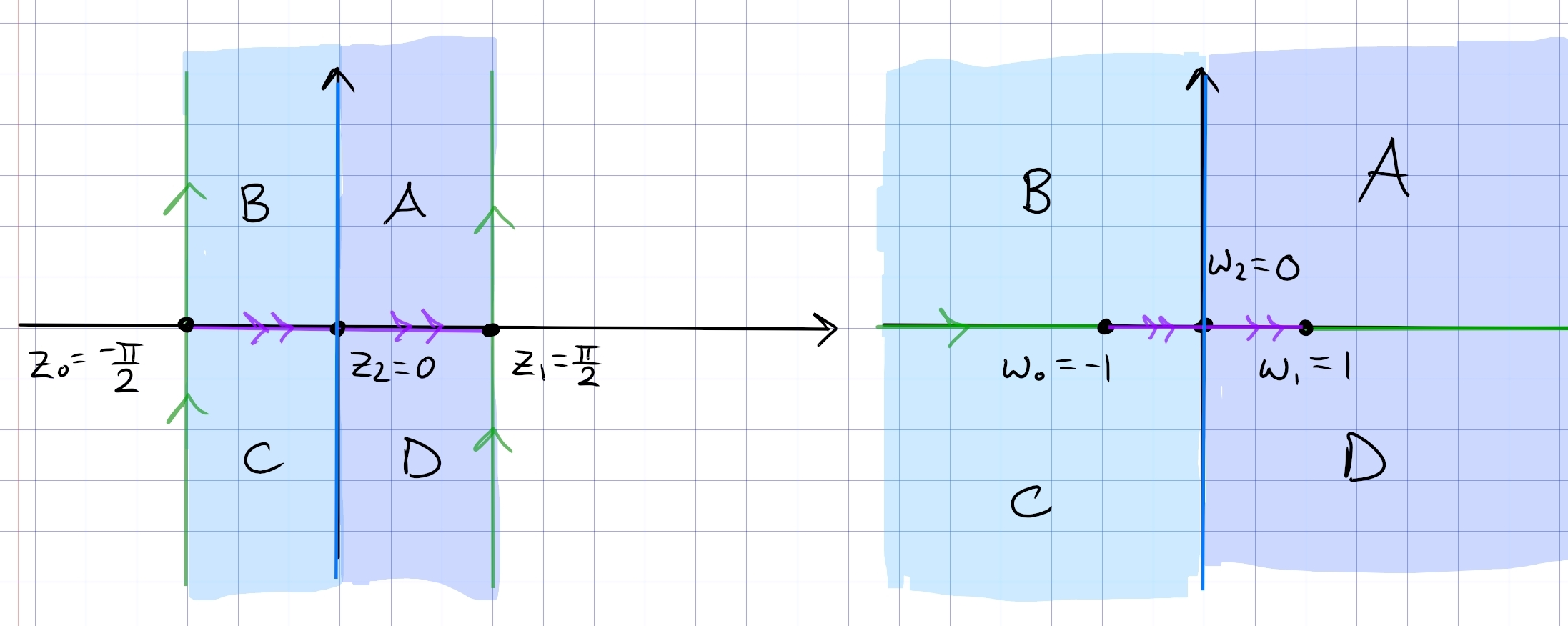
Let \(S\coloneqq\theset{z\in\CC : -\pi/2<\Re z<\pi/2,\ \Im z>0}\). Then \(\sin\) restricts to a biholomorphism \(S\to\HH\), and its inverse \(\arcsin\colon\HH\to S\) is a biholomorphism from the upper half-plane onto the vertical half-strip.
Let \(J(u)\coloneqq\frac12\qty{u+\inverseof{u}}\) for \(u\neq0\). For every \(z\in\CC\), \[ \sin(z)=\frac{e^{iz}-e^{-iz}}{2i}=-\frac12\qty{ie^{iz}+\frac{1}{ie^{iz}}}=-J\qty{ie^{iz}}, \] so \(\sin\) on \(S\) is the composite of the following holomorphic maps, each of which is a bijection onto the stated set.
\(z\mapsto iz\) maps \(S\) onto \(\theset{\zeta : \Re\zeta<0,\ \abs{\Im\zeta}<\pi/2}\).
\(\zeta\mapsto e^\zeta\) maps that half-strip onto \(\theset{w : \abs{w}<1,\ \Re w>0}\): for \(\zeta=s+it\) with \(s<0\) and \(\abs{t}<\pi/2\), \(e^\zeta\) has modulus \(e^s\in(0,1)\) and argument \(t\in(-\pi/2,\pi/2)\), and each such modulus and argument occur exactly once.
\(w\mapsto iw\) maps that half-disc onto the upper half-disc \(\theset{u : \abs{u}<1,\ \Im u>0}\).
\(J\) maps the upper half-disc onto the lower half-plane. For \(u=re^{i\theta}\) with \(0<r<1\) and \(0<\theta<\pi\), \(\Im J(u)=\frac12\qty{r-\inverseof{r}}\sin\theta<0\). For \(c\) in the lower half-plane, the solutions of \(J(u)=c\) are the roots of \(u^2-2cu+1=0\), whose product is \(1\); neither root lies on the unit circle, where \(J\) is real, so exactly one root \(u\) satisfies \(\abs{u}<1\), and \(\Im J(u)<0\) forces \(\sin\theta>0\), so that root lies in the upper half-disc.
\(v\mapsto-v\) maps the lower half-plane onto \(\HH\).
A bijective holomorphic map has a holomorphic inverse, so \(\sin\colon S\to\HH\) is a biholomorphism.
The boundary of \(S\) maps onto \(\RR\): the segment \([-\pi/2,\pi/2]\) maps onto \([-1,1]\), the ray \(\pi/2+it\) (\(t\ge0\)) maps to \(\sin(\pi/2+it)=\cosh t\), tracing \([1,\infty)\), and the ray \(-\pi/2+it\) maps to \(-\cosh t\), tracing \((-\infty,-1]\). The imaginary axis \(it\) (\(t>0\)) maps to \(\sin(it)=i\sinh t\), the positive imaginary axis.
Compositions of these maps between standard regions are on Build me a map.