For \(0<\alpha\le2\pi\), let \(S_\alpha\coloneqq\ts{ z \st 0 < \arg(z) < \alpha }\), with \(\arg z\in(0,\alpha)\) as in PR-AQFRA. Then \[ \begin{aligned} F\colon S_{\alpha} &\to \DD, \\ z &\mapsto {z^{\pi/\alpha} - i \over z^{\pi/\alpha} + i} \end{aligned} \] is a biholomorphism.
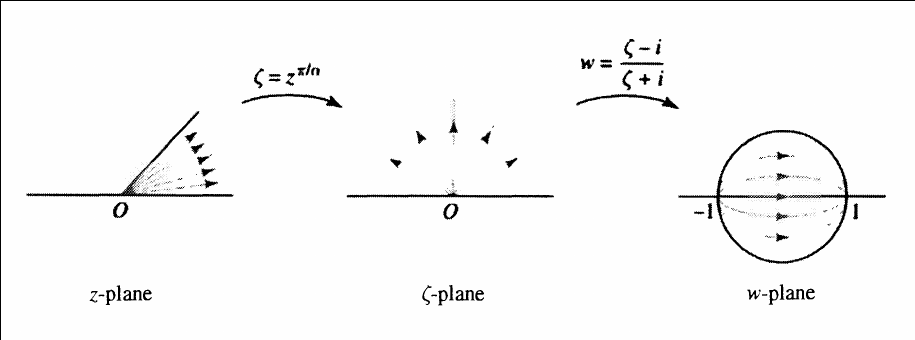
\(F\) is the composite \[ S_{\alpha} \xrightarrow{\ z\mapsto z^{\pi/\alpha}\ } S_{\pi} = \HH \xrightarrow{\ u\mapsto \frac{u-i}{u+i}\ } \DD. \] The first map is a biholomorphism by PR-AQFRA. The second is a Möbius transformation; for \(u\in\HH\) the point \(u\) is closer to \(i\) than to \(-i\), so \(\abs{u-i}<\abs{u+i}\) and the image lies in \(\DD\), and its inverse \(w\mapsto i\frac{1+w}{1-w}\) maps \(\DD\) into \(\HH\), since \(\Im\qty{i\frac{1+w}{1-w}}=\frac{1-\abs{w}^2}{\abs{1-w}^2}>0\). A composite of biholomorphisms is a biholomorphism.