For \(0<\alpha\le2\pi\), let \(S_\alpha\coloneqq\theset{re^{i\theta} : r>0,\ 0<\theta<\alpha}\), so that \(S_\pi=\HH\).
For an integer \(n\ge1\), \[ \begin{aligned} F\colon S_{\pi/n} &\to \HH, \\ z &\mapsto z^n \end{aligned} \] is a biholomorphism with inverse \(w\mapsto w^{1/n}\), the principal branch.
For \(0 < \alpha \le 2\pi\), \[ \begin{aligned} F\colon \HH &\to S_\alpha, \\ z &\mapsto z^{\alpha/\pi} \end{aligned} \] is a biholomorphism with inverse \(w\mapsto w^{\pi/\alpha}\). Here \(z^{\alpha/\pi}=e^{(\alpha/\pi)\Log z}\) uses the principal branch on \(\HH\), and \(w^{\pi/\alpha}=e^{(\pi/\alpha)(\log\abs{w}+i\theta)}\) uses the argument \(\theta\in(0,\alpha)\) of \(w\in S_\alpha\).
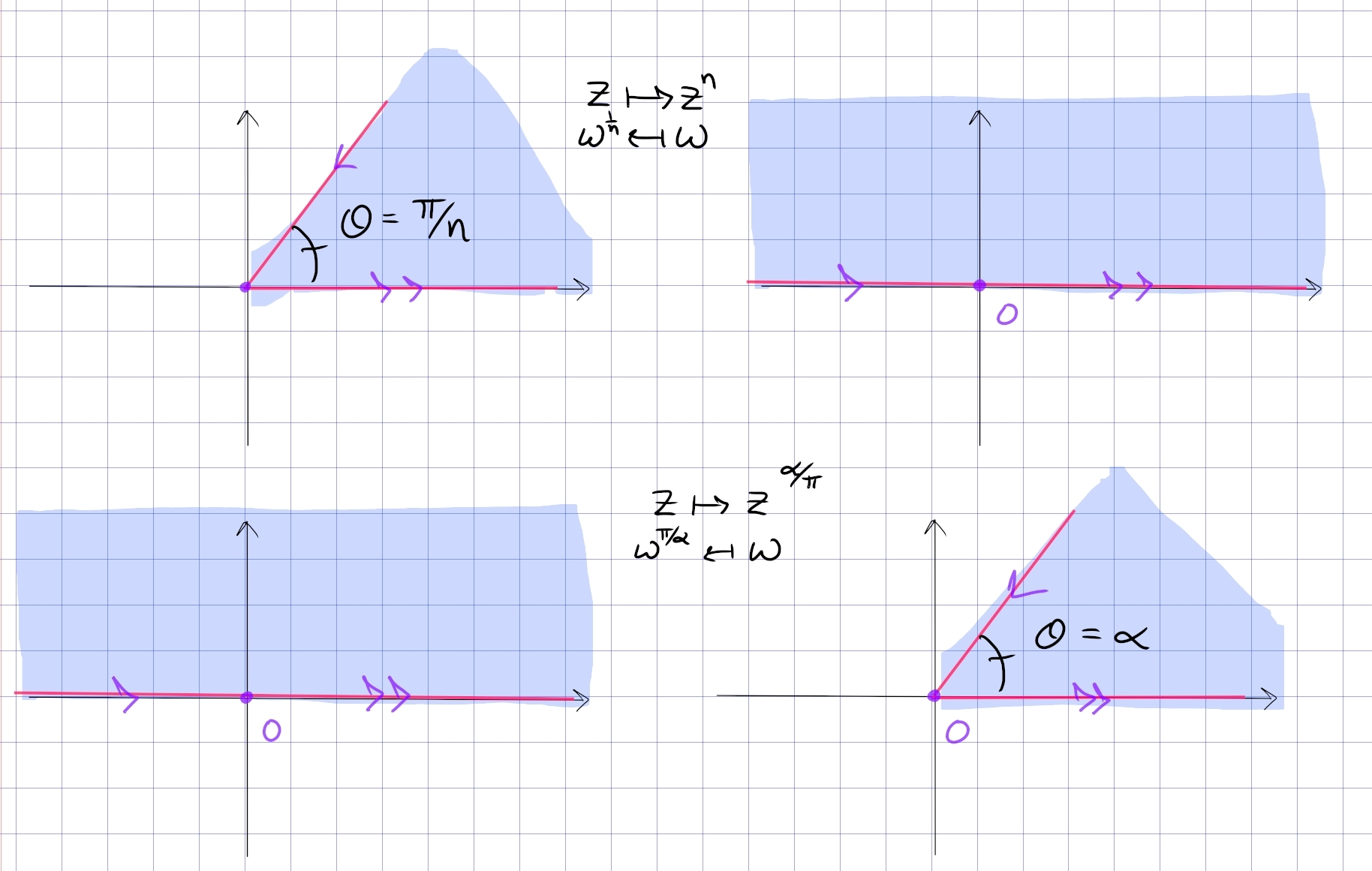
For (b), write \(z=re^{i\theta}\) with \(r>0\) and \(\theta\in(0,\pi)\); then \(z^{\alpha/\pi}=r^{\alpha/\pi}e^{i\alpha\theta/\pi}\), whose argument \(\alpha\theta/\pi\) ranges over \((0,\alpha)\). Since \(r\mapsto r^{\alpha/\pi}\) is a bijection of \((0,\infty)\) and \(\theta\mapsto\alpha\theta/\pi\) is a bijection \((0,\pi)\to(0,\alpha)\), \(F\) is a bijection \(\HH\to S_\alpha\), and the stated inverse multiplies the argument by \(\pi/\alpha\) and raises the modulus to the power \(\pi/\alpha\). Both maps are holomorphic, since on \(S_\alpha\) the chosen argument is a continuous branch of \(\arg\). Part (a) is the case \(\alpha=\pi/n\) of (b), read in the opposite direction: \(z\mapsto z^n\) is the inverse \(w\mapsto w^{\pi/\alpha}\), and on \(\HH\) the principal branch of \(w^{1/n}\) is \(z\mapsto z^{\alpha/\pi}\).