If \(f\colon U\to W\) and \(g\colon V\to W\) are conformal bijections onto a standard region \(W\) such as \(\HH\) or \(\DD\), then \(\inverseof{g}\circ f\colon U\to V\) is a conformal bijection.
Notation
| Symbol | Region |
|---|---|
| \(\DD \coloneqq \ts{z \st \abs z < 1}\) | the open unit disc |
| \(\HH \coloneqq \ts{z \st \Im z > 0}\) | the open upper half plane |
| \(Q_i\) | the \(i\)th open quadrant, so \(Q_1 \coloneqq \ts{z \st \Re z> 0,\ \Im z > 0}\) |
| \(Q_{ij}\) | the interior of \(\overline{Q_i \union Q_j}\), so \(\HH = Q_{12}\) and \(Q_{14}\) is the right half plane |
| \(L \coloneqq \ts{x+iy \st 0 < y < \pi}\) | the horizontal strip |
Maps between standard regions
\(\HH \to \DD\). The Cayley map \(z\mapsto {z-i \over z+i}\). The map \(z\mapsto{i-z\over i+z}\) is its composition with \(w\mapsto -w\).
\(\DD \to \DD\). The automorphisms \(z\mapsto\lambda\, {z-a\over 1-\bar a z}\) with \(a\in\DD\) and \(\lambda \in S^1\); by Blaschke factors and automorphisms, every automorphism of \(\DD\) has this form.
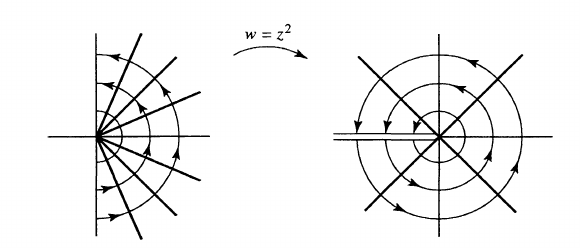
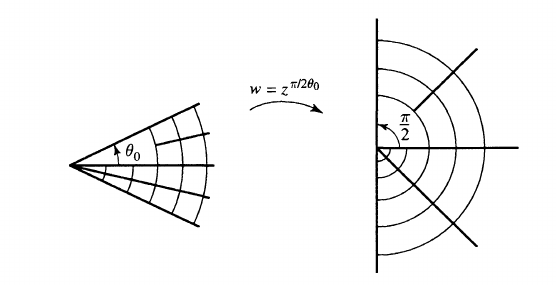
Sector \(\to \HH\). \(z\mapsto z^n\) maps \(\ts{0 < \Arg z < \pi/n}\) onto \(\HH\). More generally, for \(0<a\theta_0\leq\pi\), a branch of \(z \mapsto z^a\) maps \(\ts{\Arg z \in (-\theta_0, \theta_0)}\) onto \(\ts{\Arg w \in (-a\theta_0, a\theta_0)}\), so \(a = \pi/(2\theta_0)\) maps a symmetric sector onto the right half plane.
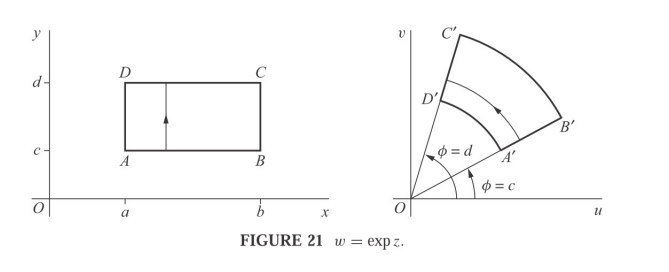
Strip \(\to \HH\). \(z\mapsto e^z\) maps \(L\) onto \(\HH\), and maps \(\ts{-\pi<\Im z<\pi}\) onto \(\CC\sm\RR_{\leq 0}\). For \(b-a>0\) and \(0<d-c\leq 2\pi\), the exponential maps rectangles to annular sectors: \[ \ts{\Re z \in [a,b],\ \Im z \in [c,d]} \mapsto \ts{Re^{i\theta} \st R\in[e^a,e^b],\ \theta\in[c,d]} .\]
Half disc \(\to\) half plane. The Joukowski map \(z\mapsto z + \inverseof{z}\) maps \(\abs z = 1\) onto \([-2,2]\), \(\DD\intersect\HH\) onto \(Q_{34}\), \(\overline{\DD}^c \intersect \HH\) onto \(\HH\), and \(\overline{\DD}^c\) onto \(\CC\sm[-2,2]\).
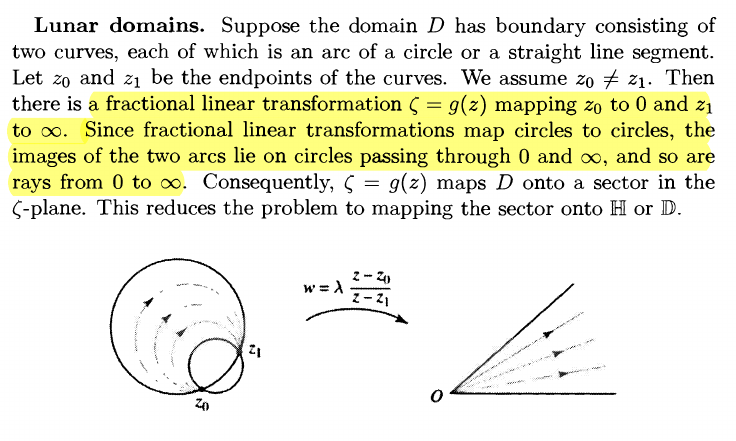
Region bounded by two circular arcs \(\to\) sector or strip. A Möbius transformation sending the two intersection points of the arcs to \(0\) and \(\infty\) maps the region onto a sector. If the arcs are tangent at one point, a Möbius transformation sending that point to \(\infty\) maps the region onto a strip.
Slit plane \(\to \HH\). The branch of \(\sqrt z\) with argument in \((0,\pi)\) maps \(\CC\sm[0,\infty)\) onto \(\HH\).
Reflections and inversions. \(z\mapsto -z\) maps \(\HH\) onto \(Q_{34}\). The map \(z\mapsto 1/z\) sends \(Re^{it}\) to \(\inverseof{R} e^{-it}\); it is reflection in \(\RR\) composed with inversion in \(S^1\), and on \(\CP^1\) it is the rotation by \(\pi\) about the axis through \(\pm 1\).
Boundary features
| The region has | Map |
|---|---|
| a corner of angle \(\theta_0\) at \(0\) | \(z^{\pi/\theta_0}\), to a half plane |
| two boundary arcs meeting at two points | a Möbius transformation taking those points to \(0\) and \(\infty\) |
| two tangent boundary circles | a Möbius transformation taking the point of tangency to \(\infty\), giving parallel lines |
| a slit along a ray | a branch of \(\sqrt z\) |
| a strip | \(e^z\) |
| a half-plane, with target \(\DD\) | the Cayley map, then an automorphism of \(\DD\) |
Computational facts
\(\inverseof{z} = \bar z/\abs z^2\); for example, under \(z\mapsto 1/z\) the point \(1+i\) on \(\abs{z-1}=1\) goes to \({1-i\over 2}\).
Conformal maps preserve angles between curves, including at \(\infty\) on \(\CP^1\). Circles meeting orthogonally map to generalized circles meeting orthogonally, and tangent circles map to tangent circles or parallel lines.
Möbius transformations map generalized circles to generalized circles, where a line is a circle through \(\infty\), and map an arc between two points onto an arc between their images.
The cross ratio sending \(a\mapsto 1\), \(b \mapsto 0\), \(c\mapsto \infty\) is \[ (z; a, b, c) = \frac{z-b}{z-c}\cdot\frac{a-c}{a-b} .\]
\(t\mapsto\tan t\) is a bijection \((-\pi/2,\pi/2)\to\RR\), which parameterizes the real line by a bounded interval.
Standard maps
\(\HH\) and \(\DD\):
Cayley transform from the upper half-plane onto the unit disc (Tag PR-OOHFS)
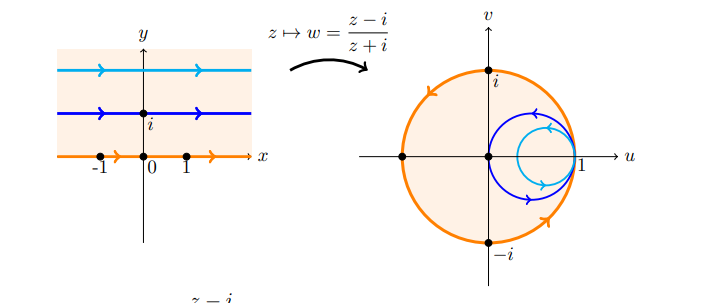
Let \(\HH\coloneqq\ts{z\in\CC\st\Im z>0}\) and \(\DD\coloneqq\ts{w\in\CC\st\abs{w}<1}\). The Cayley transform \[ \Psi\colon\HH\to\DD,\qquad \Psi(z)=\frac{z-i}{z+i}, \] is a biholomorphism, with inverse \(\Psi^{-1}(w)=i\,\frac{1+w}{1-w}\). It restricts to a biholomorphism from the first quadrant \(Q_1\coloneqq\ts{z\st\Re z>0,\ \Im z>0}\) onto the lower half-disc \(\ts{w\in\DD\st\Im w<0}\).
For \(z\in\HH\), \(\abs{z-i}^2-\abs{z+i}^2=-4\Im z<0\): every \(z\in\HH\) is closer to \(i\) than to \(-i\), so \(\abs{\Psi(z)}<1\). Solving \(w=\frac{z-i}{z+i}\) gives \(z(1-w)=i(1+w)\), so \(z=i\frac{1+w}{1-w}\); for \(w\in\DD\) this is defined, and \[ \Im\Big(i\,\frac{1+w}{1-w}\Big)=\Re\frac{(1+w)(1-\bar w)}{\abs{1-w}^2}=\frac{1-\abs{w}^2}{\abs{1-w}^2}>0, \] so the inverse formula maps \(\DD\) into \(\HH\), and the two maps are mutually inverse.
For \(z\in\HH\), \(\Im\Psi(z)=\Im\frac{(z-i)(\bar z-i)}{\abs{z+i}^2}=\frac{-2\Re z}{\abs{z+i}^2}\), since \((z-i)(\bar z-i)=\abs{z}^2-1-2i\Re z\). So \(\Psi(z)\) lies in the lower half-disc exactly when \(\Re z>0\), and \(\Psi(Q_1)=\ts{w\in\DD\st\Im w<0}\).
The real axis is mapped onto the unit circle minus \(1\), and horizontal lines \(\Im z=c>0\) are mapped onto circles in \(\DD\) tangent to the unit circle at \(1\):
Möbius map from the unit disc to the right half-plane (Tag PR-TWG7E)
Let \(\HH_R\coloneqq\ts{w\st\Re w>0}\) be the right half-plane. The map \[ F\colon\DD\to\HH_R,\qquad F(z)=\frac{1+z}{1-z}, \] is a biholomorphism, with inverse \(F^{-1}(w)=\frac{w-1}{w+1}\). It sends \(-1,0,1\) to \(0,1,\infty\) respectively.
For \(z\in\DD\), \[ F(z)=\frac{(1+z)(1-\bar z)}{\abs{1-z}^2}=\frac{1-\abs{z}^2+2i\Im z}{\abs{1-z}^2}, \] so \(\Re F(z)>0\). For \(w\in\HH_R\), \(w\) is closer to \(1\) than to \(-1\), so \(\abs{\frac{w-1}{w+1}}<1\). Solving \(w=\frac{1+z}{1-z}\) gives \(z=\frac{w-1}{w+1}\), so the two maps are mutually inverse.
The Cayley transform \(\Psi(z)=\frac{z-i}{z+i}\) from the upper half-plane \(\HH\) onto \(\DD\) is related to \(F\) by rotations. Its inverse is \(\Psi^{-1}(w)=i\,\frac{1+w}{1-w}=iF(w)\), the composite \(\DD\xrightarrow{F}\HH_R\xrightarrow{w\mapsto iw}\HH\). Conversely, \(\Psi(z)=F^{-1}(-iz)\), the composite \(\HH\xrightarrow{z\mapsto -iz}\HH_R\xrightarrow{F^{-1}}\DD\): \[ F^{-1}(-iz)=\frac{-iz-1}{-iz+1}=\frac{z-i}{z+i}. \]
On the boundary, \(F(e^{i\theta})=i\cot(\theta/2)\) for \(0<\theta<2\pi\), so the unit circle minus \(1\) is mapped onto the imaginary axis, and the segment \((-1,1)\) is mapped onto \((0,\infty)\).
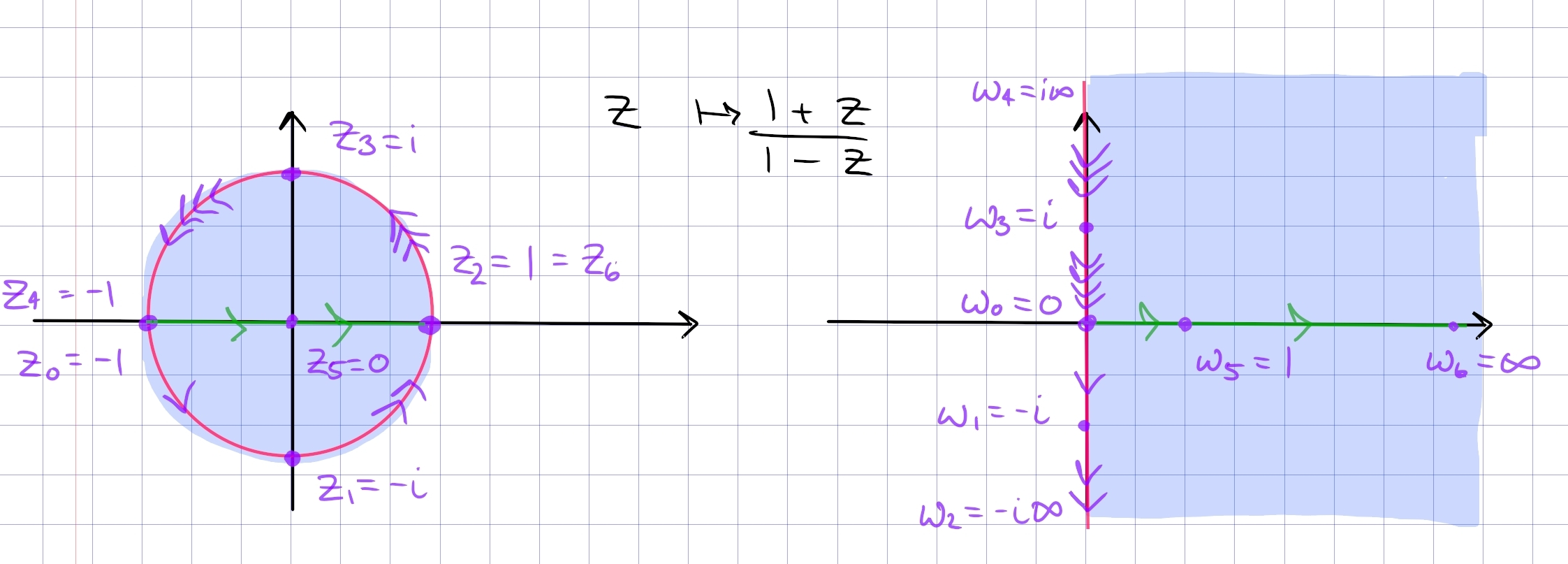
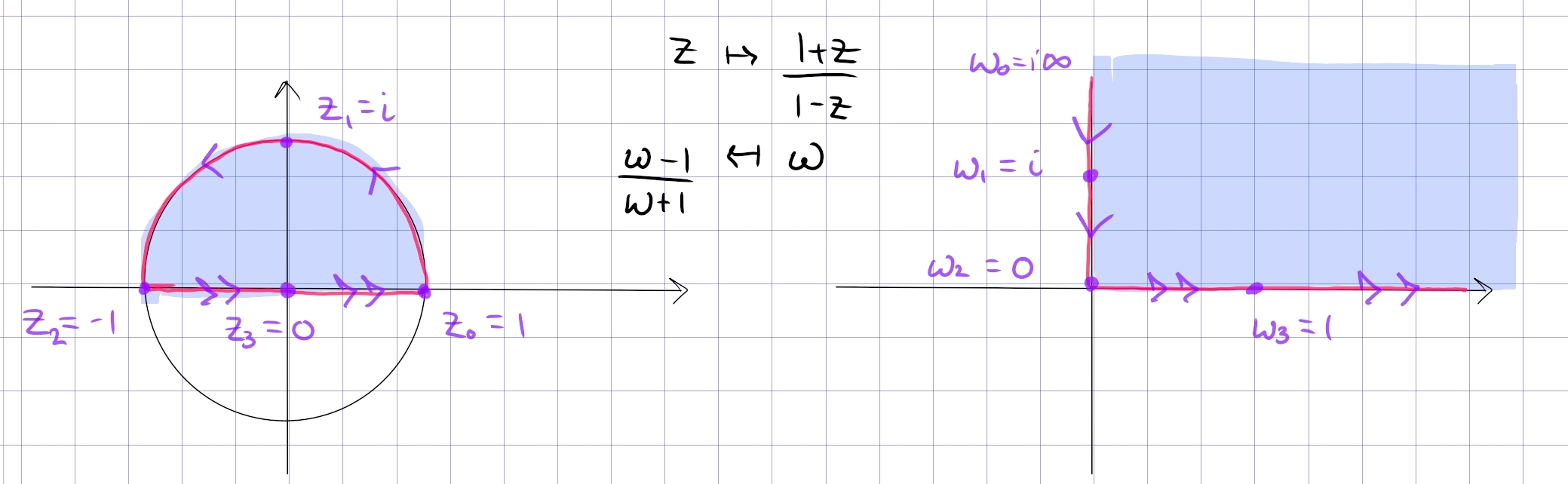
The restriction of \(F\) to the upper half-disc \(\ts{z\in\DD\st\Im z>0}\) is a biholomorphism onto the first quadrant: by the formula for \(F(z)\) in the proof, \(\Im F(z)>0\) exactly when \(\Im z>0\). This is PR-PW4Z6.
Sectors:
Upper half-plane to sectors and back (Tag PR-AQFRA)
For \(0<\alpha\le2\pi\), let \(S_\alpha\coloneqq\theset{re^{i\theta} : r>0,\ 0<\theta<\alpha}\), so that \(S_\pi=\HH\).
For an integer \(n\ge1\), \[ \begin{aligned} F\colon S_{\pi/n} &\to \HH, \\ z &\mapsto z^n \end{aligned} \] is a biholomorphism with inverse \(w\mapsto w^{1/n}\), the principal branch.
For \(0 < \alpha \le 2\pi\), \[ \begin{aligned} F\colon \HH &\to S_\alpha, \\ z &\mapsto z^{\alpha/\pi} \end{aligned} \] is a biholomorphism with inverse \(w\mapsto w^{\pi/\alpha}\). Here \(z^{\alpha/\pi}=e^{(\alpha/\pi)\Log z}\) uses the principal branch on \(\HH\), and \(w^{\pi/\alpha}=e^{(\pi/\alpha)(\log\abs{w}+i\theta)}\) uses the argument \(\theta\in(0,\alpha)\) of \(w\in S_\alpha\).
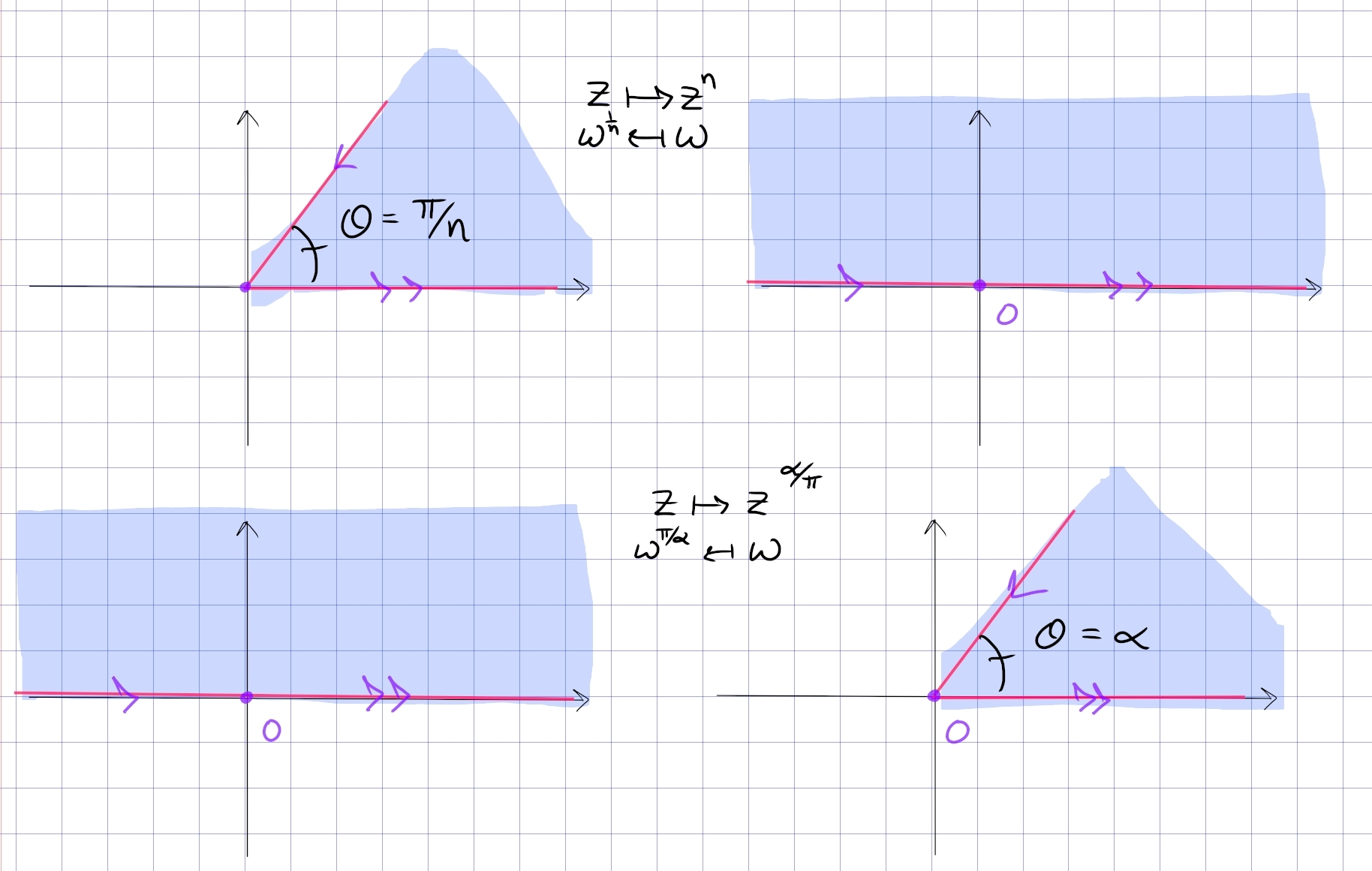
For (b), write \(z=re^{i\theta}\) with \(r>0\) and \(\theta\in(0,\pi)\); then \(z^{\alpha/\pi}=r^{\alpha/\pi}e^{i\alpha\theta/\pi}\), whose argument \(\alpha\theta/\pi\) ranges over \((0,\alpha)\). Since \(r\mapsto r^{\alpha/\pi}\) is a bijection of \((0,\infty)\) and \(\theta\mapsto\alpha\theta/\pi\) is a bijection \((0,\pi)\to(0,\alpha)\), \(F\) is a bijection \(\HH\to S_\alpha\), and the stated inverse multiplies the argument by \(\pi/\alpha\) and raises the modulus to the power \(\pi/\alpha\). Both maps are holomorphic, since on \(S_\alpha\) the chosen argument is a continuous branch of \(\arg\). Part (a) is the case \(\alpha=\pi/n\) of (b), read in the opposite direction: \(z\mapsto z^n\) is the inverse \(w\mapsto w^{\pi/\alpha}\), and on \(\HH\) the principal branch of \(w^{1/n}\) is \(z\mapsto z^{\alpha/\pi}\).
Logs and exponentials:
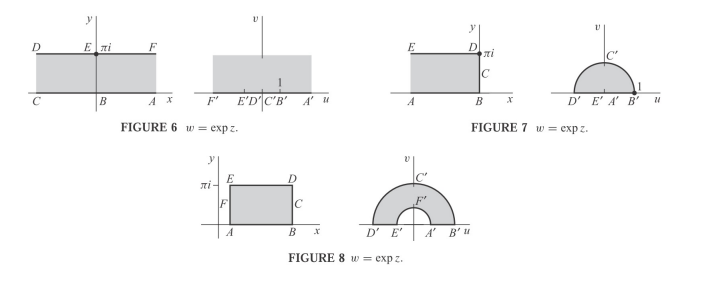
Upper half-plane to horizontal strip (Tag PR-3CDLG)
Let \(S\coloneqq\theset{w\in\CC : 0<\Im w<\pi}=\RR\times i(0,\pi)\). The principal branch \(\Log\) of the logarithm restricts to a biholomorphism \[ \begin{aligned} F\colon \HH &\to S, \\ z &\mapsto \Log(z), \end{aligned} \] with inverse \(w\mapsto e^w\).
Every \(z\in\HH\) is \(z=re^{i\theta}\) with \(r>0\) and \(\theta\in(0,\pi)\), so \(\Log(z)=\log r+i\theta\in S\) and \(e^{\Log(z)}=z\). Conversely, for \(w=s+it\in S\), \(e^w=e^se^{it}\) has argument \(t\in(0,\pi)\), so \(e^w\in\HH\) and \(\Log(e^w)=s+it=w\). Thus \(F\) and \(w\mapsto e^w\) are mutually inverse, and both are holomorphic.
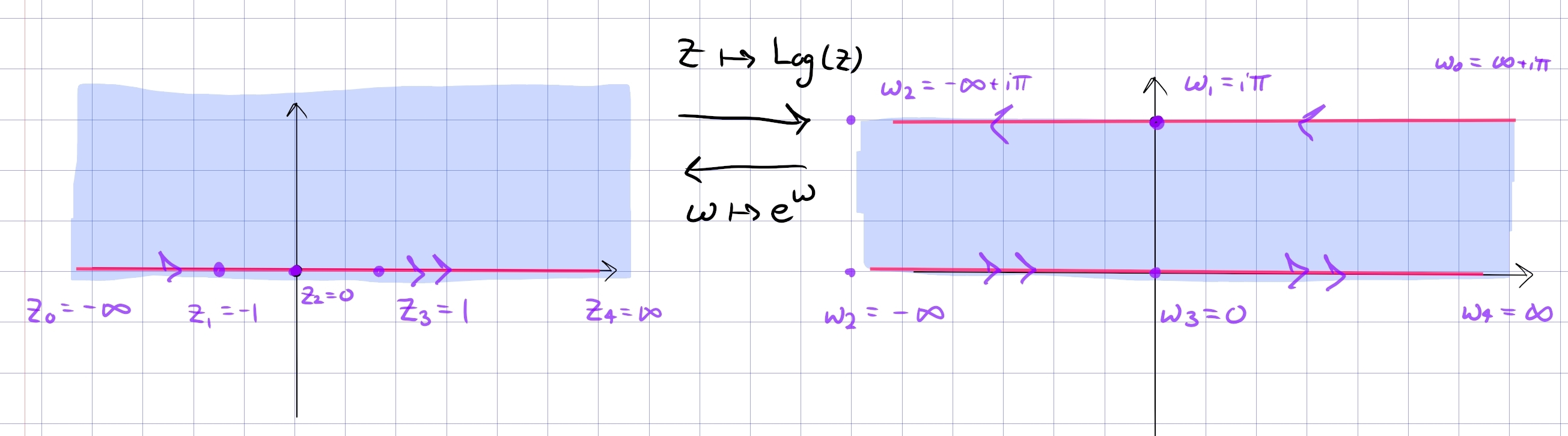
Logarithm from the slit plane to a horizontal strip (Tag PR-SF23E)
Let \(\Log\) be the principal branch of the logarithm. The map \[ F\colon\CC\sm(-\infty,0]\to\ts{w\st-\pi<\Im w<\pi},\qquad F(z)=\Log z, \] is a biholomorphism, with inverse \(w\mapsto e^w\). It maps each circle \(\ts{\abs{z}=R}\), with the point \(-R\) removed, onto the vertical segment \(\ts{\ln R+it\st-\pi<t<\pi}\), and each ray \(\ts{re^{i\theta}\st r>0}\) with \(-\pi<\theta<\pi\) onto the horizontal line \(\ts{t+i\theta\st t\in\RR}\).
For \(z=re^{i\theta}\) with \(r>0\) and \(-\pi<\theta<\pi\), \(\Log z=\ln r+i\theta\). Since \(r\mapsto\ln r\) is a bijection \((0,\infty)\to\RR\), \(F\) is a bijection onto the strip, it maps \(\ts{r=R}\) and \(\ts{\theta=\text{const}}\) as stated, and \(e^{\ln r+i\theta}=re^{i\theta}\) gives the holomorphic inverse.
The same computation shows that \(w\mapsto e^w\) maps the strip \(\ts{w\st\abs{\Im w}<\pi/2}\) biholomorphically onto the right half-plane \(\ts{z\st\Re z>0}\).
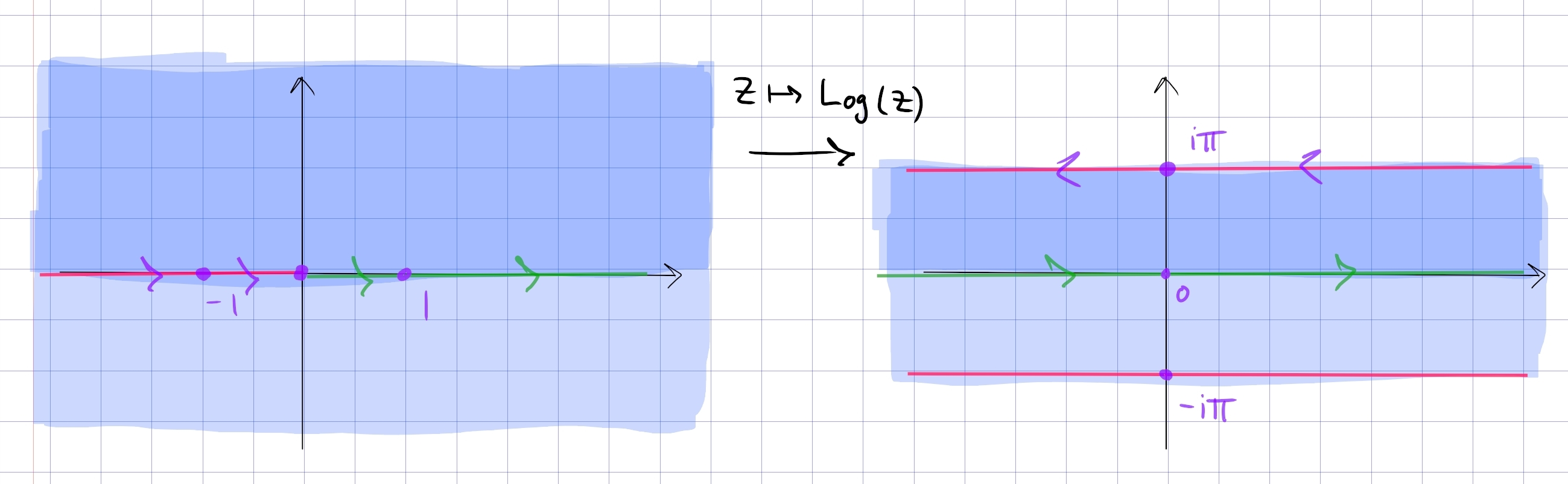
Logarithm from the upper half-disc to a half-strip (Tag PR-PELLF)
Let \(\Log\) be the principal branch of the logarithm. The map \[ F\colon\ts{z\st\abs{z}<1,\ \Im z>0}\to\ts{w\st\Re w<0,\ 0<\Im w<\pi},\qquad F(z)=\Log z, \] is a biholomorphism, with inverse \(w\mapsto e^w\).
For \(z=re^{i\theta}\) with \(0<r<1\) and \(0<\theta<\pi\), \(\Log z=\ln r+i\theta\) with \(\ln r<0\). Since \(r\mapsto\ln r\) is a bijection \((0,1)\to(-\infty,0)\), \(F\) is a bijection onto the half-strip, and \(e^{\ln r+i\theta}=re^{i\theta}\) gives the inverse, which is holomorphic.
The same computation, with \(\ln r\) ranging over \((-\infty,0)\) or \((0,\infty)\) and \(\theta\) over \((0,\pi)\) or \((-\pi,0)\), shows that \(\Log\) maps
- \(\ts{\abs{z}<1,\ \Im z>0}\) onto the half-strip \(\ts{\Re w<0,\ 0<\Im w<\pi}\) in the second quadrant,
- \(\ts{\abs{z}<1,\ \Im z<0}\) onto the half-strip \(\ts{\Re w<0,\ -\pi<\Im w<0}\) in the third quadrant,
- \(\ts{\abs{z}>1,\ \Im z>0}\) onto the half-strip \(\ts{\Re w>0,\ 0<\Im w<\pi}\) in the first quadrant,
- \(\ts{\abs{z}>1,\ \Im z<0}\) onto the half-strip \(\ts{\Re w>0,\ -\pi<\Im w<0}\) in the fourth quadrant.
On the boundary of the upper half-disc, the segment \((0,1)\) maps onto \((-\infty,0)\), the semicircle \(\ts{e^{i\theta}\st0<\theta<\pi}\) maps onto the segment from \(0\) to \(i\pi\), and the segment \((-1,0)\) maps onto the line \(\ts{t+i\pi\st t<0}\).
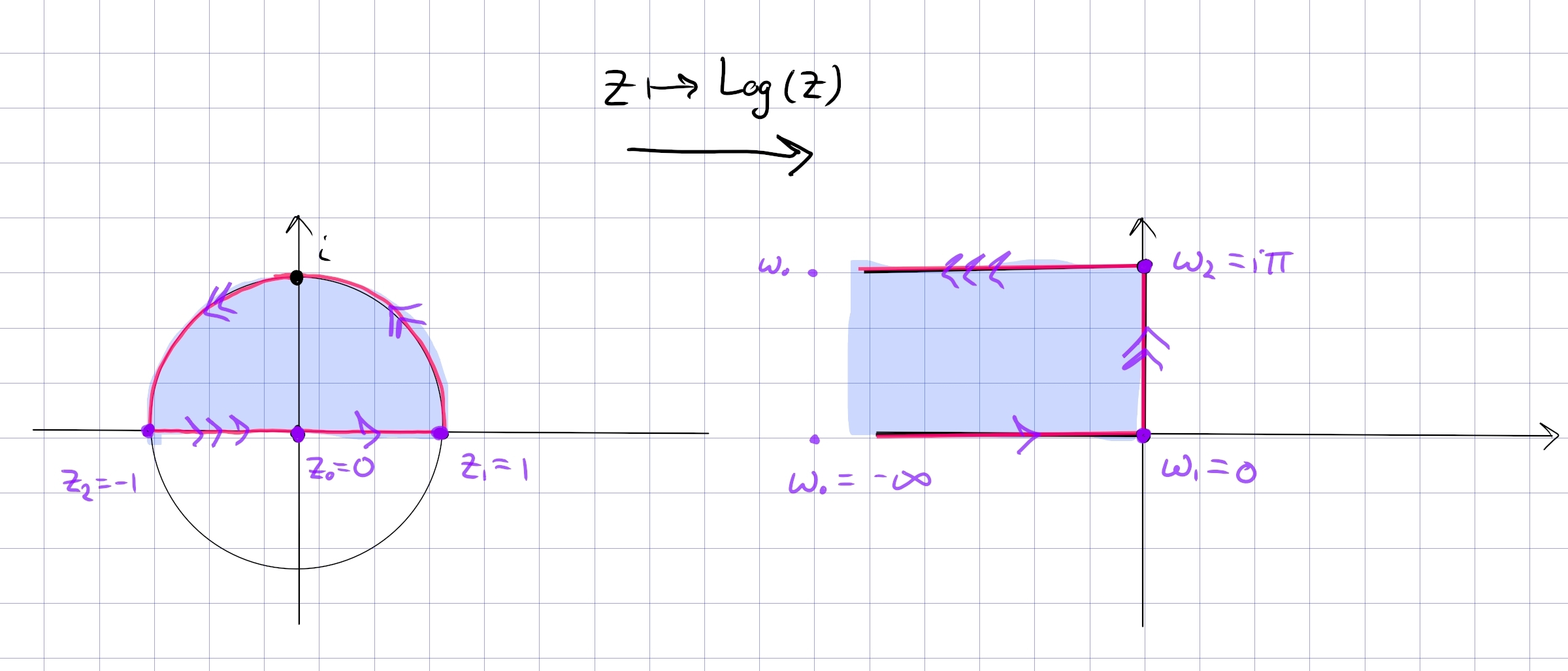
Vertical half-strip to right half-disc (Tag PR-7TLAS)
Let \(S\coloneqq\theset{z\in\CC : -\pi/2<\Re z<\pi/2,\ \Im z>0}\) and \(H\coloneqq\DD \intersect \ts{\Re(w) > 0}\). Then \[ \begin{aligned} F\colon S &\to H, \\ z &\mapsto e^{iz} \end{aligned} \] is a biholomorphism with inverse \(w\mapsto -i\Log(w)\), where \(\Log\) is the principal branch of the logarithm.
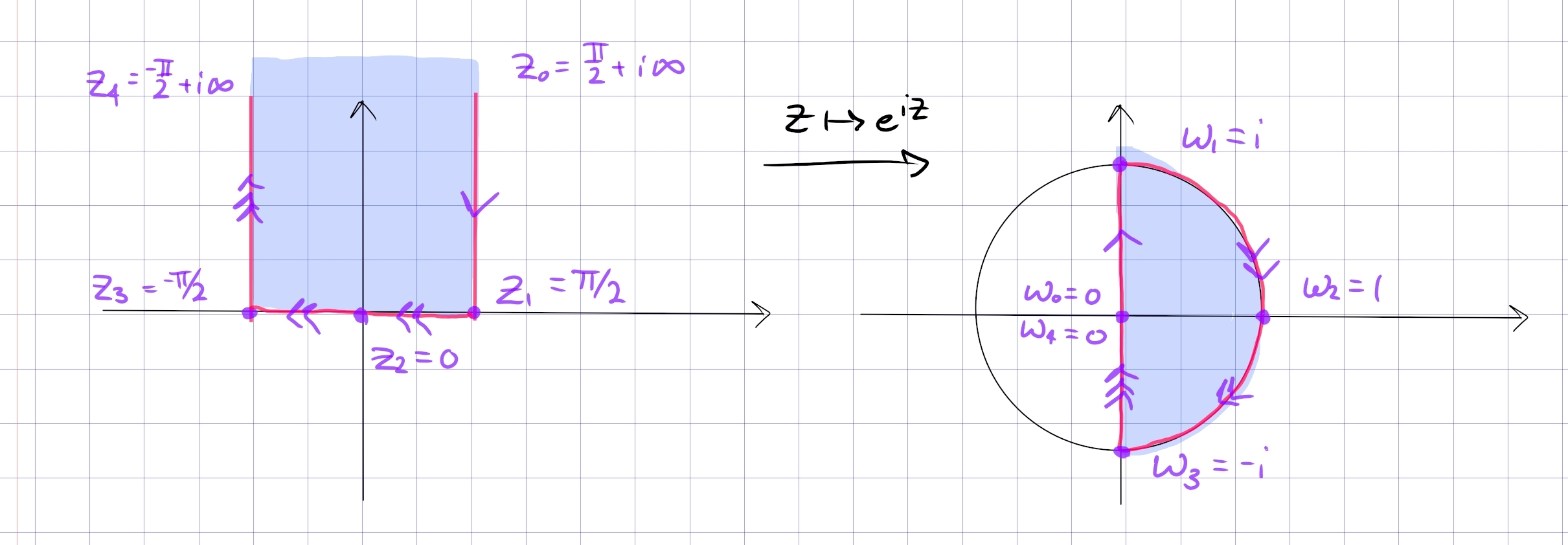
For \(z=x+iy\in S\), \(e^{iz}=e^{-y}e^{ix}\) has modulus \(e^{-y}\in(0,1)\) and argument \(x\in(-\pi/2,\pi/2)\), so \(e^{iz}\in H\), and \(-i\Log(e^{iz})=-i(-y+ix)=x+iy=z\). Conversely, every \(w\in H\) is \(w=re^{i\theta}\) with \(r\in(0,1)\) and \(\theta\in(-\pi/2,\pi/2)\), and \(-i\Log(w)=\theta-i\log r\) has real part \(\theta\in(-\pi/2,\pi/2)\) and imaginary part \(-\log r>0\), so it lies in \(S\), and \(e^{i(-i\Log w)}=e^{\Log w}=w\). Both maps are holomorphic and mutually inverse.
Joukowski maps:
Disc complement to slit plane (Tag PR-IK6LA)
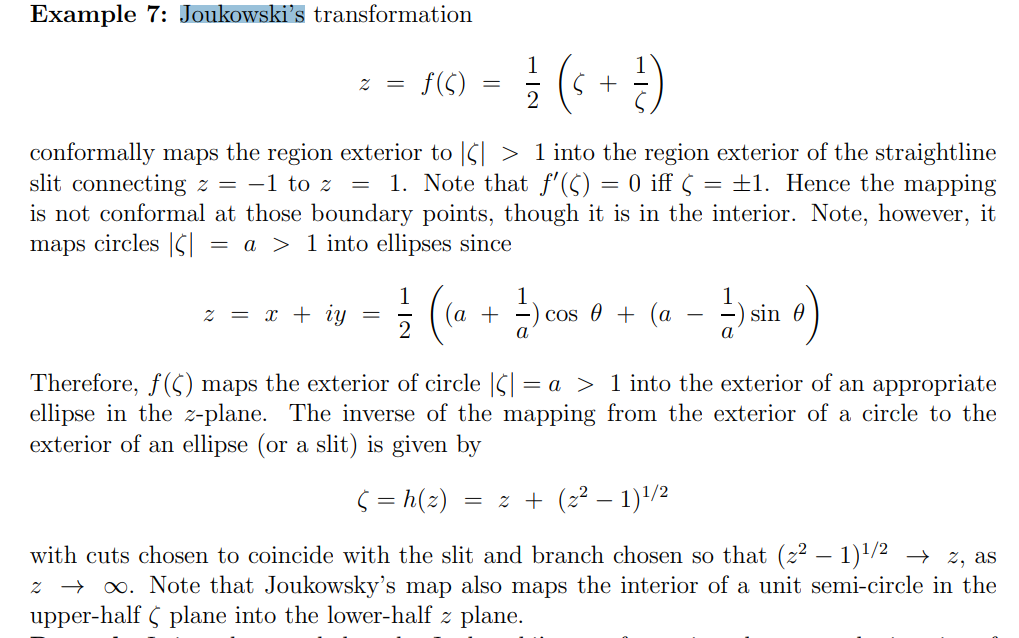
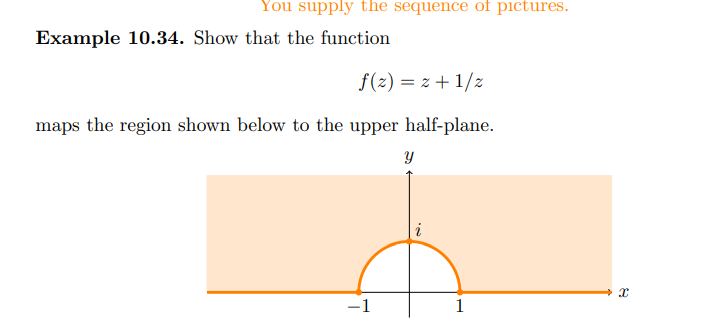
The map \[ \begin{aligned} F\colon \theset{z\in\CC : \abs{z}>1} &\to \CC\sm[-2, 2], \\ z &\mapsto z+ \inverseof{z} \end{aligned} \] is a biholomorphism.
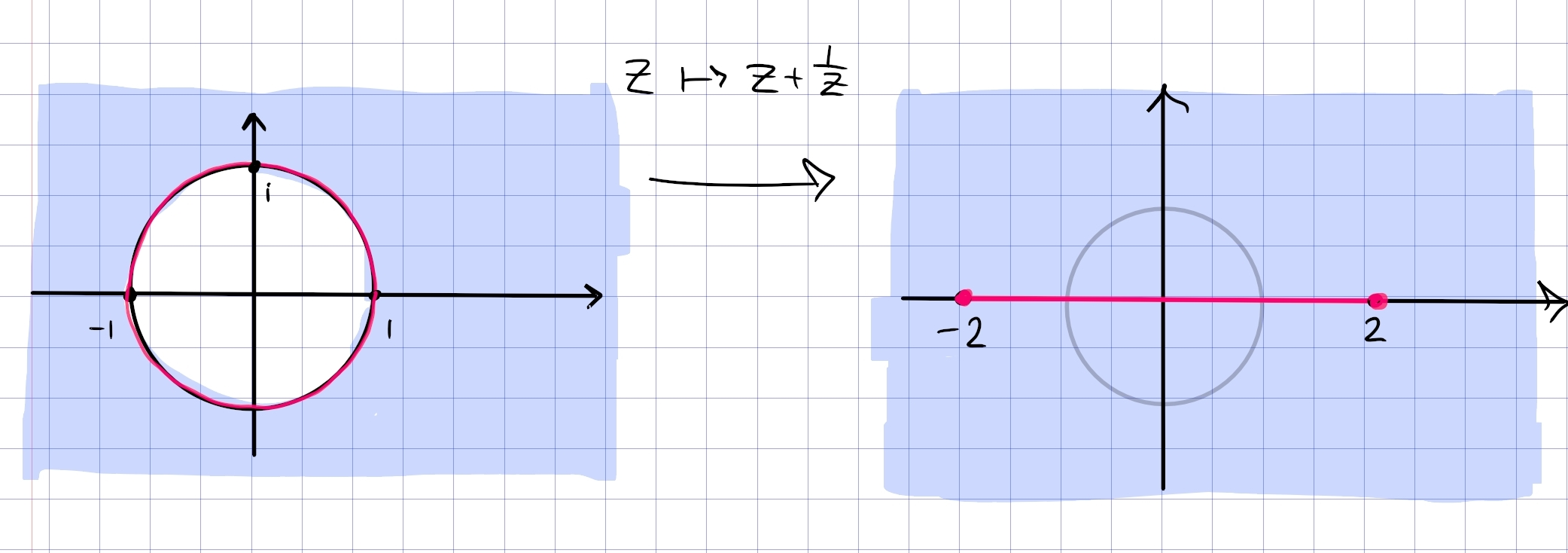
For \(w\in\CC\), the solutions of \(F(z)=w\) are the roots of \(z^2-wz+1=0\), whose product is \(1\). If \(w\in[-2,2]\), the discriminant \(w^2-4\le0\), so the roots are complex conjugates of product \(1\) and both lie on the unit circle; hence \(F\) maps \(\abs{z}>1\) into \(\CC\sm[-2,2]\). If \(w\notin[-2,2]\), no root lies on the unit circle, since \(F(e^{i\theta})=2\cos\theta\in[-2,2]\), and the roots are distinct, since a double root would be \(\pm1\) with \(w=\pm2\); as their product is \(1\), exactly one root satisfies \(\abs{z}>1\). So \(F\) is a holomorphic bijection onto \(\CC\sm[-2,2]\), and its inverse is holomorphic.
Joukowski map from the upper half-disc to the upper half-plane (Tag PR-OTMIR)
Let \(\DD\cap\HH=\ts{z\st\abs{z}<1,\ \Im z>0}\) be the upper half-disc and \(\HH=\ts{w\st\Im w>0}\) the upper half-plane. The map \[ F\colon\DD\cap\HH\to\HH,\qquad F(z)=-\frac12\big(z+z^{-1}\big), \] is a biholomorphism.
For \(z=re^{i\theta}\) with \(0<r<1\) and \(0<\theta<\pi\), \[ F(z)=-\frac12\Big(r+\frac1r\Big)\cos\theta+\frac i2\Big(\frac1r-r\Big)\sin\theta, \] so \(\Im F(z)>0\) and \(F\) is a holomorphic map into \(\HH\). Given \(w\in\HH\), the equation \(F(z)=w\) is \(z^2+2wz+1=0\). Its two roots have product \(1\), and neither lies on the unit circle or the real axis, because \(F\) maps the unit circle into \([-1,1]\) and \(\RR\sm\ts{0}\) into \(\RR\). So exactly one root \(z\) satisfies \(\abs{z}<1\), and it satisfies \(\Im z>0\) because \(\Im F(z)\) has the sign of \(\sin\theta\) when \(\abs{z}<1\). Hence \(F\) is bijective, and a bijective holomorphic map has a holomorphic inverse.
The map \(z\mapsto\frac12(z+z^{-1})\) is the Joukowski map; \(F\) is its negative. On the boundary of the half-disc, \(F\) maps the upper unit semicircle onto \([-1,1]\), with \(F(1)=-1\), \(F(i)=0\), \(F(-1)=1\), and it maps the segments \((0,1)\) and \((-1,0)\) onto \((-\infty,-1)\) and \((1,\infty)\) respectively. The inverse is \(F^{-1}(w)=-w+\sqrt{w^2-1}\), with the branch of the square root for which this value lies in \(\DD\).
The Joukowski map \(J(z)=\frac12(z+z^{-1})\) satisfies \(J(z)=J(1/z)\) and maps each of the punctured disc \(\ts{z\st 0<\abs{z}<1}\) and the exterior \(\ts{z\st\abs{z}>1}\) conformally onto \(\CC\sm[-1,1]\). It maps the upper half-disc onto the lower half-plane, and each circle \(\abs{z}=r\) with \(r\neq1\) onto the ellipse with foci \(\pm1\) and semi-axes \(\frac12(r+r^{-1})\) and \(\frac12\abs{r-r^{-1}}\) [@Ahl79].
Centered vertical half-strip to upper half-plane by $\sin$ (Tag PR-3LBLV)
Let \(S\coloneqq\theset{z\in\CC : -\pi/2<\Re z<\pi/2,\ \Im z>0}\). Then \(\sin\) restricts to a biholomorphism \(S\to\HH\), and its inverse \(\arcsin\colon\HH\to S\) is a biholomorphism from the upper half-plane onto the vertical half-strip.
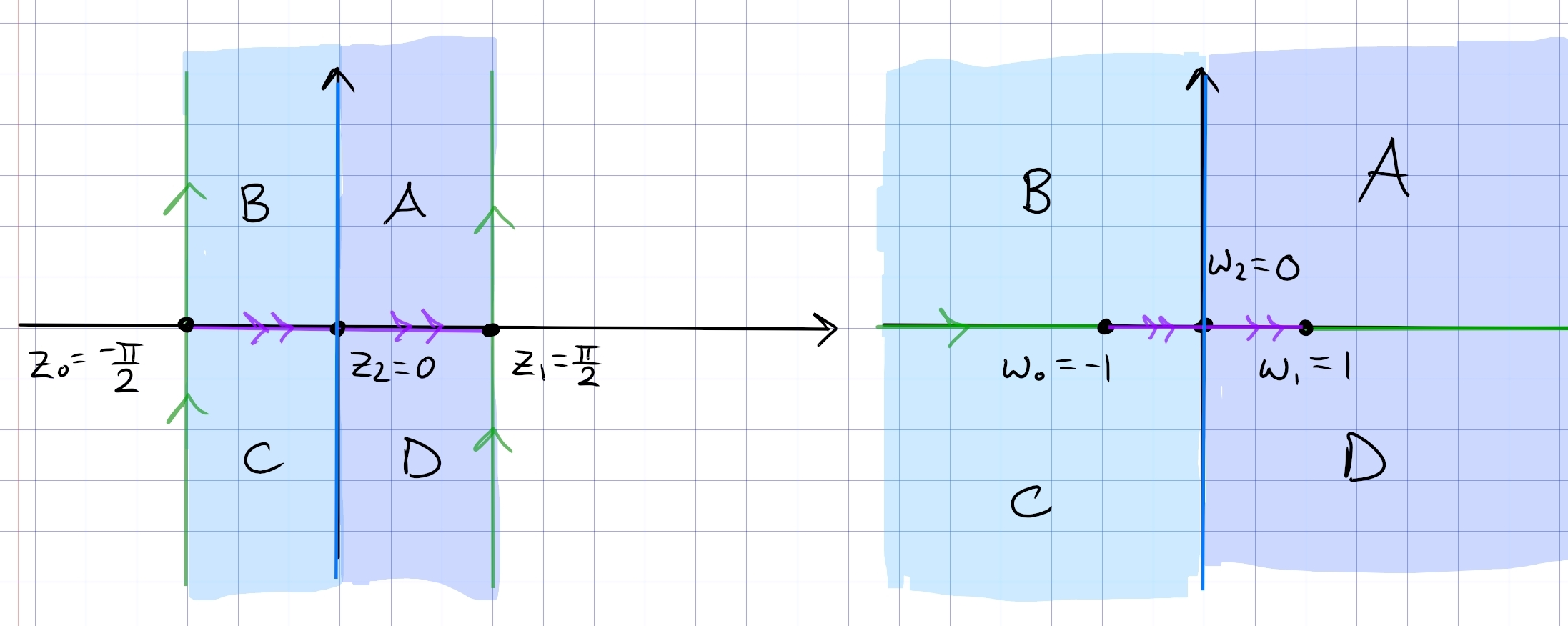
Let \(J(u)\coloneqq\frac12\qty{u+\inverseof{u}}\) for \(u\neq0\). For every \(z\in\CC\), \[ \sin(z)=\frac{e^{iz}-e^{-iz}}{2i}=-\frac12\qty{ie^{iz}+\frac{1}{ie^{iz}}}=-J\qty{ie^{iz}}, \] so \(\sin\) on \(S\) is the composite of the following holomorphic maps, each of which is a bijection onto the stated set.
\(z\mapsto iz\) maps \(S\) onto \(\theset{\zeta : \Re\zeta<0,\ \abs{\Im\zeta}<\pi/2}\).
\(\zeta\mapsto e^\zeta\) maps that half-strip onto \(\theset{w : \abs{w}<1,\ \Re w>0}\): for \(\zeta=s+it\) with \(s<0\) and \(\abs{t}<\pi/2\), \(e^\zeta\) has modulus \(e^s\in(0,1)\) and argument \(t\in(-\pi/2,\pi/2)\), and each such modulus and argument occur exactly once.
\(w\mapsto iw\) maps that half-disc onto the upper half-disc \(\theset{u : \abs{u}<1,\ \Im u>0}\).
\(J\) maps the upper half-disc onto the lower half-plane. For \(u=re^{i\theta}\) with \(0<r<1\) and \(0<\theta<\pi\), \(\Im J(u)=\frac12\qty{r-\inverseof{r}}\sin\theta<0\). For \(c\) in the lower half-plane, the solutions of \(J(u)=c\) are the roots of \(u^2-2cu+1=0\), whose product is \(1\); neither root lies on the unit circle, where \(J\) is real, so exactly one root \(u\) satisfies \(\abs{u}<1\), and \(\Im J(u)<0\) forces \(\sin\theta>0\), so that root lies in the upper half-disc.
\(v\mapsto-v\) maps the lower half-plane onto \(\HH\).
A bijective holomorphic map has a holomorphic inverse, so \(\sin\colon S\to\HH\) is a biholomorphism.
The boundary of \(S\) maps onto \(\RR\): the segment \([-\pi/2,\pi/2]\) maps onto \([-1,1]\), the ray \(\pi/2+it\) (\(t\ge0\)) maps to \(\sin(\pi/2+it)=\cosh t\), tracing \([1,\infty)\), and the ray \(-\pi/2+it\) maps to \(-\cosh t\), tracing \((-\infty,-1]\). The imaginary axis \(it\) (\(t>0\)) maps to \(\sin(it)=i\sinh t\), the positive imaginary axis.
Exercises
Cross ratios:
Conformal maps to arbitrary points (Tag E-Z23VB)
Find a Mobius transformation sending
\(1\to 3\)
\(i\to 0\)
\(2\to -1\)
Solution
Use cross ratios: set \(T(z) \da (z;,1,i,2)\) and \(S(w) = (w;,3,0,-1)\) and solve \(T(z) = S(w) \implies w = (\inverseof{S} T)(z)\): \[ {z-i \over z-2}{1-2\over 1-i} &= {w-0\over w+1}{3+1 \over 3-0} \\ \implies -\frac{\left(i + 1\right) \, {\left(z - i\right)}}{2 \, {\left(z - 2\right)}} &= \frac{4 \, w}{3 \, {\left(w + 1\right)}} \\ \implies w &= -\frac{3 \, {\left(\left(i + 1\right) \, z - i + 1\right)}}{\left(3 i + 11\right) \, z - 3 i - 13} \\ &= - {3z - 3i \over {3i+11\over i+1}z + {-3i-13 \over 3i+11}} \\ &= - {3z - 3i \over (7-4i) z + {-8+5i} } \\ &= \frac{-3 z+3 i}{(7-4 i) z+(-8+5 i)} .\]
Mapping $\DD^c \intersect \HH$ to $\HH$ via cross-ratios (Tag E-G55QF)
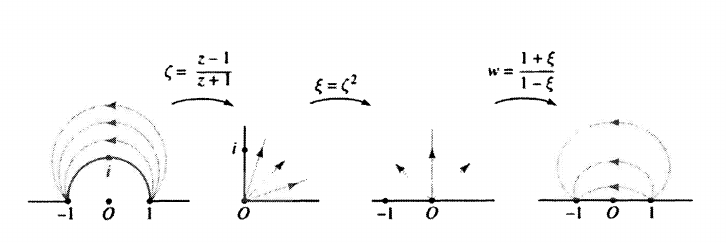
Find a conformal map from \(\DD^c \intersect \HH\) to \(\HH\) using cross-ratios.
Solution
The unit circle and the real line both pass through \(\pm1\), so a fractional linear transformation sending \(-1\to0\) and \(1\to\infty\) sends both to lines through \(0\). Take the cross-ratio sending \((i, -1, 1)\to (1,0,\infty)\):
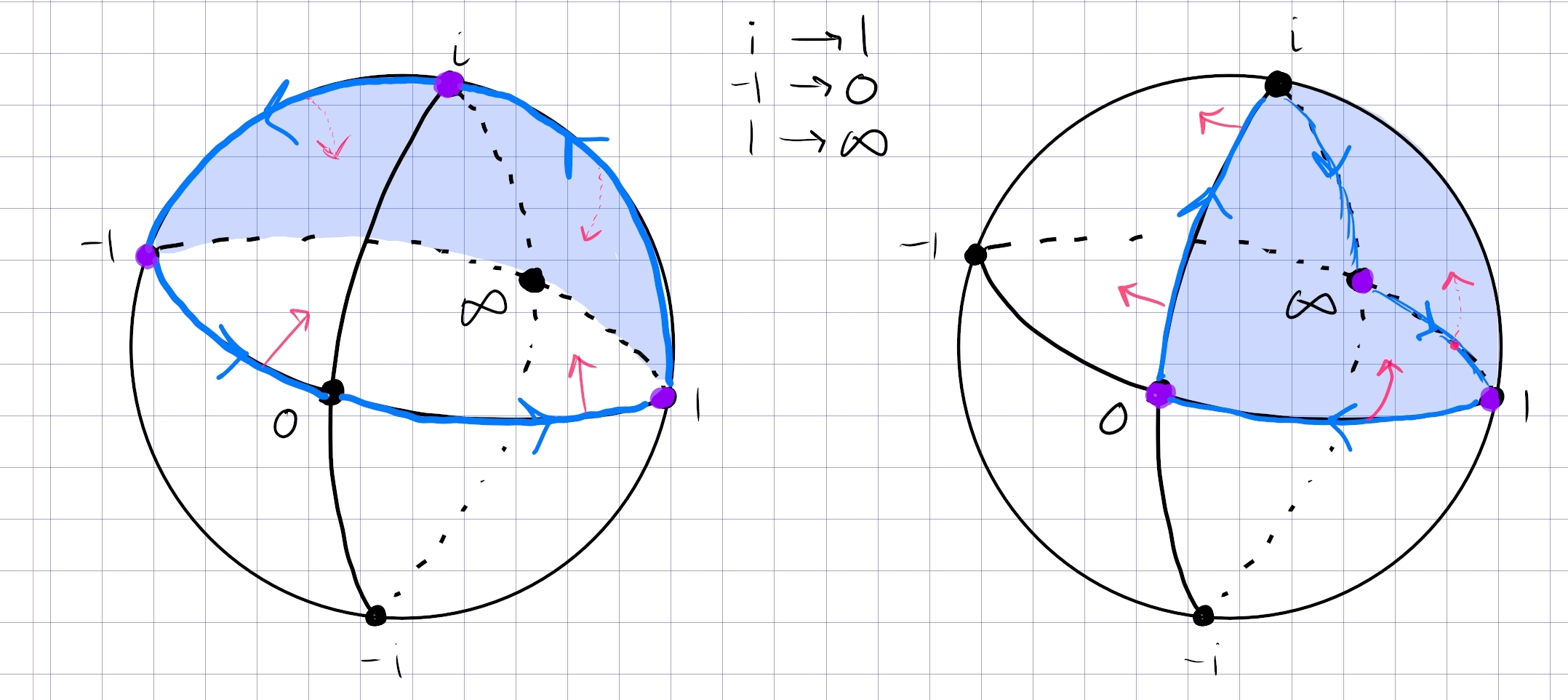
This is the cross-ratio \[ f(z) = {z+1\over z-1} {i-1\over i+1} .\]
The image of \(\DD^c \intersect \HH\) is the 1st quadrant \(\HH \intersect \Re(z) > 0\). Send this to \(\HH\) with \(z\mapsto z^2\).
Discs and planes:
A fractional linear transformation $\HH\to\DD$ and the image of the first quadrant (Tag P-IIONX)
Find a fractional linear transformation \(T\) which maps \(\HH\) to \(\DD\), and explicitly describe the image of the first quadrant under \(T\).
Solution
<1>1. The fractional linear map \[ T(z)=\frac{z-i}{z+i} \] is a biholomorphism \(\HH\to\DD\).
Let \(z=x+iy\) with \(y>0\). Then \[ |T(z)|^2 =\frac{x^2+(y-1)^2}{x^2+(y+1)^2}<1, \] so \(T(\HH)\subseteq\DD\).
Solving \(w=T(z)\) for \(z\) gives \[ z=i\frac{1+w}{1-w}. \] For \(|w|<1\) this inverse has positive imaginary part, so it maps \(\DD\) into \(\HH\). Thus \(T\) is a biholomorphism.
<1>2. For \(z=x+iy\in\HH\), \[ \Im T(z)=-\frac{2x}{|z+i|^2}. \]
Multiply numerator and denominator by \(\overline{z+i}=x-i(y+1)\): \[ T(z) =\frac{(x+i(y-1))(x-i(y+1))}{|z+i|^2}. \] The imaginary part of the numerator is \[ x(y-1)-x(y+1)=-2x. \]
<1>3. The first quadrant \[ Q_1=\{z:\Re z>0,\ \Im z>0\} \] is mapped into the lower half of the unit disk.
By <1>1, \(T(Q_1)\subseteq\DD\). By <1>2, \(\Re z>0\) implies \[ \Im T(z)<0. \] Hence \[ T(Q_1)\subseteq\{w\in\DD:\Im w<0\}. \]
<1>4. In fact, \[ \boxed{T(Q_1)=\{w\in\DD:\Im w<0\}}. \]
Let \(w\in\DD\) with \(\Im w<0\), and let \(z=T^{-1}(w)\in\HH\) by <1>1. Applying <1>2 to this \(z\) gives \[ \Im w=-\frac{2\Re z}{|z+i|^2}<0, \] so \(\Re z>0\). Thus \(z\in Q_1\) and \(w=T(z)\).
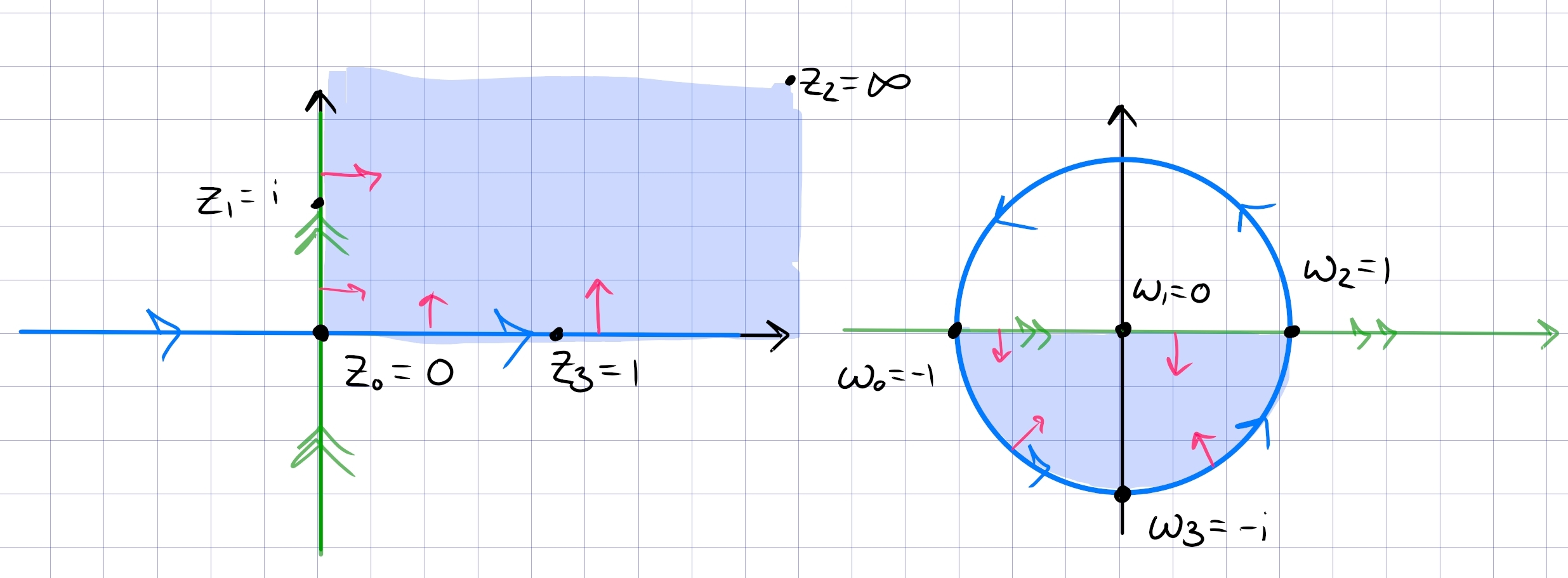
Disc to upper half-plane, cross-ratio (Tag E-W6MWU)
Find a conformal map \(\HH \to \DD\) using cross-ratios.
Solution
Idea: rotate the upper hemisphere \((\HH)\) of \(\CP^1\) to make the equator \(\bd \DD\), “zoom” by placing \(i\) at the center so \(0\to i\mapsto -1\to 0\) and \(i\to \infty\mapsto 0\to 1\). Accomplish this by sending
- \(\infty\to 1\)
- \(i\to 0\)
- \(-i\to \infty\)
Use the cross-ratio \[ R(z) \da (z, \infty, i, -i) = {z-i \over z-(-i)} {\infty - (-i) \over \infty - i} = {z-i\over z+i} .\]
Checking that this works:
- If \(z\in \RR\) then \(\abs{z-i} = \abs{z+i}\) so \(\abs{F(z)} = 1\).
- If \(z\in \HH\) then \(\abs{z-i}\leq \abs{z+i}\) so \(\abs{F(z)}< 1\).
A conformal map from $\DD$ onto $\HH$ (Tag E-4H3JY)
Find a conformal map from \(\DD\) to \(\HH\).
Solution
The inverse of the standard Cayley map \(w\mapsto(w-i)/(w+i)\) is \[ T(z)=i{1+z\over1-z}. \] For \(z\in\DD\), \[ \Im T(z) =\Re {1+z\over1-z} ={1-|z|^2\over |1-z|^2}>0, \] so \(T(\DD)\subseteq\HH\). Its inverse is \[ T^{-1}(w)={w-i\over w+i}, \] which maps \(\HH\) into \(\DD\). Thus \(T:\DD\to\HH\) is biholomorphic, hence conformal.
Half disc to full disc (Tag E-PGGNF)
Find a conformal map from \(\ts{z\in \CC \st \abs{z} < 1, \Im(z) > 0} = \DD \intersect \HH\) to \(\DD\).
Solution
Note that \(z\mapsto z^2\) doesn’t actually work, because the image is \(\DD\sm \RR_{\geq 0}\) and has a slit deleted. Instead compose:
\(z\mapsto i{z-1\over z+1}\), which maps \(\DD\to \HH\) and restricts to map \(\DD \intersect \HH \to Q_1\).
\(z\mapsto z^2\), which maps \(Q_1\to \HH\)
\(z\mapsto {z-i\over z+i}\) which maps \(\HH\to \DD\).
Solution: Using Joukowski maps
In parts:
Use \(z\mapsto \inverseof{z}\) to send \(\HH \intersect \DD\) to \(Q_{34} \intersect \DD^c\).
Use \(z\mapsto -z\) to map this to \(\HH \intersect \DD^c\)
Use \(z\mapsto {1\over 2}(z+\inverseof{z})\) to map \(\HH \intersect \DD^c\) to \(\HH\)
Then use the Cayley map \(z\mapsto {z-i\over z+i}\) to map \(\HH\to \DD\).
A conformal map from the upper half-disk onto $\HH$ (Tag E-6BH7D)
Find a conformal map from the upper half-disc to the upper half-plane.
Solution
The map \(z\mapsto {1+z\over 1-z}\) sends \(\DD\) onto the right half-plane \(\theset{\Re w>0}\). Since \(\Im{1+z\over 1-z}={2\Im z\over\abs{1-z}^2}\), it sends \(\DD \intersect \HH\) onto the first quadrant \(Q_1=\theset{\Re w>0,\ \Im w>0}\).
The map \(z\mapsto z^2\) sends \(Q_1\) onto \(\HH\).
Complement of the disc to $\mathbb{H}$ (Tag E-PQ7NC)
Find a conformal map \(\DD^c\cap\HH\to\HH\), where \(\DD^c=\{z:|z|>1\}\).
Solution
The Joukowski map \[ J(z)=z+{1\over z} \] works. Write \(z=re^{i\theta}\) with \(r>1\) and \(0<\theta<\pi\). Then \[ \Im J(z)=\qty{r-r^{-1}}\sin\theta>0, \] so \(J\) maps the domain into \(\HH\).
It is injective there. Indeed, \[ J(z_1)=J(z_2) \iff (z_1-z_2)\qty{1-{1\over z_1z_2}}=0. \] Since \(|z_1z_2|>1\), the second factor cannot vanish; hence \(z_1=z_2\).
It is also onto. Given \(w\in\HH\), the equation \(J(z)=w\) is \[ z^2-wz+1=0. \] Its two roots have product \(1\). Neither root lies on \(|z|=1\), because \(J(e^{i\theta})=2\cos\theta\in\RR\). Hence exactly one root has modulus greater than \(1\). For that root, the identity \[ \Im w=\qty{|z|-|z|^{-1}}\sin(\arg z)>0 \] forces \(0<\arg z<\pi\), so the root lies in \(\DD^c\cap\HH\).
Finally, \[ J'(z)=1-{1\over z^2}, \] which vanishes only at \(z=\pm1\), outside the domain. Thus \(J\) is a biholomorphic, hence conformal, map from \(\DD^c\cap\HH\) onto \(\HH\).
Slits:
Disc minus a slit (Tag E-YAYQB)
Find a conformal map \[ \DD\sm \left[ {1\over 2}, 1\right) \to \DD .\]
Solution
The picture:
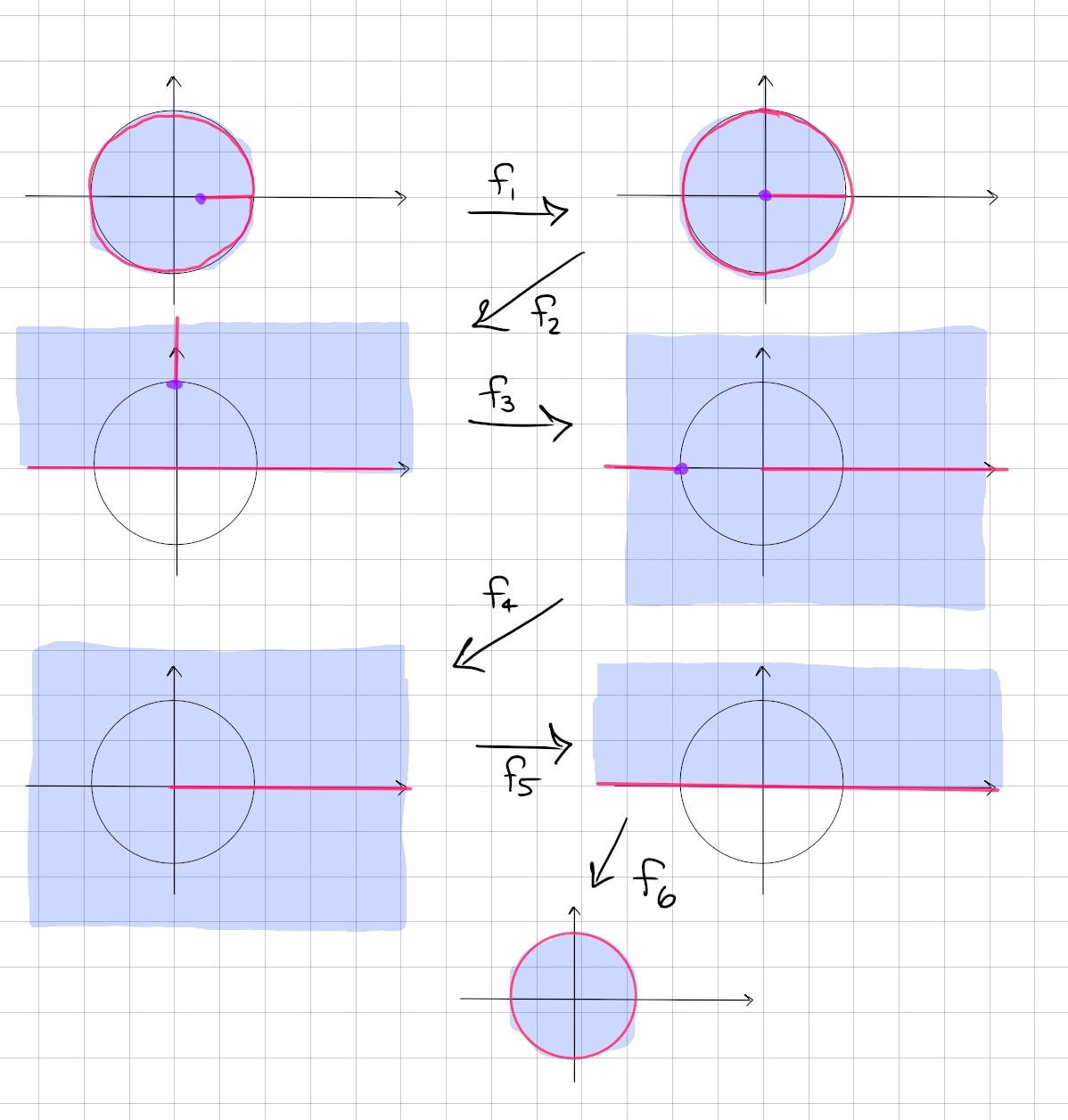
In steps:
\(f_1\): send \(1/2\to 0\) and \(1\to 1\) in order to lengthen the slit. Mobius transformations preserve lines, so take \(f_1(z) = {z-1/2 \over 1-1/2}\). New domain: \(\DD\sm [0, 1)\).
\(f_2\): send \(\DD\to \HH\) and keep track of the slit. Use the standard inverse to the Cayley transform, \(f_2(z) = i{1-z\over 1+z}\). New domain: \(\HH\sm [i, i\infty)\), noting that \(\HH\) is the open half-plane.
\(f_3\): rotate the slit so it becomes a line segment from \(-1\) to \(1\) passing through \(\infty\). Use \(f_3(z) = z^2\). New domain: \(\CC\sm\qty{(-\infty, 1] \union [1, \infty) }\)
\(f_4\): move the slit off to infinity to be left with a ray, so send \(-1\to \infty\) and \(0\to 0\). Take \(f_4(z) = {z\over z+1}\), the new domain is \(\CC\sm [0, \infty)\).
\(f_5\): fold it back. Branch cut log along \([0, \infty)\) to define \(f_5(z) = z^{1\over 2}\), so the new domain is \(\HH\).
\(f_6\): apply the standard Cayley transform \(f_6(z) = {i-z\over i+z}\)
A conformal map from $\DD\setminus[0,1)$ to $\DD$ (Tag P-DQTVL)
Let \(D\) be the region obtained by deleting the real interval \([0, 1)\) from \(\DD\); find a conformal map from \(D\) to \(\DD\).
Solution
On \[ D=\{0<|z|<1:\arg z\in(0,2\pi)\} \] choose the square-root branch \[ s(z)=\sqrt z=|z|^{1/2}e^{i\arg z/2}, \qquad 0<\arg z<2\pi. \] Then \(s\) maps \(D\) biholomorphically onto the upper half-disk \[ U=\{w:|w|<1,\ \Im w>0\}. \]
Next \[ T(w)=\frac{1+w}{1-w} \] maps \(U\) biholomorphically onto the first quadrant: the diameter \((-1,1)\) goes to the positive real axis, while the upper semicircle goes to the positive imaginary axis. Therefore \(T(w)^2\) maps \(U\) biholomorphically onto the upper half-plane. Finally the Cayley map \[ C(\zeta)=\frac{\zeta-i}{\zeta+i} \] maps the upper half-plane onto \(\mathbb D\). Thus one required map is \[ \boxed{ F(z)= \frac{\left(\frac{1+\sqrt z}{1-\sqrt z}\right)^2-i} {\left(\frac{1+\sqrt z}{1-\sqrt z}\right)^2+i}, } \] with the square-root branch specified above.
A conformal map from $\CC\setminus(-\infty,0]$ onto $\DD$ (Tag P-IJQ5Z)
Construct an explicit conformal map (biholomorphic equivalence) from the slit plane \(\Omega = \mathbb{C} \setminus (-\infty, 0]\) onto the open unit disk \(\mathbb{D} = \{w \in \mathbb{C} \mid |w| < 1\}\).
Solution
Use the principal square root on \[ \Omega=\mathbb C\setminus(-\infty,0]. \] If \(z=re^{i\theta}\) with \(-\pi<\theta<\pi\), define \[ \sqrt z=\sqrt r\,e^{i\theta/2}. \] Then \[ -\frac\pi2<\arg\sqrt z<\frac\pi2, \] so \(\Re\sqrt z>0\). Thus \[ z\longmapsto\sqrt z \] is a biholomorphism from \(\Omega\) onto the right half-plane \[ H=\{u:\Re u>0\}. \]
<1>1. The Cayley transform \[ C(u)=\frac{u-1}{u+1} \] maps \(H\) biholomorphically onto \(\mathbb D\). Indeed, if \(u=x+iy\) with \(x>0\), then \[ |C(u)|^2 =\frac{(x-1)^2+y^2}{(x+1)^2+y^2}<1. \]
<1>2. Therefore \[ F(z)=\frac{\sqrt z-1}{\sqrt z+1} \] is a conformal bijection \(\Omega\to\mathbb D\).
<1>3. Solving for \(z\) gives \[ F^{-1}(w)=\left(\frac{1+w}{1-w}\right)^2, \qquad |w|<1. \] Since \((1+w)/(1-w)\) lies in the right half-plane, its square lies in \(\Omega\), so this is indeed the inverse.
A conformal map from $\CC\setminus[1,\infty)$ onto $\DD$ (Tag P-A6PQA)
Find a conformal map from \(\CC\setminus\theset{x\in \RR\suchthat x\geq 1}\) to \(\DD\).
Solution
The map \[ z\longmapsto 1-z \] sends the slit plane \(\mathbb C\setminus[1,\infty)\) onto \(\mathbb C\setminus(-\infty,0]\). On this latter domain take the principal square root, which maps biholomorphically onto the right half-plane. Finally, the Cayley transform \[ w\longmapsto\frac{w-1}{w+1} \] maps the right half-plane biholomorphically onto \(\mathbb D\). Hence one conformal map is \[ \boxed{ F(z)=\frac{\sqrt{\,1-z\,}-1}{\sqrt{\,1-z\,}+1}, } \] where \(\sqrt{\cdot}\) is the principal square root on \(\mathbb C\setminus(-\infty,0]\).
Conformal map from a slit lens to the upper half plane (Tag P-CWXEW)
Find a bijective conformal map from \(G\) to \(\mathbb{H} = \{w \in \mathbb{C} \mid \operatorname{Im}(w) > 0\}\), where \[G \coloneqq \{z \in \mathbb{C} \mid |z-1| < \sqrt{2}, \, |z+1| < \sqrt{2}\} \setminus [0, i).\]
Solution
The two circles \(|z-1|=\sqrt2\) and \(|z+1|=\sqrt2\) meet orthogonally at \(\pm i\). Set \[ T(z)=\frac{z-i}{z+i}. \] Then \(T(i)=0\), \(T(-i)=\infty\), so the two circular boundary arcs become rays. Since \(T(0)=-1\), the unslit lens maps to the sector \[ \frac{3\pi}{4}<\arg w<\frac{5\pi}{4}. \] Moreover, for \(0\le t<1\), \[ T(it)=\frac{t-1}{t+1}\in[-1,0), \] so the slit maps to that radial segment.
<1>1. Rotate by \(-1\): \[ \zeta=-T(z). \] Then \[ -\frac\pi4<\arg\zeta<\frac\pi4, \qquad \zeta\notin(0,1]. \] Squaring maps this slit sector biholomorphically onto \[ \{u:\Re u>0\}\setminus(0,1]. \]
<1>2. The Cayley transform \[ v=\frac{u-1}{u+1} \] maps the right half-plane to \(\mathbb D\) and \((0,1]\) to \((-1,0]\). Thus \[ v\in\mathbb D\setminus(-1,0]. \] The principal square root maps this slit disk biholomorphically onto the right half-disk \[ H_+=\{s:|s|<1,\ \Re s>0\}. \]
<1>3. Finally, \[ q=\frac{s-i}{s+i} \] maps the imaginary diameter of \(H_+\) to the negative real axis and the semicircular boundary to the negative imaginary axis; hence it maps \(H_+\) biholomorphically onto the third quadrant. Squaring then maps that quadrant biholomorphically onto the upper half-plane.
Therefore the composition \[ z\mapsto T(z)\mapsto -T(z)\mapsto(-T(z))^2 \mapsto \frac{(-T(z))^2-1}{(-T(z))^2+1} \mapsto \sqrt{\frac{(-T(z))^2-1}{(-T(z))^2+1}} \mapsto q\mapsto q^2 \] with the principal square root is a bijective conformal map \(G\to\mathbb H\).
Strips:
Horizontal strip to $\mathbb{H}$ (Tag P-RMH6X)
Find a conformal map from the strip \(\theset{z\in \CC \suchthat 0 < \Im(z) < 1}\) to \(\HH\).
Solution
In steps:
- Dilate by \(z\mapsto \pi z\) to get \(0<\Im(z) < \pi\).
- Exponentiate by \(z\mapsto e^z\) to get \(\HH\).
Why \(e^z\) works: apply \(\Log\) to \(\HH\), use polar coordinates to write \(w=re^{i\theta}\) with \(0<\theta<\pi\) and note \[ \Log(w) = \ln\abs{w} +i\Arg(w) = \ln(r) + i\theta ,\] and noting that the image of \(\ln(\wait)\) is all of \(\RR\).
Lunes:
Lune between circles (Tag E-UUBBS)
Find a conformal map \(L\to \DD\) where \[ L\da \ts{\abs{z - i } < \sqrt 2} \intersect \ts{\abs{z+i} < \sqrt 2} ,\] i.e. a lune with vertices \(-1\) and \(1\).
Solution
The key insight: for lunes, map the corners to \(0\) and \(\infty\); this yields a sector. Here we want \(-1\mapsto 0\) and \(1\mapsto \infty\), so \(f(z) = {z+1\over z-1}\) gets things started.
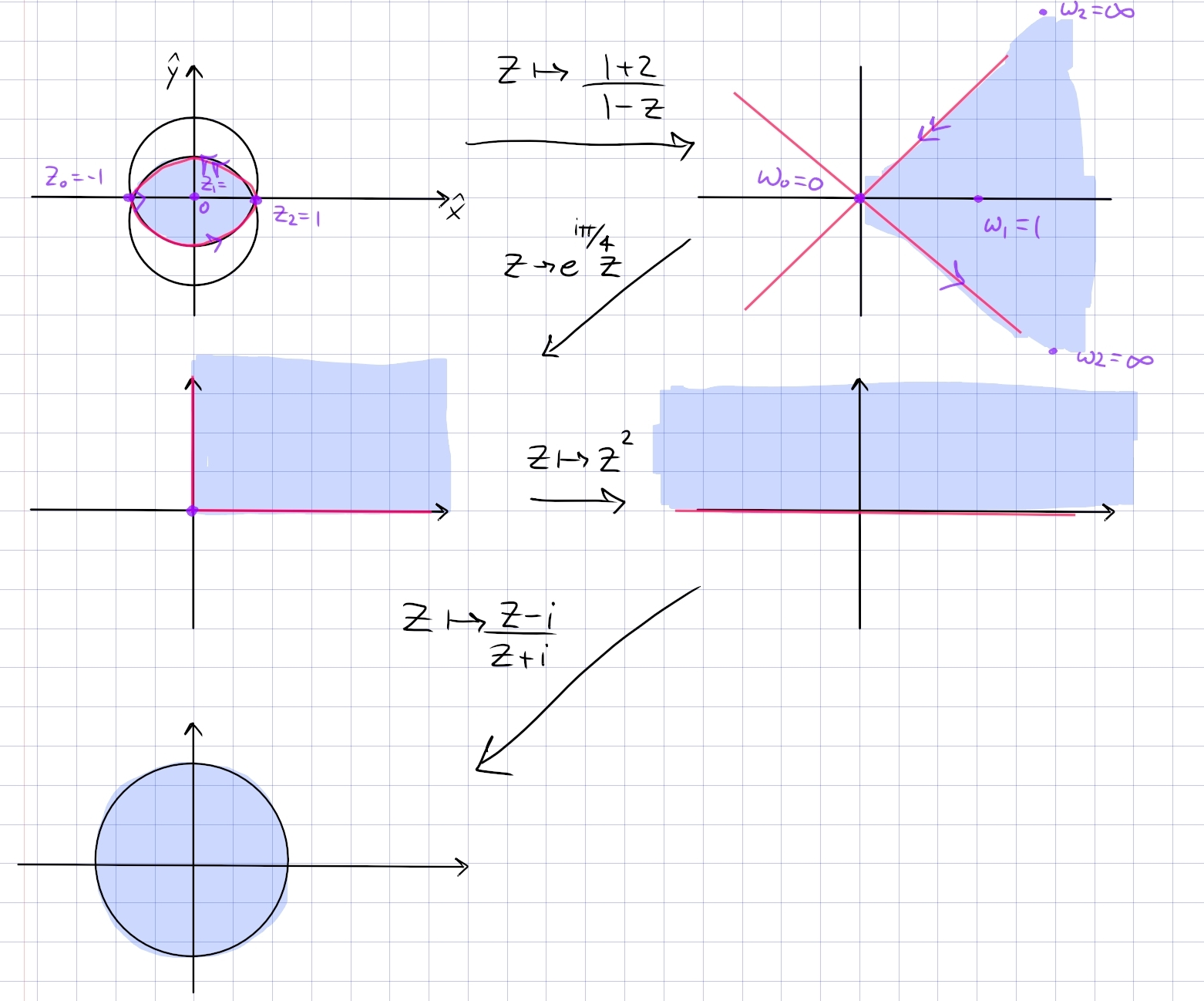
In steps:
- \(z\mapsto {1+z\over 1-z}\) sends the lune to the sector \(\Arg(z) \in (-\pi/4, \pi/4)\), since it fixes and must be symmetric about the real axis, and preserves the right angle between the circles at \(z=-1\).
- \(z\mapsto e^{i\pi/4}z\) to rotate this into \(Q_1\).
- \(z\mapsto z^2\) to dilate into \(\HH\).
- \(z\mapsto {z-i\over z+i}\) the standard Cayley map \(\HH\to\DD\).
Lune with only one intersection point (Tag E-VS4XE)
Find a conformal map: \[ \DD \sm \ts{\abs{z - {1\over 2}} = {1\over 2} } \to \DD .\]
Solution
The picture:
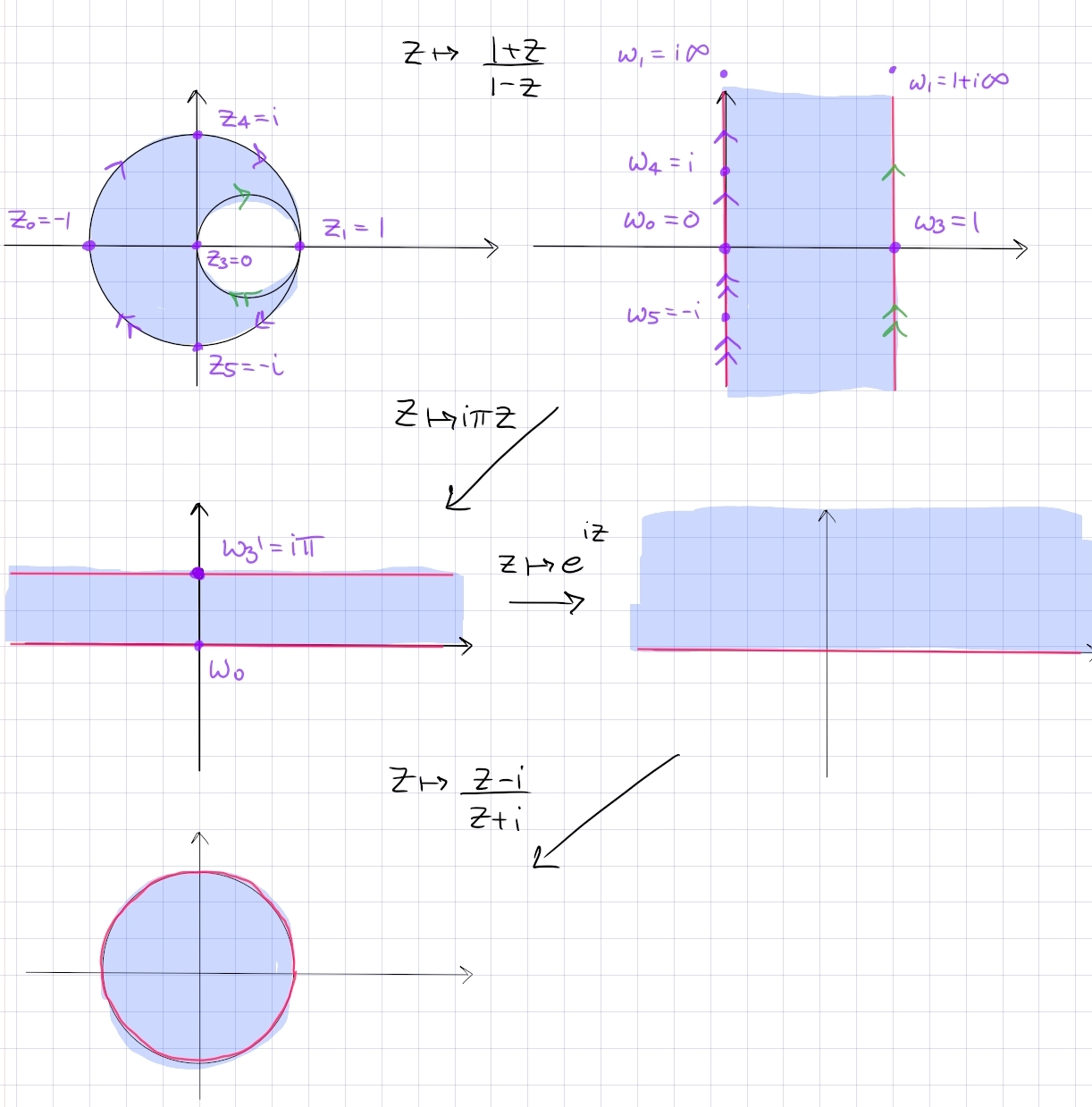
Key insight: send the point of tangency to \(\infty\) to get parallel lines. Send \(z\mapsto {1+z \over 1-z}\) to send \(-1\to 0, 0\to 1, 1\to \infty\) to get a vertical strip.
Rotate and dilate: \(z\mapsto i\pi z\) to get a strip \(\RR \cross i(0, \pi)\).
Standard exponential \(z\mapsto e^{iz}\) sends this to \(\HH\).
Standard Cayley \(z\mapsto {z-i \over z+i}\) sends this to \(\DD\).
A conformal map from $\{\Re z>0,\ |z-i|>1\}$ onto $\HH$ (Tag P-K7XDT)
Find a conformal map from \(\Omega = \{z\in \mathbb{C} \mid |z-i| > 1,\, \operatorname{Re}(z) > 0\}\) to \(\mathbb{H} = \{w \in \mathbb{C} \mid \operatorname{Im}(w) > 0\}\).
Solution
Define \[ T(z)=\frac{z}{z-2i}. \] The boundary line \(\Re z=0\) and the circle \(|z-i|=1\) both pass through \(0\) and \(2i\), so \(T\) sends them to straight lines through \(0\) and \(\infty\).
Write \(z=x+iy\). A direct computation gives \[ T(z)=\frac{|z-i|^2-1+2ix}{|z-2i|^2}. \] Thus, for \(z\in\Omega\), \[ \Re T(z)>0 \quad\text{and}\quad \Im T(z)>0. \] Hence \(T(\Omega)\) lies in the first quadrant \[ Q=\{w:\Re w>0,\ \Im w>0\}. \] Conversely, \(T\) is a Möbius transformation and the two boundary arcs of \(\Omega\) map to the two boundary rays of \(Q\); equivalently, solving \[ z=\frac{2iw}{w-1} \] shows that every \(w\in Q\) has a preimage in \(\Omega\). Therefore \(T\) maps \(\Omega\) biholomorphically onto \(Q\).
The squaring map is biholomorphic from \(Q\) onto the upper half-plane. Consequently \[ F(z)=T(z)^2=\left(\frac{z}{z-2i}\right)^2 \] is a conformal map from \(\Omega\) onto \(\mathbb H\).
A conformal map from $\{|z|<1,\ |z-1/2|>1/2\}$ onto $\DD$ (Tag P-5UKXY)
Find a conformal map from \(\theset{z\in \CC \suchthat \abs{z} < 1,\, \abs{z - {1\over 2}} > {1\over 2} }\) to \(\DD\).
Solution
Let \[ \Omega=\left\{z:|z|<1,\ |z-1/2|>1/2\right\}. \] Both boundary circles pass through \(1\). The Möbius map \[ T(z)=\frac1{1-z} \] sends that common boundary point to infinity. If \(w=T(z)\), then \[ |z|=1 \iff |w-1|=|w| \iff \operatorname{Re}w=\frac12, \] and \[ |z-1/2|=1/2 \iff |w-2|=|w| \iff \operatorname{Re}w=1. \] Testing, for example, \(z=-1/2\in\Omega\) shows that \[ T(\Omega)=\left\{\frac12<\operatorname{Re}w<1\right\}. \]
Now \[ E(w)=\exp\bigl(2\pi i(w-1/2)\bigr) \] maps this vertical strip biholomorphically onto the upper half-plane: its argument ranges from \(0\) to \(\pi\), and its real period is \(1\), larger than the strip width \(1/2\). Finally the Cayley map \[ C(\zeta)=\frac{\zeta-i}{\zeta+i} \] maps the upper half-plane biholomorphically onto \(\mathbb D\).
Therefore one required conformal map is \[ \boxed{ z\longmapsto \frac{ \exp\!\left(2\pi i\left(\frac1{1-z}-\frac12\right)\right)-i }{ \exp\!\left(2\pi i\left(\frac1{1-z}-\frac12\right)\right)+i }.} \]
A conformal map from the lens $|z-1|<2\cap|z+1|<2$ onto $\HH$ (Tag P-PYCCN)
Find a conformal map from \(\theset{\abs{z-1} < 2} \intersect \theset{\abs{z+1} < 2}\) to \(\HH\).
Solution
The two boundary circles meet at \[ z=\pm i\sqrt3. \] Set \[ T(z)=\frac{z-i\sqrt3}{z+i\sqrt3}. \] Then \(T\) sends the two intersection points to \(0\) and \(\infty\), so each of the two boundary circles is sent to a line through the origin, hence to a ray on the relevant boundary arc.
To identify the rays, note that \(-1\) lies on the circle \(|z-1|=2\) and \(1\) lies on \(|z+1|=2\). Direct computation gives \[ T(-1)=e^{2\pi i/3}, \qquad T(1)=e^{4\pi i/3}. \] Also \(0\) lies in the lens and \(T(0)=-1=e^{i\pi}\). Thus \(T\) maps the lens biholomorphically onto the sector \[ \frac{2\pi}{3}<\arg w<\frac{4\pi}{3}. \] After rotating by \(e^{-2\pi i/3}\) we obtain the sector \(0<\arg w<2\pi/3\). On this sector choose the branch of \(w^{3/2}\) with \(0<\arg(w^{3/2})<\pi\). Therefore \[ \boxed{ \Phi(z)= \left( e^{-2\pi i/3}\frac{z-i\sqrt3}{z+i\sqrt3} \right)^{3/2}} \] is a conformal bijection from the lens onto the upper half-plane.
Conformal map from $\{|z|<1,\ |z-1/2|>1/2\}$ onto the unit disc (Tag P-64ZUP)
Find a conformal map from \(D = \{z :\ |z| < 1,\ |z - 1/2| > 1/2\}\) to the unit disk \(\Delta=\{z: \ |z|<1\}\).
Solution
<1>1. \(D\) is the unit disk with the disk \(\{|z - 1/2| \le 1/2\}\) removed; it is a simply connected region bounded by two circles tangent at \(z = 1\).
the two circles \(|z| = 1\) and \(|z - 1/2| = 1/2\) are tangent at \(z = 1\).
<1>2. The Möbius map \(w = \frac{1}{1-z}\) sends \(z = 1\) to \(\infty\) and maps the two tangent circles to two parallel lines.
a Möbius map sending the tangency point to \(\infty\) turns the two tangent circles into parallel lines.
<1>3. Under \(w = \frac{1}{1-z}\), the region \(D\) maps to a vertical strip. <2>1. The circle \(|z| = 1\) maps to the line \(\operatorname{Re} w = 1/2\).
for \(|z| = 1\), \(w = \frac{1}{1-z}\) satisfies \(\operatorname{Re} w = 1/2\) (since \(\frac{1}{1-e^{i\theta}} = \frac{1}{2} + \frac{i}{2}\cot(\theta/2)\)).
<2>2. The circle \(|z - 1/2| = 1/2\) maps to the line \(\operatorname{Re} w = 1\).
for \(z = 1/2 + (1/2)e^{i\theta}\), \(w = \frac{1}{1-z} = \frac{1}{1/2 - (1/2)e^{i\theta}} = \frac{2}{1 - e^{i\theta}}\), whose real part is \(1\).
<2>3. Hence \(D\) maps to the strip \(\{w : 1/2 < \operatorname{Re} w < 1\}\).
<2>1 and <2>2.
<1>4. Map the strip \(\{1/2 < \operatorname{Re} w < 1\}\) to the unit disk. <2>1. First translate and scale to the strip \(\{0 < \operatorname{Re} \zeta < 1\}\) via \(\zeta = 2w - 1\).
\(\zeta = 2w - 1\) maps \(\operatorname{Re} w = 1/2\) to \(\operatorname{Re} \zeta = 0\) and \(\operatorname{Re} w = 1\) to \(\operatorname{Re} \zeta = 1\).
<2>2. The map \(\eta = e^{\pi i \zeta}\) sends the strip \(\{0 < \operatorname{Re} \zeta < 1\}\) to the upper half-plane.
If \(\zeta=x+iy\) with \(0<x<1\), then \[ e^{\pi i\zeta}=e^{-\pi y}e^{i\pi x}, \] whose argument lies in \((0,\pi)\). Conversely every point of \(\HH\) has a unique logarithm with argument in \((0,\pi)\), so this is a biholomorphism from the vertical strip onto \(\HH\).
<2>3. The map \(\xi = \frac{\eta - i}{\eta + i}\) sends the upper half-plane to the unit disk.
the Cayley transform.
<1>5. Composing, a conformal map \(D \to \Delta\) is \[z \mapsto \frac{e^{\pi i(2/(1-z) - 1)} - i}{e^{\pi i(2/(1-z) - 1)} + i}.\]
<1>3 and <1>4.
<1>6. Q.E.D.
<1>5.
Sectors:
Standard sector (Tag E-PYJZO)
Find a conformal map from the sector \(\ts{\Arg(z) \in (0, \alpha)} \to \DD\).
Solution
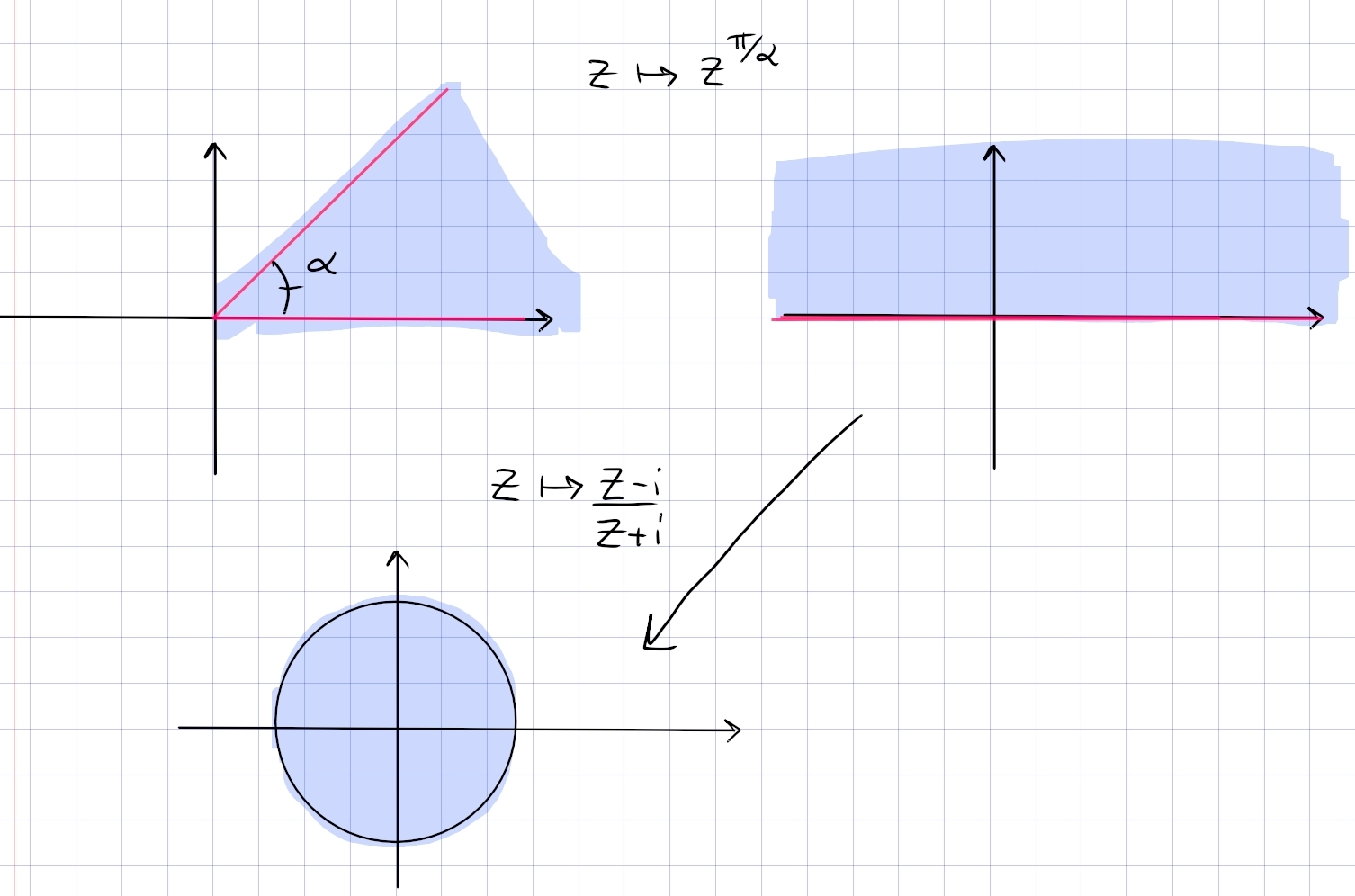
The picture:
In steps:
Map the sector to \(\HH\) using \(z\mapsto z^{\pi/\alpha}\), choosing a branch cut for \(\Log\) along \(\RR_{\leq 0}\).
Map \(\HH\to \DD\) using the standard \(z\mapsto {z-i\over z+i}\).
Joukowski regions:
Complement of a segment (Tag E-NZY3B)
Map \(\CC\sm[-1, 1]\) to \(\DD\).
Solution
In steps:
Send \(-1\to 0\) and \(1\to \infty\) with \(z\mapsto {z+1\over z-1}\). Checking that \(f(0) = -1\), this yields \(\CC\sm\RR_{\leq 0}\).
Unwrap with \(z\mapsto \sqrt{z}\) to obtain the right half-plane \(-\pi/2<\Arg(z) < \pi/2\).
Apply the rotated Cayley map \(z\mapsto {z-1\over z+1}\) to map this to \(\DD\).
Note that the composition is \[ {\sqrt{z+1\over z-1} -1 \over \sqrt{z+1\over z-1} +1} &= { \qty{ \sqrt{z+1} - \sqrt{z-1}}^2 \over (z+1)-(z-1) } \\ &= z - \sqrt{z^2-1} ,\] which has inverse \(z\mapsto {1\over 2}\qty{z+{1\over z}}\).
Mixed:
A fractional linear map sending $i\RR$ onto $\abs{z-\frac12}=\frac12$ (Tag E-H64WF)
Find a conformal map that sends \(i\RR\) to \(\abs{z-{1\over 2}} = {1\over 2}\).
- The double angle formulas: \[ \sin(2t) = {2\tan(t) \over 1+\tan^2(t)} && \cos(2t) = {1-\tan^2(t) \over 1+\tan^2(t)} .\]
- Parameterize a line by \(x=\tan(t)\) for \(t\in (-\pi/2, \pi/2)\)
- The boundary behavior of \(F(z) \da {i-z\over i+z}\) from [@SS03, Chapter 8, Theorem 1.2]: with \(x=\tan(t)\), \(F(\RR) = \ts{\cos(2t)+i\sin(2t) = e^{2it} \st t\in (-\pi/2, \pi/2)}\).
Solution
The line \(-i\infty\to 0 \to i\infty\) is to be mapped to the circle traversed \(0\to 1\to 0\):
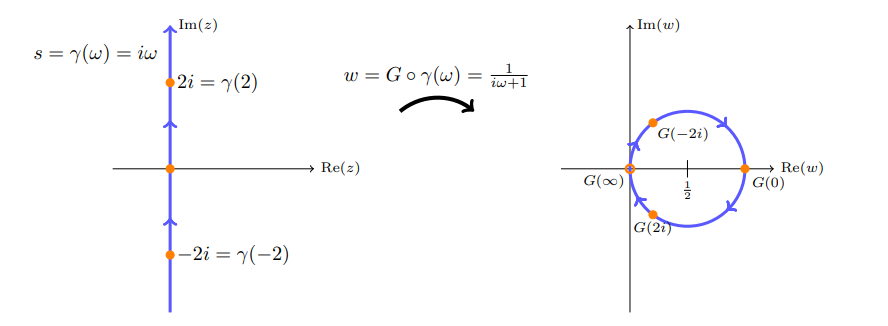
Take the cross ratio \(R(z) = (z, 0, \infty, -1)\) to send
- \(0\to 1\)
- \(\infty\to 0\)
- \(-1\to \infty\)
This yields \[ R(z) = {z-\infty \over z+1}{0+1\over 0-\infty} = {1\over z+1} .\] Some deductions:
- \(R\) preserves circles, so \(\RR\mapsto \RR\).
- The segment \(0\to\infty\mapsto 1\to 0\)
- The ray \(-1\to 0 \to \infty \mapsto \infty\to 1\to 0\)
- The ray \(-\infty \to -1 \mapsto 0\to -\infty\)
- \(R\) preserves angles, so at \(w=R(0)=1\) the image of \(i\RR\) is orthogonal to \(\RR\), so it is either a circle or the vertical line through \(1\).
- \(R\) sends \(-i\infty \to 0 \to i\infty\) to \(0\to 1\to 0\), so the image passes through \(0\) and \(1\) and is a circle.
- Parameterize \(i\RR = \ts{it\st t\in \RR}\) and put \(t=\tan(s)\) with \(s\in(-\pi/2,\pi/2)\). Then \[ R(i\RR) &= \ts{{1\over 1+it}} \\ &= \ts{1-it\over 1+t^2} \\ &= \ts{{1\over 1+t^2} - i {t\over 1+t^2}} \\ &= \ts{{1\over 2} \qty{ 1 + {1-t^2\over 1+t^2} } - i{1\over 2}\qty{2t\over 1+t^2}} \\ &= \ts{{1\over 2}\qty{1 + \cos(2s) - i\sin(2s)}} \\ &= \ts{{1\over 2} + {1\over 2}e^{-2is} } ,\] which is the circle of radius \(1/2\) about \(1/2\) with the point \(0=R(\infty)\) removed.
Conclusion:
- \(i\RR \to \ts{\abs{z-{1\over 2}} = {1\over 2} }\) by \(z\to {1\over 1+z}\).
- The reverse map: \(w\mapsto {1-w\over w}\).
Mapping $\DD^c \cap \HH$ conformally onto $\HH$ with prescribed boundary values (Tag E-3GIQS)
Map \(\DD^c \intersect \HH\) to \(\HH\), sending
\(-1\to -1\)
\(i\to 0\)
\(1\to 1\)
Solution
The Joukowski map \[ J(z)={1\over 2}\qty{z + \inverseof{z}} \] does this. For \(z=re^{i\theta}\) with \(r>1\) and \(0<\theta<\pi\), \[ \Im J(z)={1\over2}\qty{r-\inverseof{r}}\sin\theta>0, \] and \(J\) is injective on \(\theset{\abs z>1}\) with image \(\CC\setminus[-1,1]\), so \(J\) maps \(\DD^c\intersect\HH\) bijectively onto \(\HH\). Moreover \(J(-1)=-1\), \(J(i)=0\) and \(J(1)=1\).
An injective conformal map from $\{|z|<1\}\setminus\{|z-1/4|\le 1/4\}$ onto an annulus (Tag P-EEUV6)
Let \(\Omega\) be the region inside the unit circle \(\abs{z} = 1\) and outside the circle \(\abs{z-{1\over 4}} = {1\over 4}\).
Find an injective conformal map from \(\Omega\) onto some annulus \(\theset{r < \abs{z} < 1}\) for constant \(r\).
Solution
The two boundary circles are coaxial. Let \[ \alpha=2-\sqrt3, \qquad \beta=2+\sqrt3. \] Then \[ \alpha\beta=1, \qquad \alpha+\beta=4. \] These are the limiting points of the coaxial family: for the outer circle \(|z|=1\) we have \(\alpha\beta=1\), while for the inner circle \(|z-1/4|=1/4\), \[ (\alpha-1/4)(\beta-1/4)=1/16. \] Therefore the Möbius transformation \[ T(z)=\frac{z-\alpha}{z-\beta} \] maps both boundary circles to circles centered at the origin.
To determine their radii, evaluate at convenient boundary points. On \(|z|=1\), using \(z=1\), \[ |T(1)| =\frac{\sqrt3-1}{\sqrt3+1} =2-\sqrt3 =\alpha. \] On \(|z-1/4|=1/4\), using \(z=1/2\), \[ |T(1/2)| =\frac{1/2-\alpha}{\beta-1/2} =\alpha^2. \] Hence \[ T(\Omega)=\{\alpha^2<|w|<\alpha\}. \] After dividing by \(\alpha\), we obtain \[ \boxed{ \Phi(z)=\frac1\alpha\frac{z-\alpha}{z-\beta}, \qquad \alpha=2-\sqrt3,} \] and \[ \Phi(\Omega)=\{\alpha<|w|<1\}. \] Thus the required annulus has inner radius \[ \boxed{r=2-\sqrt3}. \] Since \(\beta>1\) lies outside \(\Omega\), the Möbius map is holomorphic and injective on \(\Omega\).
Characterizations of Möbius transformations preserving $\RR\cup\{\infty\}$ (Tag P-K4WSJ)
Prove that TFAE for a Möbius transformation \(T\) given by \(T(z) = {az + b \over cz + d}\):
- \(T\) maps \(\RR\union \theset{\infty}\) to itself.
- It is possible to choose \(a,b,c,d\) to be real numbers.
- \(\bar{T(z)} = T(\bar z)\) for every \(z\in \CP^1\).
- There exist \(\alpha\in \RR, \beta \in \CC\setminus \RR\) such that \(T(\alpha) = \alpha\) and \(T(\bar \beta) = \bar{T(\beta)}\).
Solution
<1>1. (a) \(\Leftrightarrow\) (b) \(\Leftrightarrow\) (c). <2>1. (a) \(\Rightarrow\) (b): \(T\) maps \(\RR \cup \{\infty\}\) to itself, so it sends three real points to three real points; a Möbius map is determined by three values, and a map sending three real points to three real points has real coefficients (up to a common real scalar).
the cross-ratio of real points is real.
<2>2. (b) \(\Rightarrow\) (c): if \(a,b,c,d \in \RR\), then \(\overline{T(z)} = \frac{\bar a \bar z + \bar b}{\bar c \bar z + \bar d} = \frac{a\bar z + b}{c\bar z + d} = T(\bar z)\).
conjugation commutes with real coefficients.
<2>3. (c) \(\Rightarrow\) (a): if \(z \in \RR\), then \(\bar z = z\), so \(\overline{T(z)} = T(\bar z) = T(z)\), hence \(T(z) \in \RR\); thus \(T\) maps \(\RR\) to \(\RR\) and \(\RR \cup \{\infty\}\) to itself.
<2>2 applied to real \(z\).
<1>2. (d) \(\Rightarrow\) (a). <2>1. \(T\) fixes \(\alpha \in \RR\) and satisfies \(T(\bar\beta) = \overline{T(\beta)}\) for \(\beta \notin \RR\).
hypothesis.
<2>2. The map \(z \mapsto \overline{T(\bar z)}\) is a Möbius map agreeing with \(T\) at the three distinct points \(\alpha, \beta, \bar\beta\).
at \(\alpha\) (real), \(\overline{T(\bar\alpha)} = \overline{T(\alpha)} = \overline{\alpha} = \alpha = T(\alpha)\); at \(\beta\), \(\overline{T(\bar\beta)} = T(\beta)\) by hypothesis; at \(\bar\beta\), \(\overline{T(\beta)} = T(\bar\beta)\) by hypothesis.
<2>3. Hence \(\overline{T(z)} = T(\bar z)\) for all \(z\), so \(T\) maps \(\RR \cup \{\infty\}\) to itself (by <1>2.3).
<2>2 and <1>2.3.
<1>3. (a) does NOT imply (d): the statement “TFAE” is false as written. <2>1. \(T(z) = -\frac{1}{z}\) has real coefficients, so it satisfies (a), (b), and (c).
\(a = 0\), \(b = -1\), \(c = 1\), \(d = 0\) are real.
<2>2. But \(T\) has no real fixed point.
\(T(z) = z\) means \(-\frac{1}{z} = z\), i.e. \(z^2 = -1\), so the fixed points are \(z = \pm i \notin \RR\).
<2>3. Hence (d) fails for \(T\), so (a) \(\not\Rightarrow\) (d).
<2>1 and <2>2.
<1>4. Q.E.D.
<1>1 proves (a) \(\Leftrightarrow\) (b) \(\Leftrightarrow\) (c); <1>2 proves (d) \(\Rightarrow\) (a); <1>3 shows (a) \(\not\Rightarrow\) (d), so the four statements are not all equivalent.
A conformal map from the upper half-disc to the upper half-plane (Tag E-YCHOS)
Find a conformal map from the upper half-disc to the upper half-plane.
Solution

Mobius transformations as cross-ratios (Tag E-JPAJE)
Write a Mobius transformation \(f(z) = {az+b\over cz + d}\) as a cross-ratio.
Solution
\[ T(z) = \qty{ z; {d-b\over a-c}, -{b\over a}, -{d\over c}} .\]
Cancelling poles (Tag E-PIB7A)
Let \(f\) be meromorphic on \(\DD\) with no poles on \(\bd\DD\). Show that there exists a meromorphic \(g\) with no poles in \(\DD\) such that \(\abs{f(z)} = \abs{g(z)}\) when \(\abs{z} = 1\).
Solution
Write \(\ts{a_1,\cdots, a_n}\) for all of the poles of \(f\), indexed with multiplicity, and define \[ g(z) \da \prod_{1\leq k\leq n} \psi_{a_k}(z) f(z) \da \qty{ \prod_{1\leq k \leq n}{z-a_k\over 1 -\bar{a_k} z}} f(z) .\] Then \(g\) has no poles, and since \(\abs{ \psi_{a_k} } = 1\) on \(\bd \DD\), this works.
Injective holomorphic maps have nonvanishing derivative (Tag E-KZB33)
Show that if \(f\) is injective, then \(f'\) is nowhere vanishing and thus \(f\) is conformal.
Solution
Contrapositive: if \(f'(z_0)=0\) at some point, then \(f\) fails injectivity in a neighborhood of \(z_0\). Without loss of generality, we can assume \(f(0) = 0\) after changes of coordinates in the domain/codomain, since this won’t affect injectivity or vanishing of derivatives. If \(z_0\) is a zero of \(f\) of some order \(n\), we can write \(f(z) = z^n g(z)\) with \(g(0) \neq 0\) and \(g\) nonvanishing in some neighborhood of zero. Choosing a branch of \(z\mapsto z^{1\over n}\), write \(g(z) = (h(z))^n\) for some \(h\), then \[ f(z) = z^n h(z)^n = (zh(z))^n .\] Write \(H(z) \da zh(z)\), then \(H'(z) = h(z) + zh'(z)\), so \(H'(0)\neq 0\). By the inverse function theorem, \(H\) is invertible on a small neighborhood of \(0\), making \(f\) \(n\)-to-one for some \(n\). Writing \(f(z) = \sum_{k\geq 0} c_k z^k\), we have \(c_0 = 0\) since \(f(0) = 0\) and \(c_1 = 0\) if \(f'(0) = 0\), making \(n\geq 2\), so \(f\) fails injectivity in this neighborhood.