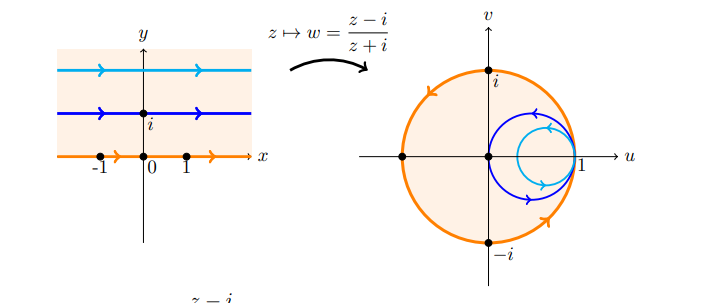
Let \(\HH\coloneqq\ts{z\in\CC\st\Im z>0}\) and \(\DD\coloneqq\ts{w\in\CC\st\abs{w}<1}\). The Cayley transform \[ \Psi\colon\HH\to\DD,\qquad \Psi(z)=\frac{z-i}{z+i}, \] is a biholomorphism, with inverse \(\Psi^{-1}(w)=i\,\frac{1+w}{1-w}\). It restricts to a biholomorphism from the first quadrant \(Q_1\coloneqq\ts{z\st\Re z>0,\ \Im z>0}\) onto the lower half-disc \(\ts{w\in\DD\st\Im w<0}\).
For \(z\in\HH\), \(\abs{z-i}^2-\abs{z+i}^2=-4\Im z<0\): every \(z\in\HH\) is closer to \(i\) than to \(-i\), so \(\abs{\Psi(z)}<1\). Solving \(w=\frac{z-i}{z+i}\) gives \(z(1-w)=i(1+w)\), so \(z=i\frac{1+w}{1-w}\); for \(w\in\DD\) this is defined, and \[ \Im\Big(i\,\frac{1+w}{1-w}\Big)=\Re\frac{(1+w)(1-\bar w)}{\abs{1-w}^2}=\frac{1-\abs{w}^2}{\abs{1-w}^2}>0, \] so the inverse formula maps \(\DD\) into \(\HH\), and the two maps are mutually inverse.
For \(z\in\HH\), \(\Im\Psi(z)=\Im\frac{(z-i)(\bar z-i)}{\abs{z+i}^2}=\frac{-2\Re z}{\abs{z+i}^2}\), since \((z-i)(\bar z-i)=\abs{z}^2-1-2i\Re z\). So \(\Psi(z)\) lies in the lower half-disc exactly when \(\Re z>0\), and \(\Psi(Q_1)=\ts{w\in\DD\st\Im w<0}\).
The real axis is mapped onto the unit circle minus \(1\), and horizontal lines \(\Im z=c>0\) are mapped onto circles in \(\DD\) tangent to the unit circle at \(1\):