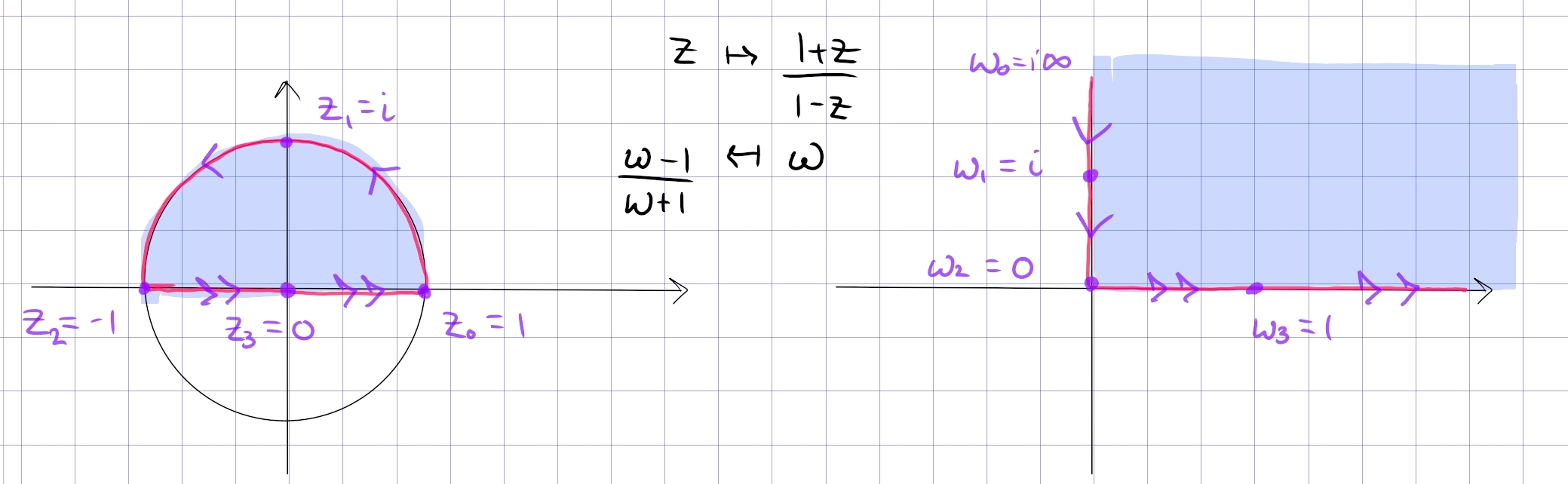
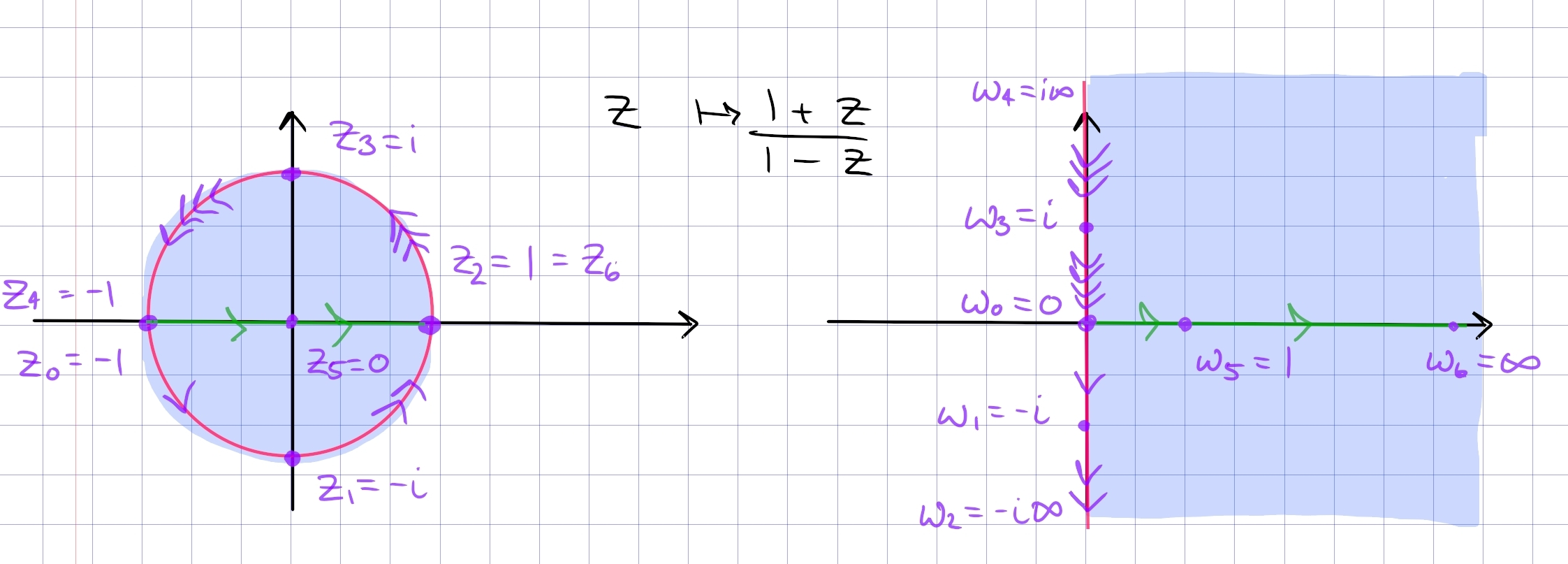
Let \(\HH_R\coloneqq\ts{w\st\Re w>0}\) be the right half-plane. The map \[ F\colon\DD\to\HH_R,\qquad F(z)=\frac{1+z}{1-z}, \] is a biholomorphism, with inverse \(F^{-1}(w)=\frac{w-1}{w+1}\). It sends \(-1,0,1\) to \(0,1,\infty\) respectively.
For \(z\in\DD\), \[ F(z)=\frac{(1+z)(1-\bar z)}{\abs{1-z}^2}=\frac{1-\abs{z}^2+2i\Im z}{\abs{1-z}^2}, \] so \(\Re F(z)>0\). For \(w\in\HH_R\), \(w\) is closer to \(1\) than to \(-1\), so \(\abs{\frac{w-1}{w+1}}<1\). Solving \(w=\frac{1+z}{1-z}\) gives \(z=\frac{w-1}{w+1}\), so the two maps are mutually inverse.
The Cayley transform \(\Psi(z)=\frac{z-i}{z+i}\) from the upper half-plane \(\HH\) onto \(\DD\) is related to \(F\) by rotations. Its inverse is \(\Psi^{-1}(w)=i\,\frac{1+w}{1-w}=iF(w)\), the composite \(\DD\xrightarrow{F}\HH_R\xrightarrow{w\mapsto iw}\HH\). Conversely, \(\Psi(z)=F^{-1}(-iz)\), the composite \(\HH\xrightarrow{z\mapsto -iz}\HH_R\xrightarrow{F^{-1}}\DD\): \[ F^{-1}(-iz)=\frac{-iz-1}{-iz+1}=\frac{z-i}{z+i}. \]
On the boundary, \(F(e^{i\theta})=i\cot(\theta/2)\) for \(0<\theta<2\pi\), so the unit circle minus \(1\) is mapped onto the imaginary axis, and the segment \((-1,1)\) is mapped onto \((0,\infty)\).
The restriction of \(F\) to the upper half-disc \(\ts{z\in\DD\st\Im z>0}\) is a biholomorphism onto the first quadrant: by the formula for \(F(z)\) in the proof, \(\Im F(z)>0\) exactly when \(\Im z>0\). This is PR-PW4Z6.