The map \[ \begin{aligned} F\colon \theset{z\in\CC : \abs{z}>1} &\to \CC\sm[-2, 2], \\ z &\mapsto z+ \inverseof{z} \end{aligned} \] is a biholomorphism.
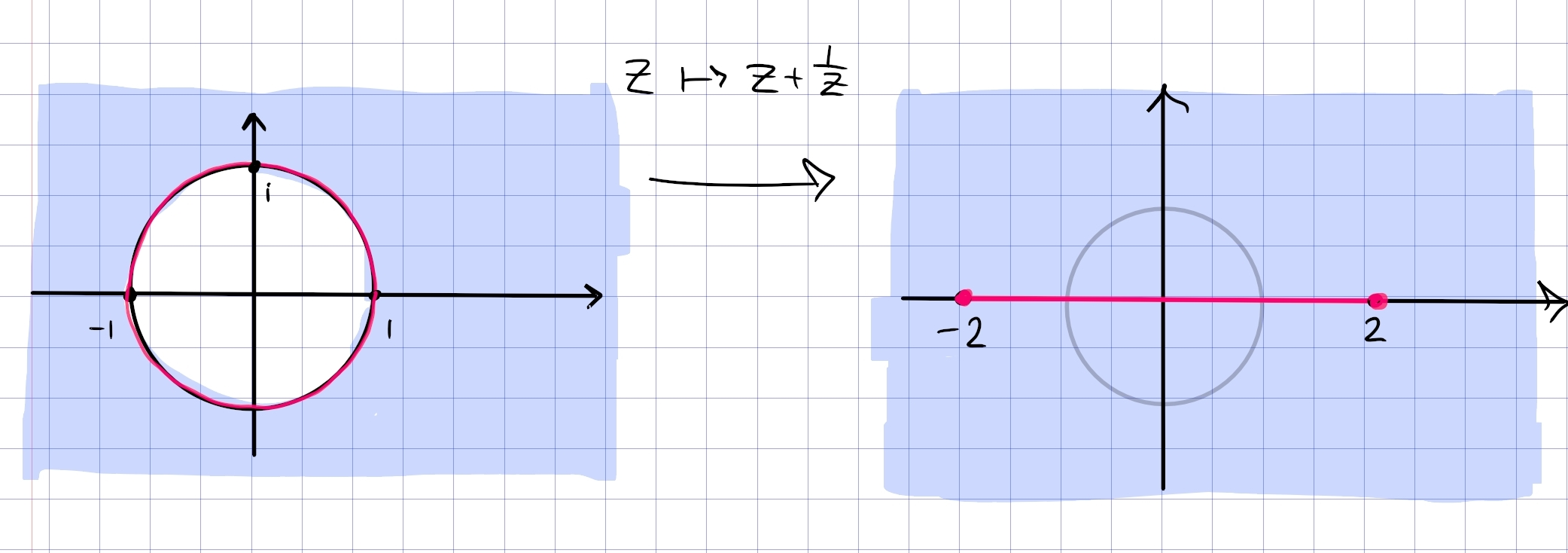
For \(w\in\CC\), the solutions of \(F(z)=w\) are the roots of \(z^2-wz+1=0\), whose product is \(1\). If \(w\in[-2,2]\), the discriminant \(w^2-4\le0\), so the roots are complex conjugates of product \(1\) and both lie on the unit circle; hence \(F\) maps \(\abs{z}>1\) into \(\CC\sm[-2,2]\). If \(w\notin[-2,2]\), no root lies on the unit circle, since \(F(e^{i\theta})=2\cos\theta\in[-2,2]\), and the roots are distinct, since a double root would be \(\pm1\) with \(w=\pm2\); as their product is \(1\), exactly one root satisfies \(\abs{z}>1\). So \(F\) is a holomorphic bijection onto \(\CC\sm[-2,2]\), and its inverse is holomorphic.