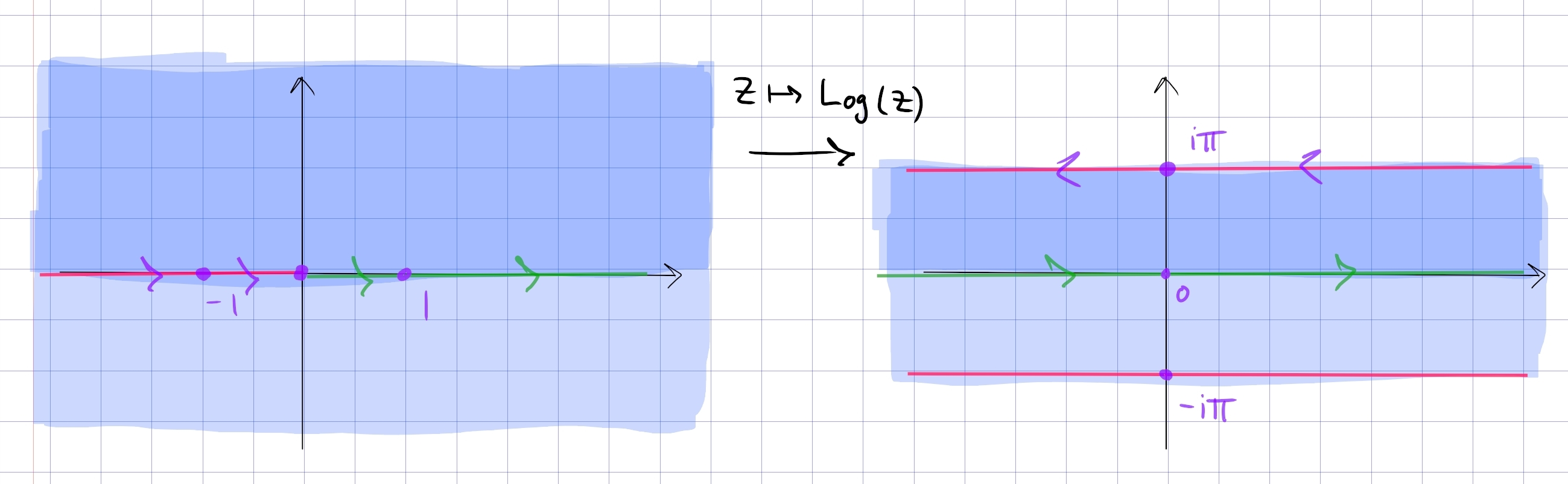
Let \(\Log\) be the principal branch of the logarithm. The map \[ F\colon\CC\sm(-\infty,0]\to\ts{w\st-\pi<\Im w<\pi},\qquad F(z)=\Log z, \] is a biholomorphism, with inverse \(w\mapsto e^w\). It maps each circle \(\ts{\abs{z}=R}\), with the point \(-R\) removed, onto the vertical segment \(\ts{\ln R+it\st-\pi<t<\pi}\), and each ray \(\ts{re^{i\theta}\st r>0}\) with \(-\pi<\theta<\pi\) onto the horizontal line \(\ts{t+i\theta\st t\in\RR}\).
For \(z=re^{i\theta}\) with \(r>0\) and \(-\pi<\theta<\pi\), \(\Log z=\ln r+i\theta\). Since \(r\mapsto\ln r\) is a bijection \((0,\infty)\to\RR\), \(F\) is a bijection onto the strip, it maps \(\ts{r=R}\) and \(\ts{\theta=\text{const}}\) as stated, and \(e^{\ln r+i\theta}=re^{i\theta}\) gives the holomorphic inverse.
The same computation shows that \(w\mapsto e^w\) maps the strip \(\ts{w\st\abs{\Im w}<\pi/2}\) biholomorphically onto the right half-plane \(\ts{z\st\Re z>0}\).