Let \(A\) be an \(n\times n\) matrix over a field \(F\), and make \(V=F^n\) an \(F[t]\)-module by \(p(t)\actson v \da p(A)v\). The minimal polynomial \(\min_A\) is the monic generator of the annihilator of this module, and the characteristic polynomial \(\chi_A(t)=\det(tI-A)\) is the product of its invariant factors, the largest of which is \(\min_A\).
Characteristic polynomials via traces of exterior powers (Tag PR-EDD7U)
Let \(k\) be a field, \(A \in \Mat_{n\times n}(k)\), and \(\chi_A(t) \coloneqq \det(tI - A)\). Then \[ \begin{aligned} \chi_A(t) &= \sum_{k=0}^n (-1)^k \trace\qty{\Extpower^k A}\, t^{n-k} \\ &= t^n - \trace\qty{A} t^{n-1} + \trace\qty{\Extpower^2 A}\, t^{n-2} - \cdots + (-1)^{n-1} \trace\qty{\Extpower^{n-1} A}\, t + (-1)^n \det(A), \end{aligned} \] where \(\trace\qty{\Extpower^0 A} = 1\), \(\Extpower^1 A = A\), and \(\trace\qty{\Extpower^n A} = \det(A)\). Moreover, for \(0 \leq \ell \leq n\), \[ \trace\qty{\Extpower^\ell A} = \sum_{\substack{S \subseteq \theset{1, \ldots, n} \\ \abs{S} = \ell}} \det\qty{A_{S,S}}, \] the sum of the \(\binom{n}{\ell}\) principal \(\ell\times\ell\) minors of \(A\), where \(A_{S,S}\) is the submatrix of \(A\) with rows and columns indexed by \(S\), obtained by deleting the rows and columns indexed by the complement of \(S\).
Let \(M = (4i + j)_{0 \leq i, j \leq 3} \in \Mat_{4\times 4}(\QQ)\). The principal submatrices of \(M\) of sizes \(\ell=1,\ldots,4\):
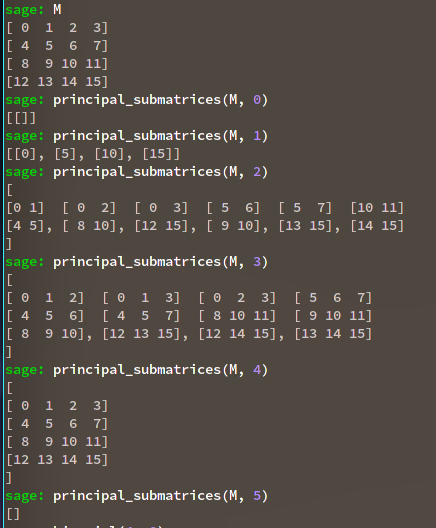
The \(1\times 1\) minors sum to \(\trace M = 0 + 5 + 10 + 15 = 30\), and the \(2\times 2\) minors are \(-4, -16, -36, -4, -16, -4\), with sum \(-80\). Every row of \(M\) is a linear combination of \((1,1,1,1)\) and \((0,1,2,3)\), so \(\rank M = 2\) and every \(3\times 3\) and \(4\times 4\) minor vanishes. Therefore \(\chi_M(t) = t^4 - 30t^3 - 80t^2\).
Let \(f(t) = a_n t^n + \cdots + a_1 t + a_0 \in \ZZ[t]\) with \(a_n \neq 0\). If \(p/q \in \QQ\) is a root of \(f\) with \(p, q \in \ZZ\) coprime, then \(p \divides a_0\) and \(q \divides a_n\). In particular, if \(f\) is monic, every rational root of \(f\) is an integer dividing \(a_0\).
If \(r\) is a root of \(f\), polynomial long division gives \(f(t) = (t - r)\,g(t)\) with \(\deg g = \deg f - 1\), and the remaining roots of \(f\) are the roots of \(g\).
(Notation)
| Symbol | Meaning |
|---|---|
| \(\min_A(x)\) | the minimal polynomial of \(A\) |
| \(\chi_A(x)\) | the characteristic polynomial of \(A\) |
Minimal polynomial of a linear map (Tag D-GK5SF)
Let \(k\) be a field, let \(V\) be a finite-dimensional \(k\)-vector space, and let \(T\colon V\to V\) be \(k\)-linear. The minimal polynomial of \(T\) is the unique monic polynomial \(\min_T(x)\in k[x]\) of minimal degree such that \(\min_T(T) = 0\).
Characteristic polynomial (Tag D-QFYAC)
Let \(k\) be a field and \(A\in\Mat_{n\times n}(k)\). The characteristic polynomial of \(A\) is \[ \chi_A(x) \coloneqq \det(xI - A)\in k[x]. \]
\(\chi_A\) is monic of degree \(n\). Some texts define the characteristic polynomial as \(\det(A-xI)=(-1)^n\chi_A(x)\).
If \(\SNF(xI-A)=\diag(d_1,\ldots,d_n)\) is the Smith normal form of \(xI-A\) over \(k[x]\), with monic invariant factors \(d_i\), then \(\det(xI-A)\) and \(d_1\cdots d_n\) are monic and differ by a unit of \(k[x]\), hence are equal, and \[ \chi_A(x)=\det(xI-A)=\det\SNF(xI-A). \]
Characteristic polynomial of a matrix (Tag FD-GOB47)
Let \(k\) be a commutative ring and \(A\) an \(n\times n\) matrix over \(k\). The characteristic polynomial of \(A\) is \[ p_A(x) \coloneqq \det(xI_n - A)\in k[x], \] where \(I_n\) is the \(n\times n\) identity matrix.
The relation between the two polynomials
Cayley--Hamilton theorem (Tag T-SJCF7)
Let \(k\) be a field and \(A\in\Mat_n(k)\), with characteristic polynomial \(\chi_A\) and minimal polynomial \(\min_A\). Then \(\chi_A(A) = 0\); equivalently, \(\min_A\) divides \(\chi_A\).
\(\min_A\) divides \(\chi_A\), and \(\min_A\) and \(\chi_A\) have the same irreducible factors; in particular they have the same roots.
By Cayley–Hamilton, \(\chi_A(A) = 0\), so \(\min_A\) divides \(\chi_A\). Let \(p_1\divides p_2\divides\cdots\divides p_m\) be the invariant factors of \(V\), so that \(\chi_A = p_1\cdots p_m\) and \(\min_A = p_m\). Every irreducible factor of \(\chi_A\) divides some \(p_i\), hence divides \(p_m = \min_A\). For the roots directly: if \(A\vector v_i = \lambda_i\vector v_i\) with \(\vector v_i\neq\vector 0\), then \[ \min_A(\lambda_i)\vector v_i = \min_A(A)\vector v_i = \vector 0, \] so \(\min_A(\lambda_i) = 0\).
(The exponents)
Since \(\min_A\) divides \(\chi_A\) and has the same irreducible factors, \(\min_A\) is determined by the exponents of the irreducible factors of \(\chi_A\) in it. When \(\chi_A\) splits, the exponent of \((t-\lambda)\) in \(\min_A\) is the size of the largest Jordan block for \(\lambda\), and in \(\chi_A\) it is the sum of the sizes of those blocks; these do not determine the Jordan form in general, as for \(J_2(0)\oplus J_2(0)\) and \(J_2(0)\oplus J_1(0)\oplus J_1(0)\).
Computing the minimal polynomial
Computing the minimal polynomial of a matrix (Tag PR-UFVPY)
Let \(k\) be a field, \(A\in M_n(k)\), \(m_A\) the minimal polynomial of \(A\), and \(\chi_A\) its characteristic polynomial.
\(m_A\divides\chi_A\), and \(m_A\) and \(\chi_A\) have the same monic irreducible factors in \(k[x]\). Hence, if \(\chi_A=\pm\prod_{j} f_j^{a_j}\) with distinct monic irreducible \(f_j\), then \(m_A=\prod_j f_j^{b_j}\) for some \(1\leq b_j\leq a_j\), and \(m_A\) is the product of this form of least degree that annihilates \(A\).
For \(v\in k^n\), let \(p_v\) be the monic polynomial of least degree with \(p_v(A)v=0\); it is found from the first linear dependence among \(v, Av, A^2v,\ldots\). Then \(p_v\divides m_A\), and if \(e_1,\ldots,e_n\) is a basis of \(k^n\), then \(m_A=\lcm(p_{e_1},\ldots,p_{e_n})\).
By the Cayley–Hamilton theorem \(\chi_A(A)=0\), so \(m_A\divides\chi_A\). Let \(f\) be a monic irreducible factor of \(\chi_A\) and \(\lambda\in\bar k\) a root of \(f\). Then \(\lambda\) is an eigenvalue of \(A\) over \(\bar k\); if \(Av=\lambda v\) with \(v\neq0\), then \(0=m_A(A)v=m_A(\lambda)v\), so \(m_A(\lambda)=0\) and \(f\divides m_A\). Every polynomial of the stated form that annihilates \(A\) is divisible by \(m_A\), so \(m_A\) is the one of least degree.
The set \(\theset{g\in k[x]\suchthat g(A)v=0}\) is an ideal generated by \(p_v\), and it contains \(m_A\), so \(p_v\divides m_A\). Hence \(L\coloneqq\lcm_i p_{e_i}\) divides \(m_A\). Conversely \(L(A)e_i=0\) for every \(i\), so \(L(A)=0\) and \(m_A\divides L\).
(Computation)
If \(\chi_A = \prod_i q_i^{e_i}\) with the \(q_i\) distinct monic irreducibles, then \(\min_A = \prod_i q_i^{f_i}\) with \(1\leq f_i\leq e_i\), and \(\min_A\) is the polynomial of this form of least degree with \(\min_A(A)=0\).
(Polynomial long division)
For \(f(x) \da x^3-6x^2+12x-8\), the rational root theorem restricts the rational roots to \(\ts{\pm 8, \pm 4, \pm 2, \pm 1}\). Since \(f(2) = 0\), divide by \(x-2\):
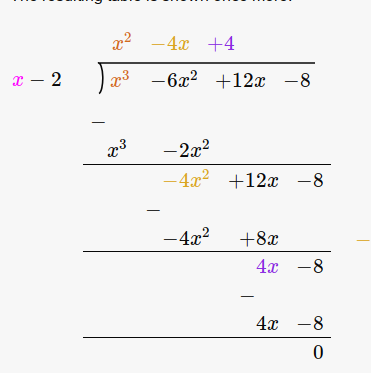
The quotient is \(x^2-4x+4 = (x-2)^2\), so \(f(x) = (x-2)^3\).
Invariant factors and cyclic operators
The characteristic polynomial is the product of the invariant factors (Tag L-VDLNM)
Let \(k\) be a field, let \(A\in\Mat_n(k)\), and let \(f_1\divides f_2\divides\cdots\divides f_n\) be the invariant factors of \(A\): the monic diagonal entries of the Smith normal form of \(xI-A\) over \(k[x]\), some of which may equal \(1\). Then \[ \det(xI-A)=\prod_{j=1}^nf_j(x). \]
The Smith normal form is \(P(xI-A)Q\) with \(P,Q\) invertible over \(k[x]\), so \(\det P\) and \(\det Q\) are nonzero constants and \(\det(xI-A)\) is a nonzero constant multiple of \(\prod_jf_j\). Both polynomials are monic, so they are equal.
The minimal polynomial is the invariant factor of highest degree (Tag L-Y5KNM)
Let \(k\) be a field, let \(A\in\Mat_n(k)\), and let \(f_1\divides f_2\divides\cdots\divides f_n\) be the invariant factors of \(A\): the monic diagonal entries of the Smith normal form of \(xI-A\) over \(k[x]\). Then the minimal polynomial of \(A\) is \[ \min_A(x)=f_n(x). \]
With \(x\) acting as \(A\), the \(k[x]\)-module \(k^n\) is isomorphic to \(\bigoplus_{j=1}^nk[x]/(f_j)\). A polynomial \(g\) satisfies \(g(A)=0\) if and only if \(g\) annihilates this module, that is, \(f_j\divides g\) for every \(j\); since \(f_j\divides f_n\) for all \(j\), this holds if and only if \(f_n\divides g\). So \(f_n\) is the monic generator of the ideal of polynomials vanishing at \(A\).
Equivalent conditions for a finite-dimensional linear operator to be cyclic (Tag PR-OF7ZW)
Let \(k\) be a field, let \(V\) be a \(k\)-vector space with \(0<\dim_k V<\infty\), and let \(T\colon V\to V\) be \(k\)-linear. Regard \(V\) as a \(k[x]\)-module with \(x\) acting by \(T\). The following are equivalent:
The minimal polynomial of \(T\) equals the monic characteristic polynomial \(\det(x\id_V-T)\).
The invariant factor decomposition of the \(k[x]\)-module \(V\) has exactly one invariant factor.
The rational canonical form of \(T\) consists of a single block.
There is a basis of \(V\) in which the matrix of \(T\) is a companion matrix.
There exists \(v\in V\) with \(\spanof_k\theset{T^j v \suchthat j\geq 0} = V\).
If \(T\) has \(\dim_k V\) distinct eigenvalues in \(k\), then \(T\) satisfies these conditions, but the converse fails. The characteristic polynomial is then a product of distinct linear factors, each of which divides the minimal polynomial, so the two polynomials are equal. For the converse, let \(n=\dim_k V\geq 2\) and let \(T\) have matrix the Jordan block \(J_n(\lambda)\) for some \(\lambda\in k\). Its minimal and characteristic polynomials are both \((x-\lambda)^n\), but \(\lambda\) is its only eigenvalue.