Groups
Subgroups of cyclic groups (Tag T-QMKXQ)
Let \(G\) be a finite group of order \(n\). Then \(G\) is cyclic if and only if, for each positive divisor \(d\) of \(n\), \(G\) has a unique subgroup of order \(d\).
First isomorphism theorem for groups (Tag T-I5N43)
Let \(\phi\colon G\to H\) be a group homomorphism. Then \(\ker \phi\) is a normal subgroup of \(G\), \(\im \phi\) is a subgroup of \(H\), and \[ G/\ker \phi \to \im \phi,\qquad g\ker\phi\mapsto\phi(g), \] is a well-defined group isomorphism.
For \(x\in\ker\phi\) and \(g\in G\), \(\phi(gxg^{-1})=\phi(g)\phi(g)^{-1}=e\), so \(\ker\phi\normal G\); \(\im\phi\) is the image of a group under a homomorphism, hence a subgroup of \(H\). The map is well defined and injective because \(\phi(g)=\phi(g')\) if and only if \(g^{-1}g'\in\ker\phi\), it is surjective by construction, and it is a homomorphism because \(\phi\) is.
Second isomorphism theorem for groups (Tag T-NFQBO)
Let \(G\) be a group, \(S \leq G\) a subgroup, and \(N \normal G\) a normal subgroup. Then \[ \frac{SN}{N} \cong \frac{S}{S\intersect N}. \] If \(S\) and \(N\) are finite, then \[ \abs{SN} = \frac{\abs S \abs N}{\abs{S\intersect N}}. \]
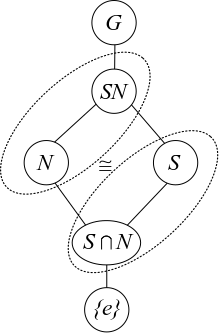
Correspondence and third isomorphism theorems (Tag T-6CQEB)
Let \(G\) be a group and \(N\normal G\) a normal subgroup.
If \(N\leq K\leq G\), then \(K/N\) is a subgroup of \(G/N\).
For \(N\leq K\leq G\), \(K\normal G\) if and only if \(K/N\normal G/N\).
The map \(K\mapsto K/N\) is a bijection from the subgroups \(K\) of \(G\) containing \(N\) to the subgroups of \(G/N\), and it restricts to a bijection between normal subgroups.
If \(N\leq K\) and \(K\normal G\), then \[ \frac{G/N}{K/N} \cong \frac{G}{K}. \]
Let \(\pi\colon G\to G/N\) be the quotient map. (a) \(K/N=\pi(K)\) is the image of a subgroup. (c) The inverse of \(K\mapsto\pi(K)\) is \(\bar K\mapsto\pi^{-1}(\bar K)\): \(\pi^{-1}(\bar K)\) is a subgroup containing \(N\), \(\pi(\pi^{-1}(\bar K))=\bar K\) since \(\pi\) is surjective, and \(\pi^{-1}(\pi(K))=KN=K\) since \(N\leq K\). (b) Since \(\pi(gKg^{-1})=\pi(g)\pi(K)\pi(g)^{-1}\) and \(\pi\) is a bijection on subgroups containing \(N\), \(gKg^{-1}=K\) for all \(g\in G\) if and only if \(\bar g(K/N)\bar g^{-1}=K/N\) for all \(\bar g\in G/N\); this also gives the second half of (c). (d) The map \(G/N\to G/K\), \(gN\mapsto gK\), is well defined because \(N\leq K\), and it is a surjective homomorphism with kernel \(K/N\); apply the first isomorphism theorem.
Correspondence theorem for groups (Tag T-RLVA4)
Let \(G\) be a group, \(N \normal G\) a normal subgroup, and \(\pi\colon G\to G/N\) the quotient map. Then \[ \theset{H \leq G \suchthat N \subseteq H} \mapstofrom \theset{\overline{H} \suchthat \overline{H} \leq G/N}, \qquad H \mapsto H/N, \qquad \pi^{-1}(\overline{H}) \mapsfrom \overline{H}, \] are mutually inverse bijections between the subgroups of \(G\) containing \(N\) and the subgroups of the quotient group \(G/N\).
Chinese remainder theorem (Tag T-TTZ2Y)
Let \(p\) and \(q\) be positive integers with \(\gcd(p, q) = 1\). Then \[ \ZZ/pq\ZZ \cong \ZZ/p\ZZ \times \ZZ/q\ZZ. \]
Recognizing internal direct products (Tag T-SVJUN)
Let \(G\) be a group with subgroups \(H\) and \(K\) such that
\(H, K \normal G\),
\(G = HK\), and
\(H\intersect K = \theset{e}\).
Then the map \(H \times K\to G\), \((h,k)\mapsto hk\), is an isomorphism, so \(G \cong H \times K\).
Hypothesis 1 may be replaced by the condition that \(hk=kh\) for all \(h\in H\) and \(k\in K\): together with \(G=HK\), this condition implies that \(H\) and \(K\) are normal in \(G\).
Recognizing internal direct products of finitely many subgroups (Tag T-YNKCZ)
Let \(G\) be a group with subgroups \(H_1,\ldots,H_n\) such that
\(H_i \normal G\) for all \(i\),
\(G = H_1 \cdots H_n\), and
for each \(k\), \(H_k \intersect \left(H_1 \cdots H_{k-1}H_{k+1} \cdots H_n\right) = \theset{e}\).
Then the map \(\prod_{i=1}^n H_i\to G\), \((h_1,\ldots,h_n)\mapsto h_1\cdots h_n\), is an isomorphism, so \(G \cong \prod_{i=1}^n H_i\).
Recognizing internal semidirect products (Tag T-SB6AV)
Let \(G\) be a group with subgroups \(N \normal G\) and \(H\leq G\) such that \(G = NH\) and \(N\intersect H=\theset{e}\). Let \(\psi\colon H \to \Aut(N)\) be the conjugation action, \(\psi(h)=h(\wait)h^{-1}\). Then \(G \cong N \semidirect_\psi H\).
If moreover \(H\normal G\), then \(hnh^{-1}n^{-1}\in N\intersect H=\theset{e}\) for all \(n\in N\) and \(h\in H\), so \(\psi\) is trivial and \(G\cong N\times H\).
Jordan--Hölder theorem (Tag T-OSJ5S)
Let \(G\) be a group, and let \[ G=G_0 \trianglerighteq G_1 \trianglerighteq \cdots \trianglerighteq G_r=\theset{e} \quad\text{and}\quad G=H_0 \trianglerighteq H_1 \trianglerighteq \cdots \trianglerighteq H_s=\theset{e} \] be two composition series of \(G\). Then \(r=s\), and there is a permutation \(\pi\) of \(\theset{1,\ldots,r}\) such that \(G_{i-1}/G_i\cong H_{\pi(i)-1}/H_{\pi(i)}\) for every \(i\).
Chapter: Groups.
Group actions
Lagrange's theorem (Tag T-GJNT5)
Let \(G\) be a finite group and \(H \leq G\) a subgroup. Then \(\abs H\) divides \(\abs G\), and \([G:H] = \abs G/ \abs H\) [@DF04].
The left cosets of \(H\) partition \(G\) (PR-VUKHO), and each coset \(gH\) has \(\abs H\) elements because \(h\mapsto gh\) is a bijection \(H\to gH\). Hence \(\abs G=[G:H]\,\abs H\).
Cauchy's theorem (Tag T-3KCD6)
Let \(G\) be a finite group and \(p\) a prime dividing \(\abs{G}\). Then \(G\) has an element of order \(p\), and hence a subgroup of order \(p\).
By Lagrange's theorem, the order of every element of \(G\) divides \(\abs G\); conversely, Cauchy’s theorem gives an element of order \(p\) for every prime \(p\) dividing \(\abs G\). Sylow's first theorem strengthens it: if \(p^a\) is the largest power of \(p\) dividing \(\abs G\), then \(G\) has a subgroup of order \(p^a\).
Orbit-stabilizer bijection for a transitive action (Tag PR-GSDKO)
Let a group \(G\) act transitively on a set \(X\), and let \(x \in X\) with stabilizer \(G_x\). Then \[ \begin{aligned} \Phi\colon G/G_{x} &\to X \\ gG_{x} &\mapsto g \cdot x \end{aligned} \] is a well-defined bijection from the set of left cosets of \(G_x\) to \(X\), and \(\Phi(h \cdot gG_x) = h \cdot \Phi(gG_x)\) for all \(g, h \in G\).
Stabilizers of points in the same orbit are conjugate (Tag PR-KGHJ2)
Let a group \(G\) act on a set \(X\), and let \(x_0, x_1 \in X\) lie in the same orbit, say \(x_1 = g \cdot x_0\) with \(g \in G\). Then the stabilizers satisfy \(G_{x_1} = g\, G_{x_0}\, \inverseof{g}\). In particular, if \(G\) acts transitively on \(X\), all stabilizers are conjugate.
Orbit-stabilizer theorem (Tag T-QYDVH)
Let a group \(G\) act on a set \(X\), and let \(x\in X\) have orbit \(Gx\) and stabilizer \(G_x\). Then \[ \size{Gx} = [G: G_x], \] and if \(G\) is finite, then \(\size{Gx} = \size{G} / \size{G_x}\).
The map \(G/G_x\to Gx\), \(gG_x\mapsto gx\), is a well-defined bijection of sets, which gives the equality \(\size{Gx} = [G:G_x]\).
Class equation (Tag C-O7CP3)
Let \(G\) be a finite group with center \(Z(G)\), and for \(g\in G\) let \(Z(g) = \theset{h\in G \st hgh^{-1} = g}\) be the centralizer of \(g\). Let \(g_1, \ldots, g_r\) be representatives of the conjugacy classes of \(G\) that have more than one element. Then \[ \size G = \size Z(G) + \sum_{i=1}^{r} [G : Z(g_i)], \] where \([G:Z(g_i)]\) is the index of \(Z(g_i)\) in \(G\).
Burnside's lemma (Tag C-HE5SL)
Let \(G\) be a finite group acting on a finite set \(X\). Let \(X/G\) be the set of orbits, and for \(g\in G\) let \(\Fix(g) = \theset{x\in X \st gx=x}\). Then \[ \size (X/G) = \frac{1}{\size G}\sum_{g\in G} \size \Fix(g). \]
The number of orbits is the average over \(G\) of the number of fixed points.
Sylow's first theorem: existence of prime-power subgroups (Tag T-WRMBM)
Let \(G\) be a finite group and \(p\) a prime, and write \(\abs G=p^a m\) with \(p\nmid m\). Then \(G\) has a subgroup of order \(p^n\) for every \(0\leq n\leq a\); in particular, \(G\) has a Sylow $p$-subgroup, of order \(p^a\). Moreover, every \(p\)-subgroup of \(G\) is contained in a Sylow \(p\)-subgroup [@DF04].
For \(a\geq1\) this strengthens Cauchy's theorem, which gives a subgroup of order \(p\).
Sylow's second theorem: Sylow subgroups are conjugate (Tag T-EF2MZ)
Let \(G\) be a finite group and \(p\) a prime. Any two Sylow $p$-subgroups of \(G\) are conjugate: if \(P,Q\in\Syl_p(G)\), then there exists \(g\in G\) with \(gPg^{-1}=Q\). In particular, a Sylow \(p\)-subgroup \(P\) is normal in \(G\) if and only if it is the unique Sylow \(p\)-subgroup of \(G\) [@DF04].
Write \(\abs G=p^a m\) with \(p\nmid m\), and let \(P\) and \(Q\) be Sylow \(p\)-subgroups of \(G\). Let \(P\) act on the set \(G/Q\) of left cosets of \(Q\) by left translation, \(x\cdot gQ=xgQ\). Since \(\abs{G/Q}=m\) is prime to \(p\), the fixed-point congruence gives \(\abs{(G/Q)^P}\equiv m\not\equiv 0\pmod p\), so some coset \(gQ\) is fixed by \(P\). Then \(xgQ=gQ\) for every \(x\in P\), that is, \(g^{-1}Pg\subseteq Q\), and since both groups have order \(p^a\), \(g^{-1}Pg=Q\).
For the second statement, every conjugate \(gPg^{-1}\) has order \(p^a\) and is therefore a Sylow \(p\)-subgroup. If \(P\normal G\), every conjugate of \(P\) equals \(P\), so by the first statement \(P\) is the only Sylow \(p\)-subgroup. Conversely, if \(P\) is the only Sylow \(p\)-subgroup, then \(gPg^{-1}=P\) for every \(g\in G\).
Sylow's third theorem: the number of Sylow subgroups (Tag T-S5T5C)
Let \(G\) be a finite group and \(p\) a prime, write \(\abs G = p^a m\) with \(p\nmid m\), let \(n_p\) be the number of Sylow $p$-subgroups of \(G\), and let \(S_p\) be one of them. Then:
\(n_p \divides m\), and in particular \(n_p \leq m\).
\(n_p \equiv 1 \pmod p\).
\(n_p = [G : N_G(S_p)]\), where \(N_G(S_p)\) is the normalizer of \(S_p\) in \(G\).
A simple group with a proper subgroup of index $n$ embeds in $S_n$ (Tag PR-5FGA7)
Let \(G\) be a simple group and \(H < G\) a proper subgroup of finite index \([G:H] = n\). Then there is an injective group homomorphism \(\phi\colon G \injects S_n\).
The action of \(G\) on the set \(G/H\) of left cosets by \(g \cdot xH \coloneqq gxH\) gives a homomorphism \(\phi\colon G \to \operatorname{Sym}(G/H) \cong S_n\). If \(g \in \ker\phi\), then \(gH = H\), so \(\ker\phi \subseteq H \neq G\). Since \(\ker\phi\) is a normal subgroup of the simple group \(G\) and \(\ker\phi \neq G\), \(\ker\phi\) is trivial.
A subgroup whose index is the smallest prime dividing $\abs{G}$ is normal (Tag PR-PADL7)
Let \(G\) be a finite group, let \(p\) be the smallest prime dividing \(\abs{G}\), and let \(H\leq G\) be a subgroup of index \([G:H]=p\). Then \(H\) is normal in \(G\).
Let \(G\) act on the set \(G/H\) of left cosets by left translation, \(g\cdot xH=gxH\). This action is a homomorphism \(\varphi\colon G\to\operatorname{Sym}(G/H)\cong S_p\); let \(K\coloneqq\ker\varphi\). If \(g\in K\) then \(gH=H\), so \(K\subseteq H\), and \(K\normal G\). By the first isomorphism theorem \(G/K\) embeds in \(S_p\), so \([G:K]\) divides \(p!\). Also \([G:K]\) divides \(\abs{G}\), so every prime factor of \([G:K]\) is at least \(p\); the only such prime dividing \(p!\) is \(p\), and \(p^2\nmid p!\). Hence \([G:K]\in\theset{1,p}\). Since \(K\subseteq H\), \([G:K]\geq[G:H]=p\), so \([G:K]=p\) and \(K=H\). Therefore \(H=\ker\varphi\) is normal in \(G\).
Chapter: Group actions.
Rings and ideals
Maximal, prime, and radical ideals via their quotient rings (Tag PR-76BDN)
Let \(R\) be a commutative ring, and let \(\mfm\), \(\mfp\), and \(J\) be ideals of \(R\).
\(R/\mfm\) is a field if and only if \(\mfm\) is a maximal ideal.
\(R/\mfp\) is an integral domain if and only if \(\mfp\) is a prime ideal.
Inclusions among fields, Euclidean domains, PIDs, UFDs, and integral domains (Tag PR-LLBRB)
Every field is a Euclidean domain, every Euclidean domain is a principal ideal domain, every principal ideal domain is a unique factorization domain, every unique factorization domain is an integral domain, and every integral domain is a commutative ring: \[ \text{Fields} \subset \text{Euclidean domains} \subset \text{PIDs} \subset \text{UFDs} \subset \text{Integral domains} \subset \text{Commutative rings}. \]
Each inclusion is proper: \(\ZZ\) is a Euclidean domain that is not a field; \(\ZZ\big[\tfrac{1+\sqrt{-19}}{2}\big]\) is a PID that is not Euclidean; \(\ZZ[x]\) is a UFD that is not a PID; \(\ZZ[\sqrt{-5}]\) is an integral domain that is not a UFD; and \(\ZZ/4\ZZ\) is a commutative ring that is not an integral domain.
Implications among fields, PIDs, UFDs, and Noetherian rings (Tag PR-GEHJF)
Let \(R\) be a commutative ring with \(1\).
If \(R\) is a commutative division ring, then \(R\) is a field.
If \(R\) is a finite integral domain, then \(R\) is a field.
\(R\) is a field if and only if \(R[x]\) is a principal ideal domain.
\(R\) is a field if and only if \(R\) is a simple ring with \(1 \neq 0\).
\(R\) is a unique factorization domain if and only if \(R[x]\) is a unique factorization domain.
If \(R\) is a principal ideal domain, then \(R[x]\) is a unique factorization domain.
If \(R\) is a principal ideal domain, then \(R\) is Noetherian.
Artin--Wedderburn theorem (Tag T-ZOTWN)
Let \(R\) be a nonzero unital ring that is semisimple as a left module over itself. Then there are integers \(m\geq 1\) and \(n_1,\ldots,n_m\geq 1\) and division rings \(D_1,\ldots,D_m\) such that \[ R \cong \bigoplus_{i=1}^m \Mat_{n_i}(D_i), \] a finite direct sum of the rings of \(n_i\times n_i\) matrices over \(D_i\).
Semisimple rings are finite direct sums of matrix rings over division rings.
Wedderburn's little theorem (Tag T-GYVNQ)
Every finite division ring is commutative, and hence a field.
Zorn's lemma (Tag T-V7JRG)
If \(P\) is a poset in which every chain has an upper bound in \(P\), then \(P\) has a maximal element.
Krull's theorem on maximal ideals (Tag T-QSTRJ)
Let \(R\) be a nonzero ring. Then every proper ideal of \(R\) is contained in a proper maximal ideal; in particular, \(R\) has a proper maximal ideal.
Chapter: Rings and ideals.
Modules
Isomorphism theorems for modules (Tag PR-DJZLY)
Let \(R\) be a ring and \(M\) an \(R\)-module.
For an \(R\)-module homomorphism \(\phi\colon M \to M'\), there is an isomorphism \(M/\ker\phi \cong \im\phi\).
For submodules \(A, B \subseteq M\), \[ \frac{A+B}{B} \cong \frac{A}{A \intersect B}. \]
For submodules \(A \subseteq B \subseteq M\), \[ \frac{M/A}{B/A} \cong \frac{M}{B}. \]
For a submodule \(N \subseteq M\), there is an inclusion-preserving bijection \[ \begin{aligned} \correspond{\text{Submodules of } M \\ \text{containing } N} &\mapstofrom \correspond{\text{Submodules of } M/N} \\ A &\mapstofrom A/N. \end{aligned} \]
The bijection in (d) preserves sums and intersections: for submodules \(A, A' \subseteq M\) containing \(N\), \((A+A')/N = A/N + A'/N\) and \((A \intersect A')/N = A/N \intersect A'/N\).
Internal direct sum of two submodules (Tag PR-RIJSC)
Let \(R\) be a ring, \(M\) an \(R\)-module, and \(M_1, M_2 \leq M\) submodules. The \(R\)-linear map \(M_1\oplus M_2\to M\), \((x,y)\mapsto x+y\), is an isomorphism, so that \(M = M_1 \oplus M_2\) internally, if and only if
\(M_1 + M_2 = M\), and
\(M_1 \cap M_2 = 0\).
The image of the map is \(M_1+M_2\), so it is surjective if and only if \(M_1+M_2=M\). Its kernel is \(\theset{(x,-x)\suchthat x\in M_1\cap M_2}\), so it is injective if and only if \(M_1\cap M_2=0\).
Structure theorem for finitely generated modules over a PID (Tag PR-UVUS6)
Let \(R\) be a principal ideal domain and \(M\) a finitely generated \(R\)-module. Then there are an integer \(r\geq0\), nonzero nonunits \(r_1 \divides r_2 \divides \cdots\divides r_m\) of \(R\), and primes \(p_1,\ldots,p_s\) of \(R\), not necessarily distinct, with exponents \(e_i\geq1\), such that \[ M \cong R^r\oplus \bigoplus_{i=1}^m R/(r_i) \qquad\text{and}\qquad M \cong R^r\oplus \bigoplus_{i=1}^s R/(p_i^{e_i}). \] The first is the invariant factor decomposition and the second the elementary divisor decomposition. The rank \(r\) is unique, the \(r_i\) are unique up to units, and the \(p_i^{e_i}\) are unique up to units and reordering.
An ideal of an integral domain is free if and only if it is principal (Tag PR-ASW5L)
Let \(R\) be an integral domain and \(I \subseteq R\) an ideal. Then \(I\) is a free \(R\)-module if and only if \(I\) is a principal ideal.
Over a ring with zero divisors, a principal ideal need not be free. In \(\ZZ/6\ZZ\), the principal ideal \(\gens{2}\) is not a free \(\ZZ/6\ZZ\)-module, since \(3 \cdot 2 = 0\) with \(3 \neq 0\), whereas a nonzero element of a basis of a free module has zero annihilator.
Free modules are projective (Tag PR-RPL4Q)
Let \(R\) be a ring. Every free \(R\)-module is projective.
Let \(F\) be free with basis \((e_i)_{i\in I}\), let \(g\colon N\to M\) be a surjective \(R\)-linear map, and let \(f\colon F\to M\) be \(R\)-linear. For each \(i\in I\) choose \(n_i\in N\) with \(g(n_i)=f(e_i)\). There is a unique \(R\)-linear map \(\tilde f\colon F\to N\) with \(\tilde f(e_i)=n_i\) for all \(i\), and \(g\circ\tilde f\) agrees with \(f\) on the basis, so \(g\circ\tilde f=f\).
Chapter: Modules.
Linear algebra
Cayley--Hamilton theorem (Tag T-SJCF7)
Let \(k\) be a field and \(A\in\Mat_n(k)\), with characteristic polynomial \(\chi_A\) and minimal polynomial \(\min_A\). Then \(\chi_A(A) = 0\); equivalently, \(\min_A\) divides \(\chi_A\).
Computing the Jordan canonical form and a change of basis via Jordan chains (Tag PR-5A2W4)
Let \(k\) be a field and \(A \in \Mat_{n\times n}(k)\), and suppose that the characteristic polynomial factors as \(\chi_A(x) = \pm\prod_{i=1}^r (x-\lambda_i)^{m_i}\) with \(\lambda_1, \ldots, \lambda_r \in k\) distinct. For each \(i\), put \(N_i \coloneqq A - \lambda_i I\). The following procedure produces \(P \in \GL_n(k)\) such that \(\inverseof{P} A P = \JCF(A)\) is a Jordan canonical form of \(A\).
Let \(\ell_i\) be the least integer \(\ell \geq 1\) with \(\rank N_i^{\ell} = \rank N_i^{\ell+1}\). Then \[ n = \rank N_i^0 > \rank N_i > \cdots > \rank N_i^{\ell_i} = \rank N_i^{\ell_i+1} = \rank N_i^{\ell_i+2} = \cdots, \] \(\dim_k \ker N_i^{\ell_i} = m_i\), and \(\ell_i\) is the size of the largest Jordan block with eigenvalue \(\lambda_i\).
The eigenspace \(E_{\lambda_i} = \ker N_i\) has dimension \(n - \rank N_i\), the number of Jordan blocks with eigenvalue \(\lambda_i\). For \(0 \leq j \leq \ell_i\), put \(K_{i,j} \coloneqq \ker N_i \cap \im N_i^{j}\), so that \[ \ker N_i = K_{i,0} \supseteq K_{i,1} \supseteq \cdots \supseteq K_{i,\ell_i} = 0 \quad\text{and}\quad \dim_k K_{i,j} = \rank N_i^{j} - \rank N_i^{j+1}. \]
Choose a basis of \(K_{i,\ell_i - 1}\) and extend it successively to bases of \(K_{i,\ell_i-2}, \ldots, K_{i,0}\). Each basis vector \(v\) chosen at the stage of \(K_{i,s-1}\) is an eigenvector lying in \(\im N_i^{s-1}\).
For each such \(v\), solve \(N_i^{s-1} w = v\), for instance by row reducing the augmented matrix \([\,N_i^{s-1} \mid v\,]\); the system is consistent because \(v \in \im N_i^{s-1}\). The Jordan chain of \(v\) is \(N_i^{s-1}w = v,\ N_i^{s-2}w,\ \ldots,\ N_i w,\ w\).
Let \(P\) be the matrix whose columns are the Jordan chains of all the vectors chosen in step (3), for all \(i\), each chain listed consecutively in the order of step (4). A chain of length \(s\) for \(\lambda_i\) contributes a Jordan block of size \(s\) with eigenvalue \(\lambda_i\) to \(\inverseof{P} A P\).
Equivalent conditions for an operator to have a cyclic vector (Tag PR-4GQIZ)
Let \(k\) be a field, let \(V\) be a nonzero finite-dimensional \(k\)-vector space, and let \(T\colon V \to V\) be a \(k\)-linear map. Make \(V\) a \(k[x]\)-module by \(f(x) \cdot v \coloneqq f(T)v\), and let \(\min_T(x)\) be the minimal polynomial of \(T\). The following are equivalent:
\(V \cong k[x]/\gens{\min_T}\) as \(k[x]\)-modules.
\(V\) admits a cyclic vector: there is \(v \in V\) such that \(v, Tv, T^2v, \ldots\) span \(V\). For such \(v\), \(\min_T\) is the monic polynomial \(p\) of least degree with \(p(T)v = 0\).
\(V\) is a cyclic \(k[x]\)-module. Its annihilator is then the ideal \(\gens{\min_T}\).
The matrix of \(T\) in some basis of \(V\) is the companion matrix \(C_{\min_T}\).
\(\min_T(x) = \det(xI - T)\), the monic characteristic polynomial of \(T\).
\(V\) has exactly one invariant factor as a \(k[x]\)-module.
The rational canonical form of \(T\) has a single block.
The minimal and characteristic polynomials agree iff there is a cyclic vector (Tag PR-GBL6P)
Let \(k\) be a field and \(A \in \Mat_{n\times n}(k)\) with \(n \geq 1\), and let \(\min_A(x)\) be the minimal polynomial of \(A\). Then \(\min_A(x) = \det(xI - A)\) if and only if \(A\) admits a cyclic vector: some \(v \in k^n\) such that \(v, Av, A^2v, \ldots\) span \(k^n\).
Rational canonical form (Tag PR-TI6YA)
Let \(k\) be a field and \(A\in M_n(k)\), and regard \(k^n\) as a \(k[x]\)-module with \(x\) acting by \(A\). Let \(r_1\divides r_2\divides\cdots\divides r_m\) be the monic nonconstant invariant factors of this module. Then \(A\) is similar to the block diagonal matrix \[ \RCF(A)=\diag(C_{r_1},\ldots,C_{r_m}), \] where \(C_{r_i}\) is the companion matrix of \(r_i\), and \(\RCF(A)\) is the unique matrix of this form similar to \(A\).
By the structure theorem for finitely generated modules over the PID \(k[x]\), \(k^n\cong\bigoplus_{i=1}^m k[x]/(r_i)\) as \(k[x]\)-modules, with the monic \(r_i\) uniquely determined. On \(k[x]/(r_i)\), multiplication by \(x\) in the basis \(1,x,\ldots,x^{\deg r_i-1}\) has matrix \(C_{r_i}\). Two matrices are similar if and only if the corresponding \(k[x]\)-modules are isomorphic, so uniqueness of the invariant factors gives uniqueness of \(\RCF(A)\).
Diagonalizability via the minimal polynomial (Tag T-6ABNR)
Let \(F\) be a field and \(M\in M_n(F)\) with minimal polynomial \(m_M\in F[x]\). Then \(M\) is diagonalizable over \(F\) if and only if \(m_M\) splits over \(F\) into distinct linear factors.
If \(M=PDP^{-1}\) with \(D\) diagonal whose distinct diagonal entries are \(\lambda_1,\ldots,\lambda_r\), then \(\prod_i(x-\lambda_i)\) annihilates \(D\) and hence \(M\), so \(m_M\) divides a product of distinct linear factors.
Conversely, suppose \(m_M=\prod_{i=1}^r(x-\lambda_i)\) with the \(\lambda_i\in F\) distinct. The factors are pairwise coprime, so by the kernel decomposition \(F^n=\ker m_M(M)=\bigoplus_{i=1}^r\ker(M-\lambda_i I)\). Choosing a basis of each eigenspace \(\ker(M-\lambda_i I)\) gives a basis of \(F^n\) of eigenvectors of \(M\).
A matrix whose minimal polynomial splits over \(F\) need not be diagonalizable over \(F\). Over any field \(F\), \(M=\begin{bmatrix} 1 & 1 \\ 0 & 1\end{bmatrix}\) has \(m_M = (x-1)^2\), which splits over \(F\), but \(\ker(M-I)\) is one-dimensional, so \(M\) is not diagonalizable.
Spectral theorem for Hermitian and real symmetric matrices (Tag T-WQHMA)
If \(A\in\Mat_n(\CC)\) is Hermitian, that is, \(A^{\dagger} = A\), then \(A\) is diagonalizable over \(\CC\); more precisely, there is a unitary matrix \(U\) such that \(U^{\dagger}AU\) is diagonal with real entries.
If \(A\in\Mat_n(\RR)\) is symmetric, that is, \(A^t = A\), then \(A\) is diagonalizable over \(\RR\); more precisely, there is an orthogonal matrix \(Q\) such that \(Q^tAQ\) is diagonal.
Simultaneous diagonalizability of commuting diagonalizable operators (Tag PR-GV5CF)
Let \(V\) be a finite-dimensional vector space over a field \(k\), and let \(\theset{A_i}_{i \in I}\) be a family of diagonalizable linear operators on \(V\). The \(A_i\) pairwise commute if and only if they are simultaneously diagonalizable: there is a basis of \(V\) in which every \(A_i\) is diagonal.
The implication from simultaneous diagonalizability to commuting holds for any family of operators, since diagonal matrices commute.
Commuting operators need not be simultaneously diagonalizable without the diagonalizability hypothesis: \(\begin{bmatrix} 1 & 1 \\ 0 & 1\end{bmatrix}\) commutes with itself and is not diagonalizable.
Chapter: Linear algebra.
Fields and Galois theory
Primitive element theorem (Tag T-3HPWT)
Let \(L/k\) be a finite separable field extension. Then \(L/k\) is simple: there exists \(\alpha\in L\) with \(L=k(\alpha)\).
Finite extensions are algebraic (Tag T-NGBVC)
Let \(L/K\) be a field extension with \([L:K]<\infty\). Then every \(\alpha\in L\) is algebraic over \(K\).
Let \(n=[L:K]\). The \(n+1\) elements \(1,\alpha,\ldots,\alpha^n\) of the \(n\)-dimensional \(K\)-vector space \(L\) are linearly dependent, so there are \(c_0,\ldots,c_n\in K\), not all zero, with \(\sum_{i=0}^n c_i\alpha^i=0\). Thus \(\alpha\) is a root of the nonzero polynomial \(\sum_{i=0}^n c_ix^i\in K[x]\).
Characterization of normal algebraic extensions (Tag PR-OZYUC)
Let \(k\) be a field, let \(L/k\) be an algebraic extension, and let \(\bar{k}\) be an algebraic closure of \(k\) containing \(L\). Then \(L/k\) is normal if and only if every \(k\)-embedding \(\sigma\colon L\to \bar{k}\) satisfies \(\sigma(L) = L\). In that case every \(k\)-embedding \(\sigma\colon L\to\bar k\) restricts to a \(k\)-automorphism of \(L\):
Suppose \(L/k\) is normal and let \(\sigma\colon L\to\bar k\) be a \(k\)-embedding. For \(\alpha\in L\) with minimal polynomial \(m_\alpha\in k[x]\), \(\sigma(\alpha)\) is a root of \(m_\alpha\), and all roots of \(m_\alpha\) lie in \(L\), so \(\sigma(L)\subseteq L\). Moreover \(\sigma\) injects the finite set of roots of \(m_\alpha\) in \(L\) into itself, hence permutes it, so \(\alpha\) lies in \(\sigma(L)\); thus \(\sigma(L)=L\).
Conversely, suppose every \(k\)-embedding \(L\to\bar k\) has image \(L\). Let \(f\in k[x]\) be irreducible with a root \(\alpha\in L\), and let \(\beta\in\bar k\) be any root of \(f\). There is a \(k\)-embedding \(k(\alpha)\to\bar k\) with \(\alpha\mapsto\beta\), and since \(L/k(\alpha)\) is algebraic and \(\bar k\) is algebraically closed, it extends to a \(k\)-embedding \(\sigma\colon L\to\bar k\). Then \(\beta=\sigma(\alpha)\in\sigma(L)=L\), so \(f\) splits in \(L\) and \(L/k\) is normal.
A polynomial is separable if and only if $\gcd(f, f') = 1$ (Tag PR-ENHVC)
Let \(k\) be a field and \(f \in k[x]\) a nonzero polynomial. Then \(f\) is separable if and only if \(\gcd(f, f') = 1\) in \(k[x]\), that is, if and only if \(f\) and \(f'\) have no common root in an algebraic closure \(\bar{k}\). Moreover, the repeated roots of \(f\) in \(\bar{k}\) are exactly the roots of \(\gcd(f, f')\).
Construction of $\GF(p^n)$ as $\FF_p[x]/(f)$ (Tag T-QBQLM)
Let \(p\) be a prime, \(n\geq 1\), and \(f \in \FF_p[x]\) an irreducible polynomial of degree \(n\), and let \(\alpha\) be a root of \(f\) in an extension field of \(\FF_p\). Then \[ \GF(p^n)\cong \frac{\FF_p[x]}{(f)} \cong \FF_p[\alpha] = \spanof_{\FF_p}\theset{1, \alpha, \ldots, \alpha^{n-1}}. \]
Fundamental theorem of Galois theory (Tag T-NLPZY)
Let \(L/k\) be a finite Galois extension with Galois group \(G \coloneqq \Gal(L/k)\). For a subgroup \(H\leq G\), let \(L^H\) be its fixed field, and for an intermediate field \(k\subseteq F\subseteq L\), let \[ \Gal(L/F) \coloneqq \theset{ \sigma \in G \suchthat \sigma(\alpha) = \alpha \text{ for all } \alpha \in F}. \] Then the maps \[ \theset{\text{subgroups } H\leq G} \mapstofrom \theset{\text{intermediate fields } k\subseteq F\subseteq L}, \qquad H\mapsto L^H, \qquad \Gal(L/F) \mapsfrom F, \] are mutually inverse bijections, and they reverse inclusions. If \(H\) and \(F\) correspond under these bijections, then:
\([F: k] = [G: H]\) and \([L : F] = \abs{H}\).
\(L/F\) is Galois and \(\Gal(L/F) = H\).
\(F/k\) is Galois if and only if \(H \normal G\), and in that case \(\Gal(F/k) \cong G/H\).
If \(H_1,H_2\) correspond to \(F_1,F_2\), then the compositum \(F_1 F_2\) corresponds to \(H_1 \intersect H_2\), and \(F_1 \intersect F_2\) corresponds to the subgroup generated by \(H_1\) and \(H_2\), \(\gens{H_1, H_2}\).
The group \(\Gal(L/F)\) fixes \(F\) pointwise. For \(\sigma\in G\) one has \(\sigma(L^H)=L^{\sigma H\sigma^{-1}}\), so the setwise stabilizer \(\theset{\sigma\in G \suchthat \sigma(F) = F}\) of \(F=L^H\) is the normalizer \(N_G(H)\), which contains \(H\) and equals \(G\) exactly when \(F/k\) is Galois.
The subgroup \(\gens{H_1,H_2}\) contains the product set \(H_1H_2\), and \(H_1H_2\) is a subgroup if and only if \(H_1H_2=H_2H_1\).
Finite normal extensions of perfect fields are Galois (Tag T-SGY3O)
Let \(k\) be a field.
If \(\ch k = 0\) or \(k\) is finite, then \(k\) is perfect; in particular \(\CC\), \(\RR\), \(\QQ\), and \(\FF_p\) for \(p\) prime are perfect.
If \(k\) is perfect, then every finite normal extension of \(k\) is Galois.
If \(k\) is perfect, then the splitting field over \(k\) of every nonconstant polynomial \(f\in k[x]\) is Galois over \(k\).
Eisenstein's criterion (Tag T-CF6S3)
Let \[ f(x) = \sum_{i=0}^n a_i x^i = a_nx^n + a_{n-1}x^{n-1} + \cdots + a_1 x + a_0 \in \ZZ[x] \] with \(n\geq1\), and suppose there is a prime \(p\) such that
\(p\) divides \(a_i\) for \(0\leq i\leq n-1\),
\(p\) does not divide \(a_n\), and
\(p^2\) does not divide \(a_0\).
Then \(f\) is irreducible in \(\QQ[x]\). If moreover the coefficients of \(f\) have no common prime factor, then \(f\) is irreducible in \(\ZZ[x]\).
Suppose \(f\) is reducible in \(\QQ[x]\). By Gauss’s lemma \(f=gh\) with \(g,h\in\ZZ[x]\) of degrees \(r,s\geq1\). Reducing modulo \(p\) gives \(\bar a_nx^n=\bar g\bar h\) in \(\FF_p[x]\) with \(\bar a_n\neq0\). The leading coefficients of \(g\) and \(h\) multiply to \(a_n\), so they are not divisible by \(p\) and \(\deg\bar g=r\), \(\deg\bar h=s\). Since \(\FF_p[x]\) is a unique factorization domain, \(\bar g=bx^r\) and \(\bar h=cx^s\) with \(b,c\in\FF_p^\times\), so \(p\) divides both constant terms \(g(0)\) and \(h(0)\), and \(p^2\) divides \(g(0)h(0)=a_0\), a contradiction. If the coefficients of \(f\) have no common prime factor, a factorization of \(f\) in \(\ZZ[x]\) into nonunits has both factors of positive degree, which the first statement excludes.
The Galois group of an irreducible polynomial is a transitive subgroup (Tag PR-LXSGE)
Let \(k\) be a field, \(f \in k[x]\) irreducible, \(\SF(f)\) a splitting field of \(f\) over \(k\), and \(\alpha_1, \ldots, \alpha_m\) the distinct roots of \(f\) in \(\SF(f)\). Then \(\Gal(\SF(f)/k)\) acts faithfully and transitively on \(\theset{\alpha_1, \ldots, \alpha_m}\), so it is isomorphic to a transitive subgroup of \(S_m\). If \(f\) is separable of degree \(n\), then \(m = n\).
Dedekind's theorem: cycle types in the Galois group from factorization modulo $p$ (Tag PR-XDWOP)
Let \(f\in\ZZ[x]\) be monic of degree \(n\) with nonzero discriminant \(\Delta\), and let \(G\) be the Galois group of \(f\) over \(\QQ\), regarded as a subgroup of \(S_n\) through its action on the roots of \(f\). Let \(p\) be a prime with \(p\notdivides\Delta\), and let \(f\equiv f_1f_2\cdots f_m\pmod p\) be the factorization into monic irreducibles in \(\FF_p[x]\). Then \(G\) contains a permutation of cycle type \((\deg f_1, \deg f_2, \ldots, \deg f_m)\). Equivalently, the Galois group of \(f\bmod p\) over \(\FF_p\), which is cyclic and generated by the Frobenius automorphism, is isomorphic to a subgroup of \(G\) through a bijection between the roots of \(f\bmod p\) and the roots of \(f\).
The Chebotarev density theorem strengthens this: for each cycle type occurring in \(G\), the set of primes \(p\notdivides\Delta\) for which \(f\bmod p\) factors with that cycle type has natural density equal to the proportion of elements of \(G\) of that cycle type.
Solvability via the derived series (Tag T-QPMGT)
A group \(G\) is solvable if and only if its derived series reaches the trivial group, that is, \(G^{(n)}=\theset{e}\) for some \(n\geq 0\).
$S_n$ is solvable if and only if $n\leq 4$ (Tag T-EN5H4)
Let \(n\geq1\). The symmetric group \(S_n\) is solvable if and only if \(n\leq 4\).
For \(n\leq4\), \(S_n\) is isomorphic to a subgroup of \(S_4\), and subgroups of solvable groups are solvable. The series \(\theset{e}\normal V_4\normal A_4\normal S_4\), with \(V_4=\theset{e,(12)(34),(13)(24),(14)(23)}\), has abelian quotients \(V_4\), \(C_3\), and \(C_2\), so \(S_4\) is solvable.
For \(n\geq5\), \(A_n\) is simple and nonabelian. Its commutator subgroup \([A_n,A_n]\) is normal and nontrivial, so \([A_n,A_n]=A_n\), and the derived series of \(A_n\) is constant at \(A_n\) and never reaches \(\theset e\). Hence \(A_n\) is not solvable, and neither is \(S_n\), which contains it.
Chapters: Fields and Galois theory.
Representations
Maschke's theorem (Tag T-PIO2B)
Let \(G\) be a finite group and \(k\) a field with \(\ch(k)\nmid \size G\). Then every finite-dimensional representation of \(G\) over \(k\) is a direct sum of irreducible representations.
If \(\ch(k)\nmid \abs{G}\), finite-dimensional \(k[G]\)-modules are direct sums of simple \(k[G]\)-modules.
Schur's lemma (Tag T-YHH3M)
Let \(G\) be a group, \(k\) an algebraically closed field, and \(M\) an irreducible representation of \(G\) over \(k\) with \(\dim_k M < \infty\). Then every \(G\)-equivariant endomorphism of \(M\) is multiplication by a scalar, so the map \[ k \mapsvia{\sim} \Endo_G(M),\qquad \lambda\mapsto \lambda\cdot\id_M, \] is an isomorphism.
For an irreducible representation \(M\) of \(G\) over an arbitrary field \(k\), every nonzero \(G\)-equivariant endomorphism of \(M\) has \(G\)-stable kernel \(0\) and image \(M\), so \(\Endo_G(M)\) is a division algebra over \(k\).
Over an algebraically closed field, an irreducible finite-dimensional representation has only scalar equivariant endomorphisms.
Chapter: Representations.
Counterexamples
Counterexamples to converses and weakened forms of several of these statements are on Counterexamples.