From a fan to a toric variety (Tag D-Q7Q2N)
For the torus \(T = \GG_m^n\), the character lattice is \(M = \Hom(T, \GG_m) \cong \ZZ^n\), with \(\chi^m(t) = \prod t_i^{m_i}\), and the cocharacter lattice is \(N = \Hom(\GG_m, T)\). The pairing \(\inp{m}{u}\) is the integer \(\ell\) with \(\chi^m \circ \lambda^u : t \mapsto t^\ell\).
(Cones and fans)
A cone \(\sigma \subseteq N_\RR\) is strongly convex rational polyhedral if it is generated by finitely many lattice vectors and contains no line. Its dual is \(\dualof{\sigma} = \ts{m \in M_\RR \st \inp{m}{u} \geq 0 \text{ for all } u \in \sigma}\). A fan \(\Sigma\) is a finite collection of such cones closed under faces, in which any two cones meet in a face of each.
(Cones with many edges)
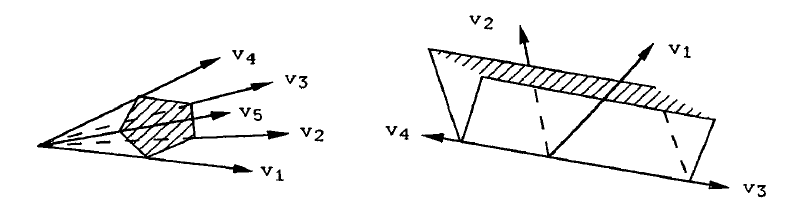
A cone in \(\RR^3\) can have any number of edges; the cross-sections in the figure have five edges \(v_1, \ldots, v_5\) and four edges \(v_1, \ldots, v_4\).
(The projective line)
The fan \(\ts{\RR_{\geq 0}, \ts{0}, \RR_{\leq 0}}\) in \(N_\RR = \RR\) gives two copies of \(\CC\) glued along \(\CC^\times\) by \(x \mapsto x^{-1}\):
so \(X_\Sigma = \PP^1\).
(The variety)
\[ \sigma \rightsquigarrow S_\sigma = \dualof{\sigma} \intersect M \rightsquigarrow U_\sigma = \Spec k[S_\sigma] , \] and \(X_\Sigma\) is obtained by gluing the \(U_\sigma\) along the \(U_{\sigma \intersect \tau}\).
By Gordan’s lemma, \(S_\sigma\) is a finitely generated semigroup, so \(k[S_\sigma]\) is a finitely generated algebra and \(U_\sigma\) is an affine variety.
The cone \(\ts{0}\) gives the torus itself, the cone spanned by a basis gives \(\AA^n\), and the fan of \(\PP^n\) has rays \(e_1,\ldots,e_n\) and \(-\sum e_i\). For \(d\geq1\), the cone spanned by \((0,1)\) and \((d,-1)\) gives the affine cone over the rational normal curve of degree \(d\).
The convex geometry underneath
Separation for convex polyhedral cones, and the double dual (Tag PR-FULSEP)
Let \(\sigma \subseteq N_\RR\) be a convex polyhedral cone and let \(v \in N_\RR\) with \(v \notin \sigma\). Then there is a support vector \(u \in \dualof{\sigma}\) with \[ \inp{u}{v} < 0 . \] That is, \(v\) lies strictly on the negative side of a hyperplane that has all of \(\sigma\) on its non-negative side.
(Double duality)
\[ \dualof{(\dualof{\sigma})} = \sigma . \]
The inclusion \(\sigma \subseteq \dualof{(\dualof{\sigma})}\) is the definition: every \(v \in \sigma\) pairs non-negatively with every \(u \in \dualof{\sigma}\).
For the reverse, take \(v \notin \sigma\) and apply separation to get \(u \in \dualof{\sigma}\) with \(\inp{u}{v} < 0\). That \(u\) witnesses \(v \notin \dualof{(\dualof{\sigma})}\).
(What separation rests on)
Separation is the finite-dimensional Hahn–Banach statement, and for a polyhedral cone it is elementary: \(\sigma\) is closed and convex, so the point of \(\sigma\) nearest to \(v\) exists, and the vector from it to \(v\) gives the required \(u\) after a sign change. Convexity and closedness are both needed, and polyhedral cones have both for free.
Double duality makes the cone-dual correspondence reversible. The equality \((\sigma^\vee)^\vee=\sigma\) means that \(\sigma\subseteq N_\RR\) and \(\sigma^\vee\subseteq M_\RR\) determine each other.
Facet normals and the half-space presentation of a cone (Tag PR-FULFACET)
Let \(\sigma \subseteq N_\RR\) span \(N_\RR\), and let \(\tau \leq \sigma\) be a facet. Then there is \(u_\tau \in \dualof{\sigma}\), unique up to a positive scalar and unique on the nose once taken primitive in \(M\), with \[ \tau = \sigma \intersect u_\tau^\perp . \] It spans the ray \(\dualof{\sigma} \intersect \tau^\perp\), and the hyperplane \(H_\tau \da u_\tau^\perp\) is the hyperplane spanned by \(\tau\).
(Two presentations)
If \(\sigma\) spans \(N_\RR\) and \(\sigma \neq N_\RR\), then \[ \sigma = \Intersect_{\tau \text{ a facet of } \sigma} H_\tau^+ , \qquad H_\tau^+ \da \ts{ v \in N_\RR \st \inp{u_\tau}{v} \geq 0 } . \] Equivalently, if \(u_1, \ldots, u_t\) generate \(\dualof{\sigma}\), then \[ \sigma = \ts{ v \in N_\RR \st \inp{u_1}{v} \geq 0, \ \ldots, \ \inp{u_t}{v} \geq 0 } . \]
(Generators against inequalities)
This is the working content of double duality. A cone arrives in one of two forms, and every computation needs the other.
Given by generators, \(\sigma = \Cone(v_1, \ldots, v_r)\): the inequalities are \(\inp{u}{v_i} \geq 0\), and solving them produces \(\dualof{\sigma}\).
Given by inequalities, \(\sigma = \Intersect H_{u_j}^+\): the \(u_j\) are generators of \(\dualof{\sigma}\).
So passing from generators to inequalities on one side is passing from inequalities to generators on the other, and dualising twice returns the start. The facet normals are the minimal such list: \(\dualof{\sigma}\) needs exactly the primitive \(u_\tau\) as its ray generators, one per facet of \(\sigma\).
Faces of a cone and faces of its dual correspond contravariantly (Tag PR-FULFACEDUAL)
Let \(\sigma \subseteq N_\RR\) be a full-dimensional convex polyhedral cone, \(\dim N_\RR = n\). The assignment \[ \tau \longmapsto \tau^\star \da \dualof{\sigma} \intersect \tau^\perp \] is an inclusion-reversing bijection from the faces of \(\sigma\) to the faces of \(\dualof{\sigma}\), with inverse of the same shape, and \[ \dim \tau + \dim \tau^\star = n . \]
(The two ends, and what they pin down)
The bijection sends \(\sigma\) itself to \(\ts{0}\) and \(\ts{0}\) to \(\dualof{\sigma}\), and in between it exchanges the two extremes of the face lattice:
| face of \(\sigma\) | image in \(\dualof{\sigma}\) |
|---|---|
| facet \(\tau\), \(\dim = n-1\) | ray spanned by the facet normal \(u_\tau\) |
| ray \(\rho\), \(\dim = 1\) | facet of \(\dualof{\sigma}\), \(\dim = n-1\) |
So the rays of \(\dualof{\sigma}\) are the facet normals of \(\sigma\) and vice versa, which is exactly what makes the plane computation work: in \(N_\RR = \RR^2\) facets and rays coincide, so dualising a two-dimensional cone is rotating its two generators a quarter turn.
Strong convexity is visible here too. \(\sigma\) contains no line exactly when \(\ts{0}\) is a face of \(\sigma\), which under the bijection says \(\dualof{\sigma}\) is full-dimensional, that is \(\dim \dualof{\sigma} = n\). That is the condition needed for \(S_\sigma\) to generate \(M\) and for \(U_\sigma\) to have the right dimension.
A polyhedral cone \(\sigma\) is both finitely generated and an intersection of finitely many closed half-spaces, \(\sigma^{\vee\vee}=\sigma\), and \(\tau\mapsto\sigma^\vee\cap\tau^\perp\) is an inclusion-reversing bijection from the faces of \(\sigma\) to the faces of \(\sigma^\vee\). The orbit-cone correspondence uses this bijection.
How the affine charts glue
A face gives a principal open subset, which is how the affine charts glue (Tag PR-FULLOC)
Let \(\tau \leq \sigma\) be a face, written \(\tau = \sigma \intersect u_\tau^\perp\) for some \(u_\tau \in S_\sigma = \dualof{\sigma} \intersect M\). Then \[ S_\tau = S_\sigma + \NN \cdot (-u_\tau) , \] so \[ k[S_\tau] = k[S_\sigma]\big[ \chi^{-u_\tau} \big] = k[S_\sigma]_{\chi^{u_\tau}} , \qquad U_\tau = D\big( \chi^{u_\tau} \big) \subseteq U_\sigma , \] a principal open subset.
(This is the gluing)
The construction of \(X_\Sigma\) says the \(U_\sigma\) are glued along the charts of their common faces, and this proposition is what makes that meaningful. If \(\sigma_1 \intersect \sigma_2 = \tau\) is a common face, then \(U_\tau\) sits inside each of \(U_{\sigma_1}\) and \(U_{\sigma_2}\) as a principal open subset, and the gluing is the identity on \(U_\tau\). Both inclusions are open immersions, so the result is a variety and not just a topological quotient, and the compatibility on triple overlaps is automatic because every chart is a localisation of the coordinate ring of the smallest cone.
The inclusion is order-reversing on cones: a smaller cone has a larger dual, hence a larger semigroup and a larger ring, hence a smaller variety. \[ \tau \leq \sigma \implies \dualof{\sigma} \subseteq \dualof{\tau} \implies U_\tau \subseteq U_\sigma . \] The zero cone gives \(S_{\ts{0}} = M\) and \(U_{\ts{0}} = T\), which is therefore contained in every chart: that is why the torus is dense in \(X_\Sigma\).
(The plane, in two charts)
Take \(\sigma_1 = \Cone(e_1, e_2)\) and the face \(\tau = \Cone(e_1)\), cut out by \(u_\tau = \dualof{e_2}\). Then \(S_{\sigma_1} = \NN^2\) and \[ S_\tau = \NN^2 + \NN \cdot (0,-1) = \NN \oplus \ZZ , \qquad U_\tau = \Spec k[x, y^{\pm 1}] = D(y) \subseteq \AA^2 . \] For \(\PP^1\), the two maximal cones \(\RR_{\geq 0}\) and \(\RR_{\leq 0}\) share the face \(\ts{0}\), whose chart is \(\Spec k[x^{\pm 1}] = \GG_m\), inverted from \(k[x]\) on one side and from \(k[\inverseof{x}]\) on the other; the gluing \(x \mapsto \inverseof{x}\) is forced.
The orbit-cone correspondence (Tag PR-O8V3I)
For a fan \(\Sigma\) in \(N_\RR\) with \(\dim N = n\), there is an inclusion-reversing bijection \[ \ts{\text{cones } \sigma \in \Sigma} \longleftrightarrow \ts{T\text{-orbits in } X_\Sigma} , \qquad \sigma \mapsto O(\sigma) = T \cdot x_\sigma , \] under which \(\dim O(\sigma) = n - \dim \sigma\), and \(\overline{O(\sigma)} = \bigcup_{\tau \supseteq \sigma} O(\tau)\).
The distinguished point \(x_\sigma\) is the semigroup homomorphism \(S_\sigma \to \ts{0,1}\) sending \(m\) to \(1\) exactly when \(m \in \sigma^\perp\), which is the limit of a one-parameter subgroup in the relative interior of \(\sigma\).
The two ends of the correspondence are the ones to say aloud: the zero cone gives the dense torus orbit, and a maximal cone of dimension \(n\) gives a fixed point. Rays give the \(T\)-invariant prime divisors, so \(\Sigma(1)\) is the set of boundary divisors, and this is the start of every divisor computation on a toric variety: \[ \ZZ^{\Sigma(1)} \to \Cl(X_\Sigma) \to 0 , \qquad \text{with kernel } M \text{ when } X_\Sigma \text{ has no torus factor} . \] The class group is a cokernel of an explicit integer matrix, which is why toric examples can realise prescribed class groups: the cone on \((0,1)\) and \((d,-1)\) has \(\Cl = \ZZ/d\).
Smoothness and resolution, read off the fan (Tag PR-D2F15)
\(U_\sigma\) is smooth exactly when the minimal generators of \(\sigma\) are part of a \(\ZZ\)-basis of \(N\); such a cone is called smooth. \(X_\Sigma\) is smooth exactly when every cone of \(\Sigma\) is. It is \(\QQ\)-factorial exactly when every cone is simplicial.
(Toric resolution)
Every fan admits a refinement into smooth cones, obtained by repeatedly subdividing along lattice points, and the induced morphism \(X_{\Sigma'} \to X_\Sigma\) is a proper birational resolution.
Resolution of singularities is a hard theorem in general; here it is a subdivision algorithm: repeatedly inserting lattice points refines every fan into smooth cones, and the induced morphism is a proper birational resolution. The dictionary turns each hard statement into a finite computation with lattice points, and supplies examples on demand for questions asked elsewhere: a normal variety that is not smooth, a Weil divisor that is not Cartier, a class group with torsion.
Orbit closures are toric too
The star of a cone, and orbit closures as toric varieties (Tag D-FULSTAR)
Let \(\tau \in \Sigma\) be a cone. Put \(N_\tau \da \ZZ\gens{\tau \intersect N}\), the sublattice generated by the lattice points of \(\tau\), and \[ N(\tau)_\RR \da N_\RR / (N_\tau)_\RR . \] For \(\sigma \geq \tau\) write \(\bar\sigma\) for the image of \(\sigma\) under the quotient map. The star of \(\tau\) is \[ \Star(\tau) \da \ts{ \bar\sigma \subseteq N(\tau)_\RR \st \tau \leq \sigma \in \Sigma } . \]
\(\Star(\tau)\) is a fan in \(N(\tau)_\RR\), and the orbit closure of \(\tau\) is its toric variety: \[ V(\tau) \da \cl \Orb(\tau) = X_{\Star(\tau)} , \qquad \dim V(\tau) = n - \dim \tau . \]
(Orbit closures)
By the orbit-cone correspondence, the torus orbits of \(X_\Sigma\) are the \(\Orb(\tau)\) for \(\tau\in\Sigma\). Every torus-invariant irreducible closed subvariety of \(X_\Sigma\) is \(V(\tau)\) for a unique \(\tau\in\Sigma\), hence is the toric variety of the fan \(\Star(\tau)\), of dimension \(n-\dim\tau\).
A ray \(\rho\) gives \(V(\rho) = D_\rho\), the boundary divisor, and \(\Star(\rho)\) is the image of the fan of cones containing \(\rho\) in \(N_\RR/\RR\rho\). For a complete toric surface, \(\Star(\rho)\) is the complete fan in \(\RR\), so \(D_\rho \cong \PP^1\). For the star subdivision of a smooth \(n\)-dimensional cone along the sum of its ray generators, the new ray \(\rho\) has \(\Star(\rho)\) the fan of \(\PP^{n-1}\), so the exceptional divisor is \(D_\rho \cong \PP^{n-1}\). A maximal cone gives a point.
The boundary \(X_\Sigma \setminus T\) is the union of the divisors \(D_\rho\). For rays \(\rho_1,\ldots,\rho_k\), the intersection \(D_{\rho_1}\cap\cdots\cap D_{\rho_k}\) is \(V(\tau)\) if \(\rho_1,\ldots,\rho_k\) span a cone \(\tau\in\Sigma\), and is empty otherwise; when \(\Sigma\) is smooth, the boundary is a simple normal crossings divisor.
The closure of the orbit \(O(\tau)\) is the toric variety of the star fan \(\Star(\tau)\) in \(N/\operatorname{span}(\tau\cap N)\). In particular each boundary divisor \(D_\rho=X_{\Star(\rho)}\) is a toric variety of dimension \(\dim X_\Sigma-1\), which permits induction on dimension.
Standard examples from fans
| Geometric feature | Fan that supplies it |
|---|---|
| a normal variety that is not smooth | cone on \((0,1)\), \((d,-1)\) for \(d \geq 2\) |
| a Weil divisor that is not Cartier | the same, \(d = 2\): the quadric cone \(V(xy - z^2)\) |
| a class group with torsion | the same: \(\Cl = \ZZ/d\) |
| a resolution, explicitly | subdivide by inserting the missing lattice rays |
| a proper variety that is not projective | a complete fan that admits no strictly convex support function |
The first four entries are computations on a two-dimensional fan. Every complete toric surface is projective, so the last entry needs a fan of dimension at least \(3\).