Factorial notation
(Rising and falling factorials)
For \(n\in\CC\) and \(k\in\ZZ_{\geq 0}\), the rising factorial is \[ \rising{n}{k} \coloneqq n(n+1)(n+2) \cdots (n+k-1), \] and the falling factorial is \[ \falling{n}{k} \coloneqq n(n-1)(n-2)\cdots(n-k+1); \] each is a product of \(k\) factors, and the empty product for \(k=0\) is \(1\).
For \(n\in\ZZ_{>0}\), \[ \rising{n}{k} = {(n+k-1)! \over (n-1)!} = {\Gamma(n+k) \over \Gamma(n)} = k!{n+k-1 \choose k}. \] For \(n\in\ZZ_{\geq 0}\) and \(0\leq k\leq n\), \[ \falling{n}{k} = {n! \over (n-k)!} = {\Gamma(n+1) \over \Gamma(n-k+1)} = k!{n\choose k}. \] For \(n\in\ZZ_{\geq 0}\), \(\qty{\frac{d}{dz}}^k z^n = \falling{n}{k} \, z^{n-k}\).
Standard series
(Generalized binomial theorem)
For \(\alpha\in\CC\) and \(k\geq 0\), set \[ {\alpha\choose k} \coloneqq {\alpha(\alpha-1)\cdots(\alpha-k+1)\over k!} = \frac{\falling{\alpha}{k}}{k!}. \] Then, for \(\abs z<1\) and the holomorphic branch of \((1+z)^\alpha\) with value \(1\) at \(z=0\), \[ (1+z)^\alpha = \sum_{k\geq 0}{\alpha\choose k}z^k. \] When \(\alpha\in\ZZ_{\geq 0}\) the series terminates and is the binomial theorem.
(Power series)
For \(z\in\CC\) unless a radius is stated, \[ \begin{aligned} \sum_{k=0}^{N} z^k &= {1 - z^{N+1} \over 1-z} \quad (z\neq 1), \\ {1\over 1-z} &= \sum_{k\geq 0} z^k, \qquad \abs z<1, \\ {1\over 1+z^n} &= \sum_{k\geq 0} (-1)^kz^{nk}, \qquad \abs{z} < 1,\ n\geq 1, \\ e^z &= \sum_{k\geq 0} {z^k \over k!}, \\ \sin(z) &= \sum_{k \geq 0} (-1)^{k} {z^{2k+1} \over (2k+1)!} = z - {1\over 3!}z^3 + {1\over 5!}z^5 - \cdots, \\ \cos(z) &= \sum_{k \geq 0} (-1)^{k} {z^{2k} \over (2k)!} = 1 - {1\over 2!}z^2 + {1\over 4!}z^4 - \cdots, \\ \cosh(z) &= \sum_{k\geq 0} { z^{2k} \over (2k)! } = 1 + {1\over 2!}z^2 + {1\over 4!}z^4 + \cdots, \\ \sinh(z) &= \sum_{k\geq 0} { z^{2k+1} \over (2k+1)! } = z + {1\over 3!}z^3 + {1\over 5!}z^5 + \cdots, \\ \log(1-z) &= - \sum_{k \geq 1} {z^k\over k}, \qquad \abs{z} < 1, \\ (1+z)^{1/2} &= \sum_{k\geq 0} {1/2 \choose k}z^k = 1 + {1\over 2}z - {1\over 8}z^2 + {1\over 16}z^3 - \cdots, \qquad \abs{z} < 1. \end{aligned} \] Within the disc of convergence, \[ \qty{\frac{d}{dz}}^k \sum_{n\geq 0} c_n z^n = \sum_{n\geq k} \falling{n}{k} \, c_n z^{n-k}. \]
Taylor series of $\cosh z$ (Tag FF-LF5ND)
For every \(z\in\CC\), \[ \cosh z=1+\frac{z^{2}}{2 !}+\frac{z^{4}}{4 !}+\frac{z^{6}}{6 !}+\cdots=\sum_{n=0}^{\infty} \frac{z^{2 n}}{(2 n) !}. \]
Taylor series of $\sinh z$ (Tag FF-XKATS)
For every \(z\in\CC\), \[ \sinh z=z+\frac{z^{3}}{3 !}+\frac{z^{5}}{5 !}+\frac{z^{7}}{7 !}+\cdots=\sum_{n=0}^{\infty} \frac{z^{2 n+1}}{(2 n+1) !}. \]
Taylor series of $\sech z$ at $0$ (Tag FF-ENSFJ)
For \(z\in\CC\) with \(\abs{z}<\pi/2\), \[ \sech z = \frac{1}{\cosh z} = 1-\frac{z^{2}}{2}+\frac{5 z^{4}}{24}-\frac{61 z^{6}}{720}+\cdots. \] The radius of convergence is \(\pi/2\), the distance from \(0\) to the nearest zeros \(\pm i\pi/2\) of \(\cosh\).
Laurent expansion of $\csch z$ at $0$ (Tag FF-5GLOZ)
The function \(\csch z\coloneqq\frac{1}{\sinh z}\) has a simple pole at \(0\), and for \(0<\abs{z}<\pi\) \[ \csch z=\frac1z-\frac{z}{6}+\frac{7z^{3}}{360}-\frac{31z^{5}}{15120}+\cdots. \]
(Expanding square roots)
Fix \(z_0\neq 0\) and a branch \(\sqrt{\phantom z}\) on the disc \(\abs{z-z_0}<\abs{z_0}\), and let \(\sqrt{z_0}\) denote its value at \(z_0\). On that disc, with \(u\coloneqq (z-z_0)/z_0\), \[ \sqrt{z} = \sqrt{z_0} \sqrt{1+u} = \sqrt{z_0} \sum_{k\geq 0} {1/2 \choose k} \qty{z- z_0 \over z_0}^k, \] where \(\sqrt{1+u}\) is the branch with value \(1\) at \(u=0\).
Finite sums
(Sums of powers)
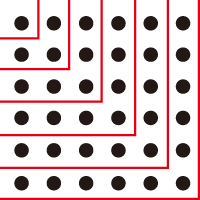
\[ \begin{aligned} \sum_{k=1}^{n} k &=\frac{n(n+1)}{2}, \\ \sum_{k=1}^{n} k^{2} &=\frac{n(n+1)(2 n+1)}{6}, \\ \sum_{k=1}^{n} k^{3} &=\frac{n^{2}(n+1)^{2}}{4} = \qty{\sum_{k=1}^n k}^2, \\ \sum_{k=1}^{n}(2k-1) &= n^2. \end{aligned} \]
(Sums of rising factorials)
For \(p\geq 1\), with \(k^{(p)}\coloneqq k(k+1) \cdots (k+p-1)\), \[ \begin{aligned} \sum_{k=1}^{n} k^{(p)} &= \frac{n^{(p+1)}}{p+1}, \\ \sum_{k=1}^{n} \frac{p}{k^{(p+1)}} &= \frac{1}{1^{(p)}}-\frac{1}{(n+1)^{(p)}}, \qquad 1^{(p)} = p!. \end{aligned} \] For \(p=2,3\) the first identity reads \(\sum_{k=1}^{n} k(k+1) = \frac{n(n+1)(n+2)}{3}\) and \(\sum_{k=1}^{n} k(k+1)(k+2) = \frac{n(n+1)(n+2)(n+3)}{4}\); for \(p=1,2\) the second reads \(\sum_{k=1}^{n} \frac{1}{k(k+1)}=1-\frac{1}{n+1}\) and \(\sum_{k=1}^{n} \frac{2}{k(k+1)(k+2)}=\frac{1}{2}-\frac{1}{(n+1)(n+2)}\).
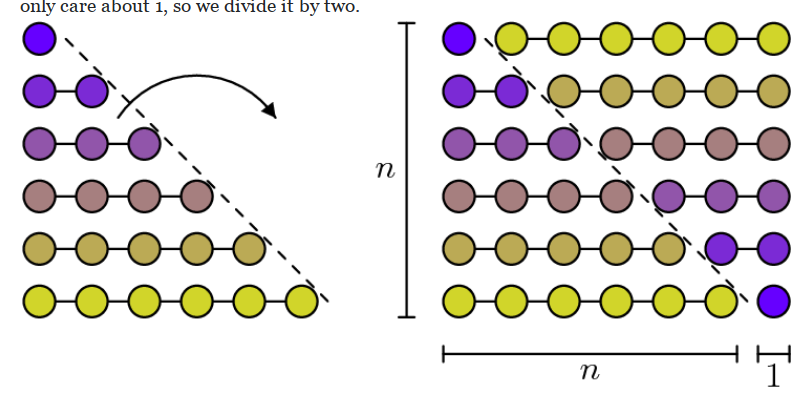
The rising-factorial sums are discrete analogues of \(\int_0^n x^p \dx = { n^{p+1} \over p+1}\) and \(\int_1^{n+1}{p\over x^{p+1}}\dx = 1 - {1\over (n+1)^p}\). Writing \(k^2 = k(k+1) - k\) gives \(\sum_{k=1}^n k^2 = \frac{n(n+1)(n+2)}{3} - \frac{n(n+1)}{2} = {n(n+1)(2n+1) \over 6}\). The identity \(\sum_{k=1}^n k = n(n+1)/2\) counts a staircase of \(n\) columns as half of an \(n\times(n+1)\) rectangle:
Inverting power series
(Cauchy product)
Where both series converge absolutely, \[ \sum_{k\geq 0} a_kz^k \cdot \sum_{k\geq 0} b_k z^k = \sum_{k\geq 0} c_k z^k,\qquad c_k \coloneqq \sum_{j=0}^k a_j b_{k-j}. \]
(Coefficients of $1/A(z)$)
For a commutative ring \(R\), \(A(z) \coloneqq \sum_{k\geq 0} a_k z^k \in R[[z]]\) is invertible if and only if \(a_0\) is a unit in \(R\); over a field, if and only if \(a_0\neq 0\). In that case the coefficients of \(B(z) \coloneqq \sum_{k\geq 0 } b_k z^k \coloneqq 1/A(z)\) are determined recursively by \[ \begin{aligned} b_0 &= \inverseof{a_0}, \\ b_n &= -\inverseof{a_0} \sum_{1\leq i \leq n} a_i b_{n-i} = -{1\over a_0}\qty{a_nb_0 + a_{n-1}b_1 + \cdots + a_1 b_{n-1} }, \qquad n\geq 1. \end{aligned} \]
Comparing coefficients of \(z^n\) in \(A(z)B(z) = 1\) gives \[ a_0b_0 =1, \qquad \sum_{i=0}^n a_ib_{n-i} = 0 \quad (n\geq 1), \] and solving the \(n\)th equation for \(b_n\) gives the recursion. Conversely, if \(a_0\) is a unit, the recursion defines \(B\) with \(AB = 1\); if \(AB=1\), then \(a_0b_0 = 1\).
Coefficients of the reciprocal of a power series (Tag FF-JKLWM)
Let \(A(z)=\sum_{k\ge0}c_kz^k\) be a power series with positive radius of convergence and \(c_0\neq0\). Then \(1/A\) is holomorphic near \(0\), and its Taylor series \(1/A(z)=\sum_{k\ge0}b_kz^k\) has coefficients determined recursively by \[ b_0=\inverseof{c_0},\qquad b_n=-\inverseof{c_0}\sum_{k=1}^{n}c_kb_{n-k}\quad(n\ge1). \] In particular, \(b_1=-\inverseof{c_0} c_1b_0\) and \(b_2=-\inverseof{c_0}(c_2b_0+c_1b_1)\).
Since \(A(0)=c_0\neq0\) and \(A\) is continuous, \(A\) has no zeros near \(0\), so \(1/A\) is holomorphic there and has a Taylor series \(\sum_k b_kz^k\). The Cauchy product of the two series is \(A(z)\cdot\frac{1}{A(z)}=1\), so comparing coefficients gives \(c_0b_0=1\) and \(\sum_{k=0}^{n}c_kb_{n-k}=0\) for \(n\ge1\). Solving the last equation for \(b_n\) gives the recursion.
Invert $1-z$, one coefficient at a time (Tag P-VFAXW)
Use this formulation to show that if \(A(z)= 1-z\) then \(1/A(z) = \sum z^k\).
Solution
Noting \(a_0 = 1, a_1 = -1\), we have
- \(b_0 = 1/a_0 = 1\)
- \(b_1 = -{1\over a_0}(a_1 b_0) = -1(-1\cdot 1) = 1\)
- \(b_2 = -{1\over a_0}(a_2 b_0 + a_1 b_1) = -1(0\cdot 1 + -1\cdot 1) = 1\),
and so on, so \[ {1\over A(z)} = 1 + 1\cdot z + 1\cdot z^2 + \cdots .\]
Invert $2z-1$, one coefficient at a time (Tag P-IM6MH)
Let \(A(z) \da 2z-1\) and find \(1/A(z)\).
Solution
To compute the inverse of \(A(z) \da (2z-1)\), note \(a_0 = -1, a_1 = 2\), so
- \(b_0 = 1/a_0 = -1\)
- \(b_1 = -{1\over a_0}(a_1b_0) = 1(2\cdot -1) = -2\)
- \(b_2 = -{1\over a_0}(a_2 b_0 + a_1 b_1) = 1(0\cdot 1 + 2\cdot -2) = -4\)
- \(b_3 = -{1\over a_0}(a_3b_0 + a_2 b_1 + a_1 b_2) = 1(0 + 0 + 2\cdot -4) = -8\)
so \[ {1\over 2z-1} = -1 - 2z - 4z^2 - 8z^3 - \cdots = - \sum_{k\geq 0} (2z)^k .\]
Invert $\cos(z)$, one coefficient at a tiem (Tag P-OCOSY)
Find \(1/\cos(z)\) using this method.
Solution
We have \(\cos(z) = c_0 +c_2^2 + c_4 z^4 + \bigo(z^6)\) where
\(c_0 = 1\)
\(c_2 = -1/2!\)
\(c_4 = 1/4!\)
Note that \(c_i\) for \(i\) odd all vanish. Write \(1/\cos(z) = \sum b_k z^k\), then
\(b_0 = \inverseof{c_0} = 1\).
\(b_1 = -\inverseof{c_0}(c_1 b_0) = -(0) = 0\).
\(b_2 = -\inverseof{c_0}(c_2 b_0 + c_1b_1) = -(c_2 + 0) = -c_2 = 1/2!\)
\(b_3 = -\inverseof{c_0}(c_3b_0 + c_2b_1 + c_1b_2) = -(0 +0 + 0)= 0\)
\(b_4 = -\inverseof{c_0}(c_4b_0 + c_3b_1 + c_2 b_2 + c_1b_3)=-(c_4 + 0 + (-1/2!)(1/2!) + 0) = 5/24\).
So \[ {1\over \cos(z)} = 1 + {1\over 2!}z^2 + {5\over 24}z^4 + \bigo(z^6) .\]
Invert $\sin(z)$, one coefficient at a time (Tag P-VT4TV)
Find \(1/\sin(z)\) using this method.
Solution
Note that the leading coefficient of the expansion for \(\sin(z)\) is 0, so this can’t be inverted directly. A standard trick: factor out the smallest power of \(z\) to get a piece with a nonzero leading coefficient, and invert that instead. Write \[ \sin(z) = z - {1\over 3!}z^3 + {1\over 5!}z^5 - \bigo(z^7) = z f(z) \da z(1 + c_2z^2 + c_4 z^4 + \bigo(z^6)) ,\] where
\(c_0 = 1\)
\(c_2 = -{1\over 3!}\)
\(c_4 = {1\over 5!}\)
\(c_i = 0\) for \(i\) odd.
Writing \(B(z) \da {1\over f(z)} = \sum b_k z^k\), we have
\(b_0 = \inverseof{c_0} = 1\)
\(b_2 = -(c_2 b_0 + c_1 b_1) = -c_2\)
\(b_4 = -(c_4 b_0 + c_2 b_2) = c_2^2 - c_4\)
Thus \(1/B(z) = 1 -c_2z^2 + (c_2^2-c_4)z^4 + \bigo(z^6)\), and \[ {1\over \sin(z)} &= {1\over z} {1\over B(z)} \\ &= {1\over z} - c_2 z + (c_2^2 - c_4)z^3 + \bigo(z^5) \\ &= {1\over z} + {1\over 3!} z + ({1\over 3! 3!} - {1\over 5!})z^3 + \bigo(z^5) \\ &= {1\over z} + {1\over 3!}z + {7\over 360}z^3 + \bigo(z^5) .\]
(Inverting with the geometric series)
For \(A(z) \coloneqq 1 + a_1 z + a_2z^2 + \cdots\), \[ {1\over A(z)} = {1 \over 1- (1-A(z))} = \sum_{k\geq 0} (1-A(z))^k = 1 - (A(z) - 1) + (A(z) - 1)^2 - (A(z) - 1)^3 + \cdots \] as formal power series. Since \((A(z)-1)^k\) has no terms of degree below \(k\), the coefficient of \(z^m\) in \(1/A(z)\) is determined by the summands with \(k\leq m\).
If \(A(z) = z^m \tilde A(z)\) with \(\tilde A(0) \neq 0\), then \(1/A(z) = z^{-m}/\tilde A(z)\), and \(1/\tilde A(z)\) is computed by the coefficient recursion for \(1/A(z)\) applied to \(\tilde A\) or, after dividing by \(\tilde A(0)\), by the geometric series.
Laurent series of $1/\sin z$ at $0$ (Tag FF-UQZNR)
For \(0<\abs{z}<\pi\), \[ {1\over \sin(z)} = \frac{1}{z}+\frac{1}{3 !} z+\frac{7}{360} z^{3}+O\qty{z^{5}}. \]
Invert $\sin(z)$ using geometric series (Tag P-VO5YR)
Invert \(\sin(z)\) using a geometric series, heeding the warning above.
Solution
Just a computation: \[ {1\over \sin(z)} &= {1\over z-{z^3\over 3!} + {z^5\over 5!} - \bigo(z^7) } \\ &={1\over z\qty{ 1 - {z^2\over 3!} + {z^4 \over 5!} - \bigo(z^6)} } \\ &= \inverseof{z} \qty{1\over 1 - p(z)} \qquad p(z) \da {z^2\over 3!} - {z^4\over 5!} + \bigo(z^6) \\ &= \inverseof{z} \sum_{k\geq 0} p(z)^k \\ &= \inverseof{z}\qty{ 1 + p(z) + p(z)^2 + \bigo(z^2)^3 } \\ &= \inverseof{z}\qty{ 1 \ + \qty{{z^2\over 3!} - {z^4\over 5!} + \bigo(z^6)} \ + \qty{{z^2\over 3!} - {z^4\over 5!} + \bigo(z^6)}^2 \ + \bigo(z^6)} \\ &= {1\over z}\qty{ 1 + {1\over 3!}z^2 + \qty{\qty{1\over 3!}^2 - {1\over 5!} }z^4 + \bigo(z^6) }\\ &= {1\over z} + {1\over 6}z + {7\over 360}z^3 + \bigo(z^5) .\]
Power series of $\tan z$ via geometric-series inversion (Tag P-NBSTW)
Laurent expand \(\tan(z)\) at \(0\) using this method to compute \(1/\cos(z)\) and taking the product \(\sin(z) \cdot {1\over \cos(z)}\).
Solution
Example. To find the coefficients of \(z^m\) for \(m \leq 5\) in the power series expansion of \(\tan z=\sin z / \cos z\) about \(z=0\), we calculate as follows, again using the notation \(\mathcal{O}\left(z^m\right)\) for terms involving powers \(z^k\) for \(k \geq m\) : \[ \begin{aligned} \frac{1}{\cos z} & =\frac{1}{1-\left(z^2 / 2 !\right)+\left(z^4 / 4 !\right)+\mathcal{O}\left(z^6\right)} \\ & =1+\left(\frac{z^2}{2 !}-\frac{z^4}{4 !}+\mathcal{O}\left(z^6\right)\right)+\left(\frac{z^2}{2 !}-\frac{z^4}{4 !}+\mathcal{O}\left(z^6\right)\right)^2+\mathcal{O}\left(z^6\right) \\ & =1+\frac{1}{2} z^2+\frac{5}{24} z^4+\mathcal{O}\left(z^6\right) \end{aligned} \] so that \[ \begin{aligned} \frac{\sin z}{\cos z} & =\left(z-\frac{z^3}{3 !}+\frac{z^5}{5 !}+\mathcal{O}\left(z^7\right)\right)\left(1+\frac{1}{2} z^2+\frac{5}{24} z^4+\mathcal{O}\left(z^6\right)\right) \\ & =z+\frac{1}{3} z^3+\frac{2}{15} z^5+\mathcal{O}\left(z^7\right) . \end{aligned} \] The end result can be checked by differentiating \(\tan z\) five times. Note that \(\tan z\) is an odd function, so that only odd terms appear in the power series.
Long division of power series
(Long division)
Polynomial long division applies to formal power series. Dividing by leading terms of highest degree gives the quotient of polynomials, as for \(\frac{z^3+1}{z+1}\): \[ \begin{aligned} z^3 + 1 &= (z+1)(z^2) + (-z^2 + 1), \\ -z^2 + 1 &= (z+1)(-z) + (z+1), \\ z+1 &= (z+1)(1) + 0, \end{aligned} \] so \(\frac{z^3 + 1}{z+1} = z^2 - z + 1\). Dividing by terms of lowest degree produces the quotient in increasing powers of \(z\), which gives the low-order terms of a power series quotient: \[ \begin{aligned} 1+z^3 &= (1+z)(1) + (-z+z^3), \\ -z+z^3 &= (1+z)(-z) + (z^2 + z^3), \\ z^2 +z^3 &= (1+z)(z^2) + 0, \end{aligned} \] so \(\frac{1+z^3}{1+z} = 1 - z + z^2\).
(The Laurent series of $1/\sin(z)$)
Write \(\frac{1}{\sin(z)} = \inverseof{z}\qty{\frac{z}{\sin(z)}}\) and divide \(z\) by \(\sin(z) = z-\frac{1}{3!}z^3 + \frac{1}{5!}z^5 - \cdots\) in increasing powers: \[ \begin{array}{rl} \underline{\hspace{8em} 1 + {1\over 3!}z^2 + \left({1\over 3!3!} - {1\over 5!} \right)z^4 + \cdots } & \\[-5pt] z-{1\over 3!}z^3 + {1\over 5!}z^5 + \cdots\hspace{3em} |z\hspace{9em} \\ \underline{-(z-{1\over 3!}z^3 + {1\over 5!}z^5 + \cdots)} & \\ {1\over 3!}z^3 - {1\over 5!}z^5 + {1\over 7!}z^7 - \cdots \hspace{0em}& \\ \underline{-{1\over 3!}z^2(z-{1\over 3!}z^3 + {1\over 5!}z^5 + \cdots)} & \\ \left( -{1\over 5!} + {1\over 3!3!}\right)z^5 + \left( {1\over 7!} - {1\over 3! 5!} \right)z^7 + \cdots & \\ \end{array} \] So \[ \begin{aligned} {z\over \sin(z)} &= 1 + {z^2\over 3!} + {7 z^4 \over 360 } + \bigo(z^6), \\ {1 \over \sin(z)} &= {1\over z} + {z\over 3!} + {7 z^3 \over 360 } + \bigo(z^5). \end{aligned} \]
Tangent from polynomial long division (Tag P-KUNLD)
Find a Laurent expansion about \(z_0=0\) for \(f(z) = \tan(z)\) by using polynomial long division on the series expansions for \(\sin(z)\) and \(\cos(z)\).
Solution
Computing the Laurent series for \(\tan(z)\) at \(z=0\):
\[ {\sin(z) \over \cos(z)} &= {z - {1\over 3!}z^3 + {1\over 5!} z^5 + \bigo(z^7) \over 1 - {1\over 2!} z^2 + {1\over 4!}z^4 + \bigo(z^6) } \\ \\ z - {1\over 3!}z^3 + {1\over 5!}z^5 &= \qty{1 - {1\over 2!}z^2 + {1\over 4!}z^4}(z) \ +\qty{ \qty{{1\over 2!} - {1\over 3!}}z^3 + \qty{-{1\over 4!} + {1\over 5!} }z^5 } \\ &= \qty{1 - {1\over 2!}z^2 + {1\over 4!}z^4}(z) \ +\qty{ {1\over 3}z^3 -{1\over 30}z^5 } \\ \\ {1\over 3}z^3 -{1\over 30}z^5 &= \qty{1 - {1\over 2!}z^2 + {1\over 4!}z^4}\qty{{1\over 3} z^3} \ +\qty{ \qty{ {1\over 6} - {1\over 30} } z^5 + \qty{ -{1\over 3\cdot 24} }z^7 } \\ &= \qty{1 - {1\over 2!}z^2 + {1\over 4!}z^4}\qty{{1\over 3} z^3} \ + \qty{ {2\over 15}z^5 - {1\over 72}z^7 } \\ \\ { {2\over 15}z^5 - {1\over 72}z^7 } &= \qty{1 - {1\over 2!}z^2 + {1\over 4!}z^4}\qty{{2\over 15} z^5} + \cdot \\ \\ \implies \tan(z) &= z + {1\over 3}z^3 + {2\over 15 }z^5 + \bigo(z^7) .\]