Holomorphic functions
Complex differentiable implies Cauchy--Riemann (Tag PR-37QA5)
Let \(\Omega\subseteq\CC\) be open, let \(f=u+iv\colon\Omega\to\CC\) with \(u,v\) real-valued, and regard \(f\), \(u\), \(v\) as functions of \((x,y)\) where \(z=x+iy\). If \(f\) is complex differentiable at \(z_0=x_0+iy_0\in\Omega\), then the partial derivatives of \(u\) and \(v\) exist at \((x_0,y_0)\), \[ f'(z_0)=\dd{f}{x}(x_0,y_0)={1\over i}\dd{f}{y}(x_0,y_0), \] and at \((x_0,y_0)\) \[ \dd{u}{x} = \dd{v}{y}, \qquad \dd{u}{y} = -\dd{v}{x}. \]
The limit \(f'(z_0)=\lim_{h\to0}\frac{f(z_0+h)-f(z_0)}{h}\) exists, so it may be computed along any direction. Along real \(h=h_1\in\RR\), \[ f'(z_0) = \lim_{h_1\to 0} { f(x_0+h_1, y_0) - f(x_0, y_0) \over h_1} = \dd{f}{x}(x_0, y_0). \] Along purely imaginary \(h=ih_2\) with \(h_2\in\RR\), \[ f'(z_0) = \lim_{h_2\to 0} { f(x_0, y_0+h_2) - f(x_0, y_0) \over ih_2 } = {1\over i} \dd{f}{y}(x_0, y_0). \] Taking real and imaginary parts of these limits shows that the partial derivatives of \(u\) and \(v\) exist. Writing \(1/i=-i\), \[ \begin{aligned} \dd{f}{x} &= \dd{u}{x} + i \dd{v}{x}, \\ {1\over i} \dd{f}{y} &= -i \qty{ \dd{u}{y} + i \dd{v}{y}} = \dd{v}{y} - i\dd{u}{y}. \end{aligned} \] Equating real and imaginary parts of the two expressions for \(f'(z_0)\) gives \(\dd{u}{x} = \dd{v}{y}\) and \(\dd{v}{x} = -\dd{u}{y}\).
Polar Cauchy--Riemann equations (Tag PR-OOHUL)
Let \(\Omega\subseteq\CC\sm\ts{0}\) be open and let \(f=u+iv\) be holomorphic on \(\Omega\), with \(u,v\) real-valued. Writing \(u\) and \(v\) as functions of \((r,\theta)\) through \(z=re^{i\theta}\), \(r>0\), \[ \frac{\partial u}{\partial r}=\frac{1}{r}\frac{\partial v}{\partial\theta}\qquad\text{and}\qquad\frac{1}{r}\frac{\partial u}{\partial\theta}=-\frac{\partial v}{\partial r}. \]
With \(x=r\cos\theta\) and \(y=r\sin\theta\), the chain rule gives \[ \begin{aligned} u_r&=u_x\cos\theta+u_y\sin\theta, & u_\theta&=r(-u_x\sin\theta+u_y\cos\theta),\\ v_r&=v_x\cos\theta+v_y\sin\theta, & v_\theta&=r(-v_x\sin\theta+v_y\cos\theta). \end{aligned} \] Substituting the Cauchy–Riemann equations \(v_x=-u_y\) and \(v_y=u_x\) gives \[ v_\theta=r(u_y\sin\theta+u_x\cos\theta)=ru_r,\qquad v_r=-u_y\cos\theta+u_x\sin\theta=-\frac1r u_\theta. \]
Cauchy--Riemann implies holomorphic (Tag PR-JKE6C)
Let \(\Omega\subseteq\CC\) be open and let \(f = u+iv\colon\Omega\to\CC\), where \(u,v\colon\Omega\to\RR\) are continuously differentiable as functions of \((x,y)\), \(z=x+iy\). If \(u_x=v_y\) and \(u_y=-v_x\) on \(\Omega\), then \(f\) is holomorphic on \(\Omega\) and \[ f'(z) = \del f(z) = u_x(z) + iv_x(z). \]
Fix \(z\in\Omega\) and write \(h=h_1+ih_2\). Since \(u\) and \(v\) are continuously differentiable, they are real differentiable at \(z\), so \[ f(z+h)-f(z)=u_xh_1+u_yh_2+i\qty{v_xh_1+v_yh_2}+o(\abs{h}), \] with the partial derivatives evaluated at \(z\). Substituting \(u_y=-v_x\) and \(v_y=u_x\) gives \(u_xh_1-v_xh_2+i\qty{v_xh_1+u_xh_2}=(u_x+iv_x)(h_1+ih_2)\), so \(\frac{f(z+h)-f(z)}{h}\to u_x+iv_x\) as \(h\to0\). Finally, \(\del f=\frac12\qty{f_x-if_y}=\frac12\qty{u_x+v_y+i(v_x-u_y)}=u_x+iv_x\) by the same equations.
Holomorphic implies analytic (Tag T-SRY2V)
Let \(\Omega\subseteq\CC\) be open, let \(f\) be holomorphic on \(\Omega\), and let \(D\) be an open disc centred at \(p\) whose closure is contained in \(\Omega\). Then for every \(z\in D\) the series below converges and \[ f(z)=\sum_{k\geq0}c_k(z-p)^k,\qquad c_k=\frac{f^{(k)}(p)}{k!}. \] In particular, \(f\) is analytic at every point of \(\Omega\).
See [@SS03]. Conversely, a function analytic on \(\Omega\) is holomorphic on \(\Omega\), since a power series is complex differentiable inside its disc of convergence; so holomorphic and analytic functions on \(\Omega\) coincide.
Power series are smooth on their disc of convergence (Tag PR-QNDSD)
Let \(f(z)=\sum_{k\ge0}c_k(z-z_0)^k\) be a power series with radius of convergence \(R>0\). Then \(f\) is holomorphic and infinitely differentiable on \(D_R(z_0)\), its derivative is obtained by term-by-term differentiation, \[ f'(z)=\sum_{k\ge1}kc_k(z-z_0)^{k-1},\qquad z\in D_R(z_0), \] where this series also has radius of convergence \(R\), and the coefficients are \[ c_k=\frac{f^{(k)}(z_0)}{k!},\qquad k\ge0. \]
Power series expansion of a holomorphic function on a disc (Tag T-GROTS)
Let \(\Omega\subseteq\CC\) be open, let \(f\) be holomorphic on \(\Omega\), and let \(z_0\in\Omega\) and \(R>0\) satisfy \(\overline{D_R(z_0)}\subseteq\Omega\). Then for every \(z\in D_R(z_0)\), \[ f(z)=\sum_{n=0}^{\infty}a_n(z-z_0)^n, \] where for every \(n\geq0\) and every \(r\in(0,R]\), \[ a_n=\frac{f^{(n)}(z_0)}{n!}=\frac{1}{2\pi r^n}\int_0^{2\pi}f(z_0+re^{i\theta})e^{-in\theta}\dtheta. \]
Abel's theorem (Tag T-B7YTE)
Let \((c_k)_{k\ge0}\) be complex numbers such that \(\sum_{k\ge0}c_k\) converges. Then \(\sum_{k\ge0}c_kz^k\) converges for \(\abs z<1\), and \[ \lim_{r\to1^-}\sum_{k\ge0}c_kr^k=\sum_{k\ge0}c_k, \] where the limit is taken over real \(r\in(0,1)\).
Holomorphic functions have harmonic components (Tag PR-K57J6)
Let \(\Omega\subseteq\CC\) be open and let \(f(z) = u(x, y) + iv(x, y)\) be holomorphic on \(\Omega\), with \(u,v\) real-valued and \(z=x+iy\). Then \(u\) and \(v\) are harmonic on \(\Omega\).
The derivative of a holomorphic function is holomorphic, so \(f\) is infinitely differentiable and \(u,v\) have continuous partial derivatives of all orders. By the Cauchy–Riemann equations \(u_x=v_y\) and \(u_y=-v_x\), so \(u_{xx}=v_{yx}=v_{xy}=-u_{yy}\) and \(v_{xx}=-u_{yx}=-u_{xy}=-v_{yy}\), using equality of mixed partials. Hence \(\Delta u=\Delta v=0\).
Mean value property for harmonic functions (Tag PR-UWGI6)
Let \(\Omega\subseteq\CC\) be open, let \(u\) be harmonic on \(\Omega\), and let \(z_0=x_0+iy_0\in\Omega\) and \(r>0\) satisfy \(\overline{D_r(z_0)}\subseteq\Omega\). Then \[ u(z_0)=\frac{1}{2\pi r}\oint_{\bd D_r(z_0)}u\,ds=\frac{1}{\pi r^2}\iint_{D_r(z_0)}u(x,y)\dx\dy, \] where \(ds\) is arc length on the circle \(\bd D_r(z_0)\).
Holomorphic logarithm when $f'/f$ has zero periods (Tag T-NRSFZ)
Let \(\Omega\subseteq\CC\) be a connected open set and let \(f\) be holomorphic and nonvanishing on \(\Omega\). Suppose that \(\int_\gamma\frac{f'(z)}{f(z)}\dz=0\) for every piecewise smooth closed curve \(\gamma\) in \(\Omega\). Fix \(z_0\in\Omega\) and \(c\in\CC\) with \(e^c=f(z_0)\), and define \[ g(z)\coloneqq c+\int_{z_0}^z\frac{f'(\xi)}{f(\xi)}\dxi, \] the integral taken along any piecewise smooth path in \(\Omega\) from \(z_0\) to \(z\). Then \(g\) is well defined and holomorphic on \(\Omega\), \(g'=f'/f\), and \(e^{g}=f\) on \(\Omega\).
Cauchy theory
Cauchy's theorem for simply connected regions (Tag T-2OVCI)
Let \(\Omega\subseteq\CC\) be a simply connected region and let \(f\) be holomorphic on \(\Omega\). Then for every closed piecewise \(C^1\) curve \(\gamma\) in \(\Omega\), \[ \int_\gamma f(z)\dz=0. \]
Goursat's theorem (Tag T-B3BDO)
Let \(\Omega\subseteq\CC\) be open, let \(f\) be holomorphic on \(\Omega\), and let \(T\subseteq\Omega\) be a closed triangle whose interior is also contained in \(\Omega\). Then the integral of \(f\) over the boundary of \(T\) vanishes: \[ \int_{\bd T}f(z)\dz=0. \]
This is [@SS03]. The hypothesis is complex differentiability of \(f\) at every point of \(\Omega\); continuity of \(f'\) is not assumed, and the proof proceeds by repeated subdivision of \(T\) into four similar triangles. Goursat’s theorem gives primitives of holomorphic functions on discs, and from these follow Cauchy’s theorem for toy contours, the Cauchy integral formula, and the power series expansion of holomorphic functions.
Cauchy integral formula (Tag T-LA2UI)
Let \(\Omega\subseteq\CC\) be open, let \(f\) be holomorphic on \(\Omega\), and let \(z_0\in\Omega\) and \(R>0\) satisfy \(\overline{D_R(z_0)}\subseteq\Omega\). Let \(\gamma\coloneqq\partial D_R(z_0)\), oriented counterclockwise. Then for every \(n\geq0\), \[ f^{(n)}(z_0)=\frac{n!}{2\pi i}\int_\gamma\frac{f(\xi)}{(\xi-z_0)^{n+1}}\dxi, \] and in particular \(f(z_0)=\frac{1}{2\pi i}\int_\gamma\frac{f(\xi)}{\xi-z_0}\dxi\). Consequently, the coefficients of the Taylor expansion \(f(z)=\sum_{k\geq0}c_k(z-z_0)^k\) at \(z_0\) are \[ c_k=\frac{f^{(k)}(z_0)}{k!}=\frac{1}{2\pi i}\int_\gamma\frac{f(\xi)}{(\xi-z_0)^{k+1}}\dxi. \]
Mean value property for holomorphic functions (Tag T-5BLYU)
Let \(f\) be holomorphic on an open set containing the closed disc \(\overline{D_r(z_0)}\). Then \[ f(z_0)=\frac{1}{2\pi}\int_0^{2\pi}f(z_0+re^{i\theta})\dtheta=\frac{1}{\pi r^2}\iint_{D_r(z_0)}f(z)\dA. \] The same identities hold for \(u=\Re f\) in place of \(f\), by taking real parts.
The Cauchy integral formula on the circle \(z=z_0+\rho e^{i\theta}\), \(0<\rho\le r\), gives \[ f(z_0)=\frac{1}{2\pi i}\int_0^{2\pi}\frac{f(z_0+\rho e^{i\theta})}{\rho e^{i\theta}}\,i\rho e^{i\theta}\dtheta=\frac{1}{2\pi}\int_0^{2\pi}f(z_0+\rho e^{i\theta})\dtheta. \] Multiplying by \(\rho\) and integrating over \(0\le\rho\le r\) in polar coordinates gives \(\frac{r^2}{2}f(z_0)=\frac{1}{2\pi}\iint_{D_r(z_0)}f\dA\).
Cauchy's inequalities (Tag T-22RQZ)
Let \(\Omega\subseteq\CC\) be open, let \(f\) be holomorphic on \(\Omega\), and let \(z_0\in\Omega\) and \(R>0\) satisfy \(\overline{D_R(z_0)}\subseteq\Omega\). Let \(\gamma\) be the circle \(\abs{z-z_0}=R\) and \(M\coloneqq\max_{z\in\gamma}\abs{f(z)}\). Then for every \(n\ge0\), \[ \abs{f^{(n)}(z_0)}\le\frac{n!\,M}{R^n}. \]
By the Cauchy integral formula for derivatives, with \(\gamma\) parametrized by \(z=z_0+Re^{i\theta}\), \[ \abs{f^{(n)}(z_0)}=\abs{\frac{n!}{2\pi i}\int_\gamma\frac{f(z)}{(z-z_0)^{n+1}}\dz}\le\frac{n!}{2\pi}\int_0^{2\pi}\frac{M}{R^{n+1}}R\dtheta=\frac{n!\,M}{R^n}. \]
Liouville's theorem (Tag T-QHIHJ)
Let \(f\) be an entire function. If there is \(M>0\) with \(\abs{f(z)}\leq M\) for all \(z\in\CC\), then \(f\) is constant.
Morera's theorem (Tag T-LHSMY)
Let \(\Omega\subseteq\CC\) be open and let \(f\colon\Omega\to\CC\) be continuous. If \(\int_{\partial T}f(z)\dz=0\) for every closed triangle \(T\subseteq\Omega\), then \(f\) is holomorphic on \(\Omega\).
Equivalent conditions for a holomorphic function to vanish identically (Tag T-SVF2W)
Let \(\Omega\subseteq\CC\) be a nonempty connected open set and let \(f\) be holomorphic on \(\Omega\). The following are equivalent.
\(f(z)=0\) for all \(z\in\Omega\).
There are \(z_0\in\Omega\) and a sequence \((z_k)_{k\geq1}\) of distinct points of \(\Omega\) with \(z_k\to z_0\) and \(f(z_k)=0\) for all \(k\).
There is \(z_0\in\Omega\) with \(f^{(n)}(z_0)=0\) for all \(n\geq0\).
Maximum modulus principle (Tag T-BYNL5)
Let \(\Omega\subseteq\CC\) be open and let \(f\) be holomorphic on \(\Omega\).
If \(\abs f\) has a local maximum at \(z_0\in\Omega\), then \(f\) is constant on a neighborhood of \(z_0\).
If \(\Omega\) is bounded and connected and \(f\) extends continuously to \(\overline\Omega\), then either \(f\) is constant or \(\abs f\) attains its maximum \(M\coloneqq\max_{z\in\overline\Omega}\abs{f(z)}\) only at points of \(\bd\Omega\).
Minimum modulus principle (Tag T-YLI6Y)
Let \(\Omega\subseteq\CC\) be a connected open set and let \(f\) be holomorphic and nonvanishing on \(\Omega\).
If \(\abs{f}\) has a local minimum at some \(z_0\in\Omega\), then \(f\) is constant on \(\Omega\).
If moreover \(\Omega\) is bounded, \(f\) extends continuously to \(\overline{\Omega}\), and \(f\) is nonconstant, then \(\min_{\overline{\Omega}}\abs{f}\) is attained only at points of \(\partial\Omega\).
Open mapping theorem (Tag C-FRF33)
Let \(\Omega\subseteq\CC\) be a connected open set and let \(f\) be a nonconstant holomorphic function on \(\Omega\). Then \(f\) is an open map: \(f(U)\) is open for every open set \(U\subseteq\Omega\).
Symmetry principle (Tag T-5SKNT)
Let \(\Omega\subseteq\CC\) be open, and put \(\Omega^+\coloneqq\Omega\cap\ts{\Im z>0}\), \(\Omega^-\coloneqq\Omega\cap\ts{\Im z<0}\), and \(I\coloneqq\Omega\cap\RR\). Let \(f^+\) be holomorphic on \(\Omega^+\) and \(f^-\) holomorphic on \(\Omega^-\), and suppose both extend continuously to \(I\) with \(f^+(x)=f^-(x)\) for all \(x\in I\). Then the function \[ f(z)\coloneqq \begin{cases} f^+(z) & z\in\Omega^+,\\ f^-(z) & z\in\Omega^-,\\ f^+(z)=f^-(z) & z\in I, \end{cases} \] is holomorphic on \(\Omega\).
Schwarz reflection principle (Tag T-Q3GGF)
Let \(\Omega\subseteq\CC\) be an open set with \(\overline{z}\in\Omega\) for every \(z\in\Omega\), and put \(\Omega^+\coloneqq\{z\in\Omega : \operatorname{Im}z>0\}\), \(\Omega^-\coloneqq\{z\in\Omega : \operatorname{Im}z<0\}\), and \(I\coloneqq\Omega\cap\RR\). Let \(f\) be holomorphic on \(\Omega^+\), continuous on \(\Omega^+\cup I\), and real-valued on \(I\). Then the function \[ F(z)\coloneqq\begin{cases}f(z), & z\in\Omega^+\cup I,\\ \overline{f(\overline{z})}, & z\in\Omega^-,\end{cases} \] is holomorphic on \(\Omega\). In particular, for \(\Omega=\CC\): if \(f\) is holomorphic on the upper half-plane, continuous on its closure, and real-valued on \(\RR\), then \(F\) is entire.
See Cauchy theory.
Singularities
Laurent expansion on an annulus (Tag T-4XPWL)
Let \(z_0\in\CC\), \(0\le r<R\le\infty\), and let \(f\) be holomorphic on the annulus \[ A\coloneqq\ts{z\in\CC\st r<\abs{z-z_0}<R}. \] Then \(f\) has a two-sided expansion \[ f(z)=\sum_{n\in\ZZ}c_n(z-z_0)^n \] converging locally uniformly on \(A\), with coefficients \[ c_n=\frac{1}{2\pi i}\int_{\abs{z-z_0}=\rho}\frac{f(z)}{(z-z_0)^{n+1}}\dz \] for any \(r<\rho<R\), independent of \(\rho\). The expansion is unique.
If \(r=0\), so that \(z_0\) is an isolated singularity of \(f\), then the principal part \(\sum_{n<0}c_n(z-z_0)^n\) has no nonzero terms if and only if \(z_0\) is removable, finitely many if and only if \(z_0\) is a pole, and infinitely many if and only if \(z_0\) is essential.
See [@Ahl79, Chapter 5, Section 1.3, p. 184].
Cauchy integral formula for Taylor coefficients and the Cauchy estimates (Tag C-7S2CO)
Let \(f\) be holomorphic on an open set containing the closed disc \(\overline{D_R(p)}\), and write \(f(z)=\sum_{k\ge0}c_k(z-p)^k\) near \(p\). Then for every \(k\ge0\), \[ c_k=\frac{f^{(k)}(p)}{k!}=\frac{1}{2\pi i}\int_{\abs{z-p}=R}\frac{f(z)}{(z-p)^{k+1}}\dz=\frac{1}{2\pi R^k}\int_0^{2\pi}f(p+Re^{i\theta})e^{-ik\theta}\dtheta. \] Consequently, with \(M_R\coloneqq\max_{\abs{z-p}=R}\abs{f(z)}\), \[ \abs{c_k}\le\frac{M_R}{R^k}, \] so \(\limsup_k\abs{c_k}^{1/k}\le1/R\), and the Taylor series of \(f\) at \(p\) converges on \(D_R(p)\), where it equals \(f\).
Differentiating the Cauchy integral formula \(f(w)=\frac{1}{2\pi i}\int_{\abs{z-p}=R}\frac{f(z)}{z-w}\dz\) under the integral sign \(k\) times at \(w=p\) gives the first two equalities. Parametrizing the circle by \(z=p+Re^{i\theta}\), so that \(\dz=iRe^{i\theta}\dtheta\), gives the third. Bounding the integrand of the third expression by \(M_R/R^k\) over an interval of length \(2\pi\) gives the estimate, and the root test gives the radius of convergence.
Riemann's removable singularity theorem (Tag T-ZZJDP)
Let \(\Omega\subseteq\CC\) be open, let \(z_0\in\Omega\), and let \(f\) be holomorphic on \(\Omega\setminus\{z_0\}\). The following are equivalent.
\(z_0\) is a removable singularity of \(f\).
\(f\) is bounded on \(\{z : 0<\abs{z-z_0}<\delta\}\) for some \(\delta>0\).
\((z-z_0)f(z)\to0\) as \(z\to z_0\).
\(f\) extends to a holomorphic function on \(\Omega\).
\(f\) extends to a continuous function on \(\Omega\).
The Laurent expansion of \(f\) on a punctured disc \(\{z : 0<\abs{z-z_0}<\delta\}\subseteq\Omega\) has vanishing principal part: \(f(z)=\sum_{k\geq0}c_k(z-z_0)^k\) there.
Meromorphic functions on the Riemann sphere are rational (Tag T-UBWL2)
Let \(f\) be meromorphic on \(\CC\) such that \(\infty\) is either a removable singularity or a pole of \(f\), in the sense of singularities at infinity. Then \(f\) is a rational function: \(f=P/Q\) for polynomials \(P,Q\in\CC[z]\) with \(Q\neq0\).
Casorati--Weierstrass theorem (Tag T-C5VEI)
Let \(\Omega\subseteq\CC\) be open, \(z_0\in\Omega\), and let \(f\) be holomorphic on \(\Omega\sm\ts{z_0}\) with an essential singularity at \(z_0\). Then for every punctured neighborhood \(V=D_\varepsilon(z_0)\sm\ts{z_0}\subseteq\Omega\) of \(z_0\), the image \(f(V)\) is dense in \(\CC\).
Equivalently, for every \(w_0\in\CC\) there is a sequence \(z_n\to z_0\), \(z_n\neq z_0\), with \(f(z_n)\to w_0\).
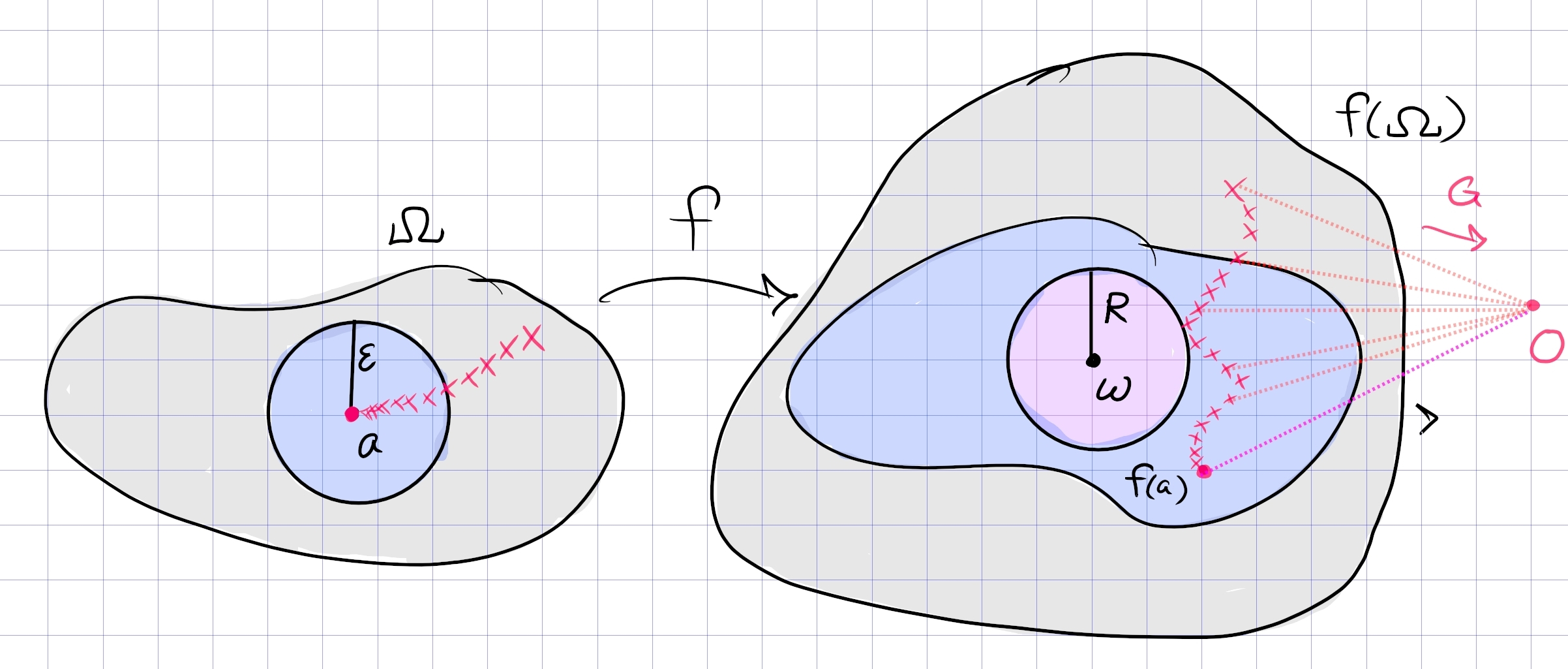
Suppose instead that for some \(\varepsilon>0\) and some \(w\in\CC\) and \(R>0\), the disc \(D_R(w)\) does not meet \(f(V)\), where \(V=D_\varepsilon(z_0)\sm\ts{z_0}\). Then \(g(z)\coloneqq\frac{1}{f(z)-w}\) is holomorphic on \(V\) and \(\abs{g}\le1/R\), so by Riemann’s removable singularity theorem \(g\) extends holomorphically to \(D_\varepsilon(z_0)\). If \(g(z_0)\neq0\), then \(f=w+1/g\) extends holomorphically over \(z_0\); if \(g(z_0)=0\), then since \(g\) is not identically zero, \(f=w+1/g\) has a pole at \(z_0\). Either case contradicts that \(z_0\) is essential.
Picard's big theorem (Tag T-DDOWW)
Let \(z_0\in\CC\), let \(\delta>0\), and let \(f\) be meromorphic on the punctured disc \(\{z : 0<\abs{z-z_0}<\delta\}\). If there are three distinct points of \(\CC\cup\{\infty\}\) that \(f\) does not take on this punctured disc, then \(f\) extends to a meromorphic function on the disc \(\{z : \abs{z-z_0}<\delta\}\).
See Singularities.
Residues and contours
Residue theorem (Tag T-HRPNO)
Let \(\Omega\subseteq\CC\) be open and let \(f\) be meromorphic on \(\Omega\) with finitely many poles \(z_1,\ldots,z_N\). Let \(\gamma\) be a piecewise smooth closed curve in \(\Omega\setminus\{z_1,\ldots,z_N\}\) whose winding number \(n_\gamma(a)\) is \(0\) for every \(a\in\CC\setminus\Omega\). Then \[ \frac{1}{2\pi i}\int_\gamma f(z)\dz=\sum_{j=1}^Nn_\gamma(z_j)\Res_{z=z_j}f. \] In particular, if \(n_\gamma(z_j)=1\) for every \(j\), then \[ \frac{1}{2\pi i}\int_\gamma f(z)\dz=\sum_{j=1}^N\Res_{z=z_j}f. \]
See [@SS03].
$ML$ estimate for contour integrals (Tag T-SFXI7)
Let \(\gamma\) be a piecewise smooth curve in \(\CC\) of length \(L\coloneqq\length(\gamma)\), and let \(f\) be continuous on the image of \(\gamma\). Then, with \(M\coloneqq\sup_{\xi\in\gamma}\abs{f(\xi)}\), \[ \abs{\int_\gamma f(z)\dz}\leq ML. \]
Jordan's lemma (Tag T-ZO5UU)
For \(R>0\) let \(C_R\) be the upper semicircle \(t\mapsto Re^{it}\), \(t\in[0,\pi]\).
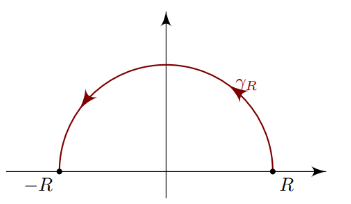
Let \(\alpha>0\), let \(g\) be continuous on \(C_R\), and let \(M_R\coloneqq\sup_{z\in C_R}\abs{g(z)}\). Then \[ \abs{\int_{C_R}e^{i\alpha z}g(z)\dz}\leq\frac{\pi}{\alpha}M_R. \] In particular, if \(g\) is continuous on \(\{z : \operatorname{Im}z\geq0,\ \abs{z}\geq R_0\}\) for some \(R_0\) and \(M_R\to0\) as \(R\to\infty\), then \(\int_{C_R}e^{i\alpha z}g(z)\dz\to0\).
For \(\alpha<0\) the same statements hold with \(C_R\) replaced by the lower semicircle \(t\mapsto Re^{-it}\), \(t\in[0,\pi]\), and \(\pi/\alpha\) replaced by \(\pi/\abs{\alpha}\).
For \(\alpha>0\) and \(z=Re^{it}\), \(\abs{e^{i\alpha z}}=e^{-\alpha R\sin t}\) and \(\abs{\dz}=R\,dt\), so \[ \abs{\int_{C_R}e^{i\alpha z}g(z)\dz}\leq M_R\int_0^\pi e^{-\alpha R\sin t}R\,dt=2M_R\int_0^{\pi/2}e^{-\alpha R\sin t}R\,dt. \] Since \(\sin t\geq 2t/\pi\) for \(t\in[0,\pi/2]\), \[ \int_0^{\pi/2}e^{-\alpha R\sin t}R\,dt\leq\int_0^{\pi/2}e^{-2\alpha Rt/\pi}R\,dt\leq\frac{\pi}{2\alpha}, \] which gives the bound. For \(\alpha<0\) and \(z=Re^{-it}\) with \(t\in[0,\pi]\), \(\abs{e^{i\alpha z}}=e^{\alpha R\sin t}=e^{-\abs{\alpha}R\sin t}\), and the same estimate applies with \(\abs{\alpha}\) in place of \(\alpha\).
See Residues and contours. Evaluated integrals are on Standard integrals.
Counting zeros
Argument principle counting zeros and poles (Tag T-JXDQT)
Let \(\Omega\subseteq\CC\) be a bounded open set whose boundary \(\gamma\coloneqq\partial\Omega\) consists of finitely many piecewise smooth closed curves, oriented positively with respect to \(\Omega\). Let \(f\) be meromorphic on an open set containing \(\overline{\Omega}\), with no zeros or poles on \(\gamma\). Let \(Z_f\) and \(P_f\) be the numbers of zeros and poles of \(f\) in \(\Omega\), counted with multiplicity. Then \[ \frac{1}{2\pi i}\int_\gamma\frac{f'(z)}{f(z)}\dz=Z_f-P_f. \] If moreover \(f\) is holomorphic with zeros \(z_1,\ldots,z_m\) in \(\Omega\), listed with multiplicity, then \[ \frac{1}{2\pi i}\int_\gamma\frac{f'(z)}{f(z)}\dz=m \quad\text{and}\quad \frac{1}{2\pi i}\int_\gamma\frac{zf'(z)}{f(z)}\dz=\sum_{k=1}^mz_k. \]
Argument principle as a winding number (Tag T-52HK6)
Let \(\Omega\subseteq\CC\) be open, let \(f\) be meromorphic on \(\Omega\), and let \(\gamma\colon[a,b]\to\Omega\) be a closed piecewise \(C^1\) curve that meets no zero and no pole of \(f\). Then the integral of the logarithmic derivative of \(f\) along \(\gamma\) is the winding number of the closed curve \(f\circ\gamma\) about \(0\): \[ \frac{1}{2\pi i}\int_\gamma\frac{f'(z)}{f(z)}\dz=\Index_{w=0}(f\circ\gamma)=\frac{1}{2\pi i}\int_{f\circ\gamma}\frac{dw}{w}. \]
The curve \(f\circ\gamma\) is closed, piecewise \(C^1\), and avoids \(0\). Substituting \(w=f(\gamma(t))\), \(dw=f'(\gamma(t))\gamma'(t)\dt\), \[ \int_\gamma\frac{f'(z)}{f(z)}\dz=\int_a^b\frac{f'(\gamma(t))\gamma'(t)}{f(\gamma(t))}\dt=\int_{f\circ\gamma}\frac{dw}{w}. \]
Rouché's theorem (Tag T-CJCKL)
Let \(\Omega\subseteq\CC\) be open, let \(M\) and \(m\) be meromorphic on \(\Omega\), and let \(\gamma\) be a piecewise smooth toy contour in \(\Omega\) whose interior \(\Omega_\gamma\) satisfies \(\overline{\Omega_\gamma}\subseteq\Omega\). Assume that \(M\) and \(m\) have no poles on \(\gamma\) and that \[ \abs{m(z)}<\abs{M(z)}\quad\text{for all } z\in\gamma. \] For a meromorphic function \(h\), write \(Z_h\) and \(P_h\) for the numbers of zeros and poles of \(h\) in \(\Omega_\gamma\), counted with multiplicity. Then the winding numbers of \(M\circ\gamma\) and \((M+m)\circ\gamma\) about \(0\) agree, and \[ Z_M-P_M=Z_{M+m}-P_{M+m}. \] In particular, if \(M\) and \(m\) are holomorphic on \(\Omega\), then \(M\) and \(M+m\) have the same number of zeros in \(\Omega_\gamma\).
Hurwitz's theorem (Tag T-FZWEC)
Let \(\Omega\subseteq\CC\) be open and let \((f_k)_{k\geq1}\) be a sequence of holomorphic functions on \(\Omega\) converging locally uniformly on \(\Omega\) to \(f\). Suppose \(f\) has a zero of order \(n\) at \(z_0\in\Omega\). Then there is \(\delta>0\) such that for all sufficiently large \(k\), \(f_k\) has exactly \(n\) zeros in the disc \(\{z : \abs{z-z_0}<\delta\}\), counted with multiplicity. Moreover, for every \(\varepsilon\in(0,\delta)\) there is \(K\) such that for all \(k\geq K\) these \(n\) zeros lie in \(\{z : \abs{z-z_0}<\varepsilon\}\).
See Counting zeros.
Conformal maps
Cayley transform $\frac{i-z}{i+z}$ between the upper half-plane and the disc (Tag T-77SHB)
The fractional linear transformation \[ G(w)=i\,\frac{1-w}{1+w} \] maps the unit disc \(\DD\) biholomorphically onto the upper half-plane \(\HH=\ts{z\st\Im z>0}\). Its inverse is \[ F(z)=\frac{i-z}{i+z}, \] which maps \(\HH\) biholomorphically onto \(\DD\).
For \(w\in\DD\), \(w\neq-1\) and \[ \Im G(w)=\Re\frac{1-w}{1+w}=\frac{\Re\big((1-w)(1+\bar w)\big)}{\abs{1+w}^2}=\frac{1-\abs w^2}{\abs{1+w}^2}>0. \] For \(z\in\HH\), \(z\) is closer to \(i\) than to \(-i\), so \(\abs{F(z)}<1\). Solving \(z=i\frac{1-w}{1+w}\) gives \(z+zw=i-iw\), so \(w(z+i)=i-z\) and \(w=F(z)\); hence \(F\) and \(G\) are mutually inverse holomorphic maps.
Schwarz lemma (Tag T-DAETF)
Let \(f\colon\DD\to\DD\) be holomorphic with \(f(0)=0\). Then
\(\abs{f(z)}\leq\abs{z}\) for all \(z\in\DD\), and
\(\abs{f'(0)}\leq1\).
If \(\abs{f(z_0)}=\abs{z_0}\) for some \(z_0\in\DD\setminus\{0\}\), or if \(\abs{f'(0)}=1\), then \(f\) is a rotation: there is \(\lambda\in\CC\) with \(\abs{\lambda}=1\) such that \(f(z)=\lambda z\) for all \(z\in\DD\).
Automorphisms of the unit disc as rotated Blaschke factors (Tag T-W26VL)
For \(a\in\DD\) let \(\psi_a(z)\coloneqq\dfrac{a-z}{1-\overline{a}z}\) be the Blaschke factor at \(a\). The group \(\Aut_\CC(\DD)\) of biholomorphisms \(\DD\to\DD\) is \[ \Aut_\CC(\DD)=\{\lambda\psi_a : a\in\DD,\ \lambda\in S^1\}, \] so every automorphism of \(\DD\) is a Blaschke factor followed by a rotation [@SS03].
Automorphisms of the upper half-plane (Tag T-VGDFW)
Let \(\HH\coloneqq\{z\in\CC : \operatorname{Im}z>0\}\) be the upper half-plane. The group \(\Aut_\CC(\HH)\) of biholomorphisms \(\HH\to\HH\) is \[ \Aut_\CC(\HH)=\Bigl\{z\mapsto\frac{az+b}{cz+d} : a,b,c,d\in\RR,\ ad-bc=1\Bigr\}, \] and sending \(\begin{pmatrix}a&b\\c&d\end{pmatrix}\in\SL_2(\RR)\) to this map induces a group isomorphism \(\PSL_2(\RR)\cong\Aut_\CC(\HH)\).
See [@SS03].
Arzelà--Ascoli theorem (Tag T-6F3GO)
Let \(X\) be a compact Hausdorff space, and give \(C(X;\RR)\) the uniform norm \[ \norm{f}_{\infty,X}\coloneqq\sup_{x\in X}\abs{f(x)}, \] under which it is a Banach space. A subset \(A\subseteq C(X;\RR)\) is compact if and only if \(A\) is closed, uniformly bounded, and equicontinuous at every point of \(X\).
In particular, for \(X=[a,b]\subseteq\RR\), every uniformly bounded and uniformly equicontinuous sequence in \(C([a,b];\RR)\) has a uniformly convergent subsequence.
Locally uniformly bounded holomorphic families are equicontinuous and normal (Tag T-MCB7V)
Let \(\Omega\subseteq\CC\) be open and let \(\mcf\) be a family of holomorphic functions on \(\Omega\) that is uniformly bounded on compact subsets of $\Omega$. Then \(\mcf\) is equicontinuous on every compact subset of \(\Omega\), and \(\mcf\) is a normal family.
Montel's theorem (Tag T-4ALS2)
Let \(\Omega\subseteq\CC\) be open and let \(\mcf\) be a family of holomorphic functions on \(\Omega\) that is uniformly bounded on compact subsets of \(\Omega\). Then
\(\mcf\) is equicontinuous on every compact subset of \(\Omega\), and
\(\mcf\) is a normal family.
Let \(K\subseteq\Omega\) be compact and choose \(r>0\) with \(3r<\operatorname{dist}(K,\CC\sm\Omega)\) (any \(r>0\) if \(\Omega=\CC\)). The set \(K'\coloneqq\ts{z\st\operatorname{dist}(z,K)\le2r}\) is a compact subset of \(\Omega\), so there is \(M\) with \(\abs f\le M\) on \(K'\) for all \(f\in\mcf\). For \(z,w\in K\) with \(\abs{z-w}<r\), the circle \(C=\ts{\abs{\zeta-w}=2r}\) lies in \(K'\), and the Cauchy integral formula gives \[ \abs{f(z)-f(w)}=\abs{\frac{1}{2\pi i}\int_Cf(\zeta)\Big(\frac{1}{\zeta-z}-\frac{1}{\zeta-w}\Big)d\zeta}\le\frac{1}{2\pi}\cdot2\pi(2r)\cdot M\cdot\frac{\abs{z-w}}{r\cdot2r}=\frac{M}{r}\abs{z-w}, \] which is independent of \(f\); this is equicontinuity on \(K\). Normality follows from the Arzelà–Ascoli theorem applied on an exhaustion of \(\Omega\) by compact sets, with a diagonal argument.
Montel’s second theorem uses the extended convention for normality in the remark on D-QTJ7T, where a subsequence may instead tend to \(\infty\) uniformly on compact subsets: a family of meromorphic functions on a region \(\Omega\) that omits the same three values of the Riemann sphere is normal in that sense.
Riemann mapping theorem (Tag T-4MDS6)
Let \(\Omega\subsetneq\CC\) be a nonempty simply connected open set. Then for every \(z_0\in\Omega\) there exists a unique biholomorphism \(F\colon\Omega\to\DD\) such that \(F(z_0)=0\) and \(F'(z_0)>0\). In particular, any two nonempty simply connected open sets \(\Omega_1,\Omega_2\subsetneq\CC\) are biholomorphic.
This is [@SS03].
See Conformal maps.
Hypotheses and counterexamples
Theorems that give a constant compares the hypotheses of Liouville’s theorem, the maximum modulus principle, the open mapping theorem, and the identity principle. Counterexamples gives functions for which Liouville’s theorem, the identity principle, the maximum and minimum modulus principles, and the Riemann mapping theorem fail when one hypothesis is dropped.