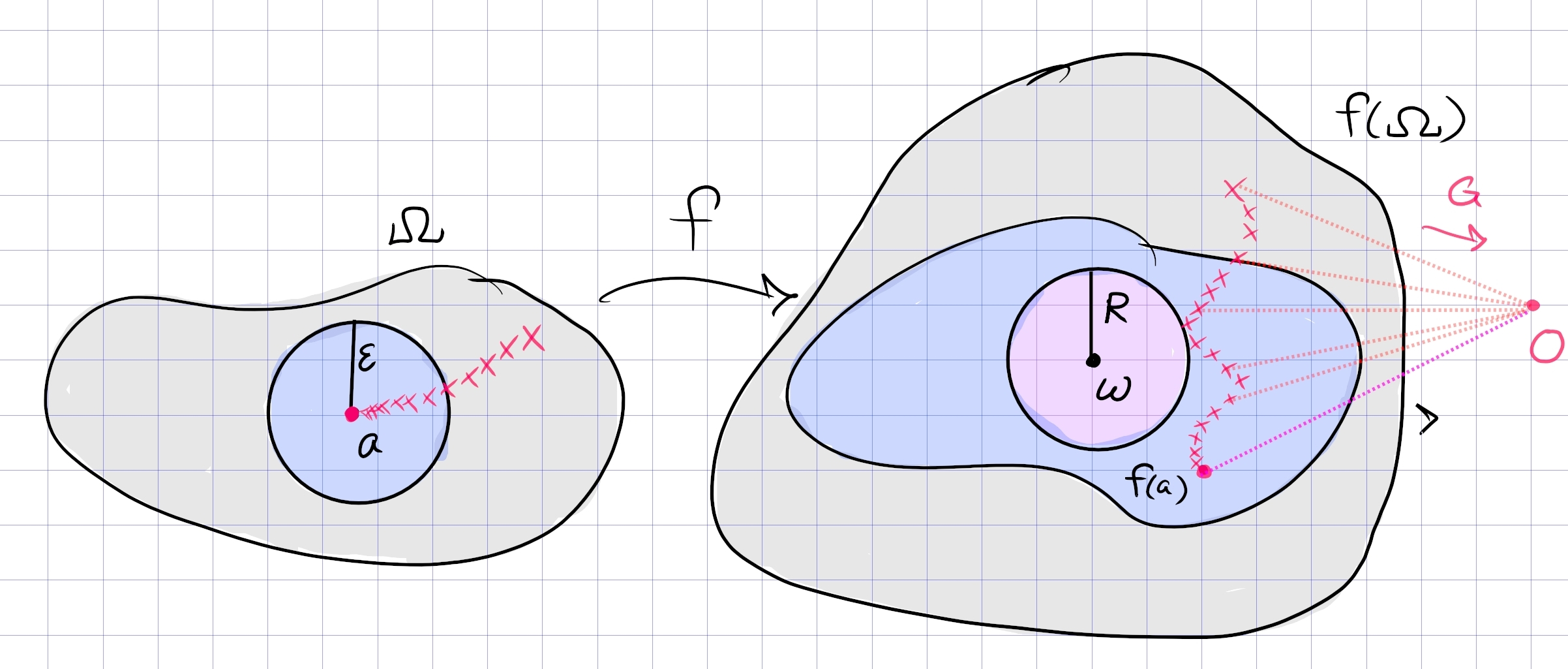
Let \(\Omega\subseteq\CC\) be open, \(z_0\in\Omega\), and let \(f\) be holomorphic on \(\Omega\sm\ts{z_0}\) with an essential singularity at \(z_0\). Then for every punctured neighborhood \(V=D_\varepsilon(z_0)\sm\ts{z_0}\subseteq\Omega\) of \(z_0\), the image \(f(V)\) is dense in \(\CC\).
Equivalently, for every \(w_0\in\CC\) there is a sequence \(z_n\to z_0\), \(z_n\neq z_0\), with \(f(z_n)\to w_0\).
Suppose instead that for some \(\varepsilon>0\) and some \(w\in\CC\) and \(R>0\), the disc \(D_R(w)\) does not meet \(f(V)\), where \(V=D_\varepsilon(z_0)\sm\ts{z_0}\). Then \(g(z)\coloneqq\frac{1}{f(z)-w}\) is holomorphic on \(V\) and \(\abs{g}\le1/R\), so by Riemann’s removable singularity theorem \(g\) extends holomorphically to \(D_\varepsilon(z_0)\). If \(g(z_0)\neq0\), then \(f=w+1/g\) extends holomorphically over \(z_0\); if \(g(z_0)=0\), then since \(g\) is not identically zero, \(f=w+1/g\) has a pole at \(z_0\). Either case contradicts that \(z_0\) is essential.