Rouché's theorem (Tag T-CJCKL)
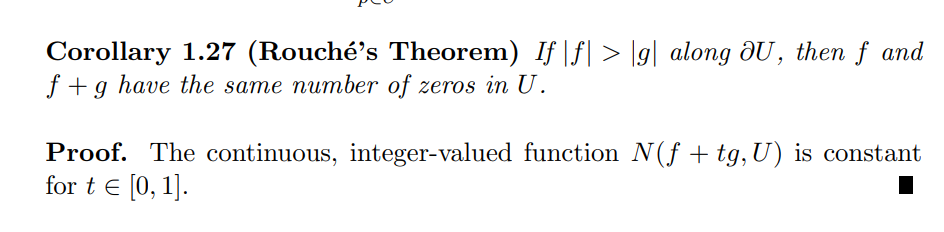
Let \(\Omega\subseteq\CC\) be open, let \(M\) and \(m\) be meromorphic on \(\Omega\), and let \(\gamma\) be a piecewise smooth toy contour in \(\Omega\) whose interior \(\Omega_\gamma\) satisfies \(\overline{\Omega_\gamma}\subseteq\Omega\). Assume that \(M\) and \(m\) have no poles on \(\gamma\) and that \[ \abs{m(z)}<\abs{M(z)}\quad\text{for all } z\in\gamma. \] For a meromorphic function \(h\), write \(Z_h\) and \(P_h\) for the numbers of zeros and poles of \(h\) in \(\Omega_\gamma\), counted with multiplicity. Then the winding numbers of \(M\circ\gamma\) and \((M+m)\circ\gamma\) about \(0\) agree, and \[ Z_M-P_M=Z_{M+m}-P_{M+m}. \] In particular, if \(M\) and \(m\) are holomorphic on \(\Omega\), then \(M\) and \(M+m\) have the same number of zeros in \(\Omega_\gamma\).
Rouché's theorem, symmetric form (Tag FT-EPR7J)
Let \(D=\theset{z : \abs{z-z_0}<R}\), and let \(f,g\) be holomorphic on an open set containing \(\overline D\). If \[ \abs{f(z) - g(z)} < \abs{f(z)} + \abs{g(z)} \quad\text{for all } z\in\bd D, \] then \(f\) and \(g\) have no zeros on \(\bd D\) and have the same number of zeros in \(D\), counted with multiplicity.
Rouché's theorem (Tag FT-FZERI)
Let \(D=\theset{z : \abs{z-z_0}<R}\), and let \(f,g\) be holomorphic on an open set containing \(\overline D\). If \(\abs{f(z) - g(z)} < \abs{f(z)} + \abs{g(z)}\) for all \(z\in\bd D\), then \(f\) and \(g\) are nonvanishing on \(\bd D\) and have the same number of zeros in \(D\), counted with multiplicity.
Rouché's theorem on a closed disc (Tag FT-ZJQ2T)
Let \(z_0\in\CC\) and \(R>0\), and let \(f\) and \(g\) be holomorphic on an open set containing the closed disc \(\abs{z-z_0} \leq R\). Suppose \(f\) and \(g\) have no zeros on the circle \(\abs{z-z_0} = R\) and \[ \abs{f(z)-g(z)} < \abs{f(z)} + \abs{g(z)} \quad\text{for all } z \text{ with } \abs{z-z_0}=R. \] Then \(f\) and \(g\) have the same number of zeros in the open disc \(\abs{z-z_0}<R\), counted with multiplicity.
Adding to \(M\) a function \(m\) with \(\abs{m} < \abs{M}\) on the boundary curve does not change the number of zeros minus poles inside it.
Forms of the hypothesis
Let \(f\), \(g\), \(M\), \(m\) be holomorphic on a neighborhood of the closed region bounded by \(\gamma\), and write \(Z_h\) for the number of zeros of \(h\) inside \(\gamma\).
For \(f = M + m\) with \(\abs{m} < \abs{M}\) on \(\gamma\), \(Z_f = Z_M\); the theorem gives a count when \(Z_M\) is known.
If \(\abs{m} < \abs{M}\) on \(\gamma\), then \(\abs{\pm m}<\abs M\), so each of \(\pm(M \pm m)\) has \(Z_M\) zeros.
If \(\abs{f-g} < \abs{f}\) on \(\gamma\), then \(Z_f = Z_g\). The symmetric form of Rouché’s theorem reaches the same conclusion from \(\abs{f-g} < \abs f + \abs g\) on \(\gamma\).
If \(\abs{f-g} < 1\) on \(\gamma\) and \(\abs f \geq 1\) or \(\abs g \geq 1\) on \(\gamma\), then \(Z_f = Z_g\).
For partial sums \(f_n\) of a power series of \(f\): if \(\abs f\geq L\) and \(\abs{f - f_n}\leq U\) on \(\gamma\) with \(U < L\), then \(Z_f = Z_{f_n}\).
(Rouché's theorem)
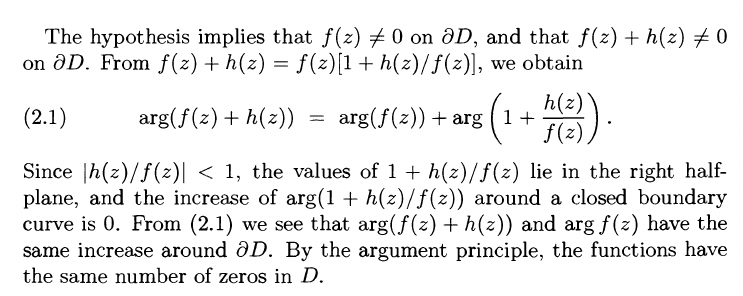
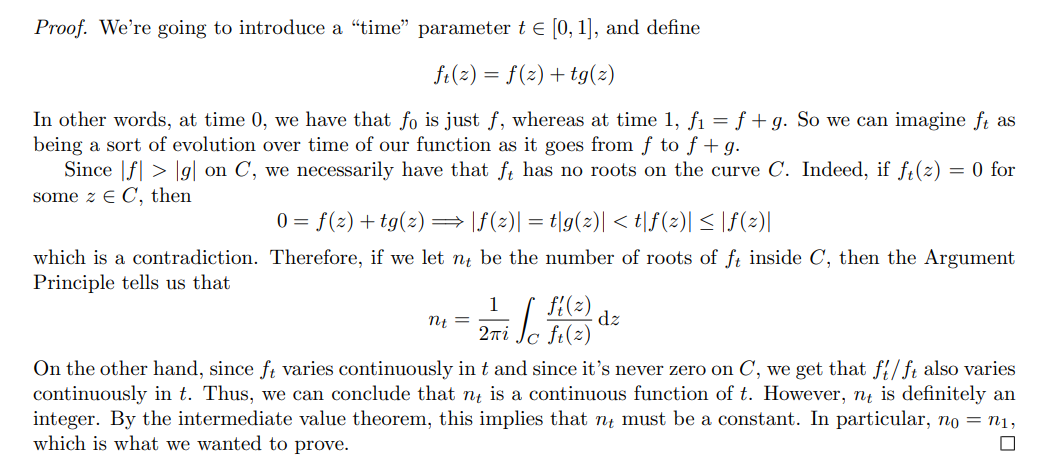
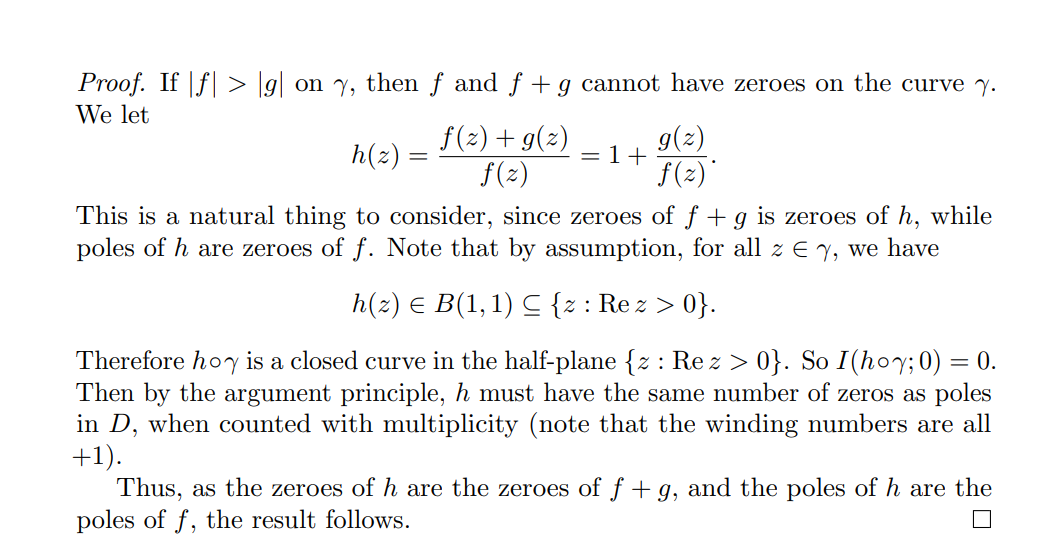
On \(\gamma\), \((M+m)/M = 1 + m/M\) takes values in the disc \(\abs{w-1}<1\), which does not contain \(0\), so the winding number of \(((M+m)/M)\circ\gamma\) about \(0\) is zero. By the argument principle applied to \((M+m)/M\), whose logarithmic derivative is \((M+m)'/(M+m) - M'/M\), the zeros minus poles of \(M+m\) and of \(M\) agree. Alternatively, \(t\mapsto Z_{M+tm}-P_{M+tm}\) is given by a continuous integral in \(t \in [0,1]\) and is integer valued, hence constant.
(Rouché's theorem, alternative)
Worked counts
(The same polynomial, two radii, two splittings)
Let \(P(z) = z^4 + 6z + 3\).
On \(\abs{z} < 2\): set \(M(z) = z^4\) and \(m(z) = 6z + 3\). Then \(\abs{m} \leq 6\abs z + 3 = 15 < 16 = \abs{M}\) on \(\abs z = 2\), so \(P\) has 4 zeros there.
On \(\abs{z} < 1\): set \(M(z) = 6z\) and \(m(z) = z^4 + 3\), so \(\abs{m} \leq \abs z^4 + 3 = 4 < 6 = \abs{M}\) on \(\abs z = 1\), and \(P\) has 1 zero there.
(Exactly one solution)
For \(\abs\alpha > e\), the equation \(\alpha z e^z = 1\) has exactly one solution in \(\DD\). It is equivalent to \(\alpha z - e^{-z} = 0\). Set \(M(z) = \alpha z\) and \(m(z) = -e^{-z}\). On \(\abs z = 1\), \(\abs{m} = e^{-\Re(z)} \leq e < \abs\alpha = \abs{M}\). Since \(M\) has exactly one zero in \(\DD\), so does \(M + m\).
Open mapping theorem (Tag C-FRF33)
Let \(\Omega\subseteq\CC\) be a connected open set and let \(f\) be a nonconstant holomorphic function on \(\Omega\). Then \(f\) is an open map: \(f(U)\) is open for every open set \(U\subseteq\Omega\).
Maximum modulus principle (Tag C-GM57K)
Let \(\Omega\subseteq\CC\) be a connected open set and let \(f\) be holomorphic on \(\Omega\).
If \(\abs{f}\) attains a local maximum at some \(z_0\in\Omega\), then \(f\) is constant on \(\Omega\).
If \(\Omega\) is bounded and \(f\) extends continuously to \(\overline\Omega\), then \(\max_{\overline\Omega}\abs{f}=\max_{\bd\Omega}\abs{f}\).
Minimum modulus principle (Tag C-YQUHR)
Let \(\Omega\subseteq\CC\) be a bounded connected open set, and let \(f\) be holomorphic on \(\Omega\), continuous on \(\overline\Omega\), and nowhere zero on \(\Omega\). Then \[ \min_{z\in\overline\Omega}\abs{f(z)}=\min_{z\in\bd\Omega}\abs{f(z)}. \]
If \(f\) vanishes at a point of \(\bd\Omega\), both minima are \(0\). Otherwise \(f\) is nowhere zero on \(\overline\Omega\), and the function \(1/f\) is holomorphic on \(\Omega\) and continuous on \(\overline\Omega\), so by the maximum modulus principle, \(\max_{\overline\Omega}\abs{1/f}=\max_{\bd\Omega}\abs{1/f}\).
The hypothesis that \(f\) has no zeros is needed: \(f(z)=z\) on \(\DD\) has \(\min_{\overline\DD}\abs{f}=0\), attained only at the interior point \(0\), while \(\abs{f}=1\) on \(\bd\DD\).
See [@SS03, Chapter 3, Theorem 4.5 and Corollary 4.6].
Exercises
$z^5+3z+1$ has five zeros in $|z|\leq 2$ (Tag E-T4VAX)
Show that \(h(z) =z^5 + 3z + 1\) has 5 zeros in \(\abs z \leq 2\).
Solution
Goal: Show that \(h(z) = z^5 + 3z + 1\) has exactly 5 zeros in \(\abs{z} \le 2\).
<1>1. Setup: write \(h = f + g\) with \(f(z) = z^5\) and \(g(z) = 3z + 1\).
\(h(z) = z^5 + 3z + 1\).
<1>2. On \(\abs{z} = 2\): \(\abs{g(z)} < \abs{f(z)}\).
\(\abs{g(z)} \le 3\abs{z} + 1 = 7\) on \(\abs{z} = 2\), while \(\abs{f(z)} = \abs{z}^5 = 32\).
Since \(7 < 32\), the strict inequality holds everywhere on the circle.
<1>3. \(h\) and \(f\) have the same number of zeros inside \(\abs{z} < 2\).
Rouch'e’s theorem with \(f(z) = z^5\), \(g(z) = 3z+1\), \(\gamma = \abs{z}=2\), using <1>2.
<1>4. \(f(z) = z^5\) has exactly 5 zeros in \(\abs{z} < 2\) (counting multiplicity).
The only zero is \(z = 0\) with multiplicity 5, and \(0\) lies in the disk.
<1>5. Q.E.D.
<1>3 and <1>4 give that \(h\) has exactly \(5\) zeros in \(\abs{z} < 2\), hence in \(\abs{z} \le 2\).
$z+3+2e^z$ has one root in $\{\Re z\le 0\}$ (Tag E-XQ4BS)
Show that \(h(z) = z + 3 + 2e^z\) has one root in \(\ts{ \Re(z) \leq 0}\).
Solution
Use the following contour:
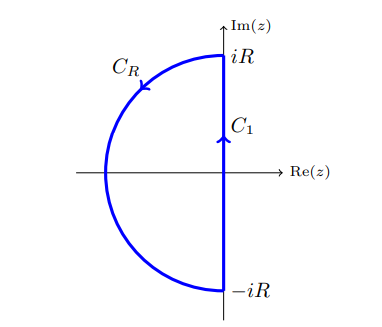
Take \(g(z) \da 2e^z < f(z) \da f(z) \da z+3\).
Explicit Rouché, $\mathbb{D}$ (Tag P-FAGTL)
Find the number of zeros in \(\abs{z} < 1\) of \[ p(z) \da z^6 + 9z^4 + z^3 + 2z + 4 .\]
Solution
Strategy: bound the difference. Find the big and small term:
- Big: \(F(z) = 9z^4\), so \(\abs{F(z)} = 9\) on the boundary
- Small: \(g(z) = p(z) - F(z) = z^6 + z^3 + 2z + 4\), so \(\abs{g(z)}\leq 1+1+2+4=8\) on the boundary.
So \(\abs{p-F} \leq \abs{F}\) on \(\abs{z} = 2\), meaning \(Z_{p} = Z_F = 4\).
Explicit Rouche, $2\mathbb{D}$ (Tag P-YSJO3)
Find the number of zeros in \(\abs{z} < 2\) of \[ h(z) \da z^5 + 3z + 1 .\]
Solution
Strategy: bound the difference.
- Big: \(F(z) \da z^5\) so \(\abs{F(z)} = 2^5 = 32\) on \(\abs{z} = 2\)
- Small: \(g(z) \da p(z) - F(z) = 3z+1\), so \(\abs{g(z)} \leq 3\abs{z}+ 1 = 7\) on \(\abs{z} = 2\).
Then \(\abs{g}\leq \abs{F}\) on \(\abs{z} = 2\), \(Z_{p} = Z_F = 5\).
Arbitrary Rouché, $R\mathbb{D}$ (Tag P-WECI4)
Find the number of zeros in \(\abs{z} < R\) of \[ p(z) \da z^d + a_1z^{d-1} + \cdots + a_d ,\] supposing that \(\abs{a_k}< {R^k \over d}\) for every \(k\) (noting the strict inequality).
Solution
Strategy: bound the difference. Find the big and small term:
- Big: \(F(z) = z^d\), so \(\abs{F(z)} = R^d\) on \(\abs{z} = R\).
- Small: \(g(z) = p(z) - F(z) = a_1 z^{d-1} + \cdots + a_d\), so \[ \abs{g(z)} &\leq \abs{a_1} R^{d-1} + \abs{a_2} R^{d-2} + \cdots + \abs{a_d} \\ &< {R\over d} \cdot R^{d-1} + {R^2 \over d} \cdot R^{d-2} + \cdots + {R^{d-1} \over d} \cdot R + {R^{d} \over d} \\ &= d {R^d\over d} = R^d ,\] so \(\abs{g} < R^d = \abs{F}\), meaning \(Z_{p-F} = Z_F = d\) in \(R\DD\).
Explicit Rouché, half-plane (Tag P-GW3Y7)
Find the number of solutions in \(\ts{\Re(z) \leq 0}\) of \[ -2e^z = z+3 .\]
Hint: show \(h(z) = z + 3 + 2e^z\) has one root in \(\ts{ \Re(z) \leq 0}\).
Solution
Note that \(\abs{e^z} = e^{\Re(z)} \leq e^{0} = 1\) since \(\Re(z) \leq 0\), so if the equality holds then \[ \abs{2e^z} = \abs{z+3} \implies \abs{z+3}\leq 2 .\] So apply Rouché to \(\Omega\) the circle of radius 2 centered at \(z=-3\). Write \(p(z) \da z+3 + 2e^z\), then
- Big: \(F(z) = z+3\), so \(\abs{F(z)} = 2\) on \(\bd \Omega\).
- Small: \(g(z) = 2e^z\), so \(\abs{g(z)} = 2e^{\Re(z)} < 2\) in \(\Omega\).
Then \(Z_p = Z_F = 1\), and any such zero is a solution to the original equation.
Solution: Alternative
Use the following region:
Consider \(p(z) \da z+3+2e^z\), take \(F(z) \da z+3\) and \(h(z) \da 2e^z\) for the perturbation. On \(C_1, z=it\) for \(t\in [-R, R]\), so \[ \abs{F(z)} &= \abs{3+it} \geq 3 \\ \abs{h(z)} &= 2e^{\Re(iy)}=2 ,\] so \(\abs{h} < \abs{F}\) here. On \(\abs{z} = R\), \(\abs{h(z)} < 2e^{\Re(z)} < 2\) since \(\Re(z) < 0\), and \(\abs{F(z)} = \bigo(R)\), so for \(R\gg 1\) we have \(\abs{F} > \abs{h}\) here too.
Thus \(Z_{h+F} = Z_f = 1\) in this region, and taking \(R\to\infty\) covers all of \(\Re(z) \leq 0\).
$z^4+6z+3$ has three zeros in $1\le|z|\le 2$ (Tag P-ER23C)
Show that \(P(z) \da z^4 + 6z + 3\) has 3 zeros in \(\ts{1\leq \abs{z} \leq 2}\).
Solution
Take \(P(z) = z^4 + 6z + 3\).
On \(\abs{z} < 2\):
Set \(f(z) = z^4\) and \(g(z) = 6z + 3\), then \(\abs{g(z)} \leq 6\abs{z} + 3 = 15 < 16= \abs{f(z)}\).
So \(P\) has 4 zeros here.
On \(\abs{z} < 1\):
Set \(f(z) = 6z\) and \(g(z) = z^4 + 3\).
Check \(\abs{g(z)} \leq \abs{z}^4 + 3 = 4 < 6 = \abs{f(z)}\).
So \(P\) has 1 zero here.
Unique solution of $\alpha ze^z=1$ in the unit disc when $|\alpha|>e$ (Tag P-5S2DR)
Show that \(\alpha z e^z = 1\) where \(\abs{\alpha} > e\) has exactly one solution in \(\DD\).
Solution
Set \(f(z) = \alpha z\) and \(g(z) = e^{-z}\).
Estimate at \(\abs{z} =1\) we have \(\abs{g} =\abs{e^{-z}} = e^{-\Re(z)} \leq e^1 < \abs{\alpha} = \abs{f(z)}\)
\(f\) has one zero at \(z_0 = 0\), thus so does \(f+g\).
Unique fixed points (Tag P-4JM4Y)
Show that if \(f\) is holomorphic on \(\DD\) and continuous on \(\bar\DD\) with \(f(\bar \DD) \subseteq \DD\), then \(f\) has a unique fixed point in \(\DD\).
Note: this is subtle because \(\DD\) is not compact!
Solution
Continuous images of compact sets are compact, so \(f(\bar\DD)\) is a compact subset of \(\DD\) and thus contained in some \(\DD_r(0)\) with \(0<r<1\). On this disc, \[ \abs{f(z)} = \abs{f(z) - z + z} < \abs{z} .\] By Rouché, \(f(z)-z\) and \(z\) have the same number of zeros, which is one. This holds for any \(r'\) with \(r<r'<1\), and thus holds on \(\DD\).
Zeros of a polynomial in the annulus one to two (Tag P-4NBXB)
Find the number of zeros in \(\abs{z} \in (1, 2)\) of \[ f(z) \da z^4 + 5z + 3 .\] Note the strict inequality.
Solution
On \(\abs{z} = 1\):
- Big: \(M(z) = 5z\)
- Small: \(m(z) = z^4 + 3\)
- The estimate: \[ \abs{m(z)} \leq \abs{z}^4 + 3 = 4 < 5 = \abs{M(z)} \implies 1 = \size Z_M = \size Z_f .\]
On \(\abs{z} = 2\):
- Big: \(M(z) = z^4\)
- Small: \(m(z) = 5z + 3\)
- The estimate: \[ \abs{m(z)} \leq 5\abs{z} + 3 = 13 < 16 = 2^4 = \abs{M(z)} \implies 4 = \size Z_M = \size Z_f .\]
So \(f\) has \(4-1=3\) zeros on \(\abs{z} \in (0, 2)\sm (0, 1) = [1, 2)\). To get the strict inequality, it suffices to show \(f\) has no zeros on \(\abs{z} = 1\). Estimate a lower bound: \[ \abs{z^4 + 5z + 3} \geq \abs{\abs{5z+3} - \abs{z}^4 } = \abs{\abs{5z+3} - 1 } \geq \abs{ 2-1} > 0 .\] The nontrivial bound at the end comes from the fact that \(5z+3 = 3 + 5e^{it}\) whose modulus ranges between \(3-5 = -2\) and \(3+5 = 8\).