Find the number of solutions in \(\ts{\Re(z) \leq 0}\) of \[ -2e^z = z+3 .\]
Hint: show \(h(z) = z + 3 + 2e^z\) has one root in \(\ts{ \Re(z) \leq 0}\).
Solution
Note that \(\abs{e^z} = e^{\Re(z)} \leq e^{0} = 1\) since \(\Re(z) \leq 0\), so if the equality holds then \[ \abs{2e^z} = \abs{z+3} \implies \abs{z+3}\leq 2 .\] So apply Rouché to \(\Omega\) the circle of radius 2 centered at \(z=-3\). Write \(p(z) \da z+3 + 2e^z\), then
- Big: \(F(z) = z+3\), so \(\abs{F(z)} = 2\) on \(\bd \Omega\).
- Small: \(g(z) = 2e^z\), so \(\abs{g(z)} = 2e^{\Re(z)} < 2\) in \(\Omega\).
Then \(Z_p = Z_F = 1\), and any such zero is a solution to the original equation.
Solution: Alternative
Use the following region:
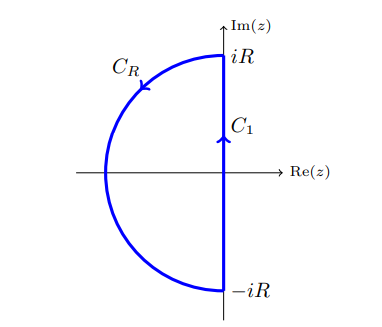
Consider \(p(z) \da z+3+2e^z\), take \(F(z) \da z+3\) and \(h(z) \da 2e^z\) for the perturbation. On \(C_1, z=it\) for \(t\in [-R, R]\), so \[ \abs{F(z)} &= \abs{3+it} \geq 3 \\ \abs{h(z)} &= 2e^{\Re(iy)}=2 ,\] so \(\abs{h} < \abs{F}\) here. On \(\abs{z} = R\), \(\abs{h(z)} < 2e^{\Re(z)} < 2\) since \(\Re(z) < 0\), and \(\abs{F(z)} = \bigo(R)\), so for \(R\gg 1\) we have \(\abs{F} > \abs{h}\) here too.
Thus \(Z_{h+F} = Z_f = 1\) in this region, and taking \(R\to\infty\) covers all of \(\Re(z) \leq 0\).