Point-set topology used in algebraic topology: definitions, theorems, and counterexamples.
Topics
Topologies, open, closed, and clopen sets, bases
Continuity, homeomorphisms
Subspaces, products, quotients
Closures, retracts
Metric spaces: completeness, boundedness
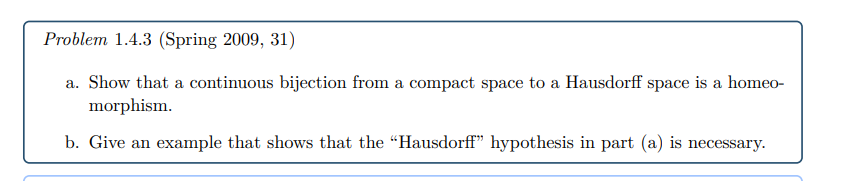
Compactness
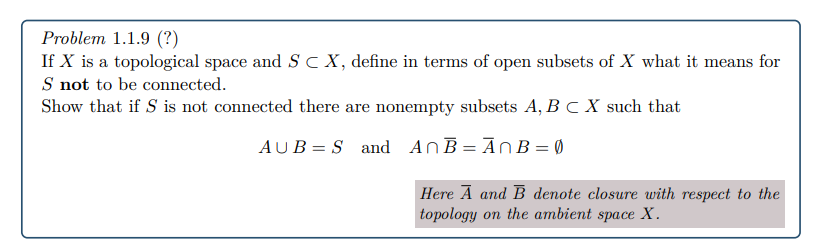
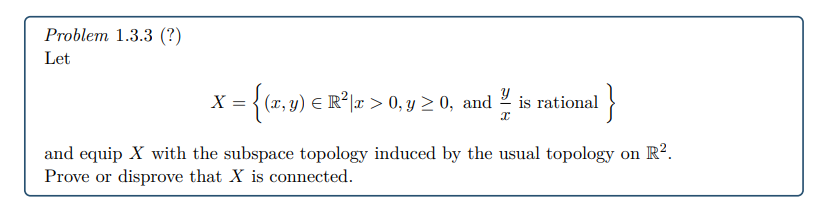
Connectedness: path-connected, locally path-connected, totally disconnected
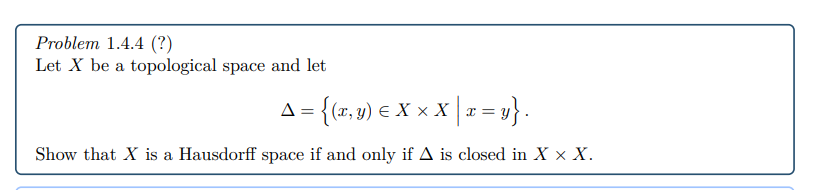
Separation axioms: Hausdorff, regular, normal
The tube lemma
Common counterexamples, such as the topologist’s sine curve
Warmups
State the axioms of a topology.
What does it mean for a set to be open? Closed? Product, subspace, and quotient topologies Definition of a basis for a topology Interior, isolated, and limit points Closure of a subspace Compact topological space Dense subspace Six topologies on $\mathbb{R}^{d}$ Separable space Nowhere dense subspace
Exercises
Prove Cantor’s intersection theorem.
Determine if the following subsets of \(\RR\) are open, closed, both, or neither: $\QQ$ $\ZZ$ Interior of a product versus product of interiors Connected versus locally connected spaces One-point compactification is compact; path-connected implies connected The topologist's sine curve is connected but not path-connected Products of Hausdorff spaces; $\RR$ versus $[0,\infty)$ A space is connected iff its only clopen subsets are $\emptyset$ and $X$ Closed subsets of compact spaces are compact Open subsets of compact spaces Continuous images of compact spaces, and compact metric spaces are complete Compact subsets of Hausdorff spaces are closed Closed versus compact subsets of Hausdorff spaces When compact sets are closed, and $\overline{A\times B}=\overline{A}\times\overline{B}$ Closed sets covering a connected space with connected intersection are connected Strict implications $T_4\Rightarrow T_3\Rightarrow T_2\Rightarrow T_1\Rightarrow T_0$ Every compact metrizable space has a countable basis
The tube lemma
(Tube lemma)
Let \(X\) and \(Y\) be spaces with \(Y\) compact, let \(x_0\in X\), and let \(N\subseteq X \times Y\) be open with \(\ts{x_0} \times Y\subseteq N\). Then there is an open neighborhood \(U\) of \(x_0\) in \(X\) with \(U \times Y \subseteq N\).
For each \(y \in Y\), choose open sets \(U_y \ni x_0\) and \(V_y \ni y\) with \(U_y \times V_y \subseteq N\). The \(V_y\) cover \(Y\), so finitely many \(V_{y_1}, \ldots, V_{y_k}\) cover \(Y\) by compactness. Set \(U \coloneqq \bigcap_{i=1}^k U_{y_i}\), an open neighborhood of \(x_0\). For \((x,y)\in U\times Y\), choose \(i\) with \(y\in V_{y_i}\); then \((x,y)\in U_{y_i}\times V_{y_i}\subseteq N\).
(Applications of the tube lemma)
Products of compact spaces are compact. Let \(X\) and \(Y\) be compact and \(\mathcal U\) an open cover of \(X\times Y\). For each \(x \in X\), the compact slice \(\ts{x} \times Y\) is covered by finitely many members of \(\mathcal U\), whose union \(N_x\) contains a tube \(W_x\times Y\) by the tube lemma. Finitely many \(W_{x_1},\ldots,W_{x_m}\) cover \(X\), and the finitely many members of \(\mathcal U\) used for \(N_{x_1},\ldots,N_{x_m}\) cover \(X\times Y\).
Projections along compact factors are closed maps. If \(Y\) is compact, the projection \(p\colon X \times Y \to X\) is closed. Given a closed \(A \subseteq X \times Y\) and \(x \notin p(A)\), the complement of \(A\) is open and contains \(\ts{x} \times Y\). The tube lemma gives a neighborhood \(U\) of \(x\) with \(U \times Y\) disjoint from \(A\), so \(U \cap p(A) = \emptyset\).
Products of quotient maps with a locally compact factor. For the quotient map \(p\colon\RR\to\RR/\ZZ_{+}\) collapsing the positive integers to a point, \(p\times\id_\QQ\colon\RR\times\QQ\to(\RR/\ZZ_{+})\times\QQ\) is not a quotient map [Munk00, Example 7]. If \(f\colon X \to Y\) is a quotient map and \(Z\) is locally compact Hausdorff, then \(f \times \operatorname{id}_Z\colon X \times Z \to Y \times Z\) is a quotient map; the proof uses compact neighborhoods in \(Z\) and the tube lemma to show that the image of a saturated open subset of \(X \times Z\) is open in \(Y \times Z\).
Worksheet problems
Problems from the tube lemma worksheet: