(Fundamental theorem of algebra)
Every nonconstant polynomial \(P(z) = a_nz^n + \cdots + a_0\in\CC[z]\) with \(a_n\neq 0\) and \(n\geq 1\) has exactly \(n\) zeros in \(\CC\), counted with multiplicity.
By the argument principle
(Using the argument principle)
Since \(\abs{P(z)}\to\infty\) as \(\abs z\to\infty\), there is \(R>0\) such that \(P\) has no zeros in \(\ts{\abs z\geq R}\). Let \(g \coloneqq P'/P\) and fix \(R' > R\). By the argument principle, the number \(N\) of zeros of \(P\), counted with multiplicity, all of which lie in \(\abs z < R'\), is \[ N = {1\over 2\pi i} \oint_{\abs{\xi} = R'} g(\xi) \,d\xi. \] The function \(g\) is holomorphic on \(\abs z > R\) and \(zg(z) = zP'(z)/P(z)\to n\) as \(z\to\infty\), so on \(\abs z > R\) it has a Laurent expansion \(g(z) = {n\over z} + {c_2 \over z^2} + \cdots\), converging uniformly on \(\abs z = R'\). Integrating term by term gives \(N = n\).
By Rouché’s theorem
(From Gamelin)
(Using Rouché's theorem)
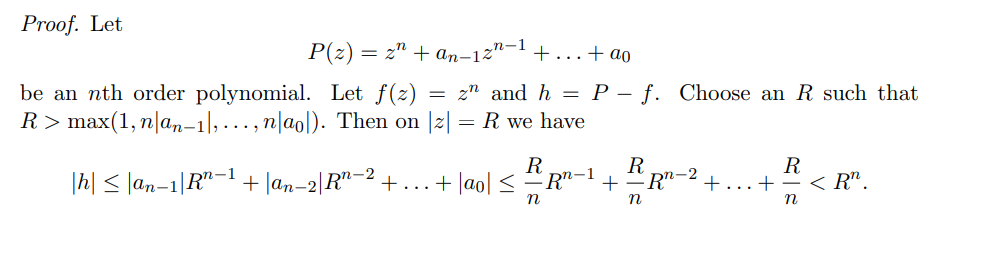
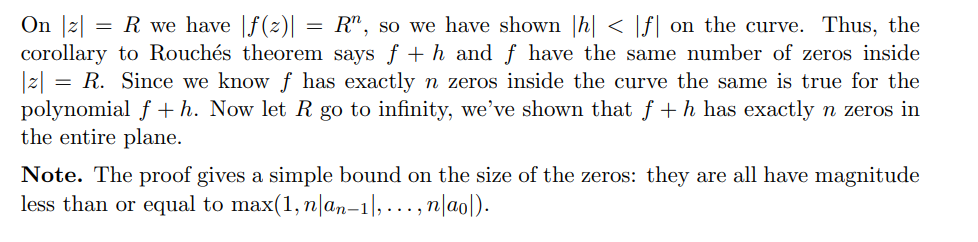
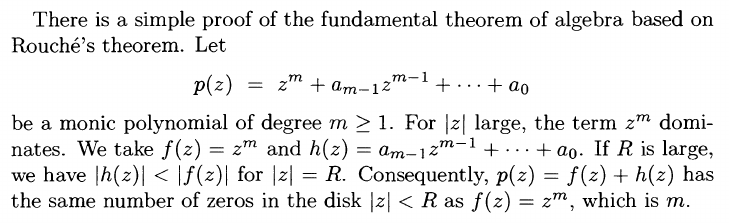
Let \(f(z) \coloneqq a_n z^n\) and \(g(z) \coloneqq P(z) - f(z) = a_{n-1}z^{n-1} + \cdots + a_0\), so \(f+g = P\). Choose \[ R > \max\qty{ { \abs{a_{n-1}} + \cdots + \abs{a_0} \over \abs{a_n} }, 1}. \] For \(\abs z = R\), \[ \begin{aligned} \abs{g(z)} &\leq \abs{a_{n-1}}R^{n-1} + \cdots + \abs{a_1} R + \abs{a_0} && \text{triangle inequality} \\ &\leq R^{n-1} \qty{ \abs{a_{n-1}} + \cdots + \abs{a_1} + \abs{a_0} } && R>1 \\ &< R^{n-1} \cdot \abs{a_n} R && \text{choice of } R \\ &= \abs{f(z)}. \end{aligned} \] By Rouché's theorem, \(P = f+g\) and \(f\) have the same number of zeros in \(\abs z<R\), namely \(n\). Every zero of \(P\) lies in \(\abs z < R\), since the same estimate gives \(\abs{P(z)}\geq\abs{f(z)}-\abs{g(z)}>0\) for \(\abs z\geq R\).
By Liouville’s theorem
(From Gamelin)
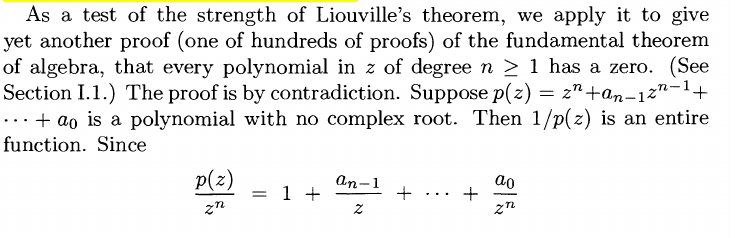

(Using Liouville's theorem)
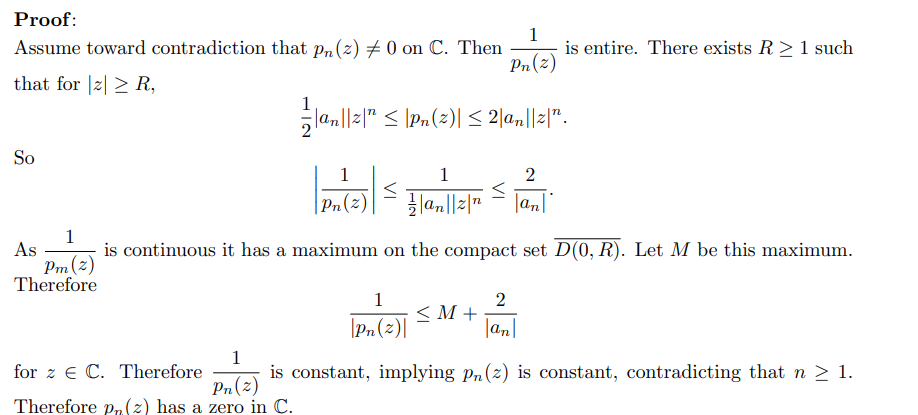
It suffices to show that \(P\) has a zero; the full count follows by induction on \(n\) after dividing by \(z - z_0\) for a zero \(z_0\). Suppose \(P\) has no zeros, so that \(1/P\) is entire.
Write \(P(z) = z^n \qty{a_n + \frac{a_{n-1}}{z}+\cdots+\frac{a_{0}}{z^{n}}}\). The bracket tends to \(a_n\) as \(z\to\infty\), so there is \(R>0\) with \(\abs{P(z)} \geq B\) for \(\abs z\geq R\), where \(B \coloneqq \abs{a_n}R^n/2 > 0\). On the compact disc \(\abs z\leq R\) the continuous function \(\abs P\) attains a minimum \(A\), and \(A>0\) because \(P\) has no zeros. With \(C \coloneqq \min(A, B)\), \(\abs{P(z)}\geq C\) on \(\CC\), so \(\abs{1/P(z)}\leq 1/C\) on \(\CC\). By Liouville's theorem \(1/P\) is constant, so \(P\) is constant, a contradiction.
By the open mapping theorem
(Using the open mapping theorem)
Extend \(P\) to a holomorphic map \(P\colon \PP^1(\CC) \to \PP^1(\CC)\) with \(P(\infty) = \infty\). Its image is compact, since \(\PP^1(\CC)\) is compact, and hence closed, since \(\PP^1(\CC)\) is Hausdorff. Since \(P\) is nonconstant, the image is open by the open mapping theorem applied in local coordinates. The image is nonempty and \(\PP^1(\CC)\) is connected, so the image is all of \(\PP^1(\CC)\). In particular \(0 = P(z_0)\) for some \(z_0\), and \(z_0\neq\infty\) because \(P(\infty)=\infty\).
By the generalized Liouville theorem
Holomorphic functions on a compact connected complex manifold are constant (Tag T-BBQLQ)
Let \(X\) be a compact connected complex manifold. Then every holomorphic function \(f\colon X\to\CC\) is constant.
Since \(X\) is compact, \(\abs f\) attains its maximum \(M\) at some point. The set \(S\coloneqq\ts{x\in X\st f(x)=c}\), for \(c\) a value with \(\abs c=M\) attained by \(f\), is nonempty and closed. At a point of \(S\), \(f\) read in a holomorphic chart is holomorphic on a connected open subset of \(\CC^n\) with an interior maximum of \(\abs f\); by the maximum modulus principle, applied on complex lines through the point, \(f\) is constant near that point, so \(S\) is open. As \(X\) is connected, \(S=X\).
Nonconstant holomorphic maps from compact Riemann surfaces (Tag L-ZXBBI)
Let \(X\) and \(Y\) be connected Riemann surfaces with \(X\) compact, and let \(f\colon X\to Y\) be a nonconstant holomorphic map. Then
\(f\) is surjective,
\(Y\) is compact,
\(\inverseof{f}(q)\) is finite for every \(q\in Y\), and
the ramification locus of \(f\) in \(X\) and the branch locus \(f(\text{ramification locus})\) in \(Y\) are finite.
By the open mapping theorem, \(f(X)\) is open in \(Y\); as the continuous image of a compact space in a Hausdorff space it is also compact, hence closed. Since \(Y\) is connected and \(X\neq\emptyset\), \(f(X)=Y\), so \(f\) is surjective and \(Y=f(X)\) is compact. For \(q\in Y\), the fibre \(\inverseof{f}(q)\) is closed in \(X\), and it is discrete because a nonconstant holomorphic map on a connected Riemann surface has isolated preimages of each point; a closed discrete subset of a compact space is finite. In a local coordinate the ramification points are the zeros of the derivative of a nonconstant holomorphic function, so the ramification locus is closed and discrete in \(X\), hence finite, and its image, the branch locus, is finite.
(Using the lemma on maps from compact Riemann surfaces)
Extend \(P\) to a nonconstant holomorphic map \(P\colon \PP^1(\CC) \to \PP^1(\CC)\) with \(P(\infty) = \infty\). Since \(\PP^1(\CC)\) is compact, \(P\) is surjective by Nonconstant holomorphic maps from compact Riemann surfaces, so \(P(z_0) = 0\) for some \(z_0\in\PP^1(\CC)\), and \(z_0\neq\infty\).
Singularities and omitted values
Riemann's removable singularity theorem (Tag T-ISZP3)
Let \(\Omega\subseteq\CC\) be open, let \(z_0\in\Omega\), and let \(f\) be holomorphic on \(\Omega\setminus\{z_0\}\) and bounded on \(\Omega\setminus\{z_0\}\). Then \(z_0\) is a removable singularity of \(f\): \(f\) extends to a holomorphic function on \(\Omega\).
Picard's little theorem (Tag T-HWBWI)
Let \(f\) be a nonconstant entire function. Then \(f\) takes every value in \(\CC\) with at most one exception. Equivalently, an entire function that omits two distinct values of \(\CC\) is constant.
Zero divisors
The ring of holomorphic functions on a domain in \(\CC\) has no zero divisors.
Let \(fg \equiv 0\) with \(f\not\equiv 0\). By the identity principle the zero set of \(f\) is discrete, so \(g\) vanishes on its complement, which has a limit point in the domain. So \(g\equiv 0\) by the identity principle again.
A Banach space of holomorphic functions
Let \(\Omega\subseteq\CC\) be open. If \(f_n\to f\) uniformly on \(\Omega\) with each \(f_n\) holomorphic, then \(\int_{\partial T}f=\lim_n\int_{\partial T}f_n=0\) for every closed triangle \(T\subseteq\Omega\), so \(f\) is holomorphic by Morera's theorem. This gives completeness of the bounded holomorphic functions under the supremum norm.
Bounded Complex Analytic Functions form a Banach Space (Tag E-QO2S7)
For an open set \(\Omega\subseteq\CC\), show that \(A(\Omega)\definedas \theset{f: \Omega \to \CC \st f\text{ is holomorphic and bounded}}\), with the supremum norm, is a Banach space.
Hint
Apply Morera’s theorem and Cauchy’s theorem.
Solution
Write \(A(\Omega) \coloneqq \{f: \Omega \to \CC \st f \text{ bounded and holomorphic}\}\) and \(\norm{f}_\infty \coloneqq \sup_{z \in \Omega}\abs{f(z)}\), and let \(\{f_n\}\) be a Cauchy sequence in \(A(\Omega)\).
<1>1. \(A(\Omega)\) is a vector space and \(\norm{\cdot}_\infty\) is a norm on it.
Pointwise addition and scalar multiplication preserve holomorphy (linearity of the derivative) and boundedness (triangle inequality); \(\norm{\cdot}_\infty\) is a norm on bounded functions, so it restricts to a norm on \(A(\Omega)\).
<1>2. There is a function \(f\colon\Omega\to\CC\) with \(f_n\to f\) uniformly on \(\Omega\).
For each \(z \in \Omega\), \(\abs{f_n(z) - f_m(z)} \le \norm{f_n - f_m}_\infty \to 0\), so \(\{f_n(z)\}\) is a Cauchy sequence in \(\CC\); define \(f(z) \coloneqq \lim_n f_n(z)\). Letting \(m\to\infty\) in \(\abs{f_n(z) - f_m(z)} \le \sup_{k\geq n}\norm{f_n - f_k}_\infty\) gives \(\sup_{z\in\Omega}\abs{f_n(z) - f(z)} \le \sup_{k\geq n}\norm{f_n - f_k}_\infty\), which tends to \(0\) because \(\{f_n\}\) is Cauchy.
<1>3. \(f\) is holomorphic.
By step <1>2, \(f\) is a uniform limit of continuous functions, so \(f\) is continuous on \(\Omega\), and for every closed triangle \(T\subseteq\Omega\), \(\int_{\partial T} f = \lim_n \int_{\partial T} f_n = \lim_n 0 = 0\) (uniform convergence lets the limit pass through the integral; each integral vanishes by Goursat’s theorem). Hence \(f\) is holomorphic by Morera’s theorem T-LHSMY.
<1>4. \(f\in A(\Omega)\) and \(\norm{f_n - f}_\infty \to 0\).
Since \(\{f_n\}\) is Cauchy it is bounded in norm, say \(\norm{f_n}_\infty \le M\); then \(\abs{f(z)} = \lim \abs{f_n(z)} \le M\) for all \(z\), so \(f\) is bounded, and \(f\) is holomorphic by step <1>3, so \(f \in A(\Omega)\). By step <1>2, \(\norm{f_n - f}_\infty \to 0\).
<1>5. Q.E.D.
By step <1>1, \(A(\Omega)\) is a normed space, and by step <1>4 every Cauchy sequence in it converges in \(A(\Omega)\), so \(A(\Omega)\) is a Banach space.