Holomorphic and analytic are equivalent: the Cauchy integral formula gives the power-series expansion, and the coefficient formula gives the Cauchy estimates.
Analytic function (Tag D-V6UQJ)
Let \(\Omega\subseteq\CC\) be open, let \(f\colon\Omega\to\CC\), and let \(z_0\in\Omega\). The function \(f\) is analytic at \(z_0\) if there exist a power series \(\sum_{n\ge0}a_n(z-z_0)^n\) with radius of convergence \(R>0\) and an open neighborhood \(U\subseteq\Omega\) of \(z_0\) with \(\abs{z-z_0}<R\) for all \(z\in U\), such that \[ f(z)=\sum_{n\ge0}a_n(z-z_0)^n\qquad\text{for all } z\in U. \] The function \(f\) is analytic on \(\Omega\) if it is analytic at every point of \(\Omega\).
Power series expansion of a holomorphic function on a disc (Tag T-GROTS)
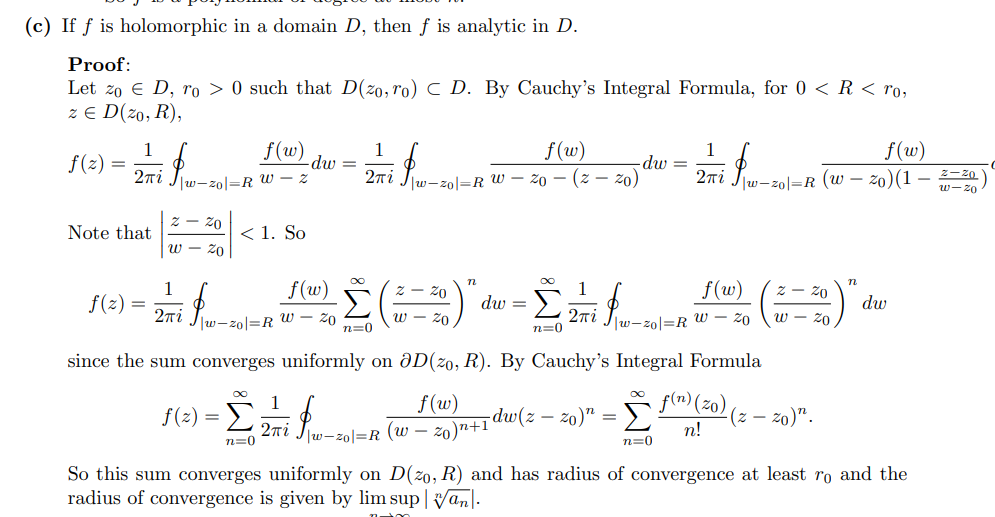
Let \(\Omega\subseteq\CC\) be open, let \(f\) be holomorphic on \(\Omega\), and let \(z_0\in\Omega\) and \(R>0\) satisfy \(\overline{D_R(z_0)}\subseteq\Omega\). Then for every \(z\in D_R(z_0)\), \[ f(z)=\sum_{n=0}^{\infty}a_n(z-z_0)^n, \] where for every \(n\geq0\) and every \(r\in(0,R]\), \[ a_n=\frac{f^{(n)}(z_0)}{n!}=\frac{1}{2\pi r^n}\int_0^{2\pi}f(z_0+re^{i\theta})e^{-in\theta}\dtheta. \]
Power series are smooth on their disc of convergence (Tag PR-QNDSD)
Let \(f(z)=\sum_{k\ge0}c_k(z-z_0)^k\) be a power series with radius of convergence \(R>0\). Then \(f\) is holomorphic and infinitely differentiable on \(D_R(z_0)\), its derivative is obtained by term-by-term differentiation, \[ f'(z)=\sum_{k\ge1}kc_k(z-z_0)^{k-1},\qquad z\in D_R(z_0), \] where this series also has radius of convergence \(R\), and the coefficients are \[ c_k=\frac{f^{(k)}(z_0)}{k!},\qquad k\ge0. \]
Holomorphic implies analytic
Holomorphic implies analytic (Tag T-SRY2V)
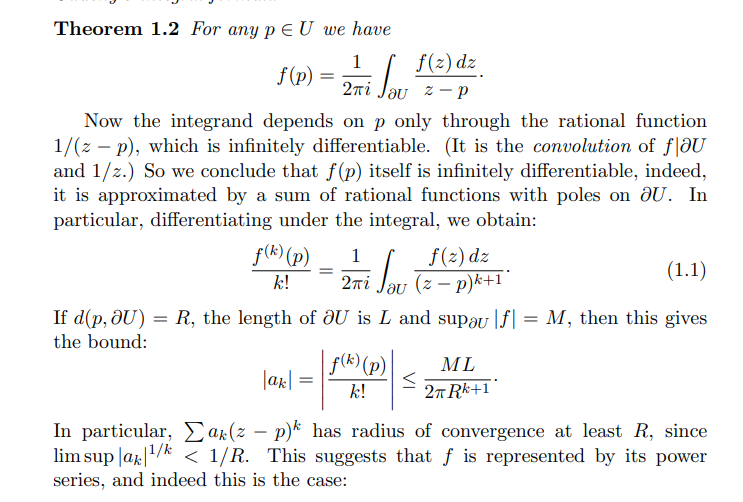
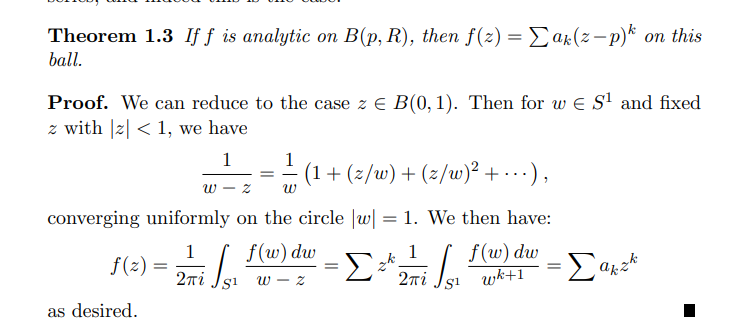
Let \(\Omega\subseteq\CC\) be open, let \(f\) be holomorphic on \(\Omega\), and let \(D\) be an open disc centred at \(p\) whose closure is contained in \(\Omega\). Then for every \(z\in D\) the series below converges and \[ f(z)=\sum_{k\geq0}c_k(z-p)^k,\qquad c_k=\frac{f^{(k)}(p)}{k!}. \] In particular, \(f\) is analytic at every point of \(\Omega\).
See [@SS03]. Conversely, a function analytic on \(\Omega\) is holomorphic on \(\Omega\), since a power series is complex differentiable inside its disc of convergence; so holomorphic and analytic functions on \(\Omega\) coincide.
After translating and rescaling, \(p=0\) and \(f\) is holomorphic on a neighborhood of \(\overline{\DD}\); fix \(z\in\DD\). For \(w\in S^1\), \[ {1\over w-z} = {1\over w} \qty{ 1 + \qty{z\over w} + \qty{z\over w}^2 + \cdots} ,\] which converges uniformly in \(w\in S^1\) because \(\abs{z/w} = \abs z < 1\), so the Cauchy integral formula may be expanded term by term: \[ f(z)=\frac{1}{2 \pi i} \int_{S^{1}} \frac{f(w) }{w-z} \dw = \sum z^{k} \frac{1}{2 \pi i} \int_{S^{1}} \frac{f(w)}{w^{k+1}} \dw =\sum c_{k} z^{k} .\]
(Holomorphic implies analytic, alternative)
Cauchy integral formula on a bounded domain (Tag T-K66DJ)
Let \(U\subseteq\CC\) be a bounded open set whose boundary \(\partial U\) consists of finitely many piecewise smooth closed curves, oriented positively with respect to \(U\), and let \(f\) be holomorphic on an open set containing \(\overline{U}\). Then for every \(p\in U\), \[ f(p)=\frac{1}{2\pi i}\int_{\partial U}\frac{f(z)}{z-p}\dz. \]
Cauchy integral formula for Taylor coefficients and the Cauchy estimates (Tag C-7S2CO)
Let \(f\) be holomorphic on an open set containing the closed disc \(\overline{D_R(p)}\), and write \(f(z)=\sum_{k\ge0}c_k(z-p)^k\) near \(p\). Then for every \(k\ge0\), \[ c_k=\frac{f^{(k)}(p)}{k!}=\frac{1}{2\pi i}\int_{\abs{z-p}=R}\frac{f(z)}{(z-p)^{k+1}}\dz=\frac{1}{2\pi R^k}\int_0^{2\pi}f(p+Re^{i\theta})e^{-ik\theta}\dtheta. \] Consequently, with \(M_R\coloneqq\max_{\abs{z-p}=R}\abs{f(z)}\), \[ \abs{c_k}\le\frac{M_R}{R^k}, \] so \(\limsup_k\abs{c_k}^{1/k}\le1/R\), and the Taylor series of \(f\) at \(p\) converges on \(D_R(p)\), where it equals \(f\).
Differentiating the Cauchy integral formula \(f(w)=\frac{1}{2\pi i}\int_{\abs{z-p}=R}\frac{f(z)}{z-w}\dz\) under the integral sign \(k\) times at \(w=p\) gives the first two equalities. Parametrizing the circle by \(z=p+Re^{i\theta}\), so that \(\dz=iRe^{i\theta}\dtheta\), gives the third. Bounding the integrand of the third expression by \(M_R/R^k\) over an interval of length \(2\pi\) gives the estimate, and the root test gives the radius of convergence.
(The coefficient formula)
By the integral formula, for \(f\) holomorphic on \(D_R(z_0)\), all \(k\geq 0\) and all \(0<r<R\): \[ c_k = {1\over 2\pi r^k} \int_0^{2\pi} f(z_0 + re^{i\theta}) e^{-ik\theta}\dtheta .\] Bounding the integrand gives the Cauchy estimate, and the same formula for \(k<0\) on an annulus gives the coefficients of the Laurent series.
Uniform convergence of the exponential series on discs (Tag PR-4BVDD)
The series \(e^z=\sum_{n\ge0}\frac{z^n}{n!}\) converges uniformly on every bounded subset of \(\CC\), in particular on every disc in \(\CC\).
A bounded set lies in a disc \(\abs{z}\le R\) for some \(R>0\). There \(\abs{z^n/n!}\le R^n/n!\), and \(\sum_n R^n/n!=e^R<\infty\), so the Weierstrass \(M\)-test gives uniform convergence.
On the disc \(\abs z\leq R\), the terms of \(e^z = \sum_{n\geq 0} z^n/n!\) satisfy \(\abs{z^n/n!}\leq R^n/n!\), and \(\sum_{n\geq 0} R^n/n! = e^R < \infty\). By the Weierstrass \(M\dash\)test, the series converges uniformly on \(\abs z\leq R\).
Abel’s theorem
Dirichlet's test (Tag L-EAZX6)
Let \((a_k)_{k\ge1}\) and \((b_k)_{k\ge1}\) be sequences of real numbers, and let \(A_n\coloneqq\sum_{k=1}^n a_k\). Suppose that
- the sequence of partial sums \((A_n)_{n\ge1}\) is bounded, and
- \((b_k)\) is nonincreasing and \(b_k\to0\).
Then the series \(\sum_{k\geq 1} a_k b_k\) converges.
Let \(A_n \coloneqq \sum_{k=1}^n a_k\) and \(A_0\coloneqq 0\), and choose \(M\) with \(\abs{A_n}\leq M\) for all \(n\). Summation by parts (Summation by parts with \(m=1\)) gives \[ \sum_{k=1}^n a_k b_k = A_n b_n + \sum_{k=1}^{n-1} A_k (b_k - b_{k+1}) .\] Since \(\abs{A_n b_n}\leq M b_n \to 0\), the first term tends to \(0\). Since \(b_k\) is decreasing, \(b_k - b_{k+1}\geq 0\), so \[ \sum_{k=1}^{n-1} \abs{A_k (b_k - b_{k+1})} \leq M\sum_{k=1}^{n-1}(b_k - b_{k+1}) = M(b_1 - b_n) \leq M b_1 ,\] and the series \(\sum_{k\geq 1} A_k(b_k - b_{k+1})\) converges absolutely. Hence the partial sums \(\sum_{k=1}^n a_k b_k\) converge.
Abel's theorem (Tag T-B7YTE)
Let \((c_k)_{k\ge0}\) be complex numbers such that \(\sum_{k\ge0}c_k\) converges. Then \(\sum_{k\ge0}c_kz^k\) converges for \(\abs z<1\), and \[ \lim_{r\to1^-}\sum_{k\ge0}c_kr^k=\sum_{k\ge0}c_k, \] where the limit is taken over real \(r\in(0,1)\).
Abel's test for power series on the unit circle (Tag L-MYZOX)
Let \((c_k)_{k\ge0}\) be a nonincreasing sequence of nonnegative real numbers with \(c_k\to0\), and let \(f(z)\coloneqq\sum_{k\ge0}c_kz^k\). Then the series \(f(z)\) converges for every \(z\) with \(\abs{z}=1\) and \(z\neq1\).
Let \(\abs{z}=1\) with \(z\neq1\). The partial sums of \(\sum_k z^k\) satisfy \(\abs{\sum_{k=0}^{N}z^k}=\abs{\frac{1-z^{N+1}}{1-z}}\le\frac{2}{\abs{1-z}}\) for every \(N\), so they are bounded. Since \((c_k)\) is nonincreasing with limit \(0\), Dirichlet's test applied to \(a_k=c_k\) and \(b_k=z^k\) shows that \(\sum_k c_kz^k\) converges.
(The alternating harmonic series)
Integrating the geometric series \(\sum_{k\geq 0}(-z)^k = 1/(1+z)\) term by term gives \[ \sum_{k\geq 1} {(-1)^{k+1} z^k \over k} = \log(1+z), \qquad \abs z < 1 .\] The series converges at \(z=1\) by the alternating series test, so Abel’s theorem gives \(\sum_{k\geq1}(-1)^{k+1}/k = \lim_{x\to 1^-}\log(1+x) = \log 2\).
(The converse of Abel's theorem fails)
Take \(f(z) = \sum (-z)^n = 1/(1+z)\). At \(z=1\) the series \(1-1+1-\cdots\) diverges, while \(\lim_{x\to 1^-} f(x) = 1/2\). So a radial limit can exist at a point where the series diverges, and the converse of Abel’s theorem is false.
Summation by parts (Tag PR-2MTPE)
Let \((a_k)_{k\ge1}\) and \((b_k)_{k\ge1}\) be sequences of complex numbers, and put \(A_n \coloneqq \sum_{k=1}^n a_k\) and \(B_n\coloneqq\sum_{k=1}^n b_k\) for \(n\ge1\), with \(A_0 \coloneqq 0\) and \(B_0\coloneqq0\).
For all integers \(1\le m\le n\), \[ \sum_{k=m}^n a_k b_k = A_nb_n - A_{m-1} b_m - \sum_{k=m}^{n-1} A_k(b_{k+1} - b_{k}). \]
For all sequences \((f_k)\) and \((g_k)\) of complex numbers and all integers \(m\le n\), writing \(\Delta g_k \coloneqq g_{k+1} - g_k\) and \(\Delta f_k\coloneqq f_{k+1}-f_k\), \[ \sum_{k=m}^n f_k \, \Delta g_k = f_{n+1} g_{n+1} - f_m g_m - \sum_{k=m}^n g_{k+1} \, \Delta f_k. \]
For every \(n\ge1\), \[ A_{n} B_{n}=\sum_{k=1}^{n} A_{k} b_{k}+\sum_{k=1}^{n} a_{k} B_{k-1}. \]
For (b), \(f_{k+1}g_{k+1}-f_kg_k=f_k\,\Delta g_k+g_{k+1}\,\Delta f_k\) for every \(k\); summing over \(m\le k\le n\) telescopes the left side to \(f_{n+1}g_{n+1}-f_mg_m\).
For (a), substitute \(a_k=A_k-A_{k-1}\): \[ \sum_{k=m}^n a_kb_k=\sum_{k=m}^nA_kb_k-\sum_{k=m-1}^{n-1}A_kb_{k+1}=A_nb_n-A_{m-1}b_m-\sum_{k=m}^{n-1}A_k(b_{k+1}-b_k). \]
For (c), \(A_kB_k-A_{k-1}B_{k-1}=A_k(B_{k-1}+b_k)-(A_k-a_k)B_{k-1}=A_kb_k+a_kB_{k-1}\) for every \(k\ge1\); summing over \(1\le k\le n\) and using \(A_0B_0=0\) gives the identity.
Identity (a) is the discrete analogue of integration by parts: for \(F\) an antiderivative of \(f\) on \([a,b]\) and \(g\) continuously differentiable, \[ \int_a^b f g = F(b)g(b) - F(a)g(a) - \int_a^b Fg'. \] The partial sums \(A_k\) play the role of \(F\), and the differences \(b_{k+1}-b_k\) the role of \(g'\).
Define \(A_n \coloneqq \sum_{k\leq n} a_k\), use \(a_k = A_k - A_{k-1}\), reindex, and peel off the top and bottom terms: \[ \begin{aligned} \sum_{m\leq k \leq n} a_k b_k &= \sum_{m\leq k \leq n} (A_k - A_{k-1}) b_k \\ &= \sum_{m\leq k \leq n} A_kb_k - \sum_{m-1\leq k \leq n-1} A_{k} b_{k+1} \\ &= A_nb_n - A_{m-1} b_{m} + \sum_{m\leq k \leq n-1} A_k(b_k - b_{k+1}) \\ &= A_nb_n - A_{m-1} b_{m} - \sum_{m\leq k \leq n-1} A_k(b_{k+1} - b_{k}) \end{aligned}.\]
Zeros of $f'$ are isolated, and $f'=g'$ implies $f-g$ is constant (Tag PR-NZZ2C)
Let \(\Omega\subseteq\CC\) be a connected open set.
If \(f\) is analytic and nonconstant on \(\Omega\), then \(f'\) is analytic on \(\Omega\) and the zeros of \(f'\) are isolated.
If \(f,g\) are analytic on \(\Omega\) with \(f'=g'\), then \(f-g\) is constant on \(\Omega\).
A power series can be differentiated term by term inside its disc of convergence, so \(f'\) is analytic on \(\Omega\). If \(f'\equiv0\) on \(\Omega\), then \(f\) is locally constant, hence constant because \(\Omega\) is connected. So \(f'\) is an analytic function on a connected open set that is not identically zero, and its zeros are isolated.
Put \(h\coloneqq f-g\). Then \(h'=0\) on \(\Omega\), so \(h\) is locally constant: on a disc \(D\subseteq\Omega\), \(h(z)-h(z_0)=\int_{[z_0,z]}h'(w)\,dw=0\). The set \(\ts{z\in\Omega\st h(z)=h(z_0)}\) is therefore open, and it is closed by continuity, so it is all of \(\Omega\).
The standard series and the factorial notation are collected on Series: Reference.
Exercises
Isolated zeros of $f'$, and $f'=g'$ implies $f-g$ is constant (Tag E-EG3W7)
Let \(\Omega \subseteq \mathbb{C}\) be a connected open region. (1) Prove that if \(f: \Omega \to \mathbb{C}\) is a non-constant holomorphic function, then \(f'\) is holomorphic on \(\Omega\) and the zeros of \(f'\) are isolated in \(\Omega\). (2) Prove that if \(f, g: \Omega \to \mathbb{C}\) are holomorphic functions satisfying \(f'(z) = g'(z)\) for all \(z \in \Omega\), then \(f(z) - g(z) = C\) for some constant \(C \in \mathbb{C}\).
Solution
Because \(f\) is holomorphic, \(f'\) is holomorphic.
If the zeros of \(f'\) had an accumulation point in \(\Omega\), the identity theorem would give \[ f'\equiv0. \] A holomorphic function with zero derivative on a connected domain is constant, contradicting the hypothesis. Hence the zeros of \(f'\) are isolated.
For the second statement, let \[ h=f-g. \] Then \(h\) is holomorphic and \[ h'=f'-g'=0. \] Therefore \(h\) is constant on the connected domain \(\Omega\). Thus \[ f-g=C \] for some \(C\in\mathbb C\).
Power series converge uniformly on their radius of convergence (Tag E-SKD7P)
Show that any power series converges uniformly within its radius of convergence.
Solution
Write \(S_N(z) \da \sum_{0\leq k\leq N} c_k (z-z_0)^k\) and \(S \da \lim_{N\to\infty} S_N\). Suppose \(R\da \inverseof{\qty{\limsup_k \abs{c_k}^{1\over k} }}\) is the radius of convergence and let \(r\leq R\), we’ll show \(S_N\to S\) uniformly on any disc \(\abs{z-z_0}< r\).
Use the \(M\dash\)test: \(\sum f_k\) converges if \(\norm{f_k}_\infty\leq M_k\) where \(\ts{M_k}\in \ell^1(\NN)\). Define \(f_k \da c_k (z-z_0)^k\), then \[ \norm{f_k}_\infty =\sup_{\abs{z-z_0}\leq r} \abs{c_k(z-z_0)^k} \leq \abs{c_k} r^k \da M_k .\] Then \[ \sum_{k\geq 0} M_k = \sum_{k\geq 0} \abs{c_k} r^k ,\] and the claim is that this converges.
Note that since \(r\leq R\), we have convergence of \[ \sum_{k\geq 0} c_k r^k .\] Recall that root test: \[ \sum_k a_k \text{ converges absolutely if } \limsup_k \abs{a_k}^{1\over k} < 1 .\] Here we take \(a_k \da c_k r^k\), then \[ \limsup_k \abs{a_k}^{1\over k} &\da \limsup_k \abs{c_k r^k}^{1\over k} \\ &= \limsup_k \abs{c_k}^{1\over k} r \\ &< \limsup_k \abs{c_k}^{1\over k} R\\ &\da \limsup_k \abs{c_k}^{1\over k} \inverseof{\qty{\limsup_{k} \abs{c_k}^{1\over k} }} \\ &= 1 ,\] so \(\sum_k \abs{c_k r^k} < \infty\). Thus \(\ts{M_k}\in \ell^1(\NN)\), and so \(\sum_k f_k\) converges uniformly and absolutely on \(\abs{z-z_0} = r < R\).
Power series are continuous (Tag E-EMISN)
Show that any power series is continuous on its domain of convergence.
Solution
Let \(f(z) = \lim_{N\to\infty} S_N(z)\) with \(S_N(z)=\sum_{k\leq N} c_k (z-z_0)^k\), and let \(R>0\) be the radius of convergence. The domain of convergence is the open disk \(\abs{z-z_0}<R\), the interior of the set where the series converges. For \(0<r<R\), the series converges absolutely and uniformly on the closed disk \(\abs{z-z_0}\le r\) (Weierstrass \(M\)-test with \(M_k=\abs{c_k}r^k\), which is summable since \(r<R\)). Each partial sum \(S_N\) is a polynomial, hence continuous, so \(f\) is continuous on \(\abs{z-z_0}\le r\) by the uniform limit theorem. Every point of the open disk \(\abs{z-z_0}<R\) lies in such a closed disk, so \(f\) is continuous on the open disk of convergence.
Uniform limits of derivatives, term-by-term differentiation (Tag E-QLRNW)
Suppose \(f_k: \Omega\to \CC\) is a sequence of differentiable functions converging locally uniformly to \(f:\Omega\to \CC\). Show that
- \(f\) is continuous,
- \(f\) is differentiable,
- \(\ts{f_k'}\to f'\) locally uniformly.
Thus if \(f(z) = \sum{k\geq 0} c_k (z-z_0)^k\) is a power series, since \(S_N\to f\) locally uniformly, \(f\) can be differentiated term-by-term within its radius of convergence.
Solution
That \(f\) is continuous is a local question: fixing a point \(z_0\), take a closed disc \(\DD+z_0\) about \(z_0\). By local uniform convergence \(f_k\to f\) uniformly on \(\DD+z_0\), and differentiable \(\implies\) continuous. So each \(f_k\) is continuous, making \(f\) continuous on \(\DD+z_0\) by the uniform limit theorem.
That \(f\) is differentiable is again a local question: fix \(z\) and write \(\gamma \da \bar{\DD + z}\) as the boundary of the disc about \(z\). Define \(g_k(\xi) \da {f_k\over \xi-z}\), so \(g_k \to {f \over \xi-a}\) locally uniformly. Now apply Cauchy’s integral formula at \(z\): \[ f(z) &= \lim_k f_k(z) \\ &= \lim_k {1\over 2\pi i}\int_\gamma {f_k(\xi) \over \xi - z}\dxi \\ &= \lim_k {1\over 2\pi i}\int_\gamma g_k(\xi)\dxi\\ &= {1\over 2\pi i}\int_\gamma \lim_k g_k(\xi)\dxi \\ &= {1\over 2\pi i}\int_\gamma g(\xi)\dxi\\ &= {1\over 2\pi i}\int_\gamma {f(\xi) \over \xi - z} \dxi ,\] where we’ve used uniform convergence on \(\gamma\) to commute the limit and integral. So \(f\) has an integral representation, making it differentiable.
That \(f_k'\to f'\): \[ \lim_k f_k'(z) &= \lim_k {1\over 2\pi i}\int_\gamma {f_k(\xi) \over (\xi - z)^2 }\dxi\\ &= {1\over 2\pi i}\int_\gamma \lim_k {f_k(\xi) \over (\xi - z)^2}\dxi\\ &= {1\over 2\pi i}\int_\gamma {f(\xi) \over (\xi - z)^2}\dxi\\ &= f'(z) .\]
That the convergence is locally uniform: first consider what happens on an closed discs \(K = D\) with \(\gamma \da \bd{D}\). Then for \(z\in D\), \[ \abs{f'(z) - f_k'(z) } &= \abs{{1\over 2\pi i} \int_{\gamma} {f(\xi) - f_k(\xi) \over (\xi - z)^2}\dxi }\\ &\leq {1\over 2\pi}\int_{\gamma} {\abs{f(\xi) - f_k(\xi) } \over \abs{\xi - z}^2} \dxi\\ &\leq {1\over 2\pi}\int_{\gamma } { \sup_{\xi \in \gamma} \abs{f(\xi) - f_k(\xi) } \over r^2 } \dxi\\ &= {1\over 2\pi} { \sup_{\xi \in \gamma } \abs{f(\xi) - f_k(\xi) } \over r^2} \cdot {2\pi r} \\ &= { \sup_{\xi \in \gamma } \abs{f(\xi) - f_k(\xi) }}/r .\] Since \(\gamma\) is compact, using locally uniform convergence of \(f_k\to f\), there exists an \(n_0\) such that \(n\geq n_0\) bounds this \(\sup\) by \(\eps\). For \(K\) arbitrary, cover \(K\) by discs \(D_z\) for every \(z\in K\) and extract a finite cover \(\ts{D_{z_k}}_{k\leq N}\). Produce \(n_0, n_1,\cdots, n_N\) as in the above argument, and take \(n\da \max\ts{n_k}_{k\leq N}\) to obtain uniform convergence on every \(D_{z_k}\) and thus on \(K\).
Radius of convergence (Tag E-ZQGR5)
Find the radius of convergence of
\(\sum a^k z^k\) for \(a\) a constant.
\(\sum a^{k^2}z^k\)
Solution
By Cauchy–Hadamard, for \(\sum c_kz^k\), \[ {1\over R}=\limsup_{k\to\infty}|c_k|^{1/k}. \]
For \(c_k=a^k\), \[ {1\over R}=|a|, \] so \[ R= \begin{cases} \infty,&a=0,\\ |a|^{-1},&a\neq0. \end{cases} \]
For \(c_k=a^{k^2}\), \[ {1\over R} =\limsup_{k\to\infty}|a|^k. \] Hence \[ R= \begin{cases} \infty,&|a|<1,\\ 1,&|a|=1,\\ 0,&|a|>1. \end{cases} \]
Radii of convergence of the principal $\sqrt z$ about $4+3i$ and $-4+3i$ (Tag E-FS7GZ)
Find the radius of convergence of the Taylor series of the principal branch of \(\sqrt z\) about \(z_0=4+3i\). Repeat with \(z_1=-4+3i\).
Solution
For a center \(c\neq0\), the disk \(\abs{z-c}<\abs c\) does not contain \(0\), so it carries a holomorphic branch of \(\sqrt z\) agreeing with the principal branch near \(c\); the Taylor series of the principal branch at \(c\) converges on this disk. It converges on no larger disk: the binomial expansion \[ \sqrt z=\sqrt c\sum_{n\ge0}\binom{1/2}{n}\qty{z-c\over c}^n \] has radius of convergence exactly \(\abs c\), since \(\binom{1/2}{n}\) has ratio \(\abs{1/2-n}/(n+1)\to1\).
For \(z_0=4+3i\), \[ R_0=|4+3i|=\boxed{5}. \]
For \(z_1=-4+3i\), \[ R_1=|-4+3i|=\boxed{5}. \] The branch cut \(\RR_{\le0}\) meets this disk: the sum of the series equals the principal branch only on the part of the disk above the cut, including the disk \(\abs{z-z_1}<3\), and equals its analytic continuation across the cut below it.
Convergence of a $\ZZ\dash$index series (Tag E-VWVTY)
Find the radius of convergence for \[ f(z) \da \sum_{k\in \ZZ} 2^{-\abs{k}}z^k .\]
Solution
Break this up into a principal part at \(z=0\) and a holomorphic part: \[ f(z) = f_1(z) + f_2(z) \da \sum_{k\geq 1} 2^{-k}z^{-k} + \sum_{k\geq 0} 2^{-k}z^k .\]
Using the ratio test: \[ f_1(z) < \infty &\impliedby \limsup_k \abs{2^{-k}z^{-k}}^{1\over k} < 1 \iff \limsup_k \abs{1\over 2z} < 1 \iff {1\over 2}< \abs{z} \\ f_2(z) < \infty &\impliedby \limsup_k \abs{2^{-k}z^{k}}^{1\over k} < 1 \iff \limsup_k \abs{z\over 2}< 1 \iff \abs{z} < 2 .\]
So \(f\) converges on \({1\over 2}< \abs{z} < 2\).
A power series of radius $1$ converging on $S^1$ except at $z=1$ (Tag FE-LAN3V)
The power series \(\sum_{n=1}^\infty \frac{z^n}{n}\) has radius of convergence \(1\), diverges at \(z=1\), and converges at every other point of \(S^1\). Its radius is \(1\) because \(\limsup_n(1/n)^{1/n}=1\). At \(z=1\) it is the harmonic series, which diverges. For \(\abs{z}=1\) with \(z\neq1\), the partial sums satisfy \(\abs{\sum_{n=1}^N z^n}=\abs{\frac{z(1-z^N)}{1-z}}\le\frac{2}{\abs{1-z}}\), and \(1/n\) decreases to \(0\), so the series converges by Dirichlet’s test.
A power series of radius $1$ converging at every point of $S^1$ (Tag FE-VWNUI)
The power series \(\sum_{n=1}^\infty \frac{z^n}{n^2}\) has radius of convergence \(1\) and converges at every \(z\) with \(\abs{z}=1\). Its radius is \(1\) because \(\limsup_n(1/n^2)^{1/n}=1\). For \(\abs{z}=1\), \(\abs{z^n/n^2}=1/n^2\) and \(\sum_n 1/n^2<\infty\), so the series converges absolutely.
A power series of radius $1$ diverging at every point of $S^1$ (Tag FE-EUOB2)
The power series \(\sum_{n=1}^\infty nz^n\) has radius of convergence \(1\) and diverges at every \(z\) with \(\abs{z}=1\). Its radius is \(1\) because \(\limsup_n n^{1/n}=1\). For \(\abs{z}=1\) the terms satisfy \(\abs{nz^n}=n\not\to0\), so the series diverges.
Laurent series of $\frac{1}{z(z-1)}$ on $\abs z<1$ and on $\abs z>1$ (Tag E-BUVLS)
Expand \(f(z) = {1\over z(z-1)}\) in both
- \(\abs{z} < 1\)
- \(\abs{z} > 1\)
Solution
\[ {1\over z(z-1)} = -{1\over z}{1 \over 1-z} = -{1\over z}\sum z^k .\] and \[ {1\over z(z-1)} = {1\over z^2(1 - {1\over z})} = {1\over z^2} \sum \qty{1\over z}^k .\]
Laurent expansions about different points (Tag E-VCLTY)
Find the Laurent expansion about \(z=0\) and \(z=1\) respectively of the following function: \[ f(z) \da {z+1 \over z(z-1)} .\]
Solution
Note: once you see that everything is in terms of powers of \((z-z_0)\), you’re essentially done. For \(z=0\): \[ {z+1 \over z(z-1)} &= {1\over z} {z+1 \over z-1} \\ &= -{z+1\over z} {1\over 1-z} \\ &= -\qty{1 + {1\over z}}\sum_{k\geq 0} z^k .\]
For \(z=1\): \[ {z+1 \over z(z-1)} &= {1\over z-1}\qty{1 + {1\over z} } \\ &= {1\over z-1}\qty{1 + {1\over 1 - (1-z)} } \\ &= {1\over z-1} \qty{1 + \sum_{k\geq 0} (1-z)^k } \\ &= {1\over z-1} \qty{1 + \sum_{k\geq 0} (-1)^k (z-1)^k } .\]
Laurent series of $\frac{1}{(z-3)(z-1)}$ on the three annuli about $0$ (Tag E-DUMQG)
Find a Laurent expansion for \(f(z) \da {1\over (z-3)(z-1)}\) on the 3 annular regions centered at \(0\) where \(f\) is holomorphic.
Solution
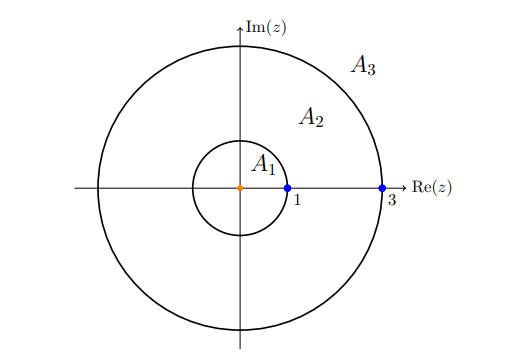
The three regions are
\(0 \leq \abs{z} < 1\)
\(1 < \abs{z} < 3\)
\(3 < \abs{z} < \infty\)
Write \(f\) in terms of its principal parts at \(z=1\) and \(z=3\) by computing the residues:
\(\Res_{z=1}f(z) = (z-1)f(z)\evalfrom_{z=1} = {1\over z-3}\evalfrom_{z=1} = -{1\over 2}\)
\(\Res_{z=3}f(z) = (z-3)f(z)\evalfrom_{z=3} = {1\over z-1}\evalfrom_{z=3} = {1\over 2}\)
Thus \[ f(z) = {-1/2 \over z-1} + {1/2 \over z-3} .\]
Now find the two expansions for each term:
\[ {-1/2 \over z-1} &= {1/2 \over 1-z} = {1\over 2}\sum_{k\geq 0} z^k && 0 < \abs{z} < 1 \\ {-1/2 \over z-1} &= -{1\over 2}{\inverseof{z} \over \inverseof{z} - 1} = -{1\over 2z}{1\over 1-\inverseof{z}} = -{1\over 2}\sum_{k\geq 0}z^{-k-1} && 1 < \abs{z} < \infty \\ {1/2\over z-3} &= -{1\over 2}{1\over 3-z} = -{1\over 6}{1\over 1-{z\over 3}} = -{1\over 6}\sum_{k\geq 0}3^{-k} z^k && 0 < \abs{z} < 3 \\ {1/2\over z-3} &= {1\over 2z}{1\over 1-3\inverseof{z}} = {1\over 2z} \sum_{k\geq 0}3^kz^{-k} = {1\over 2}\sum_{k\geq 0}3^k z^{-k-1} && 3 < \abs{z} < \infty .\]
On each region, combine the expansions of the two terms that converge there: \[ 0 \leq \abs{z} < 1 \qquad & f(z) = {1\over 2}\sum_{k\geq 0}z^k - {1\over 6}\sum_{k\geq 0} 3^{-k}z^k \\ 1 < \abs{z} < 3 \qquad & f(z) = -{1\over 2}\sum_{k\geq 0}z^{-k-1} - {1\over 6}\sum_{k\geq 0} 3^{-k}z^k \\ 3 < \abs{z} < \infty \qquad & f(z) = - {1\over 2}\sum_{k\geq 0}z^{-k-1} + {1\over 2}\sum_{k\geq 0} 3^{k}z^{-k-1} .\]
Taylor expansion of $z^2\cos(z/3)$ (Tag E-AHBVF)
Expand \(f(z) = z^2\cos\qty{z\over 3}\) about \(z=0\).
Solution
\[ \cos\qty{z\over3} =\sum_{k=0}^\infty(-1)^k{(z/3)^{2k}\over(2k)!}, \] so \[ z^2\cos\qty{z\over3} =\sum_{k=0}^\infty(-1)^k{z^{2k+2}\over 3^{2k}(2k)!} =z^2-{z^4\over 2!\,3^2}+{z^6\over 4!\,3^4}-\cdots. \] This is an ordinary Taylor series; there are no negative powers.
Expansion for a reciprocal (Tag E-SQ4GJ)
Find a power series expansion of \[ f(z) = {1\over e^z-1} .\]
Solution
One way: polynomial long division. \[ {1\over e^z-1} &= {1\over z + {1\over 2}z^2 + {1\over 6}z^2 + \cdots } \\ &= {1\over z}\qty{1 - {1\over 2}z + \qty{-{1\over 6} + {1\over 4} }z^2 + \cdots } \\ &= \inverseof{z} - {1\over 2} + {1\over 12}z + \bigo(z^3) .\] Alternatively, use geometric series. Note that something like \({1\over 1-e^z} = \sum_{k\geq 0} e^{kz}\) won’t converge, and won’t even be calculable since each \(e^{kz}\) contributes a constant term! \[ {1\over e^z-1} &= {1\over z + {1\over 2}z^2 + {1\over 6}z^3 + \cdots } \\ &= {1\over z(1 + {1\over 2}z + {1\over 6}z^2 + \cdots) } \\ &= \inverseof{z} {1\over 1 + q(z) } \qquad q(z) \da {1\over 2}z + {1\over 6}z^2 + \cdots \\ &= \inverseof{z} \sum_{k\geq 0}(-q(z))^k \\ &= \inverseof{z} \qty{1 - q(z) + q(z)^2 - \cdots } \\ &= \inverseof{z}\qty{1 - \qty{{1\over 2}z + {1\over 6}z^2 + \cdots } + \qty{{1\over 2}z + {1\over 6}z^2 + \cdots }^2 - \cdots } \\ &= \inverseof{z}\qty{ 1 - {1\over 2} z + \qty{-{1\over 6} + \qty{1\over 2}^2 } z^2 + \bigo(z^3) } \\ &= \inverseof{z} - {1\over 2} + {1\over 12}z + \bigo(z^2) .\]
Laurent series of $e^{1/z}\cos(1/z)$ at its essential singularity $0$ (Tag E-ENJAF)
Find a Laurent expansion at \(z=0\) for \[ f(z) \da e^{1\over z}\cos\qty{1\over z} .\]
Solution
Let \(g(z) \da e^z\cos(z)\), an entire function with \(g(1/z ) = f(z)\) for \(z\ne0\). The Taylor series of \(g\) at \(0\), evaluated at \(1/z\), is the Laurent series of \(f\) on \(\abs z>0\): \[ g(z) &= e^{z}\cos(z)\\ &= {1\over 2}e^z\qty{e^{iz} + e^{-iz}} \\ &= {1\over 2}\qty{e^{(1+i)z} + e^{(1-i)z}} \\ &= {1\over 2} \sum_{k\geq 0}\qty{(1+i)^k + (1-i)^k} {z^k\over k!} \\ \implies f(z) &= {1\over 2} \sum_{k\geq 0}\qty{(1+i)^k + (1-i)^k} {1 \over k!z^k } \\ .\]
Laurent series and residue of $\cos(1-1/z)$ at $0$ (Tag E-GMGFS)
Find a Laurent expansion about \(z=0\) of \[ f(z) \da \cos\qty{1- {1\over z}} ,\] and compute the “residue” coefficient \(c_{-1}\).
Solution
Write \(g(z) \da \cos(1-z)\), so \(g(1/z) = f(z)\), and expand: \[ g(z) &= \cos(1-z) \\ &= {1\over 2}\qty{e^{i(1-z)} + e^{-i(1-z)}} \\ &= {1\over 2}\qty{e^i e^{-iz} + e^{-i} e^{iz}}\\ &= {1\over 2}\sum_{k\geq 0} \qty{ (-i)^k e^i + i^k e^{-i} } {z^k \over k!} \\ \implies f(z) &= {1\over 2}\sum_{k\geq 0} \qty{ (-i)^k e^i + i^k e^{-i} } {1 \over k!z^k} .\]
Taking \(k=1\) yields \[ c_{-1} = {-ie^i + ie^{-i} \over 2} = -i\cdot {e^i - e^{-i}\over 2} = {e^i - e^{-i}\over 2i} = \sin(1) .\]
Laurent expanding exponentials (Tag E-XOCPO)
Find a Laurent expansion that converges for \(\abs{z} > 1\) of \[ f(z) \da {1 \over e^{1-z}} .\]
Solution
\[ f(z) = e^{-(1-z)} = e^{z-1} = \inverseof{e} e^z = \inverseof{e}\sum_{k\geq 0} {z^k\over k!} .\] Since \(e^z\) is entire, this converges on \(\CC\).
Laurent expanding tricky exponentials (Tag E-QCVGX)
Find a Laurent expansion for \[ f(z) = {1\over 1 + e^z} \] about \(z_0 = 0\) and \(z_1 = i\pi\).
Solution
At \(z=0\), we can use a geometric series approach since \(\abs{e^z} = e^{\Re(z)} \leq 1\) near \(0\). However, we still have to get rid of the leading 1 in the expansion of \(e^z\) in order to get a constant coefficient. \[ {1\over 1 + e^z} &= {1\over 1 + 1 + z + {1\over 2!}z^2 + {1\over 3!} z^3 + \bigo(z^4)} \\ &= {1\over 2 + z + {1\over 2!}z^2 + {1\over 3!} z^3 + \bigo(z^4) } \\ &= {1\over 2} {1\over 1 + {1\over 2} z + {1\over 2\cdot 2!}z^2 + {1\over 2\cdot 3!} z^3 + \bigo(z^4) } \\ &= {1\over 2}{1\over 1 - (-p(z)) } \qquad p(z) \da {1\over 2}z + {1\over 2\cdot 2!}z^2 + {1\over 2\cdot 3!}z^3 + \bigo(z^4) \\ &= {1\over 2} \sum_{k\geq 0} (-p(z))^k \\ &= {1\over 2}\Big[ 1 - \qty{{1\over 2}z + {1\over 2\cdot 2!}z^2 + {1\over 2\cdot 3!}z^3 + \bigo\qty{z^4} } \\ &\qquad + \qty{ {1\over 2}z + {1\over 2\cdot 2!}z^2 + {1\over 2\cdot 3!}z^3 + \bigo\qty{z^4} }^2 \\ &\qquad - \qty{{1\over 2} z + {1\over 2\cdot 2!}z^2 + {1\over 2\cdot 3!}z^3 + \bigo\qty{z^4} }^3 \\ &\qquad - \bigo(z^4) \Big]\\ &= {1\over 2} \Big[ 1 + z\qty{- {1\over 2}} + z^2\qty{- {1\over 2\cdot 2!} + \qty{1\over 2}^2}\\ &\qquad + z^3 \Big( -{1\over 2\cdot 3! } +\left[ \qty{1\over 2}^3 + {1\over 2}{1\over 2\cdot 2!}\right] - \qty{1\over 2}^3 \Big) \\ &\qquad + \bigo(z^4) \Big]\\ &= {1\over 2} - {1\over 4}z + 0z^2 + {1\over 48}z^3 + \bigo(z^4) .\]
Expanding at \(z-i\pi\): quite a bit easier. Let \(\omega \da z-i\pi\), then \[ {1\over 1 + e^z} &= {1\over 1 + e^{z-i\pi}e^{i\pi}} \\ &= {1\over 1 - e^{\omega} } \\ &= {1 \over -\omega - {1\over 2!}\omega^2 - {1\over 3!}\omega^3 - \bigo(\omega^4) } \\ &= -{1\over \omega} {1 \over 1 + {1\over 2!}\omega + {1\over 3!}\omega^2 + \bigo(\omega^3) } \\ &= -{1\over \omega}{1\over 1-(- p(z) ) } \qquad p(z) \da \sum_{k\geq 2}{\omega^{k-1}\over k!} \\ &= -{1\over \omega} \sum_{k\geq 0} (-p(z))^k \\ &= -{1\over \omega} \left[ 1 - \qty{{1\over 2!}\omega + {1\over 3!}\omega^2 + \bigo(\omega^3)} + \qty{{1\over 2!}\omega + {1\over 3!}\omega^2 + \bigo(\omega^3)}^2 - \bigo(\omega^3) \right] \\ &= -{1\over \omega} \left[ 1 + \omega\qty{-{1\over 2!}} + \omega^2\qty{-{1\over 3!} + \qty{1\over 2!}^2} + \bigo(\omega^3) \right] \\ &= -{1\over w} + {1\over 2} - {1\over 12}\omega + \bigo(\omega^2) .\]
Series convergence on the circle by summation by parts (Tag E-ZWNTH)
Use summation by parts to show that \(\sin(n)/n\) converges.
Show that
\(\sum kz^k\) diverges on \(S^1\).
\(\sum k^{-2} z^k\) converges on \(S^1\).
\(\sum \inverseof{k} z^k\) converges on \(S^1\sm\ts{1}\) and diverges at \(1\).
Solution
Use that \(\abs{z^k} = 1\) and \(\sum c_kz^k < \infty \implies \abs{c_k} \to 0\), but \(\abs{kz^k} = \abs{k} \to \infty\) here.
Use that absolutely convergent implies convergent, and \(\sum \abs{k^{-2} z^k} = \sum \abs{k^{-2}}\) converges by the \(p\dash\)test.
If \(z=1\), this is the harmonic series. Otherwise take \(a_k = 1/k, b_k = e^{i k \theta}\) where \(\theta \in (0, 2\pi)\) is some constant, and apply Dirichlet’s test. It suffices to bound the partial sums of the \(b_k\). Recalling that \(\sum_{k\leq N} r^k = (1-r^{N+1}) / (1-r)\), \[ \norm{ \sum_{k\leq m} e^{ik\theta } } = \norm{1 - e^{i(m+1)\theta} \over 1 - e^{i\theta}} \leq {2 \over \norm{ 1- e^{i\theta}}} \da M ,\] which is a constant. Here we’ve used that two points on \(S^1\) are at most distance 2 from each other.
A real-valued holomorphic function is constant (Tag E-THK2Z)
Show that a real-valued holomorphic function must be constant.
Solution
Goal: Show that a real-valued holomorphic function on a domain must be constant.
1. Write \(f = u + iv\) with \(v \equiv 0\); the Cauchy–Riemann equations give \(u_x = v_y = 0\) and \(u_y = -v_x = 0\).
If \(f\) is holomorphic, the Cauchy–Riemann equations \(u_x = v_y\), \(u_y = -v_x\) hold. Since \(f\) is real-valued, \(v \equiv 0\), so \(v_x = v_y = 0\); hence \(u_x = u_y = 0\) on the domain.
2. \(u\) is constant on the domain.
Step 1 shows both partial derivatives of \(u\) vanish. On a connected (path-connected) domain, fix \(z_0\); any other point joins to \(z_0\) by a path, and along the path \(u\) is constant (vanishing directional derivative), so \(u(z) = u(z_0)\) everywhere.
3. QED \(f = u\) (as \(v \equiv 0\)) is constant by step 2.
Convergence of $\prod_{n\in\mathbb{Z}}(1+a_n)$ when $\{a_n\}\in\ell_1(\mathbb{Z})$ (Tag E-ORJPT)
Show that \(\prod_{n\in \ZZ} (1 + a_n) < \infty\) if \(\ts{a_n} \in \ell_1(\ZZ)\).
Solution
<1>1. Since \(\{a_n\} \in \ell_1(\ZZ)\), we have \(\sum_{n \in \ZZ} |a_n| < \infty\).
definition of \(\ell_1\).
<1>2. Hence \(a_n \to 0\), so for all sufficiently large \(|n|\) we have \(|a_n| < 1/2\).
a convergent series has terms tending to \(0\).
<1>3. For \(|a_n| < 1/2\), \(|\log(1 + a_n)| \le 2|a_n|\).
\(|\log(1+z)| \le 2|z|\) for \(|z| \le 1/2\) (standard estimate).
<1>4. Hence \(\sum_{n} |\log(1 + a_n)| \le 2\sum_n |a_n| < \infty\).
<1>3 and <1>1.
<1>5. Therefore \(\sum_n \log(1 + a_n)\) converges absolutely, so the product \(\prod_n (1 + a_n)\) converges to a finite nonzero value.
a product \(\prod (1 + a_n)\) converges (absolutely) iff \(\sum \log(1 + a_n)\) converges (absolutely).
<1>6. Q.E.D.
<1>5.
Zero derivative implies constant (Tag E-TVJFL)
Show that if \(f' = 0\) on a domain \(\Omega\), then \(f\) is constant on \(\Omega\)
Solution
Write \(f = u + iv\), then \(0 = 2 f' = u_x + iv_x = u_y - iu_y\), so \(\grad u = \grad v = 0\). Show \(f\) is constant along every straight line segment \(L\) by computing the directional derivative \(\grad u \cdot \vector v = 0\) along \(L\) connecting \(p, q\). Then \(u(p) = u(q) = a\) some constant, and \(v(p) = v(q) = b\), so \(f(z) = a+bi\) everywhere.
If $f$ and $\bar f$ are holomorphic on a domain, then $f$ is constant (Tag E-3QAC4)
Show that if \(f\) and \(\bar{f}\) are both holomorphic on a domain \(\Omega\), then \(f\) is constant on \(\Omega\).
Solution
Strategy: show \(f'=0\).
Write \(f = u + iv\). Since \(f\) is analytic, it satisfies CR, so \[ u_x = v_y && u_y = -v_x .\]
Similarly write \(\bar f = U + iV\) where \(U = u\) and \(V = -v\). Since \(\bar f\) is analytic, it also satisfies CR , so \[ U_x = V_y && U_y = -V_x \\ \\ \implies u_x = -v_y && u_y = v_x .\]
Add the LHS of these two equations to get \(2u_x = 0 \implies u_x = 0\). Subtract the right-hand side to get \(-2v_x = 0 \implies v_x = 0\)
Since \(f\) is analytic, it is holomorphic, so \(f'\) exists and satisfies \(f' = u_x + iv_x\). But by above, this is zero.
Since \(\Omega\) is connected and \(f'=0\) on \(\Omega\), \(f\) is constant.
Holomorphic $f$ with constant $\Re f$, $\Im f$, or $\abs{f}$ is constant (Tag E-SS1.EX-13)
If \(f\) is holomorphic on \(\Omega\) and any of the following hold, then \(f\) is constant:
\(\Re(f)\) is constant.
\(\Im(f)\) is constant.
\(\abs{f}\) is constant.
Solution
Here \(\Omega\) is a region, that is, open and connected. Write \(f=u+iv\) with \(u,v\) real.
<1>1. (1) If \(u\) is constant on \(\Omega\), then \(f\) is constant.
At each point \(f'=\partial f/\partial x=u_x+iv_x\), and the Cauchy–Riemann equation \(v_x=-u_y\) gives \(f'=u_x-iu_y=0\). So \(f'=0\) on the connected set \(\Omega\), and \(f\) is constant.
<1>2. (2) If \(v\) is constant on \(\Omega\), then \(f\) is constant.
The function \(-if\) is holomorphic with real part \(v\), so step <1>1 makes \(-if\), and hence \(f\), constant.
<1>3. (3) If \(\abs{f} = c\) on \(\Omega\), then \(f\) is constant.
<2>1. If \(c=0\), then \(f=0\).
\(\abs{f(z)} = 0\) if and only if \(f(z) = 0\).
<2>2. If \(c>0\), then \(\bar f\) is holomorphic on \(\Omega\).
Since \(\abs{f}=c>0\), \(f\) has no zeros on \(\Omega\), and \(f\bar{f} = \abs{f}^2 = c^2\) gives \(\bar{f}=c^2/f\), a quotient of holomorphic functions with nonvanishing denominator.
<2>3. Q.E.D.
In the case \(c>0\), both \(f\) and \(\bar f\) are holomorphic, so \(\partial f/\partial\bar z=0\) and \(\overline{f'}=\overline{\partial f/\partial z}=\partial\bar f/\partial\bar z=0\). Hence \(f'=0\) on the connected set \(\Omega\), and \(f\) is constant. The case \(c=0\) is step <2>1.
<1>4. Q.E.D.
Steps <1>1, <1>2 and <1>3 are the three cases.
A zero of multiplicity $n$ is a point where $f,\ldots,f^{(n-1)}$ vanish and $f^{(n)}$ does not (Tag E-FMLK2)
Show that if \(f\) is holomorphic in \(\DD_r(a)\) and \(a\) is a zero of \(f\) of multiplicity \(n\), then \(f^{(k)}(a) = 0\) for \(k\leq n-1\) and \(f^{(n)}(a) \neq 0\). Show that this is an iff.
Solution
Write \(f(z) = \sum_{k\geq 0} c_k (z-a)^k\) on \(\DD_r(a)\), where \(c_k = f^{(k)}(a)/k!\). Recall that \(a\) is a zero of multiplicity \(m\) when \(f(z)=(z-a)^mg(z)\) with \(g\) holomorphic near \(a\) and \(g(a)\neq0\).
\(\impliedby\): Suppose \(f^{(k)}(a)=0\) for \(k\le m-1\) and \(f^{(m)}(a)\ne0\), so \(c_k=0\) for \(k\le m-1\) and \(c_m\ne0\). Then \[ f(z) = \sum_{k\geq m} c_k (z-a)^k = (z-a)^m \sum_{k\geq m} c_k (z-a)^{k-m} \da (z-a)^m g(z) ,\] where \(g\) is holomorphic on \(\DD_r(a)\) with \(g(a) = c_m \neq 0\), making \(a\) a zero of \(f\) of multiplicity \(m\).
\(\implies\): If \(a\) is a zero of multiplicity \(m\), write \(f(z) = (z-a)^m h(z)\) with \(h\) holomorphic near \(a\) and \(h(a)\neq0\), and expand \(h(z)=\sum_{j\ge0}d_j(z-a)^j\) with \(d_0=h(a)\). Then \(f(z)=\sum_{j\geq0}d_j(z-a)^{j+m}\), and by uniqueness of power series coefficients, \(c_k=0\) for \(k\le m-1\) and \(c_m=d_0\neq0\). That is, \(f^{(k)}(a)=0\) for \(k\le m-1\) and \(f^{(m)}(a)=m!\,h(a)\neq0\).
An injective holomorphic function has nonvanishing derivative (Tag E-I26BF)
Show that if \(f\) is holomorphic on \(\Omega\) and injective, then \(f'(z)\) is nonvanishing on \(\Omega\).
Solution
By contradiction: after translating, suppose \(0\in\Omega\), \(f(0) = 0\) and \(f'(0)=0\). An injective \(f\) is nonconstant, so \(0\) is a zero of \(f\) of some finite order \(m\), and \(m\geq2\) since \(f(0)=f'(0)=0\). Write \(f(z)=z^mg(z)\) with \(g\) holomorphic near \(0\) and \(g(0)\neq0\). On a small disk \(D\) about \(0\), \(g\) is nonvanishing and has a holomorphic \(m\)-th root \(h\), so \(f=\varphi^m\) with \(\varphi(z)\da zh(z)\). Since \(\varphi'(0)=h(0)\neq0\), \(\varphi\) maps a neighborhood \(U\subseteq D\) of \(0\) biholomorphically onto a disk \(\abs w<\delta\). For \(0<\eps<\delta\) and \(\zeta=e^{2\pi i/m}\neq1\), the distinct points \(w_1=\eps\) and \(w_2=\zeta\eps\) satisfy \(w_1^m=w_2^m\), so their preimages under \(\varphi\) are distinct points of \(U\) with the same image under \(f\), contradicting injectivity.