Over an algebraically closed field \(k\), \(I\mapsto V(I)\) and \(Z\mapsto I(Z)\) are inclusion-reversing bijections between radical ideals of \(k[x_1,\ldots,x_n]\) and closed subsets of \(\AA^n\); prime ideals correspond to irreducible closed subsets and maximal ideals to points.
The Zariski topology (Tag D-BIVAU)
The Zariski topology on \(\AA^n\) has as its closed sets the vanishing loci \[ V(J) \da \ts{ p \in \AA^n \st f(p) = 0 \text{ for all } f \in J } \] of ideals \(J \subseteq k[x_1,\ldots,x_n]\). The distinguished open set attached to \(f\) is \(D_f \da \AA^n \sm V(f)\), and these form a basis.
On \(\AA^1\), and on any irreducible curve, the proper closed sets are the finite sets, so the Zariski topology is the cofinite topology. For \(\AA^1\) over \(k = \bar{k}\): since \(k[x]\) is a PID, every ideal is \((f)\), and factoring \(f\) into linear factors gives \(V(f) = \ts{a_1, \ldots, a_r}\) when \(f \neq 0\). Since \(k\) is infinite, any two nonempty open subsets of \(\AA^1\) meet, because their complements are finite; so \(\AA^1\) is irreducible and not Hausdorff.
Hilbert's Nullstellensatz (Tag T-JRTS2)
Let \(k\) be algebraically closed and let \(J \subseteq k[x_1, \ldots, x_n]\) be an ideal. Then \[ I(V(J)) = \sqrt{J} . \] [@Har10a, Theorem I.1.3A]
The weak form is the case \(J \neq k[x_1,\ldots,x_n] \implies V(J) \neq \emptyset\), and it is equivalent: the strong form follows from the weak one by the Rabinowitsch trick, adjoining a variable \(y\) and the polynomial \(1 - yf\).
Algebraic closure is not a convenience here. Over \(\RR\) the ideal \((x^2+1)\) is prime, hence radical, but \(V(x^2+1) = \emptyset\) in \(\AA^1_\RR\), so \(I(V(J)) = (1) \neq \sqrt{J}\).
The ideal-variety correspondence (Tag PR-7OT2Z)
Over an algebraically closed field \(k\), the maps \(V\) and \(I\) are mutually inverse, order-reversing bijections between the radical ideals of \(k[x_1,\ldots,x_n]\) and the Zariski-closed subsets of \(\AA^n\). Under that bijection:
| Ideal \(J\) | Closed set \(V(J)\) |
|---|---|
| radical | closed |
| prime | irreducible |
| maximal | a point |
| \((1)\) | \(\emptyset\) |
| \((0)\) | \(\AA^n\) |
(Operations on vanishing sets and ideals)
Let \(\mfa, \mfa_1, \mfa_2\) and \(\mfa_i\) (\(i \in I\)) be ideals of \(A \da k[x_1,\ldots,x_n]\), and let \(Y_j\) (\(j \in J\)) be subsets of \(\AA^n\). Then \[ \bigcap_{i \in I} V(\mfa_i) = V\Big(\sum_{i \in I} \mfa_i\Big), \qquad V(\mfa_1) \union V(\mfa_2) = V(\mfa_1 \mfa_2), \qquad \AA^n \sm V(\mfa) = \bigcup_{f \in \mfa} D(f), \qquad D(fg) = D(f) \intersect D(g), \] \[ I\Big(\bigcup_{j \in J} Y_j\Big) = \bigcap_{j \in J} I(Y_j), \qquad V(I(Y)) = \overline{Y} \text{ for } Y \subseteq \AA^n . \] If \(k\) is algebraically closed, then \(V(\mfa_1) \subseteq V(\mfa_2)\) if and only if \(\sqrt{\mfa_1} \supseteq \sqrt{\mfa_2}\). [@Har10a, §I.1]
(Maximal ideals and coordinate rings)
Let \(k\) be algebraically closed. The maximal ideals of \(k[x_1,\ldots,x_n]\) are exactly the ideals \((x_1 - a_1, \ldots, x_n - a_n)\) with \((a_1,\ldots,a_n) \in \AA^n\), and they correspond to the points of \(\AA^n\). For an affine variety \(Y\) the coordinate ring \(A(Y)\) is a finitely generated \(k\)-algebra and a domain; conversely, every finitely generated \(k\)-algebra that is a domain is \(A(Y)\) for some affine variety \(Y\). [@Har10a, §I.1]
Over \(k = \RR\) the ideal \((x^2+1) \subseteq \RR[x]\) is maximal and is not of the form \((x - a)\).
The correspondence turns geometric properties into ring-theoretic ones: \(V(J)\) is irreducible exactly when \(J\) is prime, equivalently when \(k[x_1,\ldots,x_n]/J\) is a domain.
For a closed \(X \subseteq \AA^n\) the coordinate ring is \(k[X] \da k[x_1,\ldots,x_n]/I(X)\), the polynomial functions restricted to \(X\), and the same dictionary reappears inside it: closed subsets of \(X\) correspond to radical ideals of \(k[X]\), and \(X\) is irreducible exactly when \(k[X]\) is a domain.
The ideals \((x)\) and \((x^2)\) cut out the same closed subset of \(\AA^1\); as closed subschemes of \(\AA^1\), \(V(x)\) and \(V(x^2)\) are distinct.
Irreducibility, and decomposition
Irreducible and Noetherian spaces (Tag D-9DIKB)
A nonempty topological space is irreducible if it is not the union of two proper closed subsets. Equivalently, any two nonempty open subsets meet.
(Noetherian)
A topological space is Noetherian if its closed subsets satisfy the descending chain condition.
\(\AA^n\) is Noetherian: the map \(Z\mapsto I(Z)\) is injective and inclusion-reversing on closed subsets, so it turns a descending chain of closed sets into an ascending chain of radical ideals in \(k[x_1,\ldots,x_n]\), which stabilises by the Hilbert basis theorem.
Irreducible decomposition in a Noetherian space (Tag PR-TNVSI)
Every closed subset \(X\) of a Noetherian space is a finite union \[ X = X_1 \union \cdots \union X_r \] of irreducible closed subsets. If no \(X_i\) contains another, the \(X_i\) are unique, and are the irreducible components of \(X\).
Under the correspondence the components of \(V(J)\) are \(V(\mfp_i)\) for the minimal primes \(\mfp_i\) over \(J\), so decomposing a variety is finding minimal primes. A reducible hypersurface gives the basic computation: if \(f=\prod f_i^{e_i}\) with the \(f_i\) irreducible, then the components of \(V(f)\) are the \(V(f_i)\), while the multiplicities \(e_i\) are invisible to the topology. That invisibility is exactly what the scheme structure later restores.
In an irreducible space any two nonempty open subsets meet, so an irreducible Hausdorff space has at most one point.
The Zariski topology on $\AA^2$ is not the product topology (Tag FE-ISIPR)
The diagonal \(\Delta = V(x-y) \subseteq \AA^2\) is Zariski closed. It is not closed in the product topology.
Suppose it were. Then \(\AA^2 \sm \Delta\) would be open in the product, so it would contain a basic open box \(U \times V\) around any of its points. Each factor carries the cofinite topology, so \(U = \AA^1 \sm \ts{p_1,\ldots,p_m}\) and \(V = \AA^1 \sm \ts{q_1,\ldots,q_n}\). Over an infinite field choose \(z\) distinct from every \(p_i\) and \(q_j\); then \((z,z) \in (U \times V) \intersect \Delta\), contradicting \(U \times V \subseteq \AA^2 \sm \Delta\).
The product topology is strictly coarser: it sees only finite unions of horizontal and vertical lines, and no curve that is not one. The same phenomenon recurs for schemes: \(\Spec\) does not take products to products, so the product in the category of varieties is not the topological product.
The coordinate ring of a plane and a disjoint line (Tag FE-VARDISJUNION)
A disjoint union of closed subsets of \(\AA^n\) has coordinate ring the product of their coordinate rings. In \(\AA^3_\CC\) with coordinates \(x, y, z\), let \(X_1 = V(x, z-1)\) be the line through \((0,0,1)\) parallel to the \(y\)-axis, let \(X_2 = V(z)\) be the \(xy\)-plane, and let \(X = X_1 \cup X_2\).
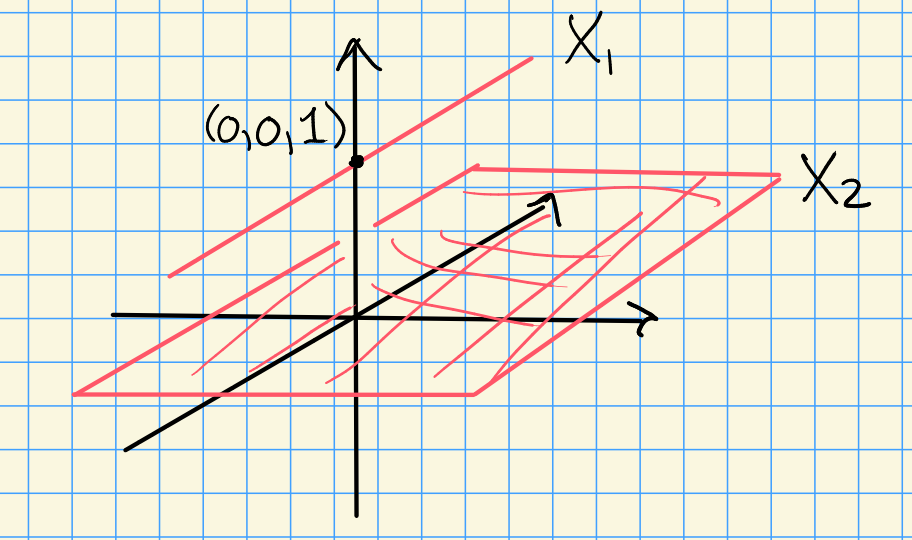
Then \[I(X) = (x, z-1) \cdot (z) = (xz, z^2 - z)\] and the coordinate ring decomposes as \[\CC[X] = \frac{\CC[x,y,z]}{(xz, z^2-z)} \cong \frac{\CC[x,y,z]}{(x, z-1)} \times \frac{\CC[x,y,z]}{(z)} .\]