Fixed points
Contraction mapping principle (Tag PR-5ZSSQ)
Let \((X,d)\) be a nonempty complete metric space, and let \(f\colon X\to X\) be a map for which there exists \(c\in[0,1)\) with \[ d(f(x),f(y)) \leq c\, d(x,y) \quad\text{for all } x, y\in X. \] Then \(f\) has a unique fixed point: there is exactly one \(x_0\in X\) with \(f(x_0) = x_0\).
Fix \(x\in X\) and set \(x_k\coloneqq f^k(x)\). By induction \(d(x_{k+1},x_k)\le c^kd(x_1,x_0)\), so for \(m>k\) the triangle inequality gives \(d(x_m,x_k)\le\frac{c^k}{1-c}d(x_1,x_0)\), and \((x_k)\) is Cauchy. By completeness \(x_k\to x^*\) for some \(x^*\in X\); since \(f\) is continuous, \(f(x^*)=\lim_k f(x_k)=\lim_kx_{k+1}=x^*\). If \(f(y)=y\) as well, then \(d(x^*,y)=d(f(x^*),f(y))\le c\,d(x^*,y)\) with \(c<1\), so \(d(x^*,y)=0\) and \(y=x^*\).
Let \(f\colon X\to X\) be a contraction with constant \(c<1\) on a complete metric space \(X\).
Uniqueness: if \(x, y\) are fixed points, then \(\abs{x-y} = \abs{f(x) - f(y)}\leq c \abs{x-y}\), and \(c<1\) forces \(\abs{x-y} = 0\).
Existence: choose \(x_0\in X\) and set \(x_k \coloneqq f(x_{k-1})\). Then \(\abs{x_{k+1}-x_k} = \abs{f(x_k) - f(x_{k-1}) } \leq c\abs{x_k - x_{k-1}}\), so by induction \(\abs{x_{k+1}- x_k}\leq c^k \abs{x_1 - x_0}\). For \(n < m\), \[ \abs{x_m - x_n} \leq \sum_{k=n}^{m-1} \abs{x_{k+1} - x_{k}} \leq \sum_{k=n}^{m-1} c^k \abs{x_1 - x_0} \leq \frac{c^n}{1-c} \abs{x_1 - x_0}, \] which tends to \(0\) as \(n\to\infty\), so \((x_k)\) is Cauchy and converges to some \(x\in X\). Since \(f\) is continuous, \(f(x) = \lim_k f(x_k) = \lim_k x_{k+1} = x\).
The implicit and inverse function theorems
Implicit function theorem (Tag T-QMGPN)
Suppose \(f\in C^1(\RR^{m+n}, \RR^n)\), written \(f(x,y)\) with \(x\in\RR^m\) and \(y\in\RR^n\), that \(f(a, b) = 0\), and that the partial derivative in the second block, \(\partial f/\partial y\, (a,b)\), is an invertible \(n\times n\) matrix. Then there exists a neighborhood \(U\subseteq \RR^m\) containing \(a\) and a unique \(g\in C^1(U, \RR^n)\) such that \(g(a) = b\) and \(f(x, g(x)) = 0\) for all \(x\in U\).
A relation is locally the graph of a function wherever the block of the derivative belonging to the solved-for variables is nonsingular.
See [@Mun91, Section 9, Theorem 9.2].
Near a point where the derivative in the dependent variables is nonsingular, the solution set of the equation is the graph of a function.
Implicit function theorem for $C^r$ maps (Tag T-TUXBP)
Let \(k,n\geq1\) and \(r\geq1\), let \(A\subseteq\RR^{k+n}\) be open, and let \(f\colon A\to\RR^n\) be of class \(C^r\). Write \(f(\vector x,\vector y)\) with \(\vector x\in\RR^k\) and \(\vector y\in\RR^n\), so that \[ Df=\begin{bmatrix}\dfrac{\partial f}{\partial\vector x} & \dfrac{\partial f}{\partial\vector y}\end{bmatrix} \] splits into an \(n\times k\) block and an \(n\times n\) block. Suppose \((\vector a,\vector b)\in A\) satisfies \(f(\vector a,\vector b)=0\) and \[ \det\frac{\partial f}{\partial\vector y}(\vector a,\vector b)\neq0. \] Then there are a neighbourhood \(B\subseteq\RR^k\) of \(\vector a\) and a unique continuous \(g\colon B\to\RR^n\) with \(g(\vector a)=\vector b\) and \[ f(\vector x,g(\vector x))=0\quad\text{for all }\vector x\in B, \] and this \(g\) is of class \(C^r\).
Differentiating \(f(\vector x,g(\vector x))=0\) gives \[ \frac{\partial f}{\partial\vector x}+\frac{\partial f}{\partial\vector y}\,Dg=0, \qquad\text{so}\qquad Dg(\vector x)=-\Bigl[\frac{\partial f}{\partial\vector y}(\vector x,g(\vector x))\Bigr]^{-1}\frac{\partial f}{\partial\vector x}(\vector x,g(\vector x)). \] The proof applies the inverse function theorem to \(F(\vector x,\vector y)\coloneqq(\vector x,f(\vector x,\vector y))\), whose derivative at a point is invertible if and only if \(\partial f/\partial\vector y\) is invertible there.
See [@Mun91, Section 9, Theorem 9.2]; the formula for \(Dg\) is [@Mun91, Theorem 9.1].
Inverse function theorem (Tag T-XECJ3)
Let \(I\subseteq\RR\) be an open interval, let \(f\in C^1(I)\), and let \(a\in I\) with \(f'(a)\neq0\). Then there are open intervals \(U\ni a\) and \(V\ni b\coloneqq f(a)\) such that \(f\) restricts to a bijection \(U\to V\) whose inverse \(g\colon V\to U\) is \(C^1\), and \[ g'(b)=\frac{1}{f'(a)}. \]
Let \(A\subseteq\RR^n\) be open, let \(F\colon A\to\RR^n\) be \(C^1\), and let \(a\in A\) with \(\det DF(a)\neq0\). Then there are open sets \(U\ni a\) and \(V\ni F(a)\) such that \(F\) restricts to a bijection \(U\to V\) whose inverse \(F^{-1}\colon V\to U\) is \(C^1\), and for every \(p\in U\), \[ D(F^{-1})(F(p))=\bigl(DF(p)\bigr)^{-1}. \]
Let \(\Omega\subseteq\CC\) be open, let \(f\) be holomorphic on \(\Omega\), and let \(p\in\Omega\) with \(f'(p)\neq0\). Then there is an open set \(V\ni p\) such that \(f(V)\) is open and \(f|_V\colon V\to f(V)\) is a biholomorphism.
A \(C^1\) map is invertible, with \(C^1\) inverse, on some neighborhood of each point at which its derivative is invertible.
Convergence of series
(A convergent series that is not absolutely convergent)
\(\sum_{k\geq 1} \inverseof{k}\) diverges, but \(\sum_{k\geq 1} (-1)^{k+1} \inverseof{k}\) converges. Its partial sums \(S_n\) satisfy \(S_2 \leq S_4 \leq \cdots \leq S_3 \leq S_1\), since \(S_{2n+2} - S_{2n} = \frac{1}{2n+1}-\frac{1}{2n+2} > 0\) and \(S_{2n+3} - S_{2n+1} = -\frac{1}{2n+2} + \frac{1}{2n+3} < 0\). The even and odd partial sums are monotone and bounded, so they converge, and \(S_{2n+1} - S_{2n} = \frac{1}{2n+1}\to 0\), so they have a common limit.
Integrals
(Line integrals in the plane)
For \(f\colon\RR^2\to\RR\) differentiable, \(\grad f = \tv{ \dd{f}{x}, \dd{f}{y} }\); a vector field of the form \(F = \grad f\) is a gradient field.
For \(f\) differentiable and a differentiable curve \(\gamma\), the chain rule gives \(\frac{d}{dt} (f\circ \gamma)(t) = \inner{ (\grad f)(\gamma(t))} {\gamma'(t)}\).
For \(F(x, y) = \tv{M(x, y), N(x, y)}\), \(\curl F = \dd{N}{x} - \dd{M}{y}\) and \(\div F = \dd{M}{x} + \dd{N}{y}\).
For \(\gamma\colon[a,b]\to\RR^2\) piecewise \(C^1\), \(\int_\gamma F\cdot \dr = \int_a^b F(\gamma(t))\cdot \gamma'(t) \dt\).
Green’s theorem
Green's theorem (Tag T-4M73O)
Let \(\Omega\subseteq\CC\) be a bounded open set whose boundary \(\bd\Omega\) is a finite union of piecewise smooth closed curves, oriented positively (with \(\Omega\) on the left), and let \(f,g\in C^1(\overline\Omega)\) be real-valued. Then \[ \int_{\bd\Omega}f\dx+g\dy=\iint_\Omega\Big(\frac{\partial g}{\partial x}-\frac{\partial f}{\partial y}\Big)\dA. \] In vector form, for the vector field \(F=(f,g)\) with scalar curl \(\curl F=g_x-f_y\), \[ \int_{\bd\Omega}F\cdot\dr=\iint_\Omega\curl F\dA. \]
Taking \((f,g)=(0,x)\), \((-y,0)\), and \(\big(-\frac y2,\frac x2\big)\), each with \(g_x-f_y=1\), gives the area of \(\Omega\): \[ \mu(\Omega)=\oint_{\bd\Omega}x\dy=-\oint_{\bd\Omega}y\dx=\frac12\oint_{\bd\Omega}(x\dy-y\dx). \]
For \(f\) holomorphic and injective on a neighborhood of \(\overline\Omega\), the real Jacobian determinant of \(f\) is \(\abs{f'(z)}^2\), so the area of the image is \(\mu(f(\Omega))=\iint_\Omega\abs{f'(z)}^2\dA\).
Stokes’ theorem
Stokes' theorem (Tag T-LO7QM)
Let \(M\) be a compact oriented smooth \(n\)-manifold with boundary \(\partial M\), carrying the induced orientation, and let \(\omega\) be a smooth \((n-1)\)-form on \(M\). Then \[ \int_{\partial M}\omega=\int_M d\omega. \] In particular, let \(\Omega\subseteq\CC\) be a bounded open set whose boundary consists of finitely many piecewise smooth closed curves, oriented positively with respect to \(\Omega\), and let \(f\in C^1(\overline{\Omega})\). For \(\omega=f(z)\dz\) one has \(d\omega=\frac{\partial f}{\partial\overline z}\,d\overline z\wedge dz\) and \(d\overline z\wedge dz=2i\,dx\wedge dy\), so \[ \int_{\partial\Omega}f(z)\dz=2i\iint_\Omega\frac{\partial f}{\partial\overline z}\dA. \]
Series and sequences
(Partial fraction decomposition)
Let \(p/q\) be a rational function with \(\deg p < \deg q\) and \(q\) factored over \(\RR\) into linear and irreducible quadratic factors. Then \(p/q\) is a sum of the following terms:
for each linear factor \((x-r)\) of multiplicity \(k\), terms \(\frac{A_1}{x-r}, \frac{A_2}{(x-r)^2}, \ldots, \frac{A_k}{(x-r)^k}\);
for each irreducible quadratic factor \(h\) of multiplicity \(k\), terms \(\frac{B_1x+C_1}{h(x)}, \ldots, \frac{B_kx+C_k}{h(x)^k}\).
Uniform convergence of a series through its tails (Tag PR-4LISY)
Let \(X\) be a set and let \(f_n\colon X\to\CC\) for \(n\ge1\) be functions such that \(\sum_{n=1}^\infty f_n(x)\) converges for every \(x\in X\). Then \(\sum_{n=1}^\infty f_n\) converges uniformly on \(X\) if and only if \[ \lim_{n\to \infty} \sup_{x\in X}\abs{ \sum_{k\geq n} f_k(x) } = 0. \]
Let \(S(x)\coloneqq\sum_{k\ge1}f_k(x)\) and \(S_n(x)\coloneqq\sum_{k=1}^nf_k(x)\). Then \(\sum_{k\ge n}f_k(x)=S(x)-S_{n-1}(x)\), so the displayed condition says exactly that \(\sup_{x\in X}\abs{S(x)-S_{n-1}(x)}\to0\), which is uniform convergence of the partial sums \(S_n\) to \(S\).
Weierstrass M-test (Tag T-AZSCN)
Let \(\Omega\) be a set, let \(f_n\colon\Omega\to\CC\) for \(n\in\NN\), and suppose there are real numbers \(M_n\) with \[ \sup_{x\in\Omega}\abs{f_n(x)}\le M_n\quad\text{for all }n,\qquad\sum_{n\in\NN}M_n<\infty. \] Then \(f(x)\coloneqq\sum_{n\in\NN}f_n(x)\) converges absolutely and uniformly on \(\Omega\). If moreover \(\Omega\) is a topological space and every \(f_n\) is continuous, then \(f\) is continuous, by the uniform limit theorem.
For each \(x\), \(\sum_n\abs{f_n(x)}\le\sum_nM_n<\infty\), so the series converges absolutely. For \(N\ge1\) and all \(x\in\Omega\), \[ \abs{f(x)-\sum_{n\le N}f_n(x)}\le\sum_{n>N}M_n, \] and the right side is independent of \(x\) and tends to \(0\) as \(N\to\infty\).
Inside its radius of convergence, a power series may be integrated and differentiated term by term, and the resulting series have the same radius of convergence. A uniformly convergent series of continuous functions on a compact interval may be integrated term by term. A uniformly convergent series of differentiable functions need not be differentiable term by term: \(\sum_{n\geq1} \frac{\sin(n^2x)}{n^2}\) converges uniformly on \(\RR\) while the series of derivatives \(\sum_{n\geq 1} \cos(n^2x)\) diverges at \(x=0\).
Ratio test (Tag PR-WIMIM)
Let \((a_k)_{k\ge0}\) be nonzero complex numbers such that \(L\coloneqq\lim_{k\to\infty}\abs{\frac{a_{k+1}}{a_k}}\) exists in \([0,\infty]\).
If \(L<1\), then \(\sum_k a_k\) converges absolutely.
If \(L>1\), then \(\sum_k a_k\) diverges.
If \(L=1\), the test gives no information: \(\sum_k 1/k\) diverges and \(\sum_k 1/k^2\) converges, and both have \(L=1\).
In particular, if \(c_k\neq0\) and \(\lim_k\abs{c_{k+1}/c_k}=\ell\in[0,\infty]\), applying the test to \(a_k=c_kz^k\) shows that \(\sum_kc_kz^k\) has radius of convergence \(1/\ell\), with \(1/0=\infty\) and \(1/\infty=0\).
Root test for power series (Tag PR-TOK44)
Let \((a_n)_{n\ge0}\) be complex numbers, \(z_0\in\CC\), and \[ R\coloneqq\liminf_{n\to\infty}\abs{a_n}^{-1/n}=\frac{1}{\limsup_{n\to\infty}\abs{a_n}^{1/n}}\in[0,\infty], \] with the conventions \(1/0=\infty\) and \(1/\infty=0\). Then the power series \(\sum_{n\ge0}a_n(z-z_0)^n\)
converges absolutely on \(\ts{z\st\abs{z-z_0}<R}\),
converges uniformly on \(\ts{z\st\abs{z-z_0}\le r}\) for every \(r<R\), and
diverges on \(\ts{z\st\abs{z-z_0}>R}\).
Radius of convergence by the root test (Tag PR-NQ64T)
Let \((c_k)_{k\ge0}\) be complex numbers, and define \(R\in[0,\infty]\) by \[ \frac1R\coloneqq\limsup_{k\to\infty}\abs{c_k}^{1/k}, \] with the conventions \(1/0=\infty\) and \(1/\infty=0\). Then the power series \(f(z)=\sum_{k\ge0}c_kz^k\) converges absolutely for \(\abs{z}<R\), uniformly on every closed disc \(\abs{z}\le r\) with \(r<R\), and diverges for \(\abs{z}>R\). So \(R\) is the radius of convergence of the series.
Moreover \(f\) is holomorphic on \(D_R\coloneqq\ts{z\st\abs{z}<R}\), and it can be differentiated term by term: \[ f'(z)=\sum_{k\ge1}kc_kz^{k-1},\qquad \abs{z}<R, \] where the differentiated series has the same radius of convergence \(R\).
The $p$-test (Tag PR-5WUAP)
For \(p\in\RR\), the series \(\sum_{n\ge1} n^{-p}\) converges if and only if \(p>1\).
If \(p\le0\), then \(n^{-p}\ge1\) for all \(n\), so the terms do not tend to \(0\) and the series diverges. If \(p>0\), the function \(x\mapsto x^{-p}\) is positive and decreasing on \([1,\infty)\), so by the integral test the series converges if and only if \(\int_1^\infty x^{-p}\dx\) is finite, which holds if and only if \(p>1\).
(Cauchy product)
Where both series converge absolutely, \[ \sum_{k\geq 0} a_kz^k \cdot \sum_{k\geq 0} b_k z^k = \sum_{k\geq 0} c_k z^k,\qquad c_k \coloneqq \sum_{j=0}^k a_j b_{k-j}. \] The standard power series are on Series reference.
(Polynomial division)
For polynomials \(f, g\) over a field with \(g\neq 0\), there are unique polynomials \(q, r\) with \(f = qg + r\) and \(\deg r < \deg g\) or \(r = 0\).
Dirichlet's test (Tag FT-3ZL25)
Let \((a_n)_{n\ge1}\) be a sequence of real numbers and \((b_n)_{n\ge1}\) a sequence of complex numbers such that
\(a_{n+1} \leq a_n\) for all \(n\) and \(a_n \to 0\), and
there exists \(M\ge0\) such that \(\abs{\sum_{n=1}^N b_n} \leq M\) for all \(N\ge1\).
Then the series \(\sum_{n=1}^\infty a_n b_n\) converges.
Dirichlet's test (Tag FT-BSOZF)
Let \((a_n)_{n\ge1}\) be a sequence of real numbers and \((b_n)_{n\ge1}\) a sequence of complex numbers such that
\((a_n)\) is nonincreasing and \(a_n\to0\), and
there exists \(M\ge0\) such that \(\abs{\sum_{n=1}^N b_n} \leq M\) for every \(N\ge1\).
Then the series \(\sum_{n=1}^\infty a_n b_n\) converges.
Convergence of functions
Locally uniform convergence (Tag D-AIQG3)
Let \(\Omega\subseteq\CC\) be open and let \(f_n,f\colon\Omega\to\CC\) for \(n\ge1\). The sequence \((f_n)\) converges locally uniformly to \(f\) on \(\Omega\) if \(f_n\to f\) uniformly on every compact subset \(K\subseteq\Omega\).
Equicontinuous family (Tag D-5Y4MC)
Let \(S\subseteq\CC\) and let \((f_n)_{n\ge1}\) be a sequence of functions \(f_n\colon S\to\CC\). The family \(\{f_n\}\) is equicontinuous on \(S\) if for every \(\varepsilon>0\) there exists \(\delta>0\) such that \[ \abs{f_n(x)-f_n(y)}<\varepsilon\qquad\text{for all } n\ge1 \text{ and all } x,y\in S \text{ with } \abs{x-y}<\delta. \]
The number \(\delta\) depends only on \(\varepsilon\), not on \(n\), \(x\), or \(y\). [@Rud76] states this definition for families of complex functions on a subset of a metric space.
(Arzelà--Ascoli)
For \(X\) compact Hausdorff, equip \(C(X; \RR)\) with the uniform norm \(\norm{f}_{\infty} \coloneqq \sup_{x\in X} \abs{f(x)}\). A subset \(A \subseteq C(X;\RR)\) is compact if and only if it is closed, bounded, and equicontinuous. In particular, every bounded equicontinuous sequence in \(C(X;\RR)\) has a uniformly convergent subsequence.
Normal family (Tag D-QTJ7T)
Let \(\Omega\subseteq\CC\) be open. A family \(\mathcal F\) of holomorphic functions on \(\Omega\) is normal if every sequence in \(\mathcal F\) has a subsequence converging uniformly on every compact subset of \(\Omega\).
The limit of such a subsequence need not lie in \(\mathcal F\): normality says that \(\mathcal F\) is precompact in the topology of locally uniform convergence, and \(\mathcal F\) is compact in that topology exactly when, in addition, every such limit lies in \(\mathcal F\).
In the proof of the Riemann mapping theorem for a simply connected open set \(\Omega\subsetneq\CC\) and \(z_0\in\Omega\), one maximizes \(\abs{f'(z_0)}\) over the injective holomorphic maps \(f\colon\Omega\to\DD\) with \(f(z_0)=0\). This family is uniformly bounded, hence normal by Montel's theorem, so a maximizing sequence has a locally uniformly convergent subsequence, whose limit is the candidate Riemann map.
Two inequivalent definitions of normality are in use. The definition by locally uniformly convergent subsequences is that of [@SS03]. In [@Ahl79], a family is normal if every sequence has a subsequence that either converges uniformly on compact sets or tends uniformly to \(\infty\) on compact sets; this is locally uniform convergence in the spherical metric on the Riemann sphere, and the same definition applies to families of meromorphic functions.
The family \(\{f_n\}_{n\ge1}\) with \(f_n(z)=n(z^2-n)\) on \(\CC\) is normal in the sense of [@Ahl79], and the sequence \((f_n)\) has no locally uniformly convergent subsequence. On \(\abs{z}\le R\) and for \(n>R^2\), \(\abs{f_n(z)}\ge n^2-nR^2\to\infty\) uniformly, so every subsequence tends uniformly to \(\infty\) on compact sets and none converges uniformly on compact sets to a finite function.
Montel's theorem is [@SS03, Theorem 3.3].
A continuous function on a compact metric space is uniformly continuous.
Univalent functions (Tag D-HL4KE)
Let \(U\subseteq\CC\) be open. A holomorphic function \(f\colon U\to\CC\) is univalent if \(f\) is injective.
If \(f\colon \Omega \to \Omega'\) is a holomorphic bijection, then \(\inverseof{f}\) is holomorphic. For real functions the analogue fails: \(f(x) = x^3\) is a smooth bijection \(\RR\to\RR\) with \(f'(0) = 0\), and \(\inverseof{f}(x) = x^{1/3}\) is not differentiable at \(0\).
Exercises
Radius of convergence of $\sqrt{z}$ about $4+3i$ (Tag E-5GT6F)
Find the radius of convergences for the power series expansion of \(\sqrt{z}\) about \(z_0 = 4 +3i\).
Solution
Let \(f(z)\) be a branch of \(\sqrt{z}\) defined and holomorphic in a neighborhood of \(z_0 = 4 + 3i\) (for example, the principal branch).
The branch \(f\) is holomorphic on the disk \(\abs{z-z_0}<\abs{z_0}\), which does not contain the branch point \(0\), so the Taylor series of \(f\) about \(z_0\) has radius of convergence at least \[ |z_0| = |4 + 3i| = \sqrt{4^2 + 3^2} = 5. \]
Writing \(z = z_0 \left(1 + \frac{z - z_0}{z_0}\right)\), \[ \sqrt{z} = \sqrt{z_0} \left(1 + \frac{z - z_0}{z_0}\right)^{1/2} = \sqrt{z_0} \sum_{n=0}^\infty \binom{1/2}{n} \left(\frac{z - z_0}{z_0}\right)^n. \] Since \(1/2\notin\NN\), the ratio \(\abs{\binom{1/2}{n+1}/\binom{1/2}{n}}=\abs{1/2-n}/(n+1)\) tends to \(1\), so the binomial series \(\sum_{n=0}^\infty \binom{1/2}{n} w^n\) has radius of convergence exactly \(1\). With \(w = \frac{z - z_0}{z_0}\), the series converges for \(|z - z_0| < |z_0| = 5\) and diverges for \(|z-z_0|>5\).
Thus, the radius of convergence is \(R = 5\), the distance from \(z_0\) to the branch point \(0\).
$\int_\Gamma\Re(z)\,dz$ around the unit square (Tag E-2JGJL)
Compute \(\int_\Gamma \Re(z) \dz\) for \(\Gamma\) the unit square.
Solution
Write \(\Gamma = \sum_{1\leq k \leq 4}\gamma_k\), starting at zero and traversing counterclockwise through \(0\), \(1\), \(1+i\), \(i\):
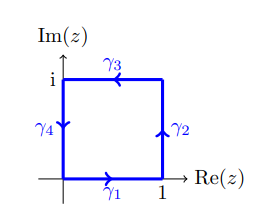
For \(t\in[0,1]\):
\(\gamma_1(t)=t\): \(\int_0^1 t\dt = 1/2\).
\(\gamma_2(t)=1+it\): \(\int_0^1 1\cdot i \dt = i\).
\(\gamma_3(t)=(1-t)+i\): \(-\int_0^1 (1-t)\dt = -1/2\).
\(\gamma_4(t)=i(1-t)\): \(-i\int_0^1 0 \dt = 0\).
So \(\int_\Gamma \Re(z) \dz = i\).
Differentiable contractions are uniformly continuous (Tag E-CLMEK)
Show that if \(f\) is a differentiable contraction, \(f\) is uniformly continuous.
Solution
By definition, a contraction satisfies \[ d(f(x),f(y))\le c\,d(x,y) \] for some constant \(0\le c<1\) and for all \(x,y\) in its domain. Thus \(f\) is Lipschitz. Given \(\varepsilon>0\), if \(c=0\) then \(f\) is constant; otherwise take \(\delta=\varepsilon/c\). Whenever \(d(x,y)<\delta\), \[ d(f(x),f(y))\le c\,d(x,y)<\varepsilon. \] Therefore \(f\) is uniformly continuous. Differentiability is not needed.
Heine--Cantor theorem: a continuous map on a compact metric space is uniformly continuous (Tag E-DXXL4)
Prove the Heine–Cantor Theorem: let \((X, d_X)\) and \((Y, d_Y)\) be metric spaces. If \(X\) is compact and \(f: X \to Y\) is continuous, then \(f\) is uniformly continuous.
Solution
Fix \(\varepsilon>0\). For each \(p\in X\), continuity gives \(r_p>0\) such that \[ d_X(x,p)<r_p \quad\Longrightarrow\quad d_Y(f(x),f(p))<\frac\varepsilon2. \] The balls \(B(p,r_p/2)\) cover \(X\). By compactness, choose a finite subcover \[ B(p_1,r_1/2),\dots,B(p_N,r_N/2). \] Set \[ \delta=\frac12\min_{1\le j\le N}r_j>0. \]
If \(d_X(x,y)<\delta\), choose \(j\) with \(x\in B(p_j,r_j/2)\). Then \[ d_X(y,p_j)\le d_X(y,x)+d_X(x,p_j) <\delta+\frac{r_j}{2}\le r_j. \] Thus \[ d_Y(f(x),f(p_j))<\frac\varepsilon2, \qquad d_Y(f(y),f(p_j))<\frac\varepsilon2. \] By the triangle inequality, \[ d_Y(f(x),f(y))<\varepsilon. \] Hence \(f\) is uniformly continuous.
Uniform limits preserve continuity and uniform continuity; pointwise limits need not (Tag E-6ULIT)
Show that a uniform limit of continuous functions is continuous, and a uniform limit of uniformly continuous functions is uniformly continuous. Show that this is not true if uniform convergence is weakened to pointwise convergence.
Solution
Suppose \(\norm{f_n - f}_\infty\to 0\) and fix \(\eps>0\). For all \(z,w\) and \(n\), \[ \abs{f(z) - f(w)} \leq \abs{f(z) - f_n(z)} + \abs{f_n(z) - f_n(w)} + \abs{f_n(w) - f(w)} \leq 2\norm{f-f_n}_\infty+\abs{f_n(z) - f_n(w)} .\] Choose \(n\) with \(\norm{f-f_n}_\infty<\eps/3\).
- Continuity: fix \(z\). Since \(f_n\) is continuous at \(z\), there is \(\delta>0\) with \(\abs{f_n(z)-f_n(w)}<\eps/3\) for \(\abs{z-w}<\delta\), and then \(\abs{f(z)-f(w)}<\eps\).
- Uniform continuity: if \(f_n\) is uniformly continuous, there is \(\delta>0\) with \(\abs{f_n(z)-f_n(w)}<\eps/3\) for all \(z,w\) with \(\abs{z-w}<\delta\), and then \(\abs{f(z)-f(w)}<\eps\) for all such \(z,w\).
The choice of one \(n\) for all \(z\) uses \(\norm{f-f_n}_\infty<\eps/3\); pointwise convergence gives an \(n\) depending on the point.
Pointwise limits: on \([0,1]\), the uniformly continuous functions \(f_n(x) \da x^n\) converge pointwise to \(\chi_{\theset{1}}\), which is not continuous, hence not uniformly continuous.
Uniform convergence of $\sin(nx)/(1+nx)$ (Tag E-5KI4G)
Determine where the following real-valued function is or is not uniformly convergent: \[ f_n(x) \da {\sin(nx)\over 1+nx} .\]
Solution
For each \(x\geq0\), \(\abs{f_n(x)}\le 1/(1+nx)\) for \(x>0\) and \(f_n(0)=0\), so \(f_n\to0\) pointwise on \([0,\infty)\).
The convergence is uniform on \([a, \infty)\) for every \(a>0\): \[ \sup_{x\geq a}\abs{\sin(nx) \over 1+nx} \leq {1\over 1 + na} \convergesto{n\to\infty} 0 .\]
The convergence is not uniform on \((0, \infty)\): \[ x_n \da {1\over n} \implies \sup_{x>0}\abs{f_n(x)}\geq\abs{f_n(x_n)} = {\sin(1) \over 2} \] for every \(n\).
$\sum_{k\geq 0}z^k/k!$ converges locally uniformly to $e^z$ (Tag E-4P3T2)
Show that \(\sum_{k\geq 0}z^k/k!\) converges locally uniformly to \(e^z\).
Solution
Let \(K\) be compact, and choose \(M\) with \(\abs{z} \leq M\) for \(z\in K\). Then, with \(\norm{\cdot}_\infty\) the supremum over \(K\), \[ \norm{e^z - \sum_{0\leq k \leq n} z^k/k!}_\infty &= \norm{\sum_{k\geq n+1}z^k/k! }_{\infty} \\ &\leq \sum_{k\geq n+1} M^k /k! .\] The right side is the tail of the convergent series \(\sum_{k\geq0}M^k/k!=e^M\), so it tends to \(0\) as \(n\to\infty\). Hence the partial sums converge to \(e^z\) uniformly on \(K\) (this is the Weierstrass \(M\)-test with \(M_k=M^k/k!\)).
Uniform convergence $f_n\to f$ implies $\int_\gamma f_n\to\int_\gamma f$ (Tag E-XXUNZ)
Show that if \(f_n\to f\) uniformly then \(\int_\gamma f_n\to \int_\gamma f\).
Solution
\[ \abs{ \int_\gamma f_n(z) \dz - \int_\gamma f(z) \dz } &= \abs{\int_\gamma f_n(z) - f(z) \dz} \\ &\leq \int_\gamma \abs{f_n - f} \abs{\dz} \\ &\leq \int_\gamma \norm{f_n - f}_{\infty, \gamma} \cdot \abs{\dz} \\ &= \eps \cdot \length(\gamma) \\ &\convergesto{n\to\infty} 0 .\]