A nonconstant holomorphic function on a connected open set is an open map, and its modulus has no local maximum.
The open mapping theorem
Open mapping theorem (Tag C-FRF33)
Let \(\Omega\subseteq\CC\) be a connected open set and let \(f\) be a nonconstant holomorphic function on \(\Omega\). Then \(f\) is an open map: \(f(U)\) is open for every open set \(U\subseteq\Omega\).
Open mapping theorem (Tag FT-OEYLQ)
Let \(\Omega\subseteq\CC\) be a connected open set and let \(f\colon \Omega \to \CC\) be holomorphic and nonconstant. Then \(f\) is an open map: \(f(U)\) is open for every open set \(U\subseteq\Omega\).
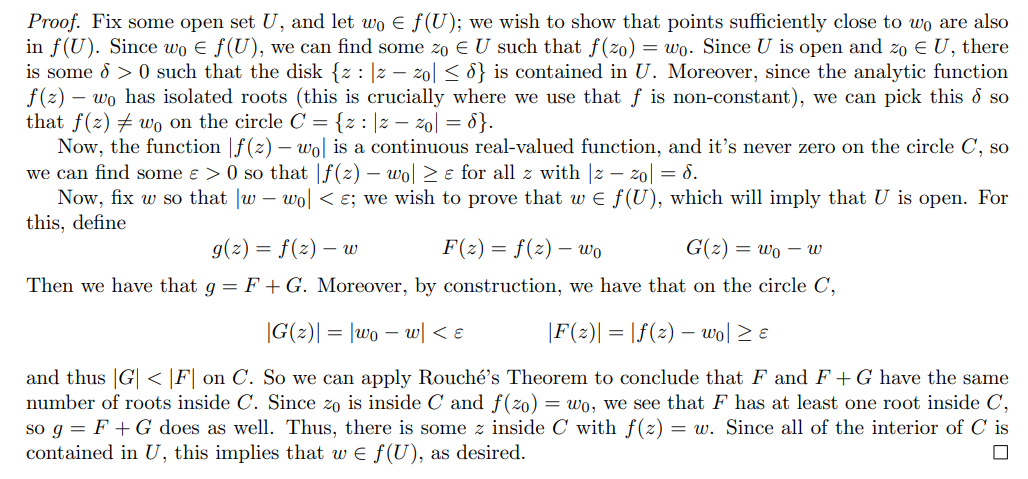
(Using Rouché's theorem)
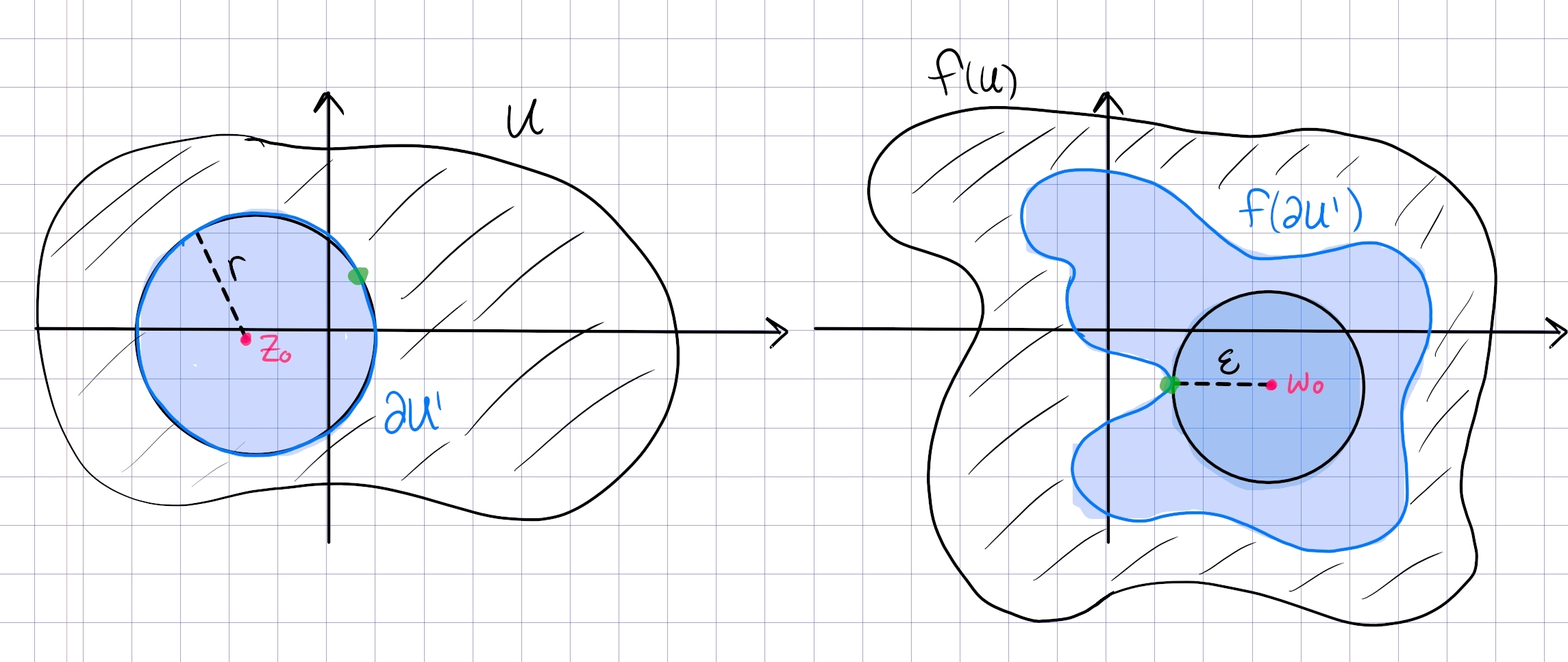
(Using the argument principle)
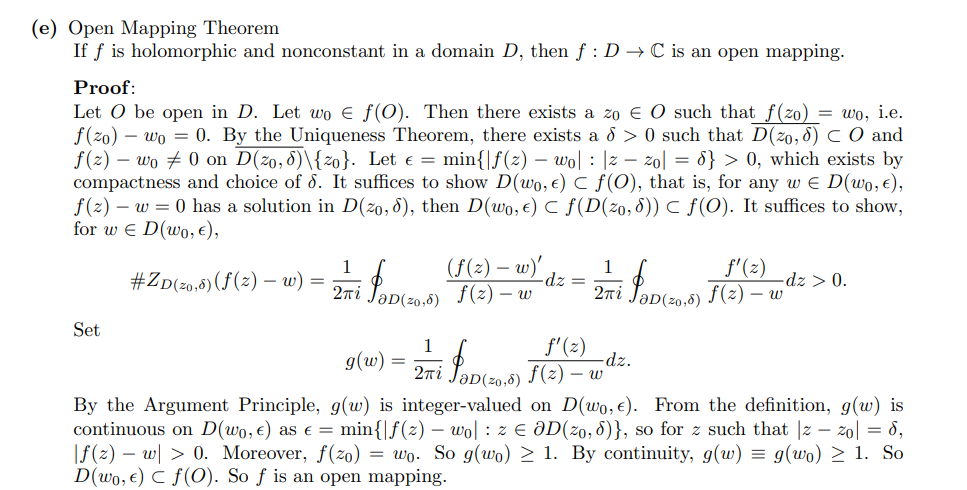
(Using local degrees)
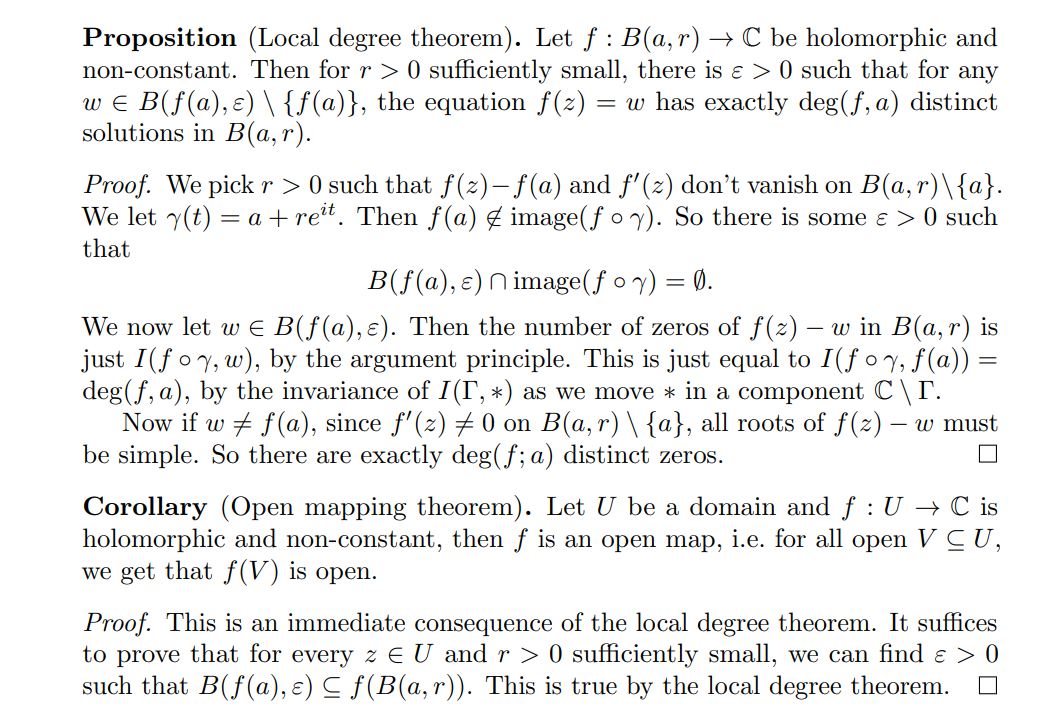
(Common structure of the proofs)
Each proof shows that for \(w\) near \(w_0 \coloneqq f(z_0)\) the equation \(f(z) = w\) has a solution near \(z_0\), by counting zeros of \(f - w\). Since \(f\) is nonconstant, the zeros of \(f - w_0\) are isolated, so there is \(r>0\) with \(\delta \coloneqq \min_{\abs{z-z_0}=r}\abs{f(z)-w_0} > 0\). For \(\abs{w-w_0}<\delta\), Rouché’s theorem applied to \(f - w = (f-w_0) + (w_0 - w)\) shows that \(f-w\) has as many zeros in \(D_r(z_0)\) as \(f-w_0\), hence at least one.
Maximum modulus
Maximum modulus principle (Tag T-BYNL5)
Let \(\Omega\subseteq\CC\) be open and let \(f\) be holomorphic on \(\Omega\).
If \(\abs f\) has a local maximum at \(z_0\in\Omega\), then \(f\) is constant on a neighborhood of \(z_0\).
If \(\Omega\) is bounded and connected and \(f\) extends continuously to \(\overline\Omega\), then either \(f\) is constant or \(\abs f\) attains its maximum \(M\coloneqq\max_{z\in\overline\Omega}\abs{f(z)}\) only at points of \(\bd\Omega\).
Maximum modulus principle (Tag FT-DWCQ7)
Let \(\Omega\subseteq\CC\) be a connected open set and let \(f\colon \Omega \to \CC\) be holomorphic and nonconstant. Then \(\abs{f}\) attains no local maximum in \(\Omega\).
(By the open mapping theorem)
Suppose \(\abs{f(z)}\leq\abs{f(z_0)}\) for \(z\) in a disc \(U\) about \(z_0\), and that \(f\) is nonconstant on \(U\). By the open mapping theorem, \(f(U)\) is an open set containing \(f(z_0)\), so it contains \((1+t)f(z_0)\) for small \(t>0\) if \(f(z_0)\neq 0\), and a small nonzero value if \(f(z_0)=0\). Either value has modulus larger than \(\abs{f(z_0)}\), a contradiction, so \(f\) is constant on \(U\).
(By the mean value property)
Suppose \(\abs{f(z)}\leq\abs{f(z_0)}\) on a disc \(\DD_R(z_0) \subseteq \Omega\). For \(0<r<R\) the mean value property gives \[ \abs{f(z_0)} = \abs{{1\over 2\pi} \int_0^{2\pi } f(z_0 + re^{it}) \dt} \leq {1\over 2\pi}\int_0^{2\pi }\abs{f(z_0 + re^{it})} \dt \leq \abs{f(z_0)} .\] The integrand \(\abs{f(z_0)} - \abs{f(z_0+re^{it})}\) is continuous and nonnegative with integral \(0\), so it vanishes, and \(\abs f = \abs{f(z_0)}\) on \(\DD_R(z_0)\). If \(\abs{f(z_0)} = 0\) then \(f\equiv 0\) there. Otherwise \(\bar f = \abs{f(z_0)}^2/f\) is holomorphic on \(\DD_R(z_0)\), so \(f\) and \(\bar f\) both satisfy the Cauchy–Riemann equations, which forces \(f' = 0\) and \(f\) constant on \(\DD_R(z_0)\). On a connected \(\Omega\), the identity principle extends this to \(\Omega\).
(Harmonic functions)
A real harmonic function \(u\) is continuous and has the mean value property, so the integral argument with \(u(z_0) - u(z_0+re^{it})\) in place of \(\abs{f(z_0)} - \abs{f(z_0+re^{it})}\) shows that \(u\) is constant near a local maximum.
Strict maximum principle, real version (Tag PR-6WOTK)
Let \(D\subseteq\CC\) be a connected open set, let \(u\colon D\to\RR\) be harmonic, and let \(M\in\RR\) satisfy \(u(z) \leq M\) for all \(z \in D\). If \(u(z_0)=M\) for some \(z_0 \in D\), then \(u(z)=M\) for all \(z \in D\).
(from Gamelin)
The set \(\ts{u(z)=M}\) is open. Suppose \(u(z_1)=M\) and \(\DD_\rho(z_1)\subseteq D\), and write the mean value equality as \[ 0=\int_{0}^{2 \pi}\left[u\left(z_{1}\right)-u\left(z_{1}+r e^{i \theta}\right)\right] \frac{\dtheta}{2 \pi}, \quad 0<r<\rho .\] Since \(u\leq M\), the integrand is nonnegative and continuous, so it vanishes identically. Thus \(u(z_1+re^{i\theta})=u(z_1)=M\) for all such \(r, \theta\), and \(\ts{u(z)=M}\) contains a disc about each of its points, hence is open. The set \(\ts{u(z)<M}\) is open by continuity. Since \(D\) is connected one of them is empty, so either \(u<M\) throughout or \(u\equiv M\).
Strict maximum principle for complex-valued harmonic functions (Tag PR-QW3ZK)
Let \(D\subseteq\CC\) be a connected open set and let \(h=u+iv\) be a complex-valued function on \(D\) whose real and imaginary parts are harmonic. If \(\abs{h(z)}\le M\) for all \(z\in D\) and \(\abs{h(z_0)}=M\) for some \(z_0\in D\), then \(h\) is constant on \(D\).
Write \(h(z_0)=Me^{i\varphi}\) and put \(U\coloneqq\Re\big(e^{-i\varphi}h\big)=u\cos\varphi+v\sin\varphi\), a real harmonic function on \(D\). Then \(U\le\abs{h}\le M\) on \(D\) and \(U(z_0)=M\), so by the strict maximum principle for real harmonic functions on a connected open set, \(U\equiv M\). Since \(M=U\le\abs{e^{-i\varphi}h}\le M\), the imaginary part of \(e^{-i\varphi}h\) vanishes, so \(e^{-i\varphi}h\equiv M\) and \(h\equiv Me^{i\varphi}\).
(from Gamelin)
Replace \(h(z)\) by \(\lambda h(z)\) for a unimodular constant \(\lambda\) so that \(h(z_0) = M\), and set \(u = \Re h\). Then \(u\) is harmonic on \(D\) and attains its maximum at \(z_0\), so \(u \equiv M\) by the strict maximum principle for real harmonic functions. Since \(\abs h \leq M\) and \(\Re h = M\), we get \(\Im h = 0\), so \(h\) is constant.
Maximum principle for complex-valued harmonic functions (Tag C-KOFDQ)
Let \(D\subseteq\CC\) be a bounded domain, and let \(h\colon D\to\CC\) be harmonic and extend continuously to \(\overline D\). If \(\abs{h(z)}\le M\) for all \(z\in\bd D\), then \(\abs{h(z)}\le M\) for all \(z\in D\).
Since \(\overline D\) is compact and \(h\) is continuous on it, \(\abs h\) attains its maximum on \(\overline D\) at some \(z^*\). If \(z^*\in\bd D\), then \(\abs h\leq \abs{h(z^*)}\leq M\) on \(D\). If \(z^*\in D\), then Strict maximum principle for complex-valued harmonic functions makes \(h\) constant on \(D\), hence on \(\overline D\) by continuity, and its constant modulus is at most \(M\) because \(\bd D\) is nonempty.
Minimum modulus
Minimum modulus principle (Tag T-YLI6Y)
Let \(\Omega\subseteq\CC\) be a connected open set and let \(f\) be holomorphic and nonvanishing on \(\Omega\).
If \(\abs{f}\) has a local minimum at some \(z_0\in\Omega\), then \(f\) is constant on \(\Omega\).
If moreover \(\Omega\) is bounded, \(f\) extends continuously to \(\overline{\Omega}\), and \(f\) is nonconstant, then \(\min_{\overline{\Omega}}\abs{f}\) is attained only at points of \(\partial\Omega\).
Since \(f\) does not vanish on \(\Omega\), \(g \coloneqq 1/f\) is holomorphic on \(\Omega\). A local minimum of \(\abs f\) at \(z_0\) is a local maximum of \(\abs g\) at \(z_0\), so \(g\), and hence \(f\), is constant near \(z_0\) by the maximum modulus principle Maximum modulus principle. On a connected \(\Omega\) the identity principle makes \(f\) constant.
(The nonvanishing hypothesis is necessary)
The function \(f(z) = z\) on \(\DD\) is nonconstant, and \(\abs f\) has its minimum at the interior point \(0\).
Exercises
A holomorphic function on $\DD\setminus\{0\}$ with $|f(z)|\le\log(1/|z|)$ is identically zero (Tag P-FHQAB)
Show that if \(f\) is holomorphic on \(\DD\smz\) and \(\abs{f(z)} \leq \log\qty{1\over \abs{z}}\), then \(f\equiv 0\).
Solution
Claim: \(f\) has a removable singularity at \(z_0=0\).
Thus \(f\) extends to some holomorphic \(F\) defined on \(\DD\).
By continuity, \(\abs{F}\) satisfies the same inequality as \(f\).
Now \(\lim_{\abs z \to 1}\abs{F(z)}\leq \lim_{\abs z\to 1} \log\qty{1\over \abs{z}} = 0\), so by the MMP on \(\DD\), \(F\equiv 0\) on \(\DD\smz\).
No conformal bijection from the punctured disk onto the annulus $1<\abs z<2$ (Tag E-7ZCKU)
Show that there is no bijective conformal map from \(A\da \ts{0< \abs{z} < 1}\) to \(B\da \ts{1<\abs{z} < 2}\).
Solution
Suppose toward a contradiction that \(f: A\to B\) is a bijective conformal map. Since \(f(A) \subseteq B\), which is bounded, the isolated singularity of \(f\) at \(0\) is removable. So \(f\) extends holomorphically to \(F: \DD\to \bar{B}\). As \(F\) is nonconstant, it is an open map, so \(F(\DD)\) is open and contained in \(\bar B\), hence \(F(\DD) \subseteq B\). Write \(w_0 \da F(0) \in B\). By surjectivity there is a \(z_0\in A\) such that \(f(z_0) = w_0\). Choose disjoint open disks \(U\ni z_0\) and \(V\ni0\) in \(\DD\) with \(0\notin U\). Since \(F\) is open, \(F(U)\intersect F(V)\) is an open set containing \(w_0\), so it contains a point \(w\neq w_0\). Then \(w=F(v)\) for some \(v\in V\) with \(v\neq0\) (as \(F(0)=w_0\)), and \(w=F(u)\) for some \(u\in U\). Both \(u\) and \(v\) lie in \(A\) and \(u\neq v\) since \(U\intersect V\) is empty, so \(f(u)=f(v)\) contradicts injectivity of \(f\).
Holomorphic functions satisfying $f^{2}=\overline{f}$ are constant (Tag E-RKPAV)
Prove that if \(f\) is holomorphic on a connected open set \(\Omega\) and \(f^2(z) = \bar{f(z)}\) then \(f\) is constant.
Solution
Write \(F(z) \da f^3(z)\) so that \[ F(z) = f^2(z) f(z) = \bar{f(z)}f(z) = \abs{f(z)}^2 .\] Since \(F\) is also holomorphic on \(\Omega\) and this calculation shows \(F(\Omega) \subseteq \Omega\), \(F\) must be constant by the open mapping theorem. So \(f^3(z) = c\) for some \(c\), forcing \(f\) to be constant as well.
A nonvanishing function holomorphic on the disc with $\abs f=1$ on the circle is constant (Tag E-SS2.EX-15)
- Suppose \(f\) is a non-vanishing continuous function on \(\overline{\mathbb{D}}\) that is holomorphic in \(\mathbb{D}\). Prove that if
\[ | f (z) | = 1 \quad \text { whenever } | z | = 1, \]
then \(f\) is constant.
[Hint: Extend \(f\) to all of \(\mathbb{C}\) by \(f ( z ) = 1 / \overline { f ( 1 / \overline { { z } } ) }\) whenever \(|z| > 1\), and argue as in the Schwarz reflection principle.]
Solution
Because \(f\) is continuous on \(\overline{\mathbb D}\), holomorphic on \(\mathbb D\), and satisfies \(|f|=1\) on \(\partial\mathbb D\), the maximum-modulus principle gives \[ |f(z)|\le1\qquad(z\in\mathbb D). \tag{1} \]
Since \(f\) is non-vanishing on \(\overline{\mathbb D}\), the function \(1/f\) is continuous on \(\overline{\mathbb D}\) and holomorphic on \(\mathbb D\). On the boundary, \[ \left|\frac1{f(z)}\right|=1. \] Applying the maximum-modulus principle to \(1/f\) yields \[ \frac1{|f(z)|}\le1, \] so \[ |f(z)|\ge1\qquad(z\in\mathbb D). \tag{2} \] Combining (1) and (2) gives \(|f(z)|=1\) throughout \(\mathbb D\).
If \(f\) were nonconstant, the open mapping theorem would imply that \(f(\mathbb D)\) is open in \(\mathbb C\), but it is contained in the unit circle, which has empty interior. This is impossible. Hence \(f\) is constant.
A holomorphic function attaining a minimum of $|f|$ vanishes there or is constant (Tag E-ZC34M)
Let \(f: \Omega\to \CC\) be holomorphic and suppose there is a \(z_0 \in \Omega\) with \(\abs{f(z_0)}\leq \abs{f(z)}\) for all \(z\in \Omega\). Show that either \(f(a) = 0\) or \(f\) is constant.
Solution
Suppose \(f(z_0)\neq 0\), then the inequality forces there to be no zeros in \(\Omega\). So \(g(z) \da 1/f(z)\) is nonzero and holomorphic on \(\Omega\) and \(\abs{g(z)}\leq \abs{1\over f(z_0)} \da \abs{g(z_0)}\). Since \(z_0\in \Omega\), the MMP forces \(g\) to be constant, and thus so is \(f\).
Entire functions with nonnegative real part are constant (Tag E-ZDVLE)
Show that if \(\Re(f(z)) \geq 0\) for all \(z\in \CC\), then \(f\) is constant.
Solution
Define \(g(z) \da e^{-f(z)}\), then \[ \abs{g(z)} = e^{-\Re(f(z))} \leq e^0 = 1 .\] Since \(g\) is entire and bounded, \(g\) is constant and thus so is \(f\).
Constancy on a closed subdisk of $\mathbb{D}$ implies constancy on $\mathbb{D}$ (Tag E-J3QMJ)
Show that if \(f\in\Hol(\DD)\) is constant on a closed disk \(r\bar\DD\) for some \(0<r<1\), then \(f\) is constant on \(\DD\).
Solution
Let \(c\) be the constant value of \(f\) on \(r\bar\DD\). Then the holomorphic function \(f-c\) vanishes on the nonempty open set \(r\DD\). Since \(\DD\) is connected, the identity theorem gives \(f-c\equiv0\) on \(\DD\). Hence \(f\equiv c\) on \(\DD\).
An entire function with bounded $n$th derivative is a polynomial of degree at most $n$ (Tag E-TYPSR)
Suppose \(f\) is entire and \(f^{(n)}\) is bounded on \(\CC\). Show that \(f\) is a polynomial of degree at most \(n\).
Solution
By Liouville or MMP, \(f^{(n)}\) is bounded and entire and thus constant. Integrating a constant \(n\) times yields a polynomial of degree t most \(n\).
Harmonic functions on $\DD$ with $u(1/2)=2$ and $\abs u\ge2$ (Tag E-6IZL3)
Find all harmonic functions \(u:\DD\to \CC\) such that \(u(1/2) = 2\) and \(\abs{u(z)}\geq 2\) for all \(\abs{z} \leq 1\).
Solution
Assume \(u\) is real-valued; the remark treats complex-valued \(u\). Since \(\DD\) is connected, \(u\) is continuous and \(\abs u\ge2\), either \(u\ge2\) on \(\DD\) or \(u\le-2\) on \(\DD\). As \(u(1/2)=2\), \(u\geq 2\) on \(\DD\), so \(u\) attains its minimum at the interior point \(1/2\). By the minimum principle for harmonic functions, \(u\equiv2\). The only such function is the constant \(\boxed{u\equiv2}\).
For complex-valued \(u\) the conditions cut out no family simpler than the conditions themselves, which is why the solution treats real-valued \(u\). For every real harmonic \(h\) on \(\DD\) with \(h(1/2)=0\), \(u=2+ih\) satisfies both, since \(\abs{u}^2=4+h^2\). The real part need not be constant either: for \(0<\eps\le1\) and \(K^2\ge4\eps\), the harmonic function \(u=2+\eps\qty{(x-\tfrac12)^2-y^2}+iKy\) has \(u(1/2)=2\) and \(\Re u\ge2-\eps y^2\ge1\) on \(\overline\DD\), so \(\abs{u}^2\ge(2-\eps y^2)^2+K^2y^2\ge4+(K^2-4\eps)y^2\ge4\).