Topics
Integrals over circles and other simple contours
Computing integrals — residue formulas, the $ML$-inequality, and Jordan's lemma
Review
Branches of the logarithm
On the slit plane \(\Omega=\CC\setminus(-\infty,0]\), the principal branch of the logarithm is \[ \log z=\log r+i\theta,\qquad z=re^{i\theta},\ \abs\theta<\pi. \] [StSh03]
Integrals and residues
The function \(f(z)=1/z\) has no primitive on \(\CC\setminus\{0\}\): for the unit circle \(C\) parametrized by \(z(t)=e^{it}\), \(0\le t\le2\pi\), \[ \int_C f(z)\,dz=\int_0^{2\pi}\frac{ie^{it}}{e^{it}}\,dt=2\pi i\neq0. \] [StSh03]
(Goursat)
If \(\Omega\subseteq\CC\) is open, \(T\subset\Omega\) is a triangle whose interior is also contained in \(\Omega\), and \(f\) is holomorphic on \(\Omega\), then \(\int_T f(z)\,dz=0\). [StSh03, Theorem 2.1.1]
Residues
The contours used with the residue theorem include the keyhole, the multiple keyhole, the rectangular keyhole, the semicircle, the indented semicircle, the sector and the parallelogram [StSh03, ch. 2, Figure 7].
(Residue formula)
Suppose \(f\) is holomorphic on an open set containing a circle \(C\) and its interior, except for poles at \(z_1,\ldots,z_N\) inside \(C\). Then \[ \int_C f(z)\,dz=2\pi i\sum_{k=1}^N\res_{z_k}f. \] [StSh03, Corollary 3.2.2]
The proof integrates over a multiple keyhole with one loop around each pole and lets the widths of the corridors tend to zero.
If \(f\) has a pole of order \(n\) at \(z_0\), then near \(z_0\) \[ f(z)=\frac{a_{-n}}{(z-z_0)^n}+\frac{a_{-n+1}}{(z-z_0)^{n-1}}+\cdots+\frac{a_{-1}}{z-z_0}+G(z), \] with \(G\) holomorphic in a neighborhood of \(z_0\) [StSh03, Theorem 3.1.3]. The sum of the negative powers is the principal part of \(f\) at \(z_0\), and the coefficient \(a_{-1}\) is the residue, written \(\res_{z_0}f=a_{-1}\). Multiplying the expansion by \((z-z_0)^n\) and differentiating \(n-1\) times gives \[ \res_{z_0}f=\lim_{z\to z_0}\frac1{(n-1)!}\left(\frac{d}{dz}\right)^{n-1}\bigl((z-z_0)^nf(z)\bigr). \] [StSh03, Theorem 3.1.4]
At a simple pole \(c\) this reads \(\res_cf=\lim_{z\to c}(z-c)f(z)\). If \(f=g/h\) near \(c\) with \(g,h\) holomorphic, \(h(c)=0\) and \(h'(c)\neq0\), then \[ \res_cf=\lim_{z\to c}\frac{(z-c)\,g(z)}{h(z)}=\frac{g(c)}{h'(c)}, \] since \(h(z)/(z-c)\to h'(c)\).
The residue at infinity is \[ \res_\infty f=-\res_0\left(\frac1{z^2}f\!\left(\frac1z\right)\right). \] If \(f(z)\to0\) as \(\abs z\to\infty\), then \(g(w)=f(1/w)\) extends holomorphically to \(w=0\) with \(g(0)=0\), so \(w^{-2}g(w)\) has residue \(g'(0)\) at \(0\), and \[ \res_\infty f=-\lim_{\abs z\to\infty}zf(z). \]
Bounds
($ML$-inequality)
For a smooth curve \(\gamma\) and \(f\) continuous on \(\gamma\), \[ \abs{\int_\gamma f(z)\,dz}\le\sup_{z\in\gamma}\abs{f(z)}\cdot\length(\gamma). \] [StSh03, Proposition 1.3.1]
Jordan's lemma (Tag T-ZO5UU)
For \(R>0\) let \(C_R\) be the upper semicircle \(t\mapsto Re^{it}\), \(t\in[0,\pi]\).
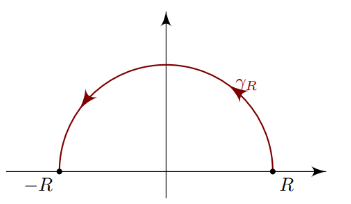
Let \(\alpha>0\), let \(g\) be continuous on \(C_R\), and let \(M_R\coloneqq\sup_{z\in C_R}\abs{g(z)}\). Then \[ \abs{\int_{C_R}e^{i\alpha z}g(z)\dz}\leq\frac{\pi}{\alpha}M_R. \] In particular, if \(g\) is continuous on \(\{z : \operatorname{Im}z\geq0,\ \abs{z}\geq R_0\}\) for some \(R_0\) and \(M_R\to0\) as \(R\to\infty\), then \(\int_{C_R}e^{i\alpha z}g(z)\dz\to0\).
For \(\alpha<0\) the same statements hold with \(C_R\) replaced by the lower semicircle \(t\mapsto Re^{-it}\), \(t\in[0,\pi]\), and \(\pi/\alpha\) replaced by \(\pi/\abs{\alpha}\).
For \(\alpha>0\) and \(z=Re^{it}\), \(\abs{e^{i\alpha z}}=e^{-\alpha R\sin t}\) and \(\abs{\dz}=R\,dt\), so \[ \abs{\int_{C_R}e^{i\alpha z}g(z)\dz}\leq M_R\int_0^\pi e^{-\alpha R\sin t}R\,dt=2M_R\int_0^{\pi/2}e^{-\alpha R\sin t}R\,dt. \] Since \(\sin t\geq 2t/\pi\) for \(t\in[0,\pi/2]\), \[ \int_0^{\pi/2}e^{-\alpha R\sin t}R\,dt\leq\int_0^{\pi/2}e^{-2\alpha Rt/\pi}R\,dt\leq\frac{\pi}{2\alpha}, \] which gives the bound. For \(\alpha<0\) and \(z=Re^{-it}\) with \(t\in[0,\pi]\), \(\abs{e^{i\alpha z}}=e^{\alpha R\sin t}=e^{-\abs{\alpha}R\sin t}\), and the same estimate applies with \(\abs{\alpha}\) in place of \(\alpha\).
Blaschke factors
Let \(z,w\in\CC\) with \(\bar zw\neq1\). Then \[ \abs{\frac{w-z}{1-\bar wz}}<1\quad\text{if }\abs z<1\text{ and }\abs w<1, \qquad \abs{\frac{w-z}{1-\bar wz}}=1\quad\text{if }\abs z=1\text{ or }\abs w=1. \] Replacing \(z,w\) by \(e^{-i\theta}z,e^{-i\theta}w\) reduces both claims to real \(z=r\), where \[ (1-rw)(1-r\bar w)-(r-w)(r-\bar w)=(1-r^2)(1-\abs w^2). \]
Fix \(w\) in the unit disc \(\DD\) and let \(F(z)\coloneqq\dfrac{w-z}{1-\bar wz}\).
\(F\) is holomorphic and maps \(\DD\) to itself.
\(F\) interchanges \(0\) and \(w\): \(F(0)=w\) and \(F(w)=0\).
\(\abs{F(z)}=1\) when \(\abs z=1\).
\(F\) is a bijection \(\DD\to\DD\), since \(F\circ F=\id\).
Cauchy’s integral formula
(Cauchy integral formula)
If \(f\) is holomorphic on an open set containing the closure of a disc \(D\), and \(C\) is the positively oriented boundary circle of \(D\), then \[ f(z)=\frac1{2\pi i}\int_C\frac{f(\zeta)}{\zeta-z}\,d\zeta\qquad(z\in D). \] [StSh03, Theorem 2.4.1]
If \(f\) is holomorphic on an open set \(\Omega\), then \(f\) has complex derivatives of all orders on \(\Omega\), and for a circle \(C\subset\Omega\) whose interior lies in \(\Omega\), \[ f^{(n)}(z)=\frac{n!}{2\pi i}\int_C\frac{f(\zeta)}{(\zeta-z)^{n+1}}\,d\zeta \] for all \(z\) inside \(C\) [StSh03, Corollary 2.4.2].
(Cauchy inequalities)
If \(f\) is holomorphic on an open set containing the closure of the disc \(D\) of radius \(R\) centered at \(z_0\), with boundary circle \(C\), then \[ \abs{f^{(n)}(z_0)}\le\frac{n!\,\norm f_C}{R^n},\qquad\norm f_C=\sup_{z\in C}\abs{f(z)}. \] [StSh03, Corollary 2.4.3]
Further review
If \(f\) is holomorphic on an open set \(\Omega\) and \(D\) is a disc centered at \(z_0\) whose closure lies in \(\Omega\), then \[ f(z)=\sum_{n=0}^\infty a_n(z-z_0)^n\quad(z\in D),\qquad a_n=\frac{f^{(n)}(z_0)}{n!}. \] [StSh03, Theorem 2.4.4]
(Liouville)
A bounded entire function is constant. [StSh03, Corollary 2.4.5]
Warmup
Holomorphic functions with vanishing derivative are constant (Tag E-W3QMS)
Do any example from here
Prove that no sequence of polynomials converges uniformly to \(1/z\) on \(S^1\).
Anything from the homeworks
Show that \(f'=0 \implies f\) is constant using integrals and primitives (i.e. antiderivatives).
See S&S Corollary 3.4.
Suppose \(f\) is continuously complex differentiable on \(\Omega\), and \(T\) is a triangle whose interior is contained in \(\Omega\). Use Green’s theorem to prove \(\int_{\partial T}f(z)\,dz=0\).
Show that for \(0<a<1\), \[ \int_{-\infty}^{\infty}{e^{ax}\over1+e^x}\,dx ={\pi\over\sin\pi a}. \]
Solution
The bullets “Do any example from here” and “Anything from the homeworks” are open-ended study prompts rather than propositions with unique answers. The remaining finite tasks are as follows.
If \(f'=0\) on a region \(\Omega\), then for any \(a,b\in\Omega\) choose a piecewise \(C^1\) path \(\gamma\) from \(a\) to \(b\). Since \(f\) is a primitive of the zero function, \[ f(b)-f(a)=\int_\gamma f'(z)\,dz=0. \] Thus \(f\) is constant.
Suppose polynomials \(p_n\) converged uniformly to \(1/z\) on \(S^1\). Then \(q_n(z)=zp_n(z)-1\) converges uniformly to \(0\) on \(S^1\). By the maximum modulus principle, \[ \sup_{|z|\le1}|q_n(z)|\le\sup_{|z|=1}|q_n(z)|\longrightarrow0. \] But \(q_n(0)=-1\) for every \(n\), a contradiction.
For the Green-theorem exercise, write \(f=u+iv\). Then \[ \int_{\partial T}f(z)\,dz =\int_{\partial T}(u\,dx-v\,dy) +i\int_{\partial T}(v\,dx+u\,dy). \] Green’s theorem turns the real and imaginary parts into \[ \iint_T(-v_x-u_y)\,dxdy, \qquad \iint_T(u_x-v_y)\,dxdy, \] respectively. Both vanish by the Cauchy–Riemann equations, proving the contour integral is zero.
Finally, with \(t=e^x\), \[ \int_{-\infty}^{\infty}{e^{ax}\over1+e^x}\,dx =\int_0^\infty {t^{a-1}\over1+t}\,dt. \] For \(0<a<1\), Euler’s beta integral gives \[ \int_0^\infty {t^{a-1}\over1+t}\,dt =B(a,1-a)=\Gamma(a)\Gamma(1-a) ={\pi\over\sin\pi a}, \] by Euler’s reflection formula.
Questions
Polynomial approximation on $\bar\DD$ and entire functions with a vanishing Taylor coefficient (Tag P-IOUZO)
- Can every continuous function on \(\bar \DD\) be uniformly approximated by polynomials in the variable \(z\)?
Hint: compare to Weierstrass for the real interval.
- Suppose \(f\) is analytic, defined on all of \(\CC\), and for each \(z_0 \in \CC\) there is at least one coefficient in the expansion \(f(z) = \sum_{n=0}^\infty c_n(z-z_0)^n\) is zero. Prove that \(f\) is a polynomial.
Hint: use the fact that \(c_n n! = f^{(n)}(z_0)\) and use a countability argument.
Let \(|\alpha|<r<|\beta|\), and let \(\gamma\) be the positively oriented circle centered at \(0\) of radius \(r\). Show that \[ \int_\gamma \frac{dz}{(z-\alpha)(z-\beta)} =\frac{2\pi i}{\alpha-\beta}. \]
Assume \(f\) is continuous on \[ \{x+iy:x\ge x_0,\ 0\le y\le b\} \] and that \(f(x+iy)\to A\) as \(x\to+\infty\) uniformly with respect to \(y\in[0,b]\). If \[ \gamma_x=\{x+it:0\le t\le b\}, \] show that \[ \lim_{x\to+\infty}\int_{\gamma_x}f(z)\,dz=iAb. \]
If \(f\) is analytic on a region \(D\), show that \[ g(z)=\overline{f(\bar z)} \] is analytic on the reflected region \(\bar D=\{z:\bar z\in D\}\).
Solution
Part 1.
<1>1. No, not every continuous function on \(\bar\DD\) is uniformly approximable by polynomials in \(z\). <2>1. A uniform limit of holomorphic polynomials on \(\bar\DD\) is holomorphic on the interior \(\DD\).
a uniform limit of holomorphic functions is holomorphic (Morera’s theorem).
<2>2. But there are continuous functions on \(\bar\DD\) that are not holomorphic on \(\DD\).
e.g. \(f(z) = \bar z\) is continuous on \(\bar\DD\) but not holomorphic.
<2>3. Hence \(\bar z\) (or any such function) cannot be uniformly approximated by polynomials in \(z\).
<2>1 and <2>2.
<1>2. Q.E.D. (part 1).
<1>1.
Part 2.
<1>1. For each \(n \ge 0\), let \(E_n = \{z \in \CC : f^{(n)}(z) = 0\}\).
define the zero sets of the derivatives.
<1>2. Each \(E_n\) is closed, and \(\CC = \bigcup_{n=0}^{\infty} E_n\).
\(f^{(n)}\) is continuous so \(E_n\) is closed; the hypothesis says that for each \(z_0\) some coefficient \(c_n = f^{(n)}(z_0)/n!\) is zero, i.e. \(f^{(n)}(z_0) = 0\) for some \(n\), so \(z_0 \in E_n\).
<1>3. By the Baire category theorem, some \(E_n\) has nonempty interior.
\(\CC\) is a complete metric space and is the countable union of the closed sets \(E_n\), so one of them has nonempty interior.
<1>4. Hence \(f^{(n)} \equiv 0\) on \(\CC\).
\(f^{(n)}\) is entire and vanishes on a set with nonempty interior (an open disk), so by the identity theorem it vanishes identically.
<1>5. Therefore \(f\) is a polynomial of degree at most \(n-1\).
\(f^{(n)} \equiv 0\) implies \(f\) is a polynomial of degree \(< n\).
<1>6. Q.E.D. (part 2).
<1>5.
Part 3. Since \(|\alpha|<r<|\beta|\), the integrand has exactly one pole inside \(\gamma\), namely the simple pole at \(\alpha\). Its residue is \[ \operatorname{Res}_{z=\alpha} \frac1{(z-\alpha)(z-\beta)} =\frac1{\alpha-\beta}. \] Therefore the residue theorem gives \[ \boxed{\int_\gamma\frac{dz}{(z-\alpha)(z-\beta)} =\frac{2\pi i}{\alpha-\beta}}. \]
Part 4. Parametrize \(\gamma_x\) by \(z=x+it\), \(0\le t\le b\). Then \[ \int_{\gamma_x}f(z)\,dz=i\int_0^b f(x+it)\,dt. \] Hence \[ \left|\int_{\gamma_x}f(z)\,dz-iAb\right| \le b\sup_{0\le t\le b}|f(x+it)-A|. \] The right-hand side tends to \(0\) by the assumed uniform convergence, so \[ \boxed{\lim_{x\to\infty}\int_{\gamma_x}f(z)\,dz=iAb}. \]
Part 5. Let \(z\in\bar D\). For small \(h\ne0\) with \(z+h\in\bar D\), \[ \frac{g(z+h)-g(z)}h =\frac{\overline{f(\bar z+\bar h)-f(\bar z)}}h =\overline{ \frac{f(\bar z+\bar h)-f(\bar z)}{\bar h} }. \] As \(h\to0\), also \(\bar h\to0\), so the last expression tends to \(\overline{f'(\bar z)}\). Thus \(g\) is complex differentiable at every point of \(\bar D\), with \[ \boxed{g'(z)=\overline{f'(\bar z)}}. \]
Qualifying exam problems
Laurent expansions of $\frac{1}{1-z^2}+\frac{1}{z-3}$ in $|z|<1$, $1<|z|<3$, and $|z|>3$ (Tag P-AQRVL)
Expand \(\frac{1}{1-z^{2}}+\frac{1}{z-3}\) in a series of the form \(\sum_{-\infty}^{\infty} a_{n} z^{n}\) so it converges for
\(|z|<1\),
\(1<|z|<3\),
\(|z|>3\).
Solution
General strategy: each has two expansions, so just compute them all and pick appropriate ones for regions afterwards.
For \(1\over z-3\): \[ {1\over z-3} &= -{1\over 3}{1\over 1- {z\over 3}} = -{1\over 3}\sum_{k\geq 0}3^{-k}z^k && \abs{z} < 3 \\ &= {1\over z} {1\over 1 - {3\over z}} = \inverseof{z} \sum_{k\geq 0} 3^k z^{-k} && \abs{z} > 3 .\]
For \(1\over 1-z^2\): \[ {1\over 1-z^2} &= \sum_{k\geq 0} z^{2k} && \abs{z} < 1 \\ &= {1\over z^2} {-1\over 1- z^{-2}} = -z^{-2}\sum_{k\geq 0}z^{-2k} && \abs{z} > 1 .\]
So take \[ 0 < \abs{z} < 1 && f(z) &= \sum_{k\geq 0}z^{2k} - {1\over 3}\sum_{k\geq 0} 3^{-k}z^k \\ 1 < \abs{z} < 3 && f(z) &= -z^{-2} \sum_{k\geq 0}z^{-2k} - {1\over 3}\sum_{k\geq 0} 3^{-k}z^k \\ 3 < \abs{z} < \infty && f(z) &= -z^{-2} \sum_{k\geq 0}z^{-2k} + \inverseof{z} \sum_{k\geq 0}3^k z^{-k} .\]