Cauchy–Schwarz, Hölder, and Plancherel
Cauchy--Schwarz inequality (Tag PR-X5D4Z)
Let \(H\) be an inner product space over \(\CC\) with inner product \(\inner{\cdot}{\cdot}\) and norm \(\norm{x}\coloneqq\inner{x}{x}^{1/2}\). For all \(f,g\in H\), \[ \abs{\inner{f}{g}} \leq \norm{f}\norm{g}, \] with equality if and only if \(f\) and \(g\) are linearly dependent. In particular, for a measure space \((X,\mcm,\mu)\) and \(f,g\in L^2(\mu)\), \(\abs{\int_X f\overline g\dmu}\leq\norm{f}_2\norm{g}_2\).
(Cauchy--Schwarz in coordinates and in $L^2$)
For \(a,b\in\RR^n\) and for \(f,g\in L^2(\RR^n)\), the inequality reads \[ \begin{aligned} \left(\sum_{k=1}^{n} a_{k} b_{k}\right)^{2} &\leq\left(\sum_{k=1}^{n} a_{k}^{2}\right)\left(\sum_{k=1}^{n} b_{k}^{2}\right), \\ \abs{\int_{\RR^{n}} f(x) \overline{g(x)} \dx}^{2} &\leq \int_{\RR^{n}}\abs{f(x)}^{2} \dx \int_{\RR^{n}}\abs{g(x)}^{2} \dx. \end{aligned} \]
Reverse triangle inequality (Tag PR-IJOPU)
Let \((V,\norm{\cdot})\) be a normed vector space. For all \(x,y\in V\), \[ \abs{\norm{x} - \norm{y}} \leq \norm{x - y} . \]
By the triangle inequality, \(\norm{x}\leq\norm{x-y}+\norm{y}\) and \(\norm{y}\leq\norm{y-x}+\norm{x}\), and \(\norm{y-x} = \norm{x-y}\). Hence \(\norm{x}-\norm{y}\leq\norm{x-y}\) and \(\norm{y}-\norm{x}\leq\norm{x-y}\).
Hölder's inequality (Tag PR-7BGSE)
Let \((X,\mcm,\mu)\) be a measure space, let \(1\le p,q\le\infty\) satisfy \(\frac 1 p + \frac 1 q = 1\), and let \(f,g\colon X\to\CC\) be measurable. Then \[ \norm{f g}_{1} \leq \norm{f}_{p} \norm{g}_{q} . \] For \(1<p,q<\infty\), this reads \[ \int_X \abs{fg}\dmu \leq \qty{\int_X \abs{f}^p\dmu}^{1/p} \qty{\int_X \abs{g}^q\dmu}^{1/q} . \]
(Hölder's inequality)
If \(\norm f_p=0\) or \(\norm g_q=0\), then \(fg=0\) almost everywhere; if either norm is infinite there is nothing to prove. Otherwise, replacing \(f\) and \(g\) by \(f/\norm f_p\) and \(g/\norm g_q\), it suffices to treat \(\norm{f}_p = \norm{g}_q = 1\). For \(1<p<\infty\), Young’s product inequality \(AB \leq \frac 1 p A^p + \frac 1 q B^q\) for \(A,B\geq0\) gives \[ \int\abs{f}\abs{g} \leq \int \qty{\frac{\abs{f}^{p}}{p} + \frac{\abs{g}^{q}}{q}}=\frac{1}{p}+\frac{1}{q}=1. \] For \(p=1\), \(q=\infty\), \(\int\abs{fg}\leq\norm g_\infty\int\abs f\).
(Inclusions of $L^p$ spaces)
If \(\mu(X)<\infty\) and \(1 \leq p < q \leq \infty\), then \(L^q(\mu) \subseteq L^p(\mu)\) and \(\norm f_p\leq\mu(X)^{\frac1p-\frac1q}\norm f_q\). For sequences, \(\ell^p \subseteq \ell^q\).
For \(q=\infty\), \(\int\abs f^p\leq\mu(X)\norm f_\infty^p\). For \(q<\infty\), let \(r \coloneqq q/p>1\) and \(s \coloneqq r/(r-1)\), so \(\frac1r+\frac1s = 1\), and let \(h \coloneqq \abs{f}^p\). By Hölder’s inequality, \[ \norm{f}_p^p = \norm{h\cdot 1}_1 \leq \norm{h}_r\norm{1}_s = \norm{f}_q^{p}\,\mu(X)^{\frac 1 s}, \] and \(\frac{1}{ps} = \frac1p\qty{1-\frac pq} = \frac 1 p - \frac 1 q\).
For sequences, if \(x\in\ell^p\) then \(x_n\to0\), so \(\abs{x_n}\leq1\) for \(n\geq N\), and then \(\abs{x_n}^q \leq \abs{x_n}^p\) for \(n\geq N\); hence \(x\in\ell^q\).
Bessel's inequality (Tag PR-RYVI7)
Let \(H\) be an inner product space with inner product \(\inner{\cdot}{\cdot}\) and norm \(\norm{x}\coloneqq\inner{x}{x}^{1/2}\), let \((e_k)_{k\geq1}\) be an orthonormal sequence in \(H\), and let \(x\in H\). Then \[ \sum_{k=1}^{\infty}\abs{\inner{x}{e_{k}}}^{2} \leq \norm{x}^{2} . \]
Parseval's identity (Tag PR-ZI7M3)
Let \(H\) be a Hilbert space and let \((e_k)_{k\geq 1}\) be an orthonormal sequence in \(H\) that is a basis of \(H\). Then for every \(x\in H\), \[ \sum_{k\geq 1} \abs{ \inner{x}{e_k} }^2 = \norm{x}^2. \]
(Parseval's identity for Fourier series)
For \(f\in L^2(-\pi,\pi)\) and the orthonormal basis \(\theset{e^{ikx}/\sqrt{2\pi}}_{k\in\ZZ}\), Parseval’s identity reads \[ {1\over 2\pi} \int_{(-\pi, \pi)} \abs{f}^2 = \sum_{k\in \ZZ} \abs{c_k}^2, \qquad c_k \coloneqq {1\over 2\pi } \int_{(-\pi, \pi)} f(x) e^{-ikx} \dx. \]
Plancherel theorem (Tag PR-JCZKL)
If \(f\in L^1(\RR^d)\cap L^2(\RR^d)\), then its Fourier transform \(\widehat f\) lies in \(L^2(\RR^d)\) and \[ \norm{f}_{L^2}^2 = \int_{\RR^d} \abs{f}^2 = \int_{\RR^d} \abs{\widehat f}^2 = \norm{\widehat{f}}_{L^2}^2 . \]
The analogue for Fourier series is Parseval’s identity: for \(f\in L^2([0,1])\) with Fourier coefficients \(c_k\coloneqq\int_0^1 f(x)e^{-2\pi i kx}\,dx\), one has \(\int_0^1\abs{f}^2=\sum_{k\in\ZZ}\abs{c_k}^2\).
Chebyshev, Minkowski, and Young
Markov and Chebyshev inequalities (Tag PR-YO7MV)
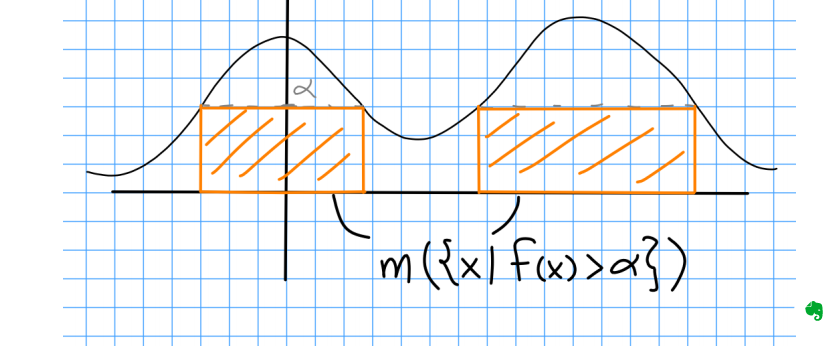
Let \((X,\mcm,\mu)\) be a measure space, let \(f\colon X\to\CC\) be measurable, let \(\alpha>0\), and put \(S_\alpha\coloneqq\theset{x\in X\suchthat\abs{f(x)}>\alpha}\). Then \[ \mu(S_\alpha) \leq \frac{1}{\alpha}\int_X\abs{f}\dmu = \frac{1}{\alpha}\norm{f}_1, \] and more generally, for \(0<p<\infty\), \[ \mu(S_\alpha) \leq \frac{1}{\alpha^p}\int_X\abs{f}^p\dmu = \frac{1}{\alpha^p}\norm{f}_p^p. \]
On \(S_\alpha\) we have \(\abs{f(x)} > \alpha\), hence \(\abs{f(x)}^p > \alpha^p\), so \[ \int_X \abs{f}^p\dmu \geq \int_{S_\alpha} \abs{f}^p\dmu \geq \int_{S_\alpha} \alpha^p\dmu = \alpha^p \mu(S_\alpha). \] Dividing by \(\alpha^p > 0\) gives the second inequality, and \(p=1\) gives the first.
For a probability space \((\Omega,\mathcal F,P)\) and a nonnegative random variable \(Y\) with expectation \(E(Y)\), the case \(p=1\) reads \(P(Y>\alpha)\leq E(Y)/\alpha\).
Chebyshev's inequality (Tag FD-3BK6U)
Let \(m\) be Lebesgue measure on \(\RR^n\), let \(f\colon\RR^n\to\CC\) be measurable, and let \(0<p<\infty\). For every \(\alpha>0\), \[ m\qty{\theset{x \in\RR^n \suchthat \abs{f(x)} \geq \alpha}} \leq \qty{\frac{\norm{f}_p}{\alpha}}^p, \qquad \norm{f}_p\coloneqq\qty{\int_{\RR^n}\abs{f(x)}^p\,dx}^{1/p}. \] Taking \(p=1\) gives \[ m\qty{\theset{x \in \RR^n\suchthat \abs{f(x)} \geq \alpha}} \leq \frac{1}{\alpha} \int_{\RR^n} \abs{f(x)} \, dx. \]
Let \(E_\alpha\coloneqq\theset{x \suchthat \abs{f(x)}\geq\alpha}\). Then \(\alpha^p\chi_{E_\alpha}\leq\abs{f}^p\) pointwise, and integrating gives \(\alpha^p\, m(E_\alpha)\leq\norm{f}_p^p\).
Minkowski's inequality (Tag PR-XUVZY)
Let \((X,\mcm,\mu)\) be a measure space, let \(1\leq p<\infty\), and let \(f,g\in L^p(\mu)\). Then \(f+g\in L^p(\mu)\) and \[ \norm{f+g}_p \leq \norm{f}_p+ \norm{g}_p . \]
For \(p=\infty\), \(\abs{f+g}\leq\norm f_\infty+\norm g_\infty\) almost everywhere, so \(\norm{f+g}_\infty\leq\norm f_\infty+\norm g_\infty\). Together with the case \(1\leq p<\infty\), Minkowski’s inequality is the triangle inequality for \(\norm{\wait}_p\), so \(L^p\) is a normed space for \(1\leq p\leq\infty\).
(Minkowski's inequality)
For \(p=1\) the inequality follows by integrating \(\abs{f+g}\leq\abs f+\abs g\). Let \(1<p<\infty\) with conjugate exponent \(q = \frac{p}{p-1}\), so that \((p-1)q = p\). Since \(\abs{f+g}^p\leq 2^{p-1}\qty{\abs f^p+\abs g^p}\), \(\norm{f+g}_p<\infty\); assume \(\norm{f+g}_p>0\). Since \(\abs{f+g}^p \leq \qty{\abs{f} + \abs{g}} \abs{f+g}^{p-1}\), Hölder’s inequality gives \[ \begin{aligned} \norm{f+g}_p^p &\leq \int \abs{f} \abs{f+g}^{p-1} + \int \abs{g} \abs{f+g}^{p-1} \\ &\leq \qty{\norm{f}_p + \norm{g}_p} \norm{\abs{f+g}^{p-1}}_q \\ &= \qty{\norm{f}_p + \norm{g}_p} \qty{\int \abs{f+g}^{p}}^{1 - \frac 1 p} \\ &= \qty{\norm{f}_p + \norm{g}_p} \norm{f+g}_p^{p-1}. \end{aligned} \] Dividing by \(\norm{f+g}_p^{p-1}\) gives \(\norm{f+g}_p \leq \norm{f}_p + \norm{g}_p\).
Young's convolution inequality (Tag PR-2C3SZ)
Let \(1\le p,q,r\le\infty\) satisfy \[ \frac1r = \frac1p + \frac1q - 1 . \] If \(f\in L^p(\RR^n)\) and \(g\in L^q(\RR^n)\), then the convolution \(f\ast g\) is defined almost everywhere, \(f\ast g\in L^r(\RR^n)\), and \[ \norm{f \ast g}_{r} \leq \norm{f}_{p} \norm{g}_{q} \] [@Fol13].
The following are the cases \(p=q=r=1\); \(p=1\) and \(q=r\); \(r=\infty\) with \(\frac1p+\frac1q=1\); and \(p=q=2\), \(r=\infty\): \[ \begin{aligned} \norm{f\ast g}_1 & \leq \norm{f}_1 \norm{g}_1, \\ \norm{f\ast g}_q & \leq \norm{f}_1 \norm{g}_q, \\ \norm{f\ast g}_\infty & \leq \norm{f}_p \norm{g}_q, \\ \norm{f\ast g}_\infty & \leq \norm{f}_2 \norm{g}_2. \end{aligned} \]
(Special cases of Young's convolution inequality)
For conjugate exponents \(p,q\) and \(1\leq p\leq\infty\), \[ \begin{aligned} \norm{f\ast g}_1 & \leq \norm{f}_1 \norm{g}_1, \\ \norm{f\ast g}_p & \leq \norm{f}_1 \norm{g}_p, \\ \norm{f\ast g}_\infty & \leq \norm{f}_p \norm{g}_q, \\ \norm{f\ast g}_\infty & \leq \norm{f}_2 \norm{g}_2. \end{aligned} \]
Elementary inequalities
AM--GM inequality for two numbers (Tag PR-IQYTA)
For all real numbers \(a,b\geq0\), \[ \sqrt{ab} \leq \frac{a+b}{2}, \] with equality if and only if \(a=b\).
Jensen's inequality (Tag PR-W4ICW)
Let \((X,\mcm,\mu)\) be a measure space with \(\mu(X)=1\), let \(-\infty\leq a<b\leq\infty\), and let \(\phi\colon(a,b)\to\RR\) be convex, that is, \[ \phi(tx + (1-t)y) \leq t\phi(x) + (1-t)\phi(y) \quad\text{for all } x,y\in(a,b) \text{ and } t\in[0,1]. \] If \(f\in L^1(\mu)\) is real-valued with \(a<f(x)<b\) for all \(x\in X\), then \[ \phi\Big(\int_X f\dmu\Big)\leq\int_X\phi\circ f\dmu . \]
Young's product inequality (Tag PR-BPOH2)
Let \(1<p,q<\infty\) satisfy \(\frac1p+\frac1q=1\), and let \(A,B\geq0\). Then \[ AB \leq \frac{A^p}{p} + \frac{B^q}{q} . \]
Convexity bound $(a+b)^p \leq 2^{p-1}(a^p+b^p)$ (Tag PR-7KTA6)
Let \(p\geq1\) and \(a,b\geq0\). Then \[ (a+b)^p \leq 2^{p-1} (a^p + b^p) . \]
The function \(t\mapsto t^p\) is convex on \([0,\infty)\) for \(p\geq1\), so \[ \qty{\frac{a+b}{2}}^p\le\frac{a^p+b^p}{2}. \] Multiplying by \(2^p\) gives the inequality.
Bernoulli's inequality (Tag FF-Z3E3C)
Let \(x\in\RR\).
If \(n\geq 0\) is an integer and \(x\geq -1\), then \((1+x)^n \geq 1 + nx\).
If \(n\geq 0\) is an even integer, then \((1+x)^n \geq 1 + nx\) for every \(x\in\RR\).
If \(r\geq 1\) is real and \(x\geq -1\), then \((1+x)^r \geq 1 + rx\).
By induction on \(n\): the case \(n = 0\) is \(1\geq 1\), and if \((1+x)^n\geq 1+nx\), then since \(1+x\geq 0\), \[ (1+x)^{n+1}\geq(1+nx)(1+x) = 1 + (n+1)x + nx^2\geq 1+(n+1)x. \]
For \(x\geq -1\) this is (1). For \(x<-1\) and even \(n\geq 2\), \((1+x)^n\geq 0\) while \(1+nx<1-n<0\); the case \(n=0\) is \(1\geq 1\).
The function \(\varphi(t)\coloneqq(1+t)^r\) is convex on \([-1,\infty)\) because \(\varphi''(t) = r(r-1)(1+t)^{r-2}\geq 0\) for \(t>-1\) and \(\varphi\) is continuous at \(-1\), so \(\varphi\) lies above its tangent line \(1+rt\) at \(t = 0\).
For all \(x\in\RR\), \[ 1-x \leq e^{-x} . \]
Exponential inequality (Tag PR-CHY3F)
For all \(t\in \RR\), \[ 1 + t \leq e^t . \]
Let \(g(t)\coloneqq e^t-1-t\). Then \(g(0)=0\) and \(g'(t) = e^t-1\) is negative for \(t<0\) and positive for \(t>0\), so \(g\) attains its minimum \(0\) at \(t=0\) and \(g\geq0\) on \(\RR\).
For \(x,y\geq0\), \(\sqrt{x + y} \leq \sqrt{x} + \sqrt{y}\), since \(\qty{\sqrt x+\sqrt y}^2 = x+y+2\sqrt{xy}\geq x+y\).