Continuous images
Continuous images of compact, connected and separable spaces (Tag PR-ZCUXL)
Let \(f\colon X\to Y\) be continuous.
If \(X\) is compact, then \(f(X)\) is compact [@Mun00].
If \(X\) is connected, then \(f(X)\) is connected [@Mun00].
If \(D\subseteq X\) is dense, then \(f(D)\) is dense in \(f(X)\) with the subspace topology; in particular, if \(X\) is separable, then so is \(f(X)\), and if \(f\) is surjective, then \(f(D)\) is dense in \(Y\).
A continuous map need not be open or closed: the constant map \(\RR\to\RR\), \(x\mapsto 0\), sends the open set \(\RR\) to \(\ts{0}\), which is not open, and \(x\mapsto e^x\) sends the closed set \(\RR\) to \((0,\infty)\), which is not closed in \(\RR\).
Metric spaces and analysis
Cantor's intersection theorem (Tag T-7DICT)
Let \(X\) be a compact space and let \(C_1 \supseteq C_2 \supseteq \cdots\) be a decreasing sequence of nonempty closed subsets of \(X\). Then \(\Intersect_n C_n \neq \emptyset\) [@Mun00].
If \(X\) is Hausdorff, it suffices that each \(C_n\) be nonempty and compact, since compact subsets of Hausdorff spaces are closed [@Mun00]. Without closedness the conclusion fails: in an infinite set \(\NN\) with the indiscrete topology every subset is compact, and \(C_n = \ts{n, n+1, \ldots}\) is a decreasing sequence of nonempty compact sets with empty intersection.
Cantor's nested intervals theorem (Tag T-PRQ7I)
Let \([a_0, b_0]\supseteq[a_1, b_1]\supseteq\cdots\) be a decreasing sequence of closed bounded intervals in \(\RR\). Then \(\Intersect_n [a_n, b_n]\neq\emptyset\) [@Rud76], and if \(b_n - a_n\to 0\), the intersection is a single point.
Let \(X\) be a complete metric space and \(E_0\supseteq E_1\supseteq\cdots\) nonempty closed bounded subsets with \(\diam E_n\to 0\). Then \(\Intersect_n E_n\) consists of exactly one point [@Rud76].
Heine--Cantor theorem (Tag T-O4UD3)
Let \(X\) and \(Y\) be metric spaces with \(X\) compact. Every continuous function \(f\colon X\to Y\) is uniformly continuous [@Mun00]; [@Rud76].
Let \(U\subseteq\RR^n\) and let \(f\colon U\to \RR\) be continuous. For every compact \(K \subseteq U\), the restriction \(\ro{f}{K}\) is uniformly continuous.
Let \(f\colon X\to Y\) be continuous with \(X\) a compact metric space, and let \(\varepsilon>0\). The sets \(\inverseof{f}\qty{B_{\varepsilon/2}(y)}\) for \(y\in Y\) form an open cover of \(X\); let \(\delta>0\) be a Lebesgue number for it. If \(d(x,x')<\delta\), then \(\ts{x,x'}\) has diameter less than \(\delta\), so it lies in some \(\inverseof{f}\qty{B_{\varepsilon/2}(y)}\), and \(d(f(x),f(x'))<\varepsilon\).
Lipschitz implies uniformly continuous (Tag C-EBAGE)
Let \((X, d_X)\) and \((Y, d_Y)\) be metric spaces and let \(f\colon X\to Y\) be Lipschitz: there exists \(C > 0\) such that \(d_Y(f(x_1), f(x_2)) \leq C\, d_X(x_1, x_2)\) for all \(x_1, x_2 \in X\). Then \(f\) is uniformly continuous.
(A uniformly continuous function that is not Lipschitz)
\(f(x) = \sqrt x\) on \([0, 1]\) is uniformly continuous, being continuous on a compact set, and is not Lipschitz, since \(\abs{f(x)-f(0)}/\abs{x-0} = 1/\sqrt x\) is unbounded as \(x\to 0^+\).
Extreme value theorem (Tag T-OPK3N)
Let \(f\colon X \to Y\) be continuous, where \(X\) is a nonempty compact space and \(Y\) is an ordered set in the order topology. Then there exist \(c, d\in X\) with \(f(c)\leq f(x)\leq f(d)\) for every \(x\in X\) [@Mun00].
Sequentially compact if and only if complete and totally bounded (Tag T-4RLPQ)
A metric space \(X\) is sequentially compact if and only if it is complete and totally bounded.
For metric spaces, sequential compactness is equivalent to compactness [@Mun00], and compactness is equivalent to being complete and totally bounded [@Mun00].
Totally bounded if and only if Cauchy subsequences exist (Tag T-PCL4H)
A metric space is totally bounded if and only if every sequence in it has a Cauchy subsequence.
Compact if and only if complete and totally bounded (Tag T-HH3YP)
A metric space is compact if and only if it is complete and totally bounded [@Mun00].
Baire category theorem (Tag FT-6WPJI)
If \(X\) is a complete metric space or a locally compact Hausdorff space, then \(X\) is a Baire space: the intersection of countably many dense open subsets of \(X\) is dense in \(X\) [@Mun00].
A nonempty complete metric space is not a countable union of nowhere dense subsets.
Let \(X\) be a nonempty complete metric space and suppose \(X=\bigcup_{k\geq1}S_k\) with each \(S_k\) nowhere dense. Each \(U_k\coloneqq X\setminus\overline{S_k}\) is open, and it is dense because \(\overline{S_k}\) has empty interior. By the theorem, \(\bigcap_k U_k\) is dense in \(X\), hence nonempty since \(X\neq\emptyset\). But \(\bigcap_k U_k\subseteq X\setminus\bigcup_k S_k=\emptyset\), a contradiction.
Compactness
Closed if and only if compact in compact Hausdorff spaces (Tag T-3FJK4)
Let \(X\) be a compact Hausdorff space. A subset \(U\subseteq X\) is closed if and only if it is compact [@Mun00].
Closed subsets of compact spaces are compact [@Mun00], and compact subsets of Hausdorff spaces are closed [@Mun00]. Only the second needs \(X\) Hausdorff, and only the first needs \(X\) compact: \(\RR\) is closed in \(\RR\) and not compact.
Closed subsets of compact spaces are compact (Tag T-UEXBK)
Let \(B\) be a compact space and \(A\subseteq B\) a closed subset. Then \(A\) is compact [@Mun00].
Let \(B\) be compact and \(A\subseteq B\) closed, and let \(\ts{A_i}_{i\in I}\) be a cover of \(A\) by sets open in \(A\). By definition of the subspace topology, \(A_i = B_i \intersect A\) for some \(B_i\) open in \(B\). Since \(A\) is closed, \(W\coloneqq B\sm A\) is open, and \(\ts{B_i}_{i\in I}\union\ts{W}\) is an open cover of \(B\). A finite subcover \(\ts{B_{i_1},\ldots,B_{i_k},W}\) exists by compactness, and \(\ts{A_{i_1},\ldots,A_{i_k}}\) covers \(A\).
Continuous image of compact is compact (Tag T-TJBYR)
Let \(f\colon X\to Y\) be continuous and \(K\subseteq X\) compact. Then \(f(K)\) is compact [@Mun00].
Let \(f\colon X\to Y\) be continuous with \(X\) compact, and let \(\mathcal{U}\) be a cover of \(f(X)\) by open subsets of \(Y\). Since \(f\) is continuous, \(\ts{\inverseof{f}(U) \suchthat U\in\mathcal U}\) is an open cover of \(X\), with a finite subcover \(\inverseof{f}(U_1),\ldots,\inverseof{f}(U_k)\). Then \(U_1,\ldots,U_k\) cover \(f(X)\).
Compact subsets of Hausdorff spaces are closed (Tag T-JFADP)
Every compact subset of a Hausdorff space is closed [@Mun00].
The converse fails: \(\RR\) is closed in the Hausdorff space \(\RR\) and is not compact.
Separability
Properties preserved under retracts (Tag PR-O7535)
Let \(A\subseteq X\) be a retract, with retraction \(r\colon X\to A\). If \(X\) is Hausdorff, then \(A = \theset{x\in X \st r(x) = x}\) is closed in \(X\). If \(X\) is connected or compact, then so is \(A = r(X)\) [@Mun00].
Points are closed in $T_1$ and Hausdorff spaces (Tag PR-R72XL)
Let \(X\) be a topological space in which every one-point set is closed, that is, a \(T_1\) space. Then every finite subset of \(X\) is closed. Every Hausdorff space is \(T_1\), so in a Hausdorff space every finite subset, in particular every singleton, is closed [@Mun00].
Separation axioms
A Hausdorff space is one in which distinct points have disjoint open neighborhoods, and a normal space is one in which disjoint closed sets have disjoint open neighborhoods.
Urysohn's lemma (Tag FT-52GNK)
Let \(X\) be a topological space. Then \(X\) is normal if and only if for every pair of disjoint closed subsets \(A, B \subseteq X\) there is a continuous function \(f\colon X\to [0,1]\) with \(f(a) = 0\) for all \(a\in A\) and \(f(b) = 1\) for all \(b\in B\) [@Mun00].
The forward direction is Urysohn’s lemma; the converse follows by taking the disjoint open sets \(f^{-1}([0,1/2))\) and \(f^{-1}((1/2,1])\).
Maps and homeomorphisms
A continuous bijection from a compact space to a Hausdorff space is a homeomorphism (Tag FT-M5BHD)
Let \(f\colon X\to Y\) be a continuous bijection. If \(X\) is compact and \(Y\) is Hausdorff, then \(f\) is a homeomorphism [@Mun00].
Closed subspaces of compact spaces are compact, continuous images of compact spaces are compact, and compact subspaces of Hausdorff spaces are closed [@Mun00]. Hence \(f\) is a closed map, so \(\inverseof{f}\) is continuous.
It suffices to show that \(f\) is a closed map, since then \(\inverseof{f}\) is continuous. If \(A\subseteq X\) is closed, then \(A\) is compact because \(X\) is compact, so \(f(A)\) is compact, and a compact subset of the Hausdorff space \(Y\) is closed.
(Retractions onto points)
For every \(x_0 \in X\), the constant map \(r\colon X \to \ts{x_0}\) is a retraction onto \(\ts{x_0}\).
When open maps are homeomorphisms (Tag T-JSXGR)
Let \(f\colon X\to Y\) be a continuous bijection. Then \(f\) is a homeomorphism if and only if \(f\) is an open map, since \(\inverseof{(\inverseof{f})}(U) = f(U)\) for every open \(U\subseteq X\).
Characterizations of continuous maps (Tag T-FA6VI)
Let \(f\colon X\to Y\) be a map of topological spaces. The following are equivalent:
\(f\) is continuous;
\(f(\cl_X(A)) \subseteq \cl_Y(f(A))\) for every \(A\subseteq X\);
\(\inverseof{f}(B)\) is closed in \(X\) for every closed \(B\subseteq Y\);
for each \(x\in X\) and each neighborhood \(V\) of \(f(x)\), there is a neighborhood \(U\) of \(x\) such that \(f(U) \subseteq V\)
[@Mun00].
See [Munk00].
Maps from compact spaces to Hausdorff spaces (Tag T-N6PYS)
Let \(f\colon X\to Y\) be continuous, with \(X\) compact and \(Y\) Hausdorff. Then
\(f\) is a closed map [@Mun00];
if \(f\) is surjective, \(f\) is a quotient map [@Lee13];
if \(f\) is injective, \(f\) is a topological embedding [@Lee13];
if \(f\) is bijective, \(f\) is a homeomorphism [@Mun00].
The tube lemma
The tube lemma (Tag T-G4GO4)
Let \(X, Y\) be topological spaces with \(Y\) compact, and let \(x_0\in X\). If \(N\subseteq X\cross Y\) is an open set containing the slice \(\theset{x_0} \cross Y\), then there is a neighborhood \(W\) of \(x_0\) in \(X\) with \(W\cross Y\subseteq N\) [@Mun00].
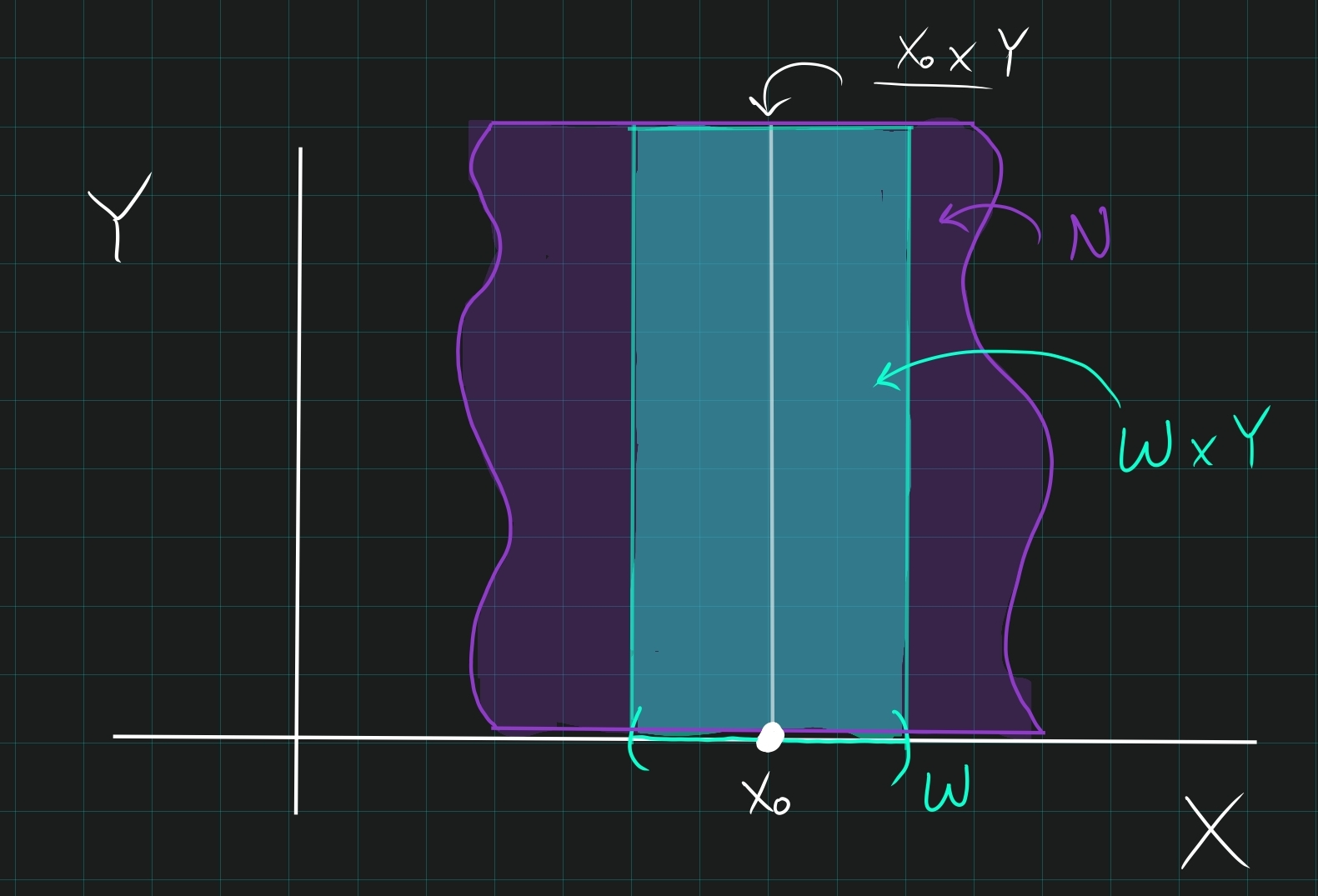
Let \(N\subseteq X\cross Y\) be open with \(\ts{x_0}\cross Y\subseteq N\). For each \(y\in Y\), choose open sets \(U_y\subseteq X\) and \(V_y\subseteq Y\) with \((x_0,y)\in U_y\cross V_y\subseteq N\). Since \(Y\) is compact, finitely many \(V_{y_1},\ldots,V_{y_n}\) cover \(Y\). Let \(W\coloneqq \bigcap_{j=1}^n U_{y_j}\), an open set containing \(x_0\). For \((x,y)\in W\cross Y\), choose \(j\) with \(y\in V_{y_j}\); since \(x\in W\subseteq U_{y_j}\), \((x,y)\in U_{y_j}\cross V_{y_j}\subseteq N\). Hence \(W\cross Y\subseteq N\).
(The tube lemma fails without compactness)
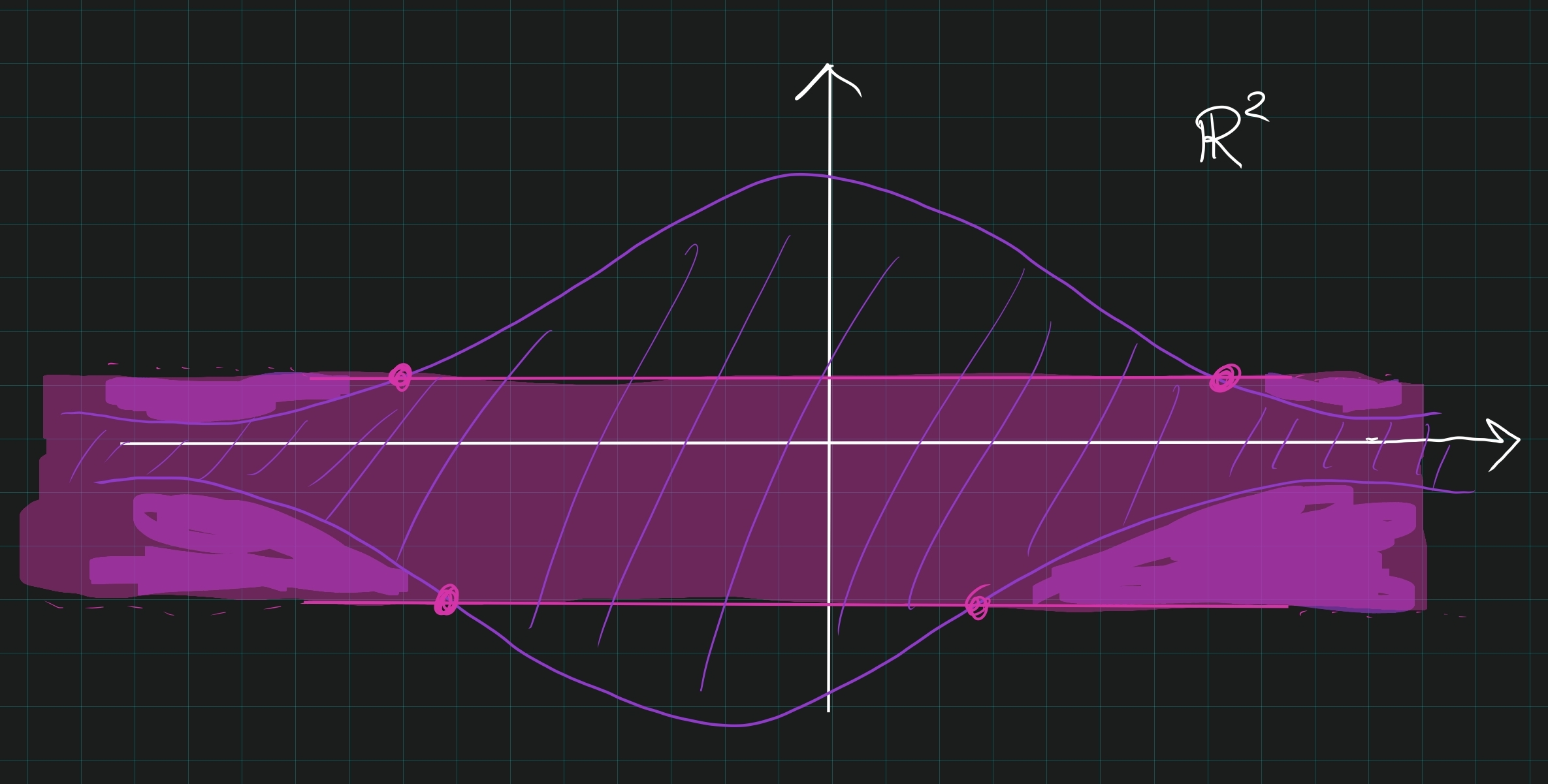
In \(\RR\cross\RR\), the open set \(N\coloneqq\ts{(x,y) \suchthat \abs y < e^{-x^2}}\) contains the slice \(\RR\cross\ts{0}\), and it contains no tube \(\RR\cross(-\delta,\delta)\) with \(\delta>0\), since \(e^{-x^2}<\delta\) for large \(\abs x\). Here the slice is taken in the noncompact factor \(\RR\).
Subsets of the real line
The rationals are neither open nor closed (Tag PR-VGX2B)
The subset \(\QQ\subseteq \RR\) is neither open nor closed in the standard topology, since every nonempty open interval contains both rational and irrational numbers.
Exercises
Continuous maps between compact Hausdorff spaces are proper (Tag E-OYP3Y)
Show that any map between compact Hausdorff spaces must be proper.
Solution
If \(Y\) is compact Hausdorff, \(U\) is compact iff \(U\) is closed, and by continuity closed sets pull back.