A smooth complete toric surface is given by primitive vectors \(u_1,\ldots,u_r\in\ZZ^2\) in cyclic order, consecutive pairs forming bases of \(\ZZ^2\). Writing \(u_{i-1}+u_{i+1}=b_iu_i\), the boundary divisors satisfy \(D_i^2=-b_i\) and \(D_i\cdot D_{i+1}=1\).
Toric morphisms, completeness, and invariants read off the fan (Tag PR-TORMOR)
A lattice map \(\phi : N_1 \to N_2\) is compatible with fans \(\Sigma_1, \Sigma_2\) if every \(\sigma_1 \in \Sigma_1\) has some \(\sigma_2 \in \Sigma_2\) with \(\phi_\RR(\sigma_1) \subseteq \sigma_2\). Such a \(\phi\) induces \(X_{\Sigma_1} \to X_{\Sigma_2}\) carrying \(T_1\) into \(T_2\) by a group homomorphism, and every equivariant morphism arises this way. On affine pieces this is a semigroup map \(S_2 \to S_1\) inducing \(k[S_2] \to k[S_1]\).
(Completeness)
\(X_\Sigma\) is complete iff \(\abs{\Sigma} = N_\RR\). More generally \(\phi\) is proper iff \(\inverseof{\phi_\RR}(\abs{\Sigma_2}) = \abs{\Sigma_1}\).
(Why, in one picture)
Each \(u \in N\) gives a one-parameter subgroup \(\lambda^u : \GG_m \to T\), and the valuative criterion asks whether \(\lim_{t \to 0} \lambda^u(t)\) exists in \(X_\Sigma\). It does exactly when \(u\) lies in some cone of \(\Sigma\), and the limit is the distinguished point \(x_\sigma\) of the smallest cone containing \(u\). So full support means every one-parameter subgroup converges, which is completeness.
For \(\PP^2\) with \(T = \ts{(1 : s : t)}\) and \(\lambda^u(t) = (1 : t^{u_1} : t^{u_2})\), the three maximal cones of the fan are precisely the three regions of \(u\) sending the limit to each of the three coordinate points.
(Two cheap invariants)
\[ \pi_1(X_\Sigma) \cong N / N', \qquad N' = \gens{ \sigma \intersect N \st \sigma \in \Sigma } , \] so a fan whose rays generate \(N\) gives a simply connected variety. For \(X_\Sigma\) smooth and complete, the topological Euler characteristic is the number of maximal cones, \[ \chi(X_\Sigma) = \size \Sigma(n) , \] because the torus orbits give a cell decomposition and only the fixed points contribute.
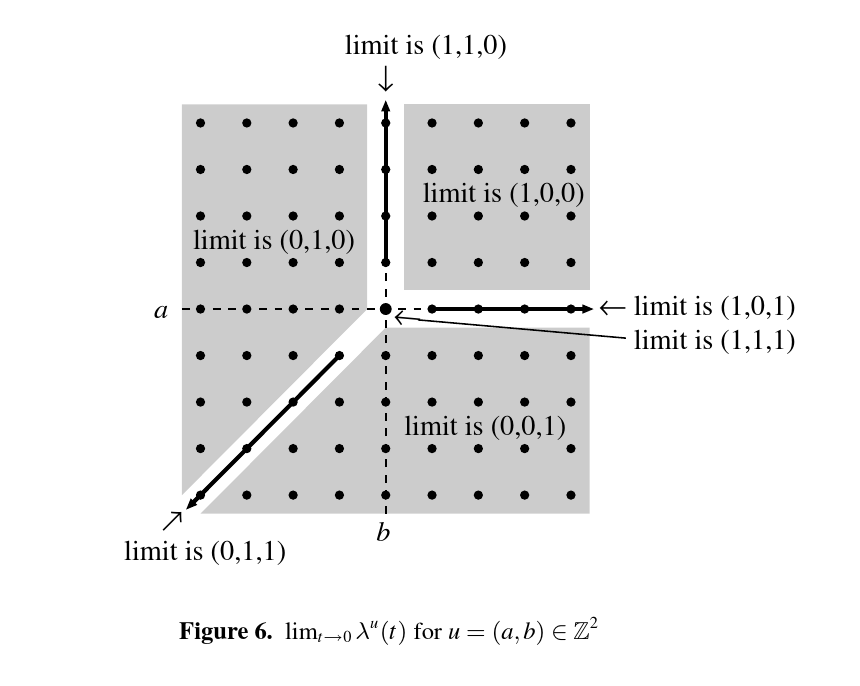
For \(u\in N\), \(\lim_{t\to0}\lambda^u(t)\) exists in \(X_\Sigma\) exactly when \(u\) lies in a cone of \(\Sigma\); testing properness on these limits gives the criterion that \(X_\Sigma\) is complete exactly when \(\abs\Sigma=N_\RR\).
The classification
Smooth complete toric surfaces and their intersection numbers (Tag T-TORSURF)
A smooth complete toric surface is given by rays \(v_0, v_1, \ldots, v_{d-1}, v_d = v_0\) in counterclockwise order such that each consecutive pair \(\ts{v_i, v_{i+1}}\) is a basis of \(N \cong \ZZ^2\). Consecutive triples then satisfy a unique relation \[ v_{i-1} + v_{i+1} = a_i v_i, \qquad a_i \in \ZZ , \] and these integers are constrained by \[ \prod_{i} \begin{bmatrix} 0 & -1 \\ 1 & a_i \end{bmatrix} = \id , \qquad \sum_i a_i = 3d - 12 . \] For \(d = 3\) the surface is \(\PP^2\); for \(d = 4\) it is a Hirzebruch surface \(\FF_a\); for \(d \geq 5\) it is a blowup of \(\PP^2\) or of some \(\FF_a\) at torus-fixed points.
(Intersection numbers)
With the same labelling, \[ D_i \cdot D_j = \begin{cases} 0 & \abs{i - j} > 1 , \\ 1 & \abs{i - j} = 1 , \\ -a_i & i = j . \end{cases} \]
Two adjacent rays span a cone, whose fixed point is the single transverse intersection of the two divisors, giving the \(1\). Non-adjacent rays span no cone, so the divisors are disjoint, giving the \(0\). The self-intersection comes from \(\operatorname{div}(\chi^m) \cdot D_i = 0\) for every \(m\): choose \(m\) with \(\inp{m}{v_i} = -1\) and \(\inp{m}{v_{i\pm1}}\) determined by the relation, and \(D_i^2 = -a_i\) drops out.
The sum rule \(\sum a_i = 3d - 12\) is a useful check. For \(\PP^2\), \(d = 3\) and each \(a_i = -1\), so each line has \(D_i^2 = 1\). For \(\FF_a\), \(d = 4\) and the \(a_i\) are \(a, 0, -a, 0\), giving self-intersections \(-a, 0, a, 0\).
The self-intersections \(D_i^2 = -a_i\) are the whole intersection form of the surface, since the \(D_i\) generate \(\Pic\) and \(D_i \cdot D_j\) is \(1\) for adjacent rays and \(0\) otherwise. They decide the birational geometry: a boundary curve with \(D_i^2 = -1\) is a \((-1)\)-curve, contracting it removes the ray \(v_i = v_{i-1} + v_{i+1}\), and repeating reaches \(\PP^2\) or a Hirzebruch surface \(\FF_a\), which is the classification of smooth complete toric surfaces. Nefness and ampleness are also read off: a torus-invariant divisor on a complete toric surface is nef exactly when its intersection with every \(D_i\) is nonnegative.
The Hirzebruch surface F_a from its fan (Tag FE-TORHIRZ)
Take \(N = \ZZ^2\) with rays \[ u_1 = (1,0), \quad u_2 = (0,1), \quad u_3 = (-1,a), \quad u_4 = (0,-1) \] and the four cones spanned by consecutive pairs. Each consecutive pair has determinant \(\pm 1\): \[ \det(u_1, u_2) = 1, \quad \det(u_2, u_3) = 1, \quad \det(u_3, u_4) = 1, \quad \det(u_4, u_1) = 1 , \] so \(\FF_a\) is smooth, and the support is all of \(N_\RR\), so it is complete.
(Intersection numbers)
Read the relations \(u_{i-1} + u_{i+1} = a_i u_i\) off the coordinates: \[ u_1 + u_3 = (0,a) = a \cdot u_2 , \qquad u_3 + u_1 = (0,a) = -a \cdot u_4 , \qquad u_4 + u_2 = (0,0) = 0 \cdot u_1 . \] Hence \[ D_2^2 = -a, \qquad D_4^2 = a, \qquad D_1^2 = D_3^2 = 0 . \] \(D_2\) is the negative section, \(D_4\) a positive section, \(D_1\) and \(D_3\) the two invariant fibres of \(\FF_a \to \PP^1\), which is the toric morphism induced by projection \(N \to \ZZ\) onto the first coordinate.
(Class group)
\(\Cl(\FF_a) = \ZZ^4 / M \cong \ZZ^2\) of rank \(4 - 2 = 2\), generated by a fibre \(F = D_1\) and the section \(S = D_2\), with \(F^2 = 0\), \(F \cdot S = 1\), \(S^2 = -a\). The fan is smooth so \(\Pic = \Cl\) and \(\rank \Pic(\FF_a) = 2\). The remaining classes are \(D_3 \sim F\) and \(D_4 \sim S + aF\). Also \(-K = \sum D_i \sim 2S + (a+2)F\).
\(\FF_0\) has rays \((\pm 1, 0), (0, \pm 1)\), a product fan, so \(\FF_0 = \PP^1 \times \PP^1\), the smooth quadric in \(\PP^3\). \(\FF_1\) is \(\PP^2\) blown up at a point, with \(D_2\) the exceptional curve of self-intersection \(-1\). For \(a \geq 2\) the surface is not Fano: \(-K \cdot D_2 = 2 - a \leq 0\). Every \(\FF_a\) is smooth, for all \(a \geq 0\), since each maximal cone has determinant \(\pm 1\).
(The Segre embedding of $\FF_0$)
The Segre embedding \(\PP^1 \times \PP^1 \to \PP^3\), \(([a:b],[c:d]) \mapsto [ac : ad : bc : bd]\), has image \(V(xw - yz)\). Its four monomials have exponent vectors \((1,0,1,0)\), \((1,0,0,1)\), \((0,1,1,0)\), \((0,1,0,1)\) in the variables \(a, b, c, d\), the vertices of a square, and the affine cone over the image is the affine toric variety \(V(xw - yz) \subseteq \CC^4\) of the cone over that square.
The Hirzebruch surface as a projective bundle over the line (Tag FE-FULHIRZBUN)
With the fan of \(\FF_a\) given by \(u_1 = (1,0)\), \(u_2 = (0,1)\), \(u_3 = (-1,a)\), \(u_4 = (0,-1)\), the lattice map \[ \phi : N = \ZZ^2 \to \ZZ, \qquad (p,q) \mapsto p \] sends \(u_1 \mapsto 1\), \(u_3 \mapsto -1\), and \(u_2, u_4 \mapsto 0\), so each cone of \(\FF_a\) lands in a cone of the fan \(\ts{\RR_{\geq 0}, \ts{0}, \RR_{\leq 0}}\) of \(\PP^1\). The induced toric morphism \(\pi : \FF_a \to \PP^1\) is the ruling, with invariant fibres \(D_1\) and \(D_3\) and disjoint invariant sections \(D_2\) and \(D_4\).
(The four charts)
Let \(\sigma_1 = \Cone(u_1, u_2)\), \(\sigma_2 = \Cone(u_4, u_1)\), \(\sigma_3 = \Cone(u_3, u_4)\) and \(\sigma_4 = \Cone(u_2, u_3)\). Then \[ U_{\sigma_1} = \Spec \CC[x, y], \quad U_{\sigma_2} = \Spec \CC[x, y^{-1}], \quad U_{\sigma_3} = \Spec \CC[x^{-1}, x^{-a}y^{-1}], \quad U_{\sigma_4} = \Spec \CC[x^{-1}, x^{a}y] , \] which patch as follows:
Setting \(y = 0\) gives the patching \(x \mapsto x^{-1}\) of a copy of \(\PP^1\), and patching in the fibre direction, for example \(U_{\sigma_1}\) with \(U_{\sigma_2}\), gives a copy of \(\CC \times \PP^1\); so \(\FF_a\) is a \(\PP^1\)-bundle over \(\PP^1\).
(The bundle)
\[ \FF_a \cong \PP\big( \OO_{\PP^1} \oplus \OO_{\PP^1}(a) \big) . \] The two disjoint sections are the ones cut out by the two summands, and they have \[ D_2^2 = -a, \qquad D_4^2 = +a , \] so \(D_2\) is the negative section. Its normal bundle is \[ N_{D_2 / \FF_a} \cong \OO_{D_2}(D_2) \cong \OO_{\PP^1}(-a) , \] because the normal bundle of a divisor in a surface is its own restriction, of degree \(D_2^2 = -a\) on \(D_2 \cong \PP^1\). Likewise \(N_{D_4/\FF_a} \cong \OO_{\PP^1}(a)\).
(Conventions, and what is invariant)
Twisting changes the bundle and not the surface: \(\PP(E) \cong \PP(E \tensor L)\) for any line bundle \(L\), so \[ \PP\big( \OO \oplus \OO(a) \big) \cong \PP\big( \OO(-a) \oplus \OO \big) , \] and both notations name \(\FF_a\). What does not depend on the convention is the pair of self-intersections \(\ts{-a, +a}\) and the difference \(a\) between them.
For \(a \geq 1\) the negative section is the unique irreducible curve on \(\FF_a\) with negative self-intersection, which is why \(\FF_a \cong \FF_b\) forces \(a = b\): the integer \(a\) is recovered from the surface. For \(a = 0\) there is no negative curve and \(\FF_0 = \PP^1 \times \PP^1\) has two rulings instead of one. Contracting the negative section of \(\FF_a\) gives the cone over the rational normal curve of degree \(a\), which is how the affine singular cone and the surface classification are the same picture seen twice.
\(\FF_0 = \PP^1 \times \PP^1\) is the quadric surface, \(\FF_1 = \Bl_p \PP^2\), and every smooth complete toric surface with at least five rays is obtained from \(\PP^2\) or some \(\FF_a\) by inserting rays.
K squared equals twelve minus the number of rays on a smooth complete toric surface (Tag PR-FULKSQ)
Let \(X\) be a smooth complete toric surface with \(d = \size \Sigma(1)\) rays and boundary divisors \(D_1, \ldots, D_d\) in cyclic order. Then \[ K_X^2 = 12 - d . \]
Write \(D_i^2 = -a_i\) with \(\sum_i a_i = 3d - 12\), and \(K_X = -\sum_i D_i\). Adjacent divisors meet once and non-adjacent ones not at all, so the cross terms contribute \(2d\): \[ K_X^2 = \Big( \sum_i D_i \Big)^2 = \sum_i D_i^2 + 2 \sum_i D_i \cdot D_{i+1} = -\sum_i a_i + 2d = -(3d - 12) + 2d = 12 - d . \]
This is Noether’s formula made trivial. A toric surface is rational, so \(\chi(\OO_X) = 1\), and its topological Euler characteristic is the number of maximal cones, which for a complete surface is also \(d\). Noether’s \(K^2 + \chi_{\mathrm{top}} = 12 \chi(\OO_X)\) then reads \(K^2 + d = 12\).
The checks are immediate. \(\PP^2\) has \(d = 3\) and \(K^2 = 9\). Each Hirzebruch surface has \(d = 4\) and \(K^2 = 8\), independent of \(a\). Every blowup adds one ray and drops \(K^2\) by one, so the toric del Pezzos \(\Bl_1, \Bl_2, \Bl_3 \PP^2\) have \(K^2 = 8, 7, 6\) and the list is exactly the surfaces with \(d \leq 6\) and \(-K\) ample.
Blowups
Blowup as star subdivision, and P^2 blown up at a fixed point (Tag FE-TORBLOW)
Let \(\sigma = \Cone(u_1, \ldots, u_k)\) be a smooth cone of \(\Sigma\), with distinguished fixed point \(x_\sigma\). Insert the ray \(u_0 = u_1 + \cdots + u_k\) and replace \(\sigma\) by the cones spanned by \(u_0\) together with each proper face of \(\sigma\). The identity map of \(N\) is compatible with the new fan and the old, and the induced morphism \[ \Bl_{x_\sigma} X_\Sigma = X_{\Sigma'} \to X_\Sigma \] is the blowup at \(x_\sigma\), with exceptional divisor \(D_{u_0} \cong \PP^{k-1}\).
(Blowing up the affine plane)
Subdivide the first quadrant by the ray through \(e_1 + e_2\), giving \(\sigma_0 = \Cone(e_2, e_1 + e_2)\) and \(\sigma_1 = \Cone(e_1 + e_2, e_1)\):
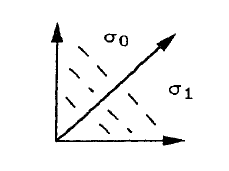
Then \(U_{\sigma_0} = \Spec \CC[x, x^{-1}y]\) and \(U_{\sigma_1} = \Spec \CC[y, xy^{-1}]\), both copies of \(\CC^2\). The blowup of \(\CC^2\) at the origin is \(\Bl_0 \CC^2 = V(x t_1 - y t_0) \subseteq \CC^2 \times \PP^1\) with \(\PP^1 = \ts{[t_0 : t_1]}\), covered by \(U_i = D(t_i) \cong \CC^2\) with coordinates \(x, t_1/t_0 = x^{-1}y\) on \(U_0\) and \(y, t_0/t_1 = xy^{-1}\) on \(U_1\). These are the two charts above, glued the same way, so \(X_{\Sigma} = \Bl_0 \CC^2\).
(Blowing up the plane)
\(\PP^2\) has rays \((1,0), (0,1), (-1,-1)\). Blow up the fixed point of \(\sigma = \Cone\big((1,0),(0,1)\big)\) by inserting \((1,0) + (0,1) = (1,1)\). The new fan has rays in counterclockwise order \[ (1,0), \quad (1,1), \quad (0,1), \quad (-1,-1) . \] Now read the relations \(u_{i-1} + u_{i+1} = a_i u_i\): \[ (1,0) + (0,1) = (1,1) \rightsquigarrow a = 1, \quad (-1,-1) + (1,1) = (0,0) \rightsquigarrow a = 0 , \] \[ (1,1) + (-1,-1) = (0,0) \rightsquigarrow a = 0, \quad (0,1) + (1,0) = (1,1) = -1 \cdot (-1,-1) \rightsquigarrow a = -1 . \] The self-intersections \(-a_i\) are therefore \[ E^2 = D_{(1,1)}^2 = -1, \qquad D_{(1,0)}^2 = D_{(0,1)}^2 = 0, \qquad D_{(-1,-1)}^2 = 1 . \]
Every number is the expected one. \(E\) is a \((-1)\)-curve. The two lines through the blown-up point become their strict transforms \(L - E\) with self-intersection \(1 - 1 = 0\). The third line misses the point and keeps \(L^2 = 1\). Four rays with a \(-1\) among the self-intersections identifies the surface as \(\FF_1\).
The sum rule holds: \(\sum a_i = 1 + 0 + 0 - 1 = 0 = 3 \cdot 4 - 12\).
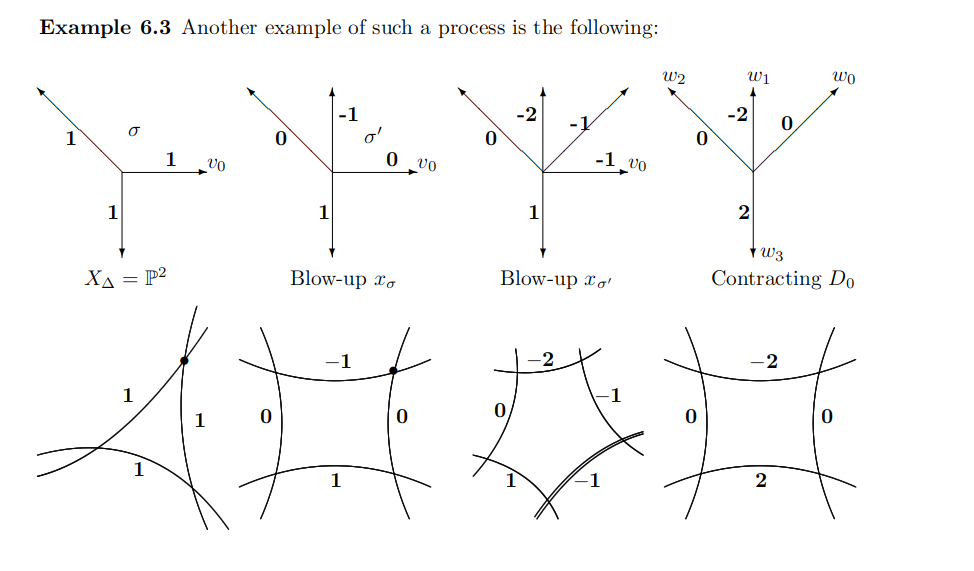
Inserting a ray between two adjacent rays raises \(\rank\Pic\) by one, raises \(\chi\) by one, creates a \(-1\)-curve, and drops the self-intersection of each neighbour by one. Contracting reverses all four.
Beyond surfaces
Weighted projective space as a toric variety (Tag FE-TORWPS)
For weights \(q_0, \ldots, q_n\) with \(\gcd = 1\), choose \(v_0, \ldots, v_n \in N \cong \ZZ^n\) generating \(N\) and satisfying the single relation \[ q_0 v_0 + q_1 v_1 + \cdots + q_n v_n = 0 . \] The fan of \(\PP(q_0, \ldots, q_n)\) has these as rays, with maximal cones spanned by every \(n\) of them. Taking all \(q_i = 1\) and \(v_i = e_i\), \(v_0 = -\sum e_i\) recovers \(\PP^n\).
(P(1,1,2))
Solve \(1 \cdot v_0 + 1 \cdot v_1 + 2 \cdot v_2 = 0\) in \(\ZZ^2\) with \[ v_2 = (1,0), \quad v_1 = (0,1), \quad v_0 = (-2,-1) \] — check \((-2,-1) + (0,1) + 2(1,0) = (0,0)\), and \(v_1, v_2\) generate \(N\). The three maximal cones have determinants \[ \det(v_1, v_2) = -1, \qquad \det(v_2, v_0) = -1, \qquad \det(v_0, v_1) = -2 , \] so exactly one torus-fixed point is singular, an \(A_1\) point of index \(2\). Its cone is \(\Cone\big( (-2,-1), (0,1) \big)\), which is \(\Cone\big( (0,1), (2,-1) \big)\) after a change of basis: the quadric cone \(V(xy - z^2)\).
\(\Cl\big(\PP(1,1,2)\big) = \ZZ^3 / M \cong \ZZ\), and the classes of \(D_0, D_1, D_2\) are the weights \(1, 1, 2\). So \(\Cl\) is generated by \(\OO(1)\), which is a Weil divisor class that is not Cartier at the singular point; \(\Pic\) is the index-two subgroup generated by \(\OO(2)\). This is the smallest example where \(\Pic \subsetneq \Cl\) with both torsion free, and it is the cone over a conic in disguise.
(P(1,1,2) from a polygon)
Let \(P = \operatorname{Conv}(0, 2e_1, e_2) \subseteq M_\RR = \RR^2\), with lattice points \(0, e_1, 2e_1, e_2\). The characters of these points give \((\CC^*)^2 \to \PP^3\), \((s,t) \mapsto [1 : s : s^2 : t]\), and \(X_P\) is the closure of the image, \[ X_P = V(y_0 y_2 - y_1^2) \subseteq \PP^3 , \] the projective cone over a conic. The inward facet normals of \(P\) are \((0,1)\), \((1,0)\) and \((-1,-2)\), with the relation \(1 \cdot (1,0) + 2 \cdot (0,1) + 1 \cdot (-1,-2) = 0\), so the normal fan is the fan of \(\PP(1,1,2)\) above.
The fan of a weighted projective space is simplicial, so it is \(\QQ\)-factorial, with \(\Pic\) of finite index in \(\Cl\); \(\PP(1,1,2)\) is singular, being the projective cone over a conic. The three-dimensional cone on \((1,0,0)\), \((0,1,0)\), \((1,0,1)\), \((0,1,1)\) is not simplicial, and its affine toric variety is \(V(xy-zw)\), the cone over the quadric surface. Subdividing the cone along either diagonal of the square gives the two small resolutions of \(V(xy-zw)\), each with exceptional locus a \(\PP^1\).
Cohomology of smooth toric varieties
The Stanley--Reisner presentation of the cohomology of a smooth toric variety (Tag T-TORCOHOM)
Let \(X_\Sigma\) be a smooth complete toric variety over \(\CC\) with rays \(\rho_1, \ldots, \rho_r\), primitive generators \(u_i\), and invariant divisors \(D_i\). Then \[ H^\bullet(X_\Sigma, \ZZ) \cong A^\bullet(X_\Sigma) \cong \ZZ[x_1, \ldots, x_r] / (I_\Sigma + J_\Sigma), \qquad x_i \mapsto [D_i] \in H^2, \] where \[ I_\Sigma = \big( x_{i_1} \cdots x_{i_k} \st \rho_{i_1}, \ldots, \rho_{i_k} \text{ do not span a cone of } \Sigma \big) \] is the Stanley–Reisner ideal of \(\Sigma\), and \(J_\Sigma = \big( \sum_i \inp{m}{u_i} x_i \st m \in M \big)\) is generated by the linear relations. In particular the odd cohomology vanishes and \(H^\bullet\) is generated in degree \(2\).
The Stanley–Reisner relation \(D_{i_1} \cdots D_{i_k} = 0\) says that invariant divisors whose rays span no cone have empty common intersection, since their orbit closures do not meet. The linear relations are \(\div(\chi^m) \sim 0\) from the class-group sequence.
For \(\PP^2\) with rays \(e_1, e_2, -e_1 - e_2\), the three rays together span no cone, so \(I_\Sigma = (x_1 x_2 x_3)\), and \(J_\Sigma = (x_1 - x_3, x_2 - x_3)\). So \(H^\bullet(\PP^2) = \ZZ[H]/(H^3)\). For the Hirzebruch surface \(\FF_a\) with rays \(e_1, e_2, -e_1 + a e_2, -e_2\), the opposite pairs span no cone, so \(x_1 x_3 = x_2 x_4 = 0\), with linear relations \(x_1 = x_3\) and \(x_2 = x_4 - a x_3\), and the ring is \(\ZZ[f, s]/(f^2, s^2 - a s f)\) for \(f = x_1\) and \(s = x_4\); so \(D_4^2 = a\) and \(D_2^2 = (s - af)^2 = -a\).
(Betti numbers)
Let \(X_\Sigma\) be a smooth complete toric variety of dimension \(n\), and let \(d_j\) be the number of \(j\)-dimensional cones of \(\Sigma\). Then the odd Betti numbers vanish and \[ \beta_{2k}(X_\Sigma) = \sum_{i=k}^{n} (-1)^{i-k} \binom{i}{k} d_{n-i} . \] In particular \(\chi(X_\Sigma) = d_n\), the number of maximal cones. [@Ful93]
For \(\PP^2\), \(d_0 = 1\) and \(d_1 = d_2 = 3\), so \(\beta_0 = d_2 - d_1 + d_0 = 1\), \(\beta_2 = d_1 - 2 d_0 = 1\) and \(\beta_4 = d_0 = 1\).