(Star subdivision)
Let \(\sigma = \Cone(u_1, \ldots, u_k)\) be a smooth cone of \(\Sigma\), with distinguished fixed point \(x_\sigma\). Insert the ray \(u_0 = u_1 + \cdots + u_k\) and replace \(\sigma\) by the cones spanned by \(u_0\) together with each proper face of \(\sigma\). The identity map of \(N\) is compatible with the new fan and the old, and the induced morphism \[ \Bl_{x_\sigma} X_\Sigma = X_{\Sigma'} \to X_\Sigma \] is the blowup at \(x_\sigma\), with exceptional divisor \(D_{u_0} \cong \PP^{k-1}\).
(Blowing up the affine plane)
Subdivide the first quadrant by the ray through \(e_1 + e_2\), giving \(\sigma_0 = \Cone(e_2, e_1 + e_2)\) and \(\sigma_1 = \Cone(e_1 + e_2, e_1)\):
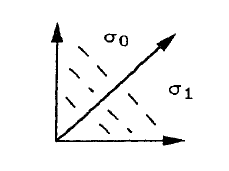
Then \(U_{\sigma_0} = \Spec \CC[x, x^{-1}y]\) and \(U_{\sigma_1} = \Spec \CC[y, xy^{-1}]\), both copies of \(\CC^2\). The blowup of \(\CC^2\) at the origin is \(\Bl_0 \CC^2 = V(x t_1 - y t_0) \subseteq \CC^2 \times \PP^1\) with \(\PP^1 = \ts{[t_0 : t_1]}\), covered by \(U_i = D(t_i) \cong \CC^2\) with coordinates \(x, t_1/t_0 = x^{-1}y\) on \(U_0\) and \(y, t_0/t_1 = xy^{-1}\) on \(U_1\). These are the two charts above, glued the same way, so \(X_{\Sigma} = \Bl_0 \CC^2\).
(Blowing up the plane)
\(\PP^2\) has rays \((1,0), (0,1), (-1,-1)\). Blow up the fixed point of \(\sigma = \Cone\big((1,0),(0,1)\big)\) by inserting \((1,0) + (0,1) = (1,1)\). The new fan has rays in counterclockwise order \[ (1,0), \quad (1,1), \quad (0,1), \quad (-1,-1) . \] Now read the relations \(u_{i-1} + u_{i+1} = a_i u_i\): \[ (1,0) + (0,1) = (1,1) \rightsquigarrow a = 1, \quad (-1,-1) + (1,1) = (0,0) \rightsquigarrow a = 0 , \] \[ (1,1) + (-1,-1) = (0,0) \rightsquigarrow a = 0, \quad (0,1) + (1,0) = (1,1) = -1 \cdot (-1,-1) \rightsquigarrow a = -1 . \] The self-intersections \(-a_i\) are therefore \[ E^2 = D_{(1,1)}^2 = -1, \qquad D_{(1,0)}^2 = D_{(0,1)}^2 = 0, \qquad D_{(-1,-1)}^2 = 1 . \]
Every number is the expected one. \(E\) is a \((-1)\)-curve. The two lines through the blown-up point become their strict transforms \(L - E\) with self-intersection \(1 - 1 = 0\). The third line misses the point and keeps \(L^2 = 1\). Four rays with a \(-1\) among the self-intersections identifies the surface as \(\FF_1\).
The sum rule holds: \(\sum a_i = 1 + 0 + 0 - 1 = 0 = 3 \cdot 4 - 12\).