Geometry
The interior angles of a convex \(n\)-gon sum to \((n-2)\pi\), so each interior angle of a regular \(n\)-gon is \(\frac{n-2}{n}\pi\).
(Standard forms of conic sections)
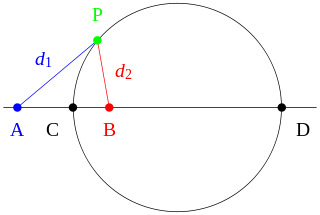
- Circle: \(x^2 + y^2 = r^2\), or \(\abs{z-a}=r\). For \(a\neq b\) and a constant \(c>0\) with \(c\neq 1\), the locus \(\abs{z-a} = c\abs{z-b}\) of points whose distances \(d_1, d_2\) to the two points \(a, b\) have constant ratio \(d_1/d_2 = c\) is also a circle:
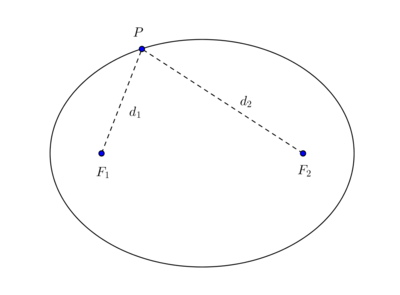
- Ellipse: \(\qty{\frac x a}^2 + \qty{\frac y b}^2 = 1\), or \(\abs{z-a} + \abs{z-b} = c\) with \(c > \abs{a-b}\), the locus of points whose distances to \(a\) and \(b\) have constant sum \(d_1 + d_2 = c\):
- Hyperbola: \(\qty{\frac x a}^2 - \qty{\frac y b}^2 = 1\), or \(\abs{\abs{z-a} - \abs{z-b}} = c\) with \(0 < c < \abs{a-b}\):
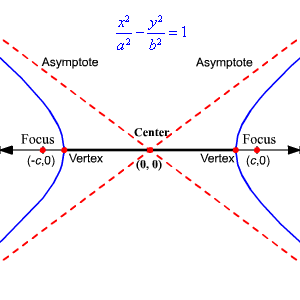
The rectangular hyperbola is \(xy = \frac{c^2}{2}\). - Parabola: \(y^2 = 4ax\).
(Classification by the discriminant)
For a nondegenerate real conic \(Ax^2 + Bxy + Cy^2 + Dx + Ey + F = 0\) with at least one real point and discriminant \(\Delta \coloneqq B^2 - 4AC\):
- \(\Delta < 0\) if and only if the conic is an ellipse, and it is a circle if and only if moreover \(A=C\) and \(B=0\);
- \(\Delta = 0\) if and only if the conic is a parabola;
- \(\Delta > 0\) if and only if the conic is a hyperbola.
(Parameterizations)
- The ellipse \(\qty{x\over a}^2 + \qty{y\over b}^2 = 1\) is parameterized by \(t\mapsto (a\cos(t), b\sin(t))\):
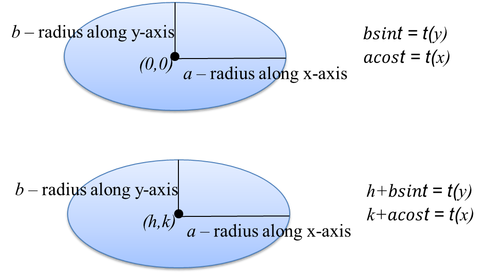
In complex form, \(\gamma(t) = pe^{it} + qe^{-it}\) with \(p \coloneqq \frac{a+b}{2}\) and \(q \coloneqq \frac{a-b}{2}\), since \(pe^{it} + qe^{-it} = a\cos(t) + ib\sin(t)\).
For \(a\geq b\) the foci are \((\pm c, 0)\) with \(c\coloneqq \sqrt{a^2-b^2}\), and the vertices are \((\pm a, 0)\) and \((0, \pm b)\):
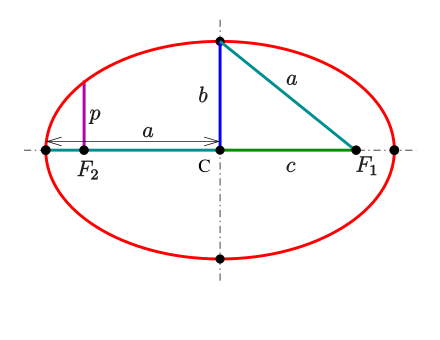
The circle \((x-h)^2 + (y-k)^2 = r^2\) is parameterized by \(t\mapsto (r\cos(t) + h, r\sin(t) + k)\), in complex form \(\gamma(t) = z_0 + re^{it}\) with \(z_0\coloneqq h + ik\).
With \(u\coloneqq \tan(t/2)\), \[ \cos(t) = {1-u^2\over 1+u^2}, \qquad \sin(t) = {2u\over 1+u^2}. \] This gives the rational parameterization of the ellipse \[ u\mapsto a {1-u^2\over 1+u^2} +ib{2u\over 1+u^2}, \] and, for \(a=b=R\), of the circle of radius \(R\); each misses only the point \(-a\).
For \(a\in\CC\setminus\ts{0}\) and \(c\in\RR\), the set \(\ts{z \st \bar{a}z + a\bar{z} + c = 0}\) is a line, and every line has this form.
Algebra
(Numerical values)
\(\sqrt{2} \approx 1.4142\), \(1/\sqrt{2} \approx 0.7071\), \(\sqrt{3} \approx 1.7321\), \(1/\sqrt{3} \approx 0.5774\), \(e\approx 2.7183\), \(\pi \approx 3.14159\).
(Completing the square)
For \(a\neq 0\), \[ ax^2 + bx + c = a\qty{x + d}^2 + e, \qquad d \coloneqq \frac{b}{2a}, \quad e\coloneqq c - \frac{b^2}{4a}. \] In particular \(x^2 + bx + c = \qty{x+ {b\over 2}}^2 + c - \qty{b\over 2}^2\).
Trigonometry
Value of $\sin(\pi/6)$ (Tag FF-ATMHV)
\[ \sin(\pi/6) = \frac{1}{2}. \]
Value of $\sin(\pi/4)$ (Tag FF-ZQFSR)
\[ \sin(\pi/4) = \frac{\sqrt 2}{2}. \]
Value of $\sin(\pi/3)$ (Tag FF-TGTS7)
\[ \sin(\pi/3) = \frac{\sqrt 3}{2}. \]
Value of $\cos(\pi/6)$ (Tag FF-CLFAB)
\[ \cos(\pi/6) = \frac{\sqrt 3}{2}. \]
Value of $\cos(\pi/4)$ (Tag FF-W2TS2)
\[ \cos(\pi/4) = \frac{\sqrt 2}{2}. \]
Value of $\cos(\pi/3)$ (Tag FF-VT2E7)
\[ \cos(\pi/3) = \frac{1}{2}. \]
Value of $\tan(\pi/6)$ (Tag FF-YBIQV)
\[ \tan(\pi/6) = \frac{\sqrt 3}{3}. \]
Value of $\tan(\pi/4)$ (Tag FF-CIESS)
\[ \tan(\pi/4) = 1. \]
Value of $\tan(\pi/3)$ (Tag FF-SF7VN)
\[ \tan(\pi/3) = \sqrt 3. \]
Double-angle formulas in terms of $\tan t$ (Tag FF-JLUCP)
For every \(t\in\RR\) with \(\cos t\neq0\), \[ \begin{aligned} \sin(2t) &= {2\tan(t) \over 1+\tan^2(t)}, \\ \cos(2t) &= {1-\tan^2(t) \over 1+\tan^2(t)}. \end{aligned} \]
Value of $\arctan(0)$ (Tag FF-Y6IOA)
\(\arctan(0) = 0\)
Value of $\arctan(1)$ (Tag FF-WDDTM)
\(\arctan(1) = {\pi\over 4}\)
Limit of $\arctan x$ as $x\to\infty$ (Tag FF-A7OEY)
For real \(x\), \(\lim_{x\to+\infty}\arctan x = {\pi \over 2}\).
Value of $\arctan(1/\sqrt 3)$ (Tag FF-7KQCC)
\(\arctan\qty{1\over \sqrt 3} = {\pi\over 6}\)
Value of $\arctan(\sqrt{3}/3)$ (Tag FF-2VUTS)
\(\arctan\qty{\frac{\sqrt3}{3}}=\frac{\pi}{6}\), because \(\tan\frac{\pi}{6}=\frac{1/2}{\sqrt3/2}=\frac{1}{\sqrt3}=\frac{\sqrt3}{3}\) and \(\frac{\pi}{6}\in\qty{-\frac{\pi}{2},\frac{\pi}{2}}\).
Value of $\arctan(\sqrt 3)$ (Tag FF-2ABHQ)
\(\arctan(\sqrt 3)=\frac{\pi}{3}\), because \(\tan\frac{\pi}{3}=\frac{\sqrt3/2}{1/2}=\sqrt3\) and \(\frac{\pi}{3}\in\qty{-\frac{\pi}{2},\frac{\pi}{2}}\).
The root of unity \(e^{2\pi i k/n}\) has rectangular coordinates \(\qty{\cos(2\pi k/n), \sin(2\pi k/n)}\), so \(e^{2\pi i/3} = -\frac12 + \frac{\sqrt3}{2}i\) and \(e^{2\pi i/6} = \frac12 + \frac{\sqrt3}{2}i\).
$e^{2\pi i/3}$ in rectangular coordinates (Tag FF-XEQFR)
\[ e^{2\pi i/3} = \cos\frac{2\pi}{3} + i\sin\frac{2\pi}{3} = \frac{1}{2}\qty{-1 + i\sqrt 3}. \]
$e^{2\pi i/6}$ in rectangular coordinates (Tag FF-TGHJ5)
\[ e^{2\pi i/6} = \cos\frac{\pi}{3} + i\sin\frac{\pi}{3} = \frac{1}{2}\qty{1 + i\sqrt 3}. \]
Rational parametrization of the unit circle (Tag FF-2OHYV)
The map \[ x\mapsto\frac{1-x^2}{1+x^2}+i\,\frac{2x}{1+x^2}=\frac{1+ix}{1-ix},\qquad x\in\RR, \] is a bijection from \(\RR\) onto \(S^1\setminus\{-1\}\). Substituting \(x=\tan t\) for \(t\in\qty{-\frac{\pi}{2},\frac{\pi}{2}}\) gives \[ F(t)\coloneqq\frac{1-x^2}{1+x^2}+i\,\frac{2x}{1+x^2}=\cos 2t+i\sin 2t=e^{2it}. \]
Since \((1+ix)(1-ix)=1+x^2\), we have \(\frac{1+ix}{1-ix}=\frac{(1+ix)^2}{1+x^2}=\frac{1-x^2+2ix}{1+x^2}\), and its modulus is \(\abs{1+ix}/\abs{1-ix}=1\). For \(t\in(-\pi/2,\pi/2)\) and \(x=\tan t\), \(1+x^2=\sec^2t\), so \(\frac{1-x^2}{1+x^2}=\cos^2t-\sin^2t=\cos2t\) and \(\frac{2x}{1+x^2}=2\sin t\cos t=\sin2t\). As \(t\) runs over \((-\pi/2,\pi/2)\), \(x=\tan t\) runs bijectively over \(\RR\) and \(2t\) runs over \((-\pi,\pi)\), so \(e^{2it}\) runs bijectively over \(S^1\setminus\{-1\}\).
$\sin\theta$ and $d\theta$ under the substitution $z=e^{i\theta}$ (Tag FF-TBIC5)
For \(\theta\in\RR\) and \(z=e^{i\theta}\) on the unit circle, \[ \begin{aligned} \sin(\theta) &= \frac{e^{i\theta} - e^{-i\theta}}{2i} = \frac{z - \inverseof{z}}{2i}, \\ d\theta &= \frac{dz}{iz}. \end{aligned} \]
Hyperbolic functions
Exponential definitions of $\cosh$ and $\sinh$ (Tag FD-XUGN3)
For \(z\in\CC\), the hyperbolic cosine and hyperbolic sine are \[ \begin{aligned} \cosh(z)&\coloneqq\frac{e^{z}+e^{-z}}{2},\\ \sinh(z)&\coloneqq\frac{e^{z}-e^{-z}}{2}. \end{aligned} \]
With \(iz\) in place of \(z\), the same expressions give the trigonometric functions: \(\cos(z)=\frac{e^{iz}+e^{-iz}}{2}=\cosh(iz)\) and \(\sin(z)=\frac{e^{iz}-e^{-iz}}{2i}=-i\sinh(iz)\).
$\cos z = \cosh(iz)$ (Tag FF-AGEQ4)
For every \(z\in\CC\), \[ \cos(z) = \cosh(iz). \]
$\sin z = \frac{1}{i}\sinh(iz)$ (Tag FF-MV5X6)
For every \(z\in\CC\), \[ \sin(z) = {1\over i} \sinh(iz). \]
$\cosh(x+iy)$ in terms of real and imaginary parts (Tag FF-VFWB6)
For \(x,y\in\RR\), \[ \cosh (x+i y) =\cosh (x) \cos (y)+i \sinh (x) \sin (y). \]
$\sinh(x+iy)$ in terms of real and imaginary parts (Tag FF-VR4UT)
For \(x,y\in\RR\), \[ \sinh (x+i y) =\sinh (x) \cos (y)+i \cosh (x) \sin (y). \]
For \(z = x+iy\), the addition formulas together with \(\cos(iy) = \cosh(y)\) and \(\sin(iy) = i\sinh(y)\) give \(\cos(z) = \cos(x)\cosh(y) - i\sin(x)\sinh(y)\) and \(\sin(z) = \sin(x)\cosh(y) + i\cos(x)\sinh(y)\). The series expansions are on Series reference.