Galois groups of irreducible polynomials over \(\QQ\) of small degree, using the methods on Compute this Galois group.
Quadratics
An irreducible quadratic \(f\in\QQ[x]\) with discriminant \(\Delta\) has splitting field \(\QQ(\sqrt\Delta)\) and Galois group \(C_2\). The fields \(\QQ(\sqrt d)\) for squarefree integers \(d\neq1\) are pairwise distinct, and a quadratic \(f\) splits over \(\QQ\) if and only if \(\sqrt\Delta \in \QQ\).
Cubics
For an irreducible cubic \(f\in\QQ[x]\) with discriminant \(\Delta\), the Galois group is \(S_3\) or \(A_3 \cong C_3\): \[ G = A_3 \text{ if } \Delta \text{ is a square in } \QQ, \qquad G = S_3 \text{ otherwise}. \] For a cubic \(t^3+pt+q\), \(\Delta = -4p^3-27q^2\).
Galois group of an irreducible cubic (Tag PR-XPDHE)
Let \(k\) be a field with \(\ch k\neq 2\), let \(f\in k[x]\) be an irreducible separable cubic with discriminant \(\Delta\), and let \(G\) be the Galois group of \(f\) over \(k\), regarded as a subgroup of \(S_3\) through its action on the roots of \(f\). Then \(G\cong A_3\cong C_3\) if \(\Delta\) is a square in \(k\), and \(G\cong S_3\) otherwise.
Since \(f\) is irreducible, \(G\) acts transitively on the three roots, so \(3\divides\abs G\) and \(G\) is \(A_3\) or \(S_3\). Let \(\alpha_1,\alpha_2,\alpha_3\) be the roots and \(\delta\coloneqq\prod_{i<j}(\alpha_i-\alpha_j)\), so \(\delta^2=\Delta\) and \(\delta\neq0\) because \(f\) is separable. Every \(\sigma\in G\) satisfies \(\sigma(\delta)=\operatorname{sgn}(\sigma)\,\delta\), and \(\delta\neq-\delta\) because \(\ch k\neq2\). Hence \(\delta\) is fixed by \(G\), equivalently \(\delta\in k\), if and only if \(G\subseteq A_3\). Since the square roots of \(\Delta\) are \(\pm\delta\), \(\Delta\) is a square in \(k\) if and only if \(G=A_3\).
Quartics
For an irreducible quartic \(f\in\QQ[x]\), the Galois group is one of \(S_4\), \(A_4\), \(D_4\), \(C_4\), \(C_2^2\), and the resolvent cubic together with the discriminant \(\Delta\) determines which.
Resolvent cubic of a quartic (Tag D-4DWC5)
Let \(k\) be a field and let \[ f(x)=x^{4}+a_{3} x^{3}+a_{2} x^{2}+a_{1} x+a_{0} \in k[x]. \] The resolvent cubic of \(f\) is \[ R_{4}(t) \coloneqq t^{3}-a_{2} t^{2}+\left(a_{1} a_{3}-4 a_{0}\right) t+4 a_{0} a_{2}-a_{1}^{2}-a_{0} a_{3}^{2} \in k[t]. \]
Let \(f\in k[x]\) be as in the definition, and let \(r_1, r_2, r_3, r_4\) be the roots of \(f\), with multiplicity, in a splitting field of \(f\) over \(k\). Then \[ R_4(t) = \left(t-\left(r_{1} r_{2}+r_{3} r_{4}\right)\right)\left(t-\left(r_{1} r_{3}+r_{2} r_{4}\right)\right)\left(t-\left(r_{1} r_{4}+r_{2} r_{3}\right)\right). \]
For \(f(x) = x^4 + cx + d\), that is, \(a_3 = a_2 = 0\), \(a_1 = c\), and \(a_0 = d\), the resolvent cubic is \(R_4(t) = t^3 - 4dt - c^2\).
Galois groups of irreducible quartics over $\QQ$ (Tag PR-E4T3S)
Let \(f \in \QQ[x]\) be a monic irreducible quartic with discriminant \(\Delta\) and resolvent cubic \(R_4\), and let \(G \leq S_4\) be the Galois group of a splitting field of \(f\) over \(\QQ\) [@Hun74].
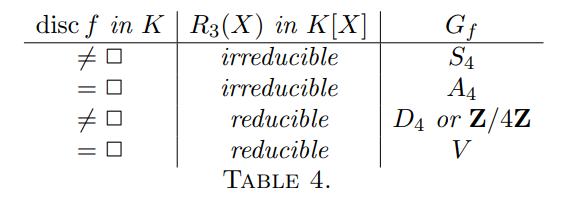
If \(\sqrt{\Delta} \in \QQ\), then \(G = A_4\) or \(G = V_4 \cong C_2^2\): \(G = A_4\) if \(R_4\) is irreducible over \(\QQ\), and \(G = V_4\) otherwise.
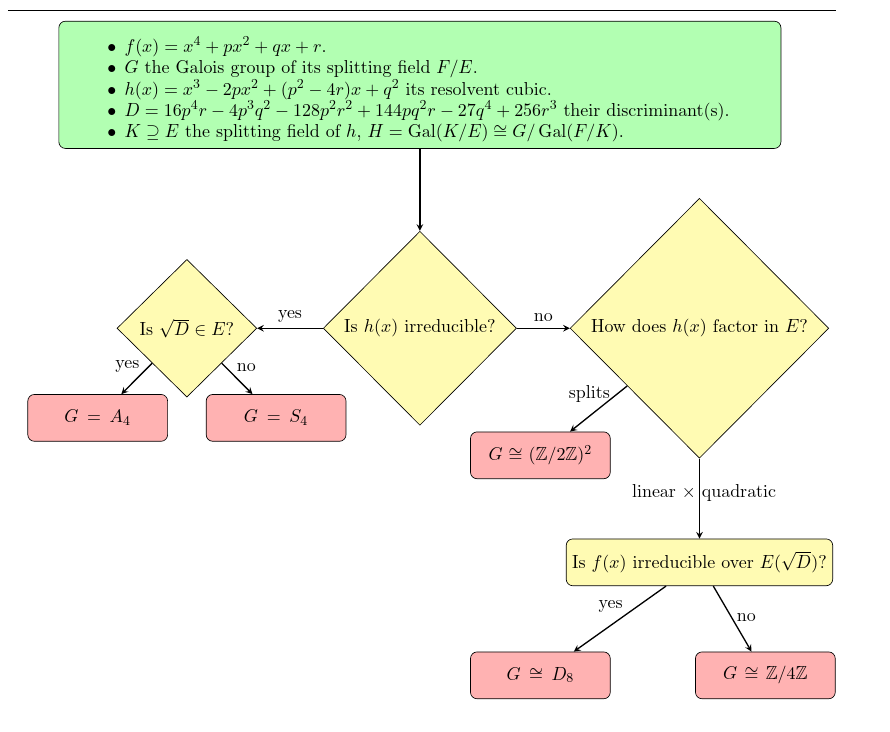
If \(\sqrt{\Delta} \notin \QQ\), then \(G = S_4\), \(D_4\), or \(C_4\): \(G = S_4\) if \(R_4\) is irreducible over \(\QQ\). Otherwise \(G = D_4\) if \(f\) is irreducible over \(\QQ(\sqrt{\Delta})\), and \(G = C_4\) if \(f\) is reducible over \(\QQ(\sqrt{\Delta})\).
The groups \(D_4\) and \(C_4\) can also be distinguished by cycle types: the copy of \(D_4\) in \(S_4\) contains transpositions, whereas \(C_4\) contains only \(4\)-cycles, the identity, and one product of two transpositions.
The cases are summarized in the following table:
and in the following flow chart:
(Classification by the resolvent cubic)
Let \(R\) be the resolvent cubic of \(f\).
If \(R\) is irreducible over \(\QQ\) and \(\Delta\) is not a square, then \(G = S_4\).
If \(R\) is irreducible over \(\QQ\) and \(\Delta\) is a square, then \(G = A_4\).
If \(R\) splits into linear factors over \(\QQ\), then \(G = C_2^2\).
If \(R\) has exactly one root in \(\QQ\), then \(G\) is \(C_4\) if \(f\) is reducible over \(\QQ(\sqrt\Delta)\), and \(D_4\) if \(f\) is irreducible over \(\QQ(\sqrt\Delta)\).
Cyclotomic fields
\(\Gal(\QQ(\zeta_n)/\QQ)\cong(\ZZ/n)^\times\); see Cyclotomic and radical extensions.
Finite fields
\(\Gal(\FF_{p^n}/\FF_p)\) is cyclic of order \(n\), generated by the Frobenius automorphism \(x\mapsto x^p\); see Finite fields.