Let \(f \in \QQ[x]\) be a monic irreducible quartic with discriminant \(\Delta\) and resolvent cubic \(R_4\), and let \(G \leq S_4\) be the Galois group of a splitting field of \(f\) over \(\QQ\) [@Hun74].
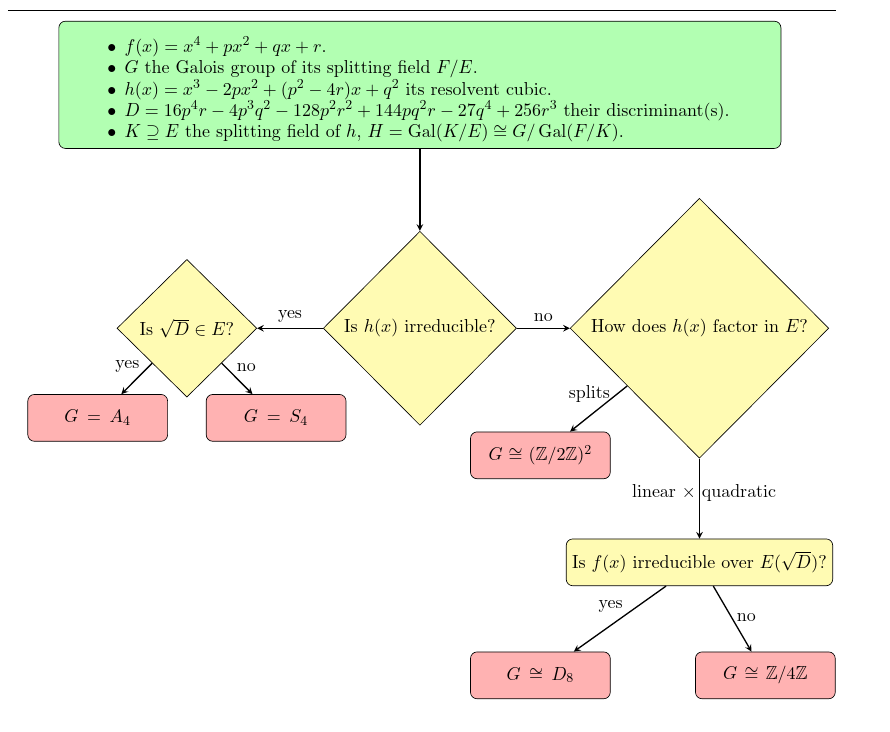
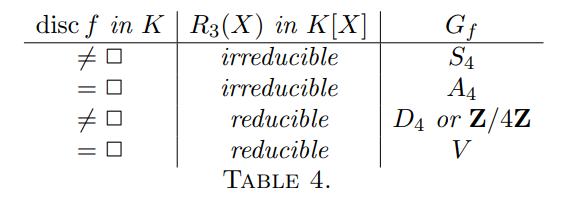
If \(\sqrt{\Delta} \in \QQ\), then \(G = A_4\) or \(G = V_4 \cong C_2^2\): \(G = A_4\) if \(R_4\) is irreducible over \(\QQ\), and \(G = V_4\) otherwise.
If \(\sqrt{\Delta} \notin \QQ\), then \(G = S_4\), \(D_4\), or \(C_4\): \(G = S_4\) if \(R_4\) is irreducible over \(\QQ\). Otherwise \(G = D_4\) if \(f\) is irreducible over \(\QQ(\sqrt{\Delta})\), and \(G = C_4\) if \(f\) is reducible over \(\QQ(\sqrt{\Delta})\).
The groups \(D_4\) and \(C_4\) can also be distinguished by cycle types: the copy of \(D_4\) in \(S_4\) contains transpositions, whereas \(C_4\) contains only \(4\)-cycles, the identity, and one product of two transpositions.
The cases are summarized in the following table:
and in the following flow chart: