A finite extension \(L/K\) is Galois if it is normal and separable, equivalently if the fixed field of \(\Aut(L/K)\) is \(K\), equivalently if \(\abs{\Aut(L/K)}=[L:K]\). For \(L/K\) finite Galois with group \(G\), \(H\mapsto L^H\) is an inclusion-reversing bijection from the subgroups of \(G\) to the intermediate fields, with \([L:L^H]=\abs{H}\); the extension \(L^H/K\) is Galois if and only if \(H\trianglelefteq G\), and then \(\Gal(L^H/K)\cong G/H\). The Galois group of a separable polynomial of degree \(n\) embeds in \(S_n\) through its action on the roots, as a transitive subgroup when the polynomial is irreducible; in characteristic different from \(2\) it lies in \(A_n\) if and only if the discriminant is a square in \(K\). For an irreducible separable quartic, the factorization of the resolvent cubic and whether the discriminant is a square determine the Galois group among \(S_4\), \(A_4\), \(V_4\), and \(\{D_4,C_4\}\).
Galois extension and Galois group (Tag D-5JYEI)
Let \(L/k\) be a finite field extension. \(L/k\) is a Galois extension if it is normal and separable. In this case the Galois group of \(L/k\) is \[ \Gal(L/k) \coloneqq \Aut_{\Fieldsover{k}} (L). \]
Let \(L/k\) be a finite field extension, and let \([L:k]_s\) be its separable degree. The following are equivalent:
\(L/k\) is normal and separable.
The fixed field of \(\Aut_{\Fieldsover{k}}(L)\) is \(k\).
\(L\) is a splitting field over \(k\) of a separable polynomial \(p\in k[x]\).
\(L\) is a splitting field over \(k\) of an irreducible separable polynomial \(p\in k[x]\).
\(\size \Aut_{\Fieldsover{k}} (L) = [L: k]_s = [L: k]\).
The separable degree counts the embeddings of \(L\) into an algebraic closure that extend a fixed embedding of \(k\):
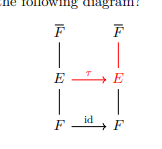
Finite Galois extension (Tag FD-4GFTY)
Let \(K/F\) be a finite field extension, and let \(\Aut(K/F)\) be the group of field automorphisms of \(K\) that restrict to the identity on \(F\). \(K/F\) is Galois if \(\abs{\Aut(K/F)} = [K: F]\).
Characterizations of finite Galois extensions (Tag FT-3WWKN)
Let \(K/F\) be a finite field extension. The following are equivalent:
\(K\) is a splitting field over \(F\) of a separable polynomial in \(F[x]\).
The fixed field of \(\Aut(K/F)\) is \(F\).
\([K:F]=\abs{\Aut(K/F)}\).
A finite extension satisfying these conditions is Galois.
Fixed field (Tag D-5FG7E)
Let \(L/k\) be a field extension and let \(H \leq \Aut_{\Fieldsover{k}}(L)\) be a subgroup of the automorphisms of \(L\) fixing \(k\). The fixed field of \(H\) is \[ L^H \coloneqq \theset{ \ell \in L \st \sigma(\ell) = \ell \text{ for all } \sigma\in H }. \]
Automorphism group of a field extension (Tag D-MN47W)
Let \(L/k\) be a field extension. The automorphism group of \(L/k\) is the group, under composition, \[ \Aut(L/k) \coloneqq \theset{\sigma\colon L \to L \text{ a field automorphism} \suchthat \restrictionof{\sigma}{k} = \id_k}. \]
Conjugates of an algebraic element (Tag FD-YJEDU)
Let \(L/K\) be a field extension and let \(\alpha\in L\) be algebraic over \(K\), with minimal polynomial \(m_\alpha\in K[x]\), the monic irreducible polynomial in \(K[x]\) having \(\alpha\) as a root. A conjugate of \(\alpha\) over \(K\) is a root of \(m_\alpha\), in a splitting field of \(m_\alpha\) over \(L\), other than \(\alpha\).
Finite normal extensions of perfect fields are Galois (Tag T-SGY3O)
Let \(k\) be a field.
If \(\ch k = 0\) or \(k\) is finite, then \(k\) is perfect; in particular \(\CC\), \(\RR\), \(\QQ\), and \(\FF_p\) for \(p\) prime are perfect.
If \(k\) is perfect, then every finite normal extension of \(k\) is Galois.
If \(k\) is perfect, then the splitting field over \(k\) of every nonconstant polynomial \(f\in k[x]\) is Galois over \(k\).
Separable splitting fields are Galois (Tag PR-ZCKLJ)
Let \(L/k\) be a finite field extension, with separable degree \([L:k]_s\).
If \(L/k\) is separable, then \([L: k] = [L:k]_s\).
If \(L/k\) is separable and \(L\) is the splitting field of a polynomial in \(k[x]\), then \[ [L:k] = \abs{\Aut_{\Fieldsover{k}}(L)}, \] so \(L/k\) is Galois with \(\Gal(L/k)=\Aut_{\Fieldsover{k}}(L)\).
- Fix an algebraic closure \(\bar k\) containing \(L\). Since \(L/k\) is a finite splitting field, it is normal (PR-TZN4M), so every \(k\)-embedding \(L\to\bar k\) has image \(L\) (PR-OZYUC) and is a \(k\)-automorphism of \(L\). Hence \([L:k]_s=\abs{\Aut_{\Fieldsover{k}}(L)}\), and (a) gives \([L:k]=\abs{\Aut_{\Fieldsover{k}}(L)}\).
Fundamental theorem of Galois theory (Tag FT-GJ6NR)
Let \(K/F\) be a finite Galois extension with Galois group \(G=\Gal(K/F)\). The maps \[ \begin{aligned} \theset{E\suchthat F\subseteq E\subseteq K\text{ a field}}&\longleftrightarrow\theset{H\suchthat H\le G}\\ E&\mapsto\Gal(K/E)=\theset{\tau\in G\suchthat\tau|_E=\id_E}\\ K^H&\mapsfrom H \end{aligned} \] are mutually inverse bijections, where \(K^H\) is the fixed field of \(H\). If \(E\) corresponds to \(H\), and \(E_1,E_2\) correspond to \(H_1,H_2\), then:
\(E_1\subseteq E_2\) if and only if \(H_2\le H_1\).
\(\abs H=[K:E]\) and \([E:F]=[G:H]\).
\(K/E\) is Galois with \(\Gal(K/E)=H\).
\(E/F\) is Galois if and only if \(H\) is normal in \(G\), in which case \(\Gal(E/F)\cong G/H\).
The intersection \(E_1\cap E_2\) corresponds to the subgroup \(\gens{H_1,H_2}\) generated by \(H_1\) and \(H_2\), and the compositum \(E_1E_2\) corresponds to \(H_1\cap H_2\).
Fundamental theorem of Galois theory (Tag T-NLPZY)
Let \(L/k\) be a finite Galois extension with Galois group \(G \coloneqq \Gal(L/k)\). For a subgroup \(H\leq G\), let \(L^H\) be its fixed field, and for an intermediate field \(k\subseteq F\subseteq L\), let \[ \Gal(L/F) \coloneqq \theset{ \sigma \in G \suchthat \sigma(\alpha) = \alpha \text{ for all } \alpha \in F}. \] Then the maps \[ \theset{\text{subgroups } H\leq G} \mapstofrom \theset{\text{intermediate fields } k\subseteq F\subseteq L}, \qquad H\mapsto L^H, \qquad \Gal(L/F) \mapsfrom F, \] are mutually inverse bijections, and they reverse inclusions. If \(H\) and \(F\) correspond under these bijections, then:
\([F: k] = [G: H]\) and \([L : F] = \abs{H}\).
\(L/F\) is Galois and \(\Gal(L/F) = H\).
\(F/k\) is Galois if and only if \(H \normal G\), and in that case \(\Gal(F/k) \cong G/H\).
If \(H_1,H_2\) correspond to \(F_1,F_2\), then the compositum \(F_1 F_2\) corresponds to \(H_1 \intersect H_2\), and \(F_1 \intersect F_2\) corresponds to the subgroup generated by \(H_1\) and \(H_2\), \(\gens{H_1, H_2}\).
The group \(\Gal(L/F)\) fixes \(F\) pointwise. For \(\sigma\in G\) one has \(\sigma(L^H)=L^{\sigma H\sigma^{-1}}\), so the setwise stabilizer \(\theset{\sigma\in G \suchthat \sigma(F) = F}\) of \(F=L^H\) is the normalizer \(N_G(H)\), which contains \(H\) and equals \(G\) exactly when \(F/k\) is Galois.
The subgroup \(\gens{H_1,H_2}\) contains the product set \(H_1H_2\), and \(H_1H_2\) is a subgroup if and only if \(H_1H_2=H_2H_1\).
Galois subextensions of a Galois tower (Tag PR-QDRB4)
Let \(L/k\) be a finite Galois extension and let \(F\) be an intermediate field, \(k\subseteq F\subseteq L\). Then:
\(L/F\) is Galois.
\(F/k\) is Galois if and only if \(\Gal(L/F) \normal \Gal(L/k)\).
In that case restriction \(\sigma\mapsto\sigma|_F\) induces an isomorphism \[ \Gal(F/k) \cong \Gal(L/k)/\Gal(L/F). \]
\(L\) is the splitting field over \(k\) of a separable polynomial \(f\in k[x]\), and \(L\) is also generated over \(F\) by the roots of \(f\in F[x]\), so \(L\) is the splitting field of \(f\) over \(F\) and \(L/F\) is Galois.
and (c). Fix an algebraic closure \(\bar k\) containing \(L\). Every \(k\)-embedding \(F\to\bar k\) extends to a \(k\)-embedding \(L\to\bar k\), which has image \(L\) by PR-OZYUC because \(L/k\) is normal; so the \(k\)-embeddings \(F\to\bar k\) are exactly the restrictions \(\sigma|_F\) with \(\sigma\in\Gal(L/k)\). For \(\sigma\in\Gal(L/k)\) we have \(\Gal(L/\sigma(F))=\sigma\Gal(L/F)\sigma^{-1}\), and by the Galois correspondence \(\sigma(F)=F\) if and only if \(\sigma\Gal(L/F)\sigma^{-1}=\Gal(L/F)\). Hence \(\Gal(L/F)\normal\Gal(L/k)\) if and only if \(\sigma(F)=F\) for every \(\sigma\in\Gal(L/k)\), if and only if every \(k\)-embedding \(F\to\bar k\) has image \(F\), which by PR-OZYUC means \(F/k\) is normal. Since \(F/k\) is separable as a subextension of the separable extension \(L/k\), this is equivalent to \(F/k\) being Galois. In that case restriction is a homomorphism \(\Gal(L/k)\to\Gal(F/k)\); it is surjective because every \(k\)-automorphism of \(F\) extends to \(L\), and its kernel is \(\Gal(L/F)\), which gives (c).
An intermediate field $K$ is Galois over $k$ iff $\Gal(L/K) \normal \Gal(L/k)$ (Tag PR-3TYBE)
Let \(L/k\) be a Galois extension and let \(K\) be a field with \(k \subseteq K \subseteq L\). Then \[ K/k \text{ is Galois} \iff \Gal(L/K) \normal \Gal(L/k), \] where \(\normal\) denotes a normal subgroup, and in that case \[ \Gal(K/k) \cong \Gal(L/k) / \Gal(L/K). \]
Galois group of the composite of a Galois extension with an arbitrary extension (Tag PR-FM5FN)
Let \(F/k\) be a finite Galois extension and \(L/k\) an arbitrary extension, with \(F\) and \(L\) subfields of a common field. Then \(FL/L\) is Galois, and restriction \(\sigma \mapsto \sigma|_F\) is an isomorphism \[ \Gal(FL/L) \cong \Gal(F / F\intersect L) \leq \Gal(F/k). \]
The Galois group of an irreducible polynomial is a transitive subgroup (Tag PR-LXSGE)
Let \(k\) be a field, \(f \in k[x]\) irreducible, \(\SF(f)\) a splitting field of \(f\) over \(k\), and \(\alpha_1, \ldots, \alpha_m\) the distinct roots of \(f\) in \(\SF(f)\). Then \(\Gal(\SF(f)/k)\) acts faithfully and transitively on \(\theset{\alpha_1, \ldots, \alpha_m}\), so it is isomorphic to a transitive subgroup of \(S_m\). If \(f\) is separable of degree \(n\), then \(m = n\).
Galois group of an irreducible separable polynomial as a transitive subgroup of $S_n$ (Tag T-AILFB)
Let \(k\) be a field, let \(f\in k[x]\) be irreducible and separable of degree \(n\), let \(L\) be a splitting field of \(f\) over \(k\), and let \(G\coloneqq\Gal(L/k)\).
\(L/k\) is Galois, and \(\abs G=[L:k]\).
The action of \(G\) on the \(n\) roots of \(f\) identifies \(G\) with a transitive subgroup of \(S_n\), well defined up to conjugation, and \(n\divides\abs G\divides n!\).
\(L\) is the splitting field of the separable polynomial \(f\), so \(L/k\) is Galois and \(\abs G=[L:k]\) (PR-ZCKLJ).
An element of \(G\) permutes the roots \(\alpha_1,\ldots,\alpha_n\) of \(f\) and is determined by this permutation because \(L=k(\alpha_1,\ldots,\alpha_n)\); reordering the roots conjugates the image in \(S_n\). For each \(i\) there is a \(k\)-isomorphism \(k(\alpha_1)\to k(\alpha_i)\) with \(\alpha_1\mapsto\alpha_i\), since \(f\) is irreducible, and it extends to an element of \(G\), so the action is transitive. Then \(n=[k(\alpha_1):k]\) divides \([L:k]=\abs G\), and \(\abs G\) divides \(\abs{S_n}=n!\).
These facts give a procedure for computing \(G\). Check that \(f\) is irreducible and separable, compute \([L:k]=\abs G\), and list the transitive subgroups of \(S_n\) of that order. The remaining candidates are separated by the cycle types that occur in \(G\), read off from factorizations of \(f\) modulo primes when \(k=\QQ\) (PR-XDWOP), or, for cubics, by the discriminant (PR-XPDHE).
Galois group of an irreducible cubic (Tag PR-XPDHE)
Let \(k\) be a field with \(\ch k\neq 2\), let \(f\in k[x]\) be an irreducible separable cubic with discriminant \(\Delta\), and let \(G\) be the Galois group of \(f\) over \(k\), regarded as a subgroup of \(S_3\) through its action on the roots of \(f\). Then \(G\cong A_3\cong C_3\) if \(\Delta\) is a square in \(k\), and \(G\cong S_3\) otherwise.
Since \(f\) is irreducible, \(G\) acts transitively on the three roots, so \(3\divides\abs G\) and \(G\) is \(A_3\) or \(S_3\). Let \(\alpha_1,\alpha_2,\alpha_3\) be the roots and \(\delta\coloneqq\prod_{i<j}(\alpha_i-\alpha_j)\), so \(\delta^2=\Delta\) and \(\delta\neq0\) because \(f\) is separable. Every \(\sigma\in G\) satisfies \(\sigma(\delta)=\operatorname{sgn}(\sigma)\,\delta\), and \(\delta\neq-\delta\) because \(\ch k\neq2\). Hence \(\delta\) is fixed by \(G\), equivalently \(\delta\in k\), if and only if \(G\subseteq A_3\). Since the square roots of \(\Delta\) are \(\pm\delta\), \(\Delta\) is a square in \(k\) if and only if \(G=A_3\).
Resolvent cubic of a quartic (Tag D-4DWC5)
Let \(k\) be a field and let \[ f(x)=x^{4}+a_{3} x^{3}+a_{2} x^{2}+a_{1} x+a_{0} \in k[x]. \] The resolvent cubic of \(f\) is \[ R_{4}(t) \coloneqq t^{3}-a_{2} t^{2}+\left(a_{1} a_{3}-4 a_{0}\right) t+4 a_{0} a_{2}-a_{1}^{2}-a_{0} a_{3}^{2} \in k[t]. \]
Let \(f\in k[x]\) be as in the definition, and let \(r_1, r_2, r_3, r_4\) be the roots of \(f\), with multiplicity, in a splitting field of \(f\) over \(k\). Then \[ R_4(t) = \left(t-\left(r_{1} r_{2}+r_{3} r_{4}\right)\right)\left(t-\left(r_{1} r_{3}+r_{2} r_{4}\right)\right)\left(t-\left(r_{1} r_{4}+r_{2} r_{3}\right)\right). \]
For \(f(x) = x^4 + cx + d\), that is, \(a_3 = a_2 = 0\), \(a_1 = c\), and \(a_0 = d\), the resolvent cubic is \(R_4(t) = t^3 - 4dt - c^2\).
Galois groups of irreducible quartics over $\QQ$ (Tag PR-E4T3S)
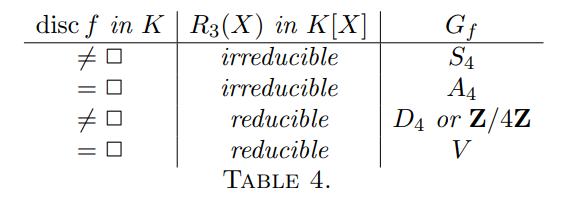
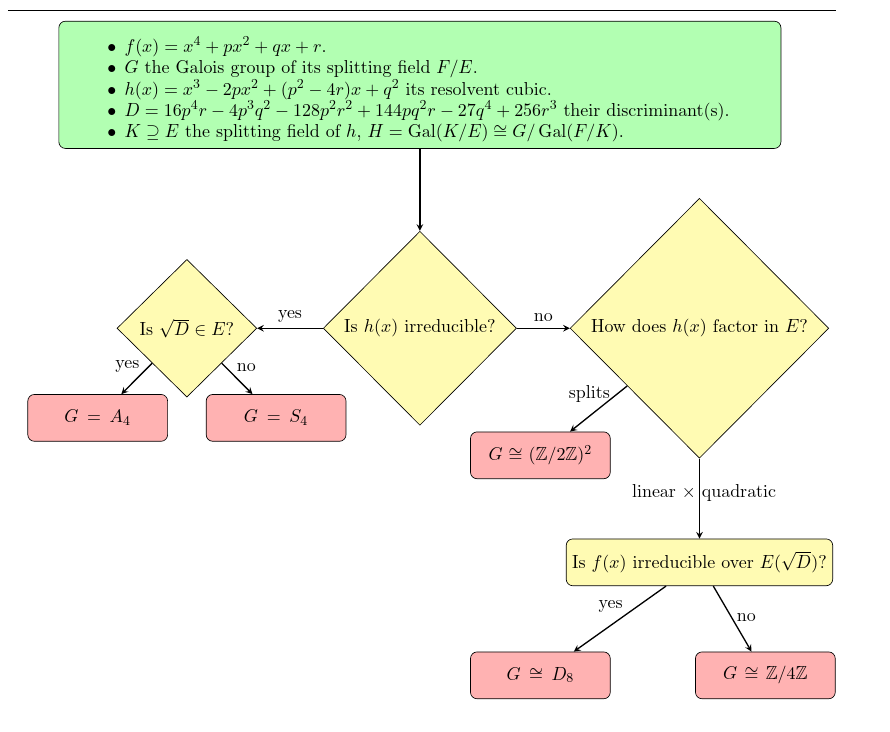
Let \(f \in \QQ[x]\) be a monic irreducible quartic with discriminant \(\Delta\) and resolvent cubic \(R_4\), and let \(G \leq S_4\) be the Galois group of a splitting field of \(f\) over \(\QQ\) [@Hun74].
If \(\sqrt{\Delta} \in \QQ\), then \(G = A_4\) or \(G = V_4 \cong C_2^2\): \(G = A_4\) if \(R_4\) is irreducible over \(\QQ\), and \(G = V_4\) otherwise.
If \(\sqrt{\Delta} \notin \QQ\), then \(G = S_4\), \(D_4\), or \(C_4\): \(G = S_4\) if \(R_4\) is irreducible over \(\QQ\). Otherwise \(G = D_4\) if \(f\) is irreducible over \(\QQ(\sqrt{\Delta})\), and \(G = C_4\) if \(f\) is reducible over \(\QQ(\sqrt{\Delta})\).
The groups \(D_4\) and \(C_4\) can also be distinguished by cycle types: the copy of \(D_4\) in \(S_4\) contains transpositions, whereas \(C_4\) contains only \(4\)-cycles, the identity, and one product of two transpositions.
The cases are summarized in the following table:
and in the following flow chart:
Quadratic extensions in characteristic not $2$ (Tag PR-OFBRQ)
Let \(F\) be a field with \(\ch(F)\neq 2\) and let \(E/F\) be a field extension with \([E:F]=2\). Then \(E/F\) is Galois, and \(E=F(\sqrt{a})\) for some \(a\in F\) that is not a square in \(F\). For \(F=\QQ\), \(a\) can be taken to be a squarefree integer different from \(1\).
Choose \(\alpha\in E\setminus F\); then \(E=F(\alpha)\) and the minimal polynomial of \(\alpha\) over \(F\) is \(x^2+bx+c\) with \(b,c\in F\). Since \(2\) is invertible in \(F\), put \(\beta\coloneqq\alpha+b/2\) and \(a\coloneqq b^2/4-c\in F\). Then \(\beta^2=a\), \(\beta\notin F\), and \(E=F(\beta)=F(\sqrt a)\), so \(a\) is not a square in \(F\). The roots of \(x^2-a\) are \(\pm\beta\in E\), and \(\beta\neq-\beta\) because \(\beta\neq0\) and \(\ch(F)\neq2\). Thus \(E\) is the splitting field of the separable polynomial \(x^2-a\), so \(E/F\) is Galois. For \(F=\QQ\), write \(a=m^2 d/n^2\) with \(m,n\) nonzero integers and \(d\) a squarefree integer; then \(\QQ(\sqrt a)=\QQ(\sqrt d)\), and \(d\neq1\) because \(a\) is not a square.
Quadratic extensions of $\QQ$ (Tag C-BOM4E)
Let \(E/\QQ\) be a field extension with \([E:\QQ] = 2\). Then \(E = \QQ(\sqrt q)\) for some squarefree integer \(q \notin \theset{0, 1}\).
Choose \(\alpha\in E\setminus\QQ\). Since \(\QQ \subsetneq \QQ(\alpha) \subseteq E\) and \([E:\QQ]=2\), we have \(E = \QQ(\alpha)\), and the minimal polynomial of \(\alpha\) over \(\QQ\) has the form \(x^2 + bx + c\) with \(b, c\in\QQ\). By the quadratic formula, \(\alpha = \frac{-b \pm \sqrt d}{2}\) with \(d \coloneqq b^2 - 4c\in\QQ\), so \(E = \QQ(\sqrt d)\), and \(d\) is not a square in \(\QQ\) because \(\alpha\notin\QQ\). Write \(d = m/n\) with \(m, n\in\ZZ\) and \(n \neq 0\); then \(\sqrt d = \sqrt{mn}/n\), so \(E = \QQ(\sqrt{mn})\). Write \(mn = s^2 q\) with \(s\in\ZZ\setminus\theset 0\) and \(q\) a squarefree integer; then \(E = \QQ(\sqrt q)\), and \(q\notin\theset{0,1}\) because \(d\) is not a square in \(\QQ\).
A monic integer polynomial irreducible modulo a prime is irreducible over $\QQ$ (Tag PR-PB6UE)
Let \(f\in \ZZ[x]\) be monic. If there exists a prime \(p\) such that the reduction \(\bar f\in\FF_p[x]\) is irreducible, then \(f\) is irreducible in \(\QQ[x]\).
Suppose \(f=gh\) with \(g,h\in\QQ[x]\) of degree at least \(1\). By Gauss’s lemma we may take \(g,h\) monic in \(\ZZ[x]\). Reducing modulo \(p\) gives \(\bar f=\bar g\bar h\), and since \(g\) and \(h\) are monic, \(\deg\bar g=\deg g\geq1\) and \(\deg\bar h=\deg h\geq1\). This contradicts the irreducibility of \(\bar f\).
The converse fails: \(x^4+1\) is irreducible in \(\QQ[x]\) but reducible modulo every prime \(p\). Modulo \(2\), \(x^4+1=(x+1)^4\). For \(p\) odd, at least one of \(-1\), \(2\), \(-2\) is a square modulo \(p\), since the product of two nonsquares is a square. If \(i^2=-1\) then \(x^4+1=(x^2-i)(x^2+i)\); if \(c^2=2\) then \(x^4+1=(x^2+cx+1)(x^2-cx+1)\); if \(c^2=-2\) then \(x^4+1=(x^2+cx-1)(x^2-cx-1)\). For a monic irreducible \(f\in\ZZ[x]\), the Chebotarev density theorem shows that \(\bar f\) is reducible for every prime \(p\) exactly when the Galois group of \(f\) over \(\QQ\) contains no \((\deg f)\)-cycle; the Galois group of \(x^4+1\) over \(\QQ\) is \((\ZZ/2\ZZ)^2\).
Dedekind's theorem: cycle types in the Galois group from factorization modulo $p$ (Tag PR-XDWOP)
Let \(f\in\ZZ[x]\) be monic of degree \(n\) with nonzero discriminant \(\Delta\), and let \(G\) be the Galois group of \(f\) over \(\QQ\), regarded as a subgroup of \(S_n\) through its action on the roots of \(f\). Let \(p\) be a prime with \(p\notdivides\Delta\), and let \(f\equiv f_1f_2\cdots f_m\pmod p\) be the factorization into monic irreducibles in \(\FF_p[x]\). Then \(G\) contains a permutation of cycle type \((\deg f_1, \deg f_2, \ldots, \deg f_m)\). Equivalently, the Galois group of \(f\bmod p\) over \(\FF_p\), which is cyclic and generated by the Frobenius automorphism, is isomorphic to a subgroup of \(G\) through a bijection between the roots of \(f\bmod p\) and the roots of \(f\).
The Chebotarev density theorem strengthens this: for each cycle type occurring in \(G\), the set of primes \(p\notdivides\Delta\) for which \(f\bmod p\) factors with that cycle type has natural density equal to the proportion of elements of \(G\) of that cycle type.
Kronecker--Weber theorem (Tag T-QX5QU)
Let \(K\subseteq\CC\) be a finite Galois extension of \(\QQ\) with \(\Gal(K/\QQ)\) abelian. Then there is an integer \(m\geq 1\) such that \(K \subseteq \QQ(\zeta_m)\), where \(\zeta_m\coloneqq e^{2\pi i/m}\).