Two left cosets of a subgroup \(H\le G\) are equal or disjoint, so for finite \(G\), \(\abs{G}=[G:H]\,\abs{H}\) (Lagrange’s theorem). A subgroup \(N\le G\) is normal if and only if \((aN)(bN)=abN\) is well defined on cosets, and then \(G/N\) is a group. The isomorphism theorems: a homomorphism \(\varphi\colon G\to G'\) induces \(G/\ker\varphi\cong\im\varphi\); for \(H\le G\) and \(N\trianglelefteq G\), \(HN/N\cong H/(H\cap N)\); for normal subgroups \(N\le M\) of \(G\), \((G/N)/(M/N)\cong G/M\); and \(M\mapsto M/N\) is a bijection from the subgroups of \(G\) containing \(N\) to the subgroups of \(G/N\). Every subgroup of a cyclic group is cyclic, and a cyclic group of order \(n\) has exactly one subgroup of each order dividing \(n\). Cauchy’s theorem: if a prime \(p\) divides \(\abs{G}\), then \(G\) has an element of order \(p\).
Subgroup (Tag D-IQ4OX)
Let \(G\) be a group with identity \(e\). A subset \(H\subseteq G\) is a subgroup of \(G\) if
\(gh\in H\) for all \(g,h\in H\);
\(e\in H\);
\(g^{-1} \in H\) for all \(g\in H\).
One-step subgroup test (Tag PR-U5CHT)
Let \(G\) be a group and \(H \subseteq G\) a nonempty subset. If \(ab^{-1}\in H\) for all \(a,b\in H\), then \(H\) is a subgroup of \(G\).
Choose \(a\in H\); then \(1=aa^{-1}\in H\). For \(b\in H\), \(b^{-1}=1\cdot b^{-1}\in H\). For \(a,b\in H\), \(ab=a(b^{-1})^{-1}\in H\).
One-step subgroup test (Tag FF-QVQXM)
Let \(G\) be a group and let \(H\subseteq G\) be a nonempty subset. If \(ab^{-1}\in H\) for all \(a,b\in H\), then \(H\) is a subgroup of \(G\).
Choose \(a\in H\); then \(e=aa^{-1}\in H\). For \(b\in H\), \(b^{-1}=eb^{-1}\in H\). For \(a,b\in H\), \(ab=a(b^{-1})^{-1}\in H\).
Subgroup generated by a subset (Tag D-D36IY)
Let \(G\) be a group and let \(H\subseteq G\) be a subset. The subgroup generated by \(H\) is the intersection of all subgroups of \(G\) containing \(H\): \[ \gens{H} \coloneqq \bigcap \theset{M \suchthat H\subseteq M \leq G}. \]
Let \(G\) be a group and let \(H\subseteq G\) be a subset. Then \(\gens{H}\) is the smallest subgroup of \(G\) containing \(H\), and \[ \gens{H} = \theset{ h_1^{\varepsilon_1} \cdots h_n^{\varepsilon_n} \suchthat n\geq 0,\ h_i \in H,\ \varepsilon_i\in\theset{1,-1}}. \]
Index of a subgroup (Tag D-VJGH5)
Let \(G\) be a group and \(H\leq G\) a subgroup. The index of \(H\) in \(G\), written \([G:H]\), is the cardinality of the set \(G/H=\theset{gH \st g\in G}\) of left cosets of \(H\).
The map \(gH\mapsto Hg^{-1}\) is a well-defined bijection from left cosets to right cosets, since \(g_1H=g_2H\) if and only if \(g_2^{-1}g_1\in H\) if and only if \(Hg_1^{-1}=Hg_2^{-1}\). So \([G:H]\) is also the number of right cosets of \(H\).
Cosets are equal or disjoint (Tag PR-VUKHO)
Let \(G\) be a group, \(H\leq G\) a subgroup, and \(x,y\in G\). Then the left cosets \(xH\) and \(yH\) are either equal or disjoint.
Suppose \(g\in xH\cap yH\), say \(g=xh=yh'\) with \(h,h'\in H\). Then \(x=yh'h^{-1}\in yH\), so \(xH\subseteq yHH=yH\); by symmetry \(yH\subseteq xH\).
Equality of left cosets (Tag T-5KGVV)
Let \(G\) be a group, \(H\leq G\) a subgroup, and \(a,b\in G\). Then \[ aH = bH \iff a^{-1} b \in H \iff b^{-1} a\in H. \]
If \(aH=bH\), then \(b=b\cdot e\in aH\), so \(b=ah\) with \(h\in H\) and \(a^{-1}b=h\in H\). If \(a^{-1}b=h\in H\), then \(bH=ahH=aH\). Finally, \(b^{-1}a=(a^{-1}b)^{-1}\), and \(H\) is closed under inverses.
Lagrange's theorem (Tag T-SZRXI)
If \(H\) is a subgroup of a finite group \(G\) with index \([G:H]\), then \[ \abs G = [G:H]\abs H. \] In particular, \(\abs H\) divides \(\abs G\), and the order of every element of \(G\) divides \(\abs G\).
The left cosets of \(H\) partition \(G\). Multiplication by a coset representative is a bijection \(H\to gH\), so every coset has \(\abs H\) elements. There are \([G:H]\) cosets, and summing their equal sizes gives the formula.
Lagrange's theorem (Tag T-GJNT5)
Let \(G\) be a finite group and \(H \leq G\) a subgroup. Then \(\abs H\) divides \(\abs G\), and \([G:H] = \abs G/ \abs H\) [@DF04].
The left cosets of \(H\) partition \(G\) (PR-VUKHO), and each coset \(gH\) has \(\abs H\) elements because \(h\mapsto gh\) is a bijection \(H\to gH\). Hence \(\abs G=[G:H]\,\abs H\).
Coset counting formula $\# G = [G:H]\,\#H$ (Tag C-HWX2P)
Let \(G\) be a finite group, let \(H\leq G\) be a subgroup, and let \(G/H\) be the set of left cosets of \(H\) in \(G\), so that \([G:H] = \size (G/H)\) is the index of \(H\). Then \[ \size G = [G:H]\, \size H, \qquad\text{equivalently}\qquad [G:H] = \frac{\size G}{\size H}. \]
Tower law for subgroups (Tag PR-SF6ZE)
Let \(G\) be a group and \(K\leq H \leq G\) subgroups. Then \[ [G: K] = [G:H]\, [H: K] \] as cardinals; in particular \([G:K]\) is finite if and only if \([G:H]\) and \([H:K]\) are both finite.
Write \(G=\coprod_{i\in I}g_iH\) and \(H=\coprod_{j\in J}h_jK\) as disjoint unions of left cosets, with \(\abs{I}=[G:H]\) and \(\abs{J}=[H:K]\). Then \(G=\bigcup_{i,j}g_ih_jK\). If \(g_ih_jK=g_{i'}h_{j'}K\), then \(g_ih_j\in g_{i'}h_{j'}K\subseteq g_{i'}H\), so \(g_iH=g_{i'}H\) and \(i=i'\); cancelling \(g_i\) gives \(h_jK=h_{j'}K\) and \(j=j'\). Hence the cosets \(g_ih_jK\) are pairwise distinct, and \([G:K]=\abs{I\times J}\).
Larger subgroups have smaller index (Tag PR-YY3JG)
Let \(G\) be a group and \(H\leq K \leq G\) subgroups. Then \[ \abs{G} = [G:1] \geq [G:H] \geq [G:K] \geq [G:G] = 1 \] as cardinals. In particular, for arbitrary subgroups \(H, K\leq G\), applying this to \(H \cap K \leq H\leq G\) and \(H\cap K\leq K\leq G\) gives \([G: H \cap K] \geq [G:H]\) and \([G:H\cap K]\geq[G:K]\).
By the tower law, \([G:H]=[G:K]\,[K:H]\geq[G:K]\) since \([K:H]\geq1\); the outer inequalities are the cases \(H=1\) and \(K=G\).
Order of a group element (Tag D-ZTPHF)
Let \(G\) be a group with identity \(e\) and \(g\in G\). If \(g^n=e\) for some integer \(n\geq 1\), the order of \(g\), written \(o(g)\), is the smallest such \(n\). If no such \(n\) exists, \(g\) has infinite order.
Cauchy's theorem (Tag T-XDMK2)
Let \(G\) be a finite group and let \(p\) be prime. If \(p\) divides \(\abs G\), then \(G\) contains an element of order \(p\), and therefore a subgroup of order \(p\).
By Lagrange's theorem, the order of every element of \(G\) divides \(\abs G\); Cauchy’s theorem is the converse for prime divisors of \(\abs G\). Sylow's first theorem strengthens the existence statement from order \(p\) to order \(p^a\), where \(p^a\) is the largest power of \(p\) dividing \(\abs G\).
Subgroups of cyclic groups (Tag T-QMKXQ)
Let \(G\) be a finite group of order \(n\). Then \(G\) is cyclic if and only if, for each positive divisor \(d\) of \(n\), \(G\) has a unique subgroup of order \(d\).
Normal subgroup (Tag D-EKE4Q)
Let \(G\) be a group. A subgroup \(N\leq G\) is normal, written \(N\normal G\), if \(gNg^{-1} = N\) for every \(g\in G\).
Let \(G\) be a group and \(N\leq G\). The following are equivalent:
\(N\normal G\).
\(gN = Ng\) for every \(g\in G\).
\(\psi(N) = N\) for every inner automorphism \(\psi \in \Inn(G)\).
\(N\) is the only subgroup of \(G\) conjugate to \(N\).
Normal closure of a subgroup (Tag D-BPRD3)
Let \(G\) be a group and \(H\leq G\) a subgroup. The normal closure of \(H\) in \(G\) is the subgroup generated by the conjugates of \(H\): \[ H^G \coloneqq \gens{ \Union_{g\in G} gHg^{-1} }. \]
Let \(G\) be a group and \(H\leq G\). Then \(H^G\) is the smallest normal subgroup of \(G\) containing \(H\): \[ H^G = \bigcap \theset{N \st H \leq N \normal G }. \]
Normal core of a subgroup (Tag D-QMVEB)
Let \(G\) be a group and \(H\leq G\) a subgroup. The normal core of \(H\) in \(G\) is \[ H_G \coloneqq \Intersect_{g\in G} gHg^{-1}. \]
Let \(H\leq G\), and let \(\psi\colon G \to \Sym(G/H)\), \(g \mapsto (xH\mapsto gxH)\), be the action of \(G\) on the left cosets of \(H\). Then \(H_G\) is the largest normal subgroup of \(G\) contained in \(H\), and \[ H_G = \gens{ N \st N \normal G,\ N \leq H} = \ker \psi. \]
For \(g\in G\), \(\psi(g)=\id\) if and only if \(gxH=xH\) for all \(x\in G\), that is, \(x^{-1}gx\in H\) for all \(x\), that is, \(g\in\Intersect_{x\in G}xHx^{-1}=H_G\). Hence \(H_G=\ker\psi\) is a normal subgroup of \(G\), and \(H_G\subseteq 1\cdot H\cdot 1=H\). If \(N\normal G\) and \(N\leq H\), then \(N=gNg^{-1}\subseteq gHg^{-1}\) for every \(g\), so \(N\subseteq H_G\). Therefore the subgroup generated by all such \(N\) lies in \(H_G\), and it contains \(H_G\), which is one of them.
Characteristic subgroups (Tag D-53LTN)
Let \(G\) be a group. A subgroup \(H\leq G\) is characteristic in \(G\), written \(H \ch G\), if \(\phi(H) \leq H\) for every \(\phi \in \Aut(G)\).
If \(H \ch G\), then \(\phi(H) = H\) for every \(\phi\in\Aut(G)\): applying the definition to \(\phi^{-1}\) gives \(\phi^{-1}(H)\leq H\), so \(H\leq\phi(H)\). The automorphisms need not fix \(H\) pointwise.
The center is a characteristic subgroup (Tag PR-GJLQP)
For every group \(G\), the center \(Z(G)\) is a characteristic subgroup of \(G\), \(Z(G) \ch G\).
Let \(\phi \in \Aut(G)\), \(z \in Z(G)\), and \(g \in G\). Then \(\phi(z)\,g = \phi\big(z\,\inverseof{\phi}(g)\big) = \phi\big(\inverseof{\phi}(g)\,z\big) = g\,\phi(z)\), so \(\phi(z) \in Z(G)\).
Characteristic subgroups of normal subgroups are normal (Tag PR-IOMVN)
Let \(G\) be a group, \(H \normal G\) a normal subgroup, and \(N \ch H\) a characteristic subgroup of \(H\). Then \(N \normal G\).
Order of a quotient group (Tag T-WR7CD)
Let \(G\) be a finite group and \(H\normal G\) a normal subgroup. Then \[ [G: H] = \abs{G/H} = \frac{\abs G}{\abs H}. \]
First isomorphism theorem for groups (Tag T-I5N43)
Let \(\phi\colon G\to H\) be a group homomorphism. Then \(\ker \phi\) is a normal subgroup of \(G\), \(\im \phi\) is a subgroup of \(H\), and \[ G/\ker \phi \to \im \phi,\qquad g\ker\phi\mapsto\phi(g), \] is a well-defined group isomorphism.
For \(x\in\ker\phi\) and \(g\in G\), \(\phi(gxg^{-1})=\phi(g)\phi(g)^{-1}=e\), so \(\ker\phi\normal G\); \(\im\phi\) is the image of a group under a homomorphism, hence a subgroup of \(H\). The map is well defined and injective because \(\phi(g)=\phi(g')\) if and only if \(g^{-1}g'\in\ker\phi\), it is surjective by construction, and it is a homomorphism because \(\phi\) is.
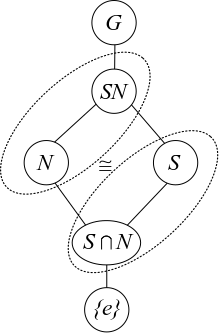
Second isomorphism theorem for groups (Tag T-NFQBO)
Let \(G\) be a group, \(S \leq G\) a subgroup, and \(N \normal G\) a normal subgroup. Then \[ \frac{SN}{N} \cong \frac{S}{S\intersect N}. \] If \(S\) and \(N\) are finite, then \[ \abs{SN} = \frac{\abs S \abs N}{\abs{S\intersect N}}. \]
Correspondence and third isomorphism theorems (Tag T-6CQEB)
Let \(G\) be a group and \(N\normal G\) a normal subgroup.
If \(N\leq K\leq G\), then \(K/N\) is a subgroup of \(G/N\).
For \(N\leq K\leq G\), \(K\normal G\) if and only if \(K/N\normal G/N\).
The map \(K\mapsto K/N\) is a bijection from the subgroups \(K\) of \(G\) containing \(N\) to the subgroups of \(G/N\), and it restricts to a bijection between normal subgroups.
If \(N\leq K\) and \(K\normal G\), then \[ \frac{G/N}{K/N} \cong \frac{G}{K}. \]
Let \(\pi\colon G\to G/N\) be the quotient map. (a) \(K/N=\pi(K)\) is the image of a subgroup. (c) The inverse of \(K\mapsto\pi(K)\) is \(\bar K\mapsto\pi^{-1}(\bar K)\): \(\pi^{-1}(\bar K)\) is a subgroup containing \(N\), \(\pi(\pi^{-1}(\bar K))=\bar K\) since \(\pi\) is surjective, and \(\pi^{-1}(\pi(K))=KN=K\) since \(N\leq K\). (b) Since \(\pi(gKg^{-1})=\pi(g)\pi(K)\pi(g)^{-1}\) and \(\pi\) is a bijection on subgroups containing \(N\), \(gKg^{-1}=K\) for all \(g\in G\) if and only if \(\bar g(K/N)\bar g^{-1}=K/N\) for all \(\bar g\in G/N\); this also gives the second half of (c). (d) The map \(G/N\to G/K\), \(gN\mapsto gK\), is well defined because \(N\leq K\), and it is a surjective homomorphism with kernel \(K/N\); apply the first isomorphism theorem.
Correspondence theorem for groups (Tag T-RLVA4)
Let \(G\) be a group, \(N \normal G\) a normal subgroup, and \(\pi\colon G\to G/N\) the quotient map. Then \[ \theset{H \leq G \suchthat N \subseteq H} \mapstofrom \theset{\overline{H} \suchthat \overline{H} \leq G/N}, \qquad H \mapsto H/N, \qquad \pi^{-1}(\overline{H}) \mapsfrom \overline{H}, \] are mutually inverse bijections between the subgroups of \(G\) containing \(N\) and the subgroups of the quotient group \(G/N\).
Isomorphism theorems for modules (Tag PR-DJZLY)
Let \(R\) be a ring and \(M\) an \(R\)-module.
For an \(R\)-module homomorphism \(\phi\colon M \to M'\), there is an isomorphism \(M/\ker\phi \cong \im\phi\).
For submodules \(A, B \subseteq M\), \[ \frac{A+B}{B} \cong \frac{A}{A \intersect B}. \]
For submodules \(A \subseteq B \subseteq M\), \[ \frac{M/A}{B/A} \cong \frac{M}{B}. \]
For a submodule \(N \subseteq M\), there is an inclusion-preserving bijection \[ \begin{aligned} \correspond{\text{Submodules of } M \\ \text{containing } N} &\mapstofrom \correspond{\text{Submodules of } M/N} \\ A &\mapstofrom A/N. \end{aligned} \]
The bijection in (d) preserves sums and intersections: for submodules \(A, A' \subseteq M\) containing \(N\), \((A+A')/N = A/N + A'/N\) and \((A \intersect A')/N = A/N \intersect A'/N\).