A linear operator \(T\) on a finite-dimensional vector space \(V\) over a field \(F\) makes \(V\) a finitely generated torsion \(F[x]\)-module, to which the structure theorem applies. The invariant factors \(d_1\mid\cdots\mid d_s\) give the rational canonical form, the block diagonal matrix of their companion matrices, which exists over every field; \(d_s\) is the minimal polynomial of \(T\) and \(d_1\cdots d_s\) its characteristic polynomial. When the characteristic polynomial splits over \(F\), the elementary divisors \((x-\lambda)^e\) give the Jordan form. For an eigenvalue \(\lambda\), the exponent of \(x-\lambda\) in the minimal polynomial is the size of the largest Jordan block for \(\lambda\), its exponent in the characteristic polynomial is the sum of the sizes of the Jordan blocks for \(\lambda\), and \(\dim\ker(T-\lambda)\) is the number of those blocks. \(T\) is diagonalizable if and only if its minimal polynomial is a product of distinct linear factors in \(F[x]\).
Minimal polynomial of a linear map (Tag D-GK5SF)
Let \(k\) be a field, let \(V\) be a finite-dimensional \(k\)-vector space, and let \(T\colon V\to V\) be \(k\)-linear. The minimal polynomial of \(T\) is the unique monic polynomial \(\min_T(x)\in k[x]\) of minimal degree such that \(\min_T(T) = 0\).
Characteristic polynomial (Tag D-QFYAC)
Let \(k\) be a field and \(A\in\Mat_{n\times n}(k)\). The characteristic polynomial of \(A\) is \[ \chi_A(x) \coloneqq \det(xI - A)\in k[x]. \]
\(\chi_A\) is monic of degree \(n\). Some texts define the characteristic polynomial as \(\det(A-xI)=(-1)^n\chi_A(x)\).
If \(\SNF(xI-A)=\diag(d_1,\ldots,d_n)\) is the Smith normal form of \(xI-A\) over \(k[x]\), with monic invariant factors \(d_i\), then \(\det(xI-A)\) and \(d_1\cdots d_n\) are monic and differ by a unit of \(k[x]\), hence are equal, and \[ \chi_A(x)=\det(xI-A)=\det\SNF(xI-A). \]
Characteristic polynomial of a matrix (Tag FD-GOB47)
Let \(k\) be a commutative ring and \(A\) an \(n\times n\) matrix over \(k\). The characteristic polynomial of \(A\) is \[ p_A(x) \coloneqq \det(xI_n - A)\in k[x], \] where \(I_n\) is the \(n\times n\) identity matrix.
Cayley--Hamilton theorem (Tag T-SJCF7)
Let \(k\) be a field and \(A\in\Mat_n(k)\), with characteristic polynomial \(\chi_A\) and minimal polynomial \(\min_A\). Then \(\chi_A(A) = 0\); equivalently, \(\min_A\) divides \(\chi_A\).
Computing the minimal polynomial of a matrix (Tag PR-UFVPY)
Let \(k\) be a field, \(A\in M_n(k)\), \(m_A\) the minimal polynomial of \(A\), and \(\chi_A\) its characteristic polynomial.
\(m_A\divides\chi_A\), and \(m_A\) and \(\chi_A\) have the same monic irreducible factors in \(k[x]\). Hence, if \(\chi_A=\pm\prod_{j} f_j^{a_j}\) with distinct monic irreducible \(f_j\), then \(m_A=\prod_j f_j^{b_j}\) for some \(1\leq b_j\leq a_j\), and \(m_A\) is the product of this form of least degree that annihilates \(A\).
For \(v\in k^n\), let \(p_v\) be the monic polynomial of least degree with \(p_v(A)v=0\); it is found from the first linear dependence among \(v, Av, A^2v,\ldots\). Then \(p_v\divides m_A\), and if \(e_1,\ldots,e_n\) is a basis of \(k^n\), then \(m_A=\lcm(p_{e_1},\ldots,p_{e_n})\).
By the Cayley–Hamilton theorem \(\chi_A(A)=0\), so \(m_A\divides\chi_A\). Let \(f\) be a monic irreducible factor of \(\chi_A\) and \(\lambda\in\bar k\) a root of \(f\). Then \(\lambda\) is an eigenvalue of \(A\) over \(\bar k\); if \(Av=\lambda v\) with \(v\neq0\), then \(0=m_A(A)v=m_A(\lambda)v\), so \(m_A(\lambda)=0\) and \(f\divides m_A\). Every polynomial of the stated form that annihilates \(A\) is divisible by \(m_A\), so \(m_A\) is the one of least degree.
The set \(\theset{g\in k[x]\suchthat g(A)v=0}\) is an ideal generated by \(p_v\), and it contains \(m_A\), so \(p_v\divides m_A\). Hence \(L\coloneqq\lcm_i p_{e_i}\) divides \(m_A\). Conversely \(L(A)e_i=0\) for every \(i\), so \(L(A)=0\) and \(m_A\divides L\).
Characteristic polynomials via traces of exterior powers (Tag PR-EDD7U)
Let \(k\) be a field, \(A \in \Mat_{n\times n}(k)\), and \(\chi_A(t) \coloneqq \det(tI - A)\). Then \[ \begin{aligned} \chi_A(t) &= \sum_{k=0}^n (-1)^k \trace\qty{\Extpower^k A}\, t^{n-k} \\ &= t^n - \trace\qty{A} t^{n-1} + \trace\qty{\Extpower^2 A}\, t^{n-2} - \cdots + (-1)^{n-1} \trace\qty{\Extpower^{n-1} A}\, t + (-1)^n \det(A), \end{aligned} \] where \(\trace\qty{\Extpower^0 A} = 1\), \(\Extpower^1 A = A\), and \(\trace\qty{\Extpower^n A} = \det(A)\). Moreover, for \(0 \leq \ell \leq n\), \[ \trace\qty{\Extpower^\ell A} = \sum_{\substack{S \subseteq \theset{1, \ldots, n} \\ \abs{S} = \ell}} \det\qty{A_{S,S}}, \] the sum of the \(\binom{n}{\ell}\) principal \(\ell\times\ell\) minors of \(A\), where \(A_{S,S}\) is the submatrix of \(A\) with rows and columns indexed by \(S\), obtained by deleting the rows and columns indexed by the complement of \(S\).
Let \(M = (4i + j)_{0 \leq i, j \leq 3} \in \Mat_{4\times 4}(\QQ)\). The principal submatrices of \(M\) of sizes \(\ell=1,\ldots,4\):
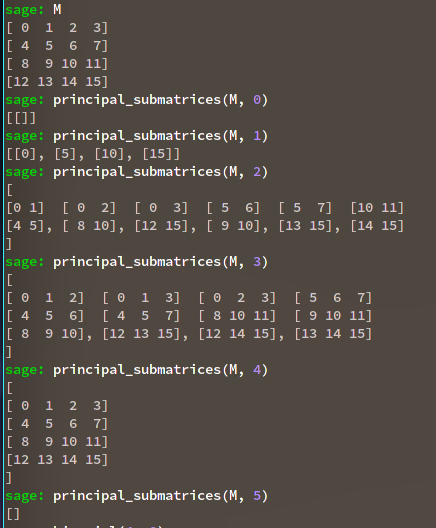
The \(1\times 1\) minors sum to \(\trace M = 0 + 5 + 10 + 15 = 30\), and the \(2\times 2\) minors are \(-4, -16, -36, -4, -16, -4\), with sum \(-80\). Every row of \(M\) is a linear combination of \((1,1,1,1)\) and \((0,1,2,3)\), so \(\rank M = 2\) and every \(3\times 3\) and \(4\times 4\) minor vanishes. Therefore \(\chi_M(t) = t^4 - 30t^3 - 80t^2\).
Let \(f(t) = a_n t^n + \cdots + a_1 t + a_0 \in \ZZ[t]\) with \(a_n \neq 0\). If \(p/q \in \QQ\) is a root of \(f\) with \(p, q \in \ZZ\) coprime, then \(p \divides a_0\) and \(q \divides a_n\). In particular, if \(f\) is monic, every rational root of \(f\) is an integer dividing \(a_0\).
If \(r\) is a root of \(f\), polynomial long division gives \(f(t) = (t - r)\,g(t)\) with \(\deg g = \deg f - 1\), and the remaining roots of \(f\) are the roots of \(g\).
Characteristic polynomials via traces of exterior powers (Tag PR-EDD7U)
Let \(k\) be a field, \(A \in \Mat_{n\times n}(k)\), and \(\chi_A(t) \coloneqq \det(tI - A)\). Then \[ \begin{aligned} \chi_A(t) &= \sum_{k=0}^n (-1)^k \trace\qty{\Extpower^k A}\, t^{n-k} \\ &= t^n - \trace\qty{A} t^{n-1} + \trace\qty{\Extpower^2 A}\, t^{n-2} - \cdots + (-1)^{n-1} \trace\qty{\Extpower^{n-1} A}\, t + (-1)^n \det(A), \end{aligned} \] where \(\trace\qty{\Extpower^0 A} = 1\), \(\Extpower^1 A = A\), and \(\trace\qty{\Extpower^n A} = \det(A)\). Moreover, for \(0 \leq \ell \leq n\), \[ \trace\qty{\Extpower^\ell A} = \sum_{\substack{S \subseteq \theset{1, \ldots, n} \\ \abs{S} = \ell}} \det\qty{A_{S,S}}, \] the sum of the \(\binom{n}{\ell}\) principal \(\ell\times\ell\) minors of \(A\), where \(A_{S,S}\) is the submatrix of \(A\) with rows and columns indexed by \(S\), obtained by deleting the rows and columns indexed by the complement of \(S\).
Let \(M = (4i + j)_{0 \leq i, j \leq 3} \in \Mat_{4\times 4}(\QQ)\). The principal submatrices of \(M\) of sizes \(\ell=1,\ldots,4\):
The \(1\times 1\) minors sum to \(\trace M = 0 + 5 + 10 + 15 = 30\), and the \(2\times 2\) minors are \(-4, -16, -36, -4, -16, -4\), with sum \(-80\). Every row of \(M\) is a linear combination of \((1,1,1,1)\) and \((0,1,2,3)\), so \(\rank M = 2\) and every \(3\times 3\) and \(4\times 4\) minor vanishes. Therefore \(\chi_M(t) = t^4 - 30t^3 - 80t^2\).
Let \(f(t) = a_n t^n + \cdots + a_1 t + a_0 \in \ZZ[t]\) with \(a_n \neq 0\). If \(p/q \in \QQ\) is a root of \(f\) with \(p, q \in \ZZ\) coprime, then \(p \divides a_0\) and \(q \divides a_n\). In particular, if \(f\) is monic, every rational root of \(f\) is an integer dividing \(a_0\).
If \(r\) is a root of \(f\), polynomial long division gives \(f(t) = (t - r)\,g(t)\) with \(\deg g = \deg f - 1\), and the remaining roots of \(f\) are the roots of \(g\).
Similar matrices (Tag D-JIGMN)
Let \(k\) be a field and \(n\geq 1\). Matrices \(A,B\in\Mat_{n\times n}(k)\) are similar if there exists \(P\in\GL_n(k)\) such that \(A = PBP^{-1}\).
Let \(k\) be an algebraically closed field and \(A,B\in\Mat_{n\times n}(k)\). Then \(A\) and \(B\) are similar if and only if they have the same Jordan canonical form, up to the order of the Jordan blocks.
Every matrix over \(k\) is similar to a Jordan canonical form, and similarity is an equivalence relation, so matrices with the same Jordan form are similar. Conversely, for \(\lambda\in k\) and \(j\geq 1\), the number of Jordan blocks of \(A\) with eigenvalue \(\lambda\) and size at least \(j\) is \(\dim\ker(A-\lambda I)^j-\dim\ker(A-\lambda I)^{j-1}\). If \(A=PBP^{-1}\), then \((A-\lambda I)^j=P(B-\lambda I)^jP^{-1}\), so these dimensions agree for \(A\) and \(B\), and hence so do their Jordan blocks.
Equivalent matrices (Tag D-JRPTK)
Let \(R\) be a principal ideal domain and \(m,n\geq 1\). Matrices \(A, B\in\Mat_{m\times n}(R)\) are equivalent if there exist \(P\in\GL_m(R)\) and \(Q\in\GL_n(R)\) such that \(A = PBQ\).
Let \(R\) be a principal ideal domain and \(A,B\in\Mat_{m\times n}(R)\). Then \(A\) and \(B\) are equivalent if and only if they have the same invariant factors, that is, the same Smith normal form. In particular, equivalent matrices have the same rank, namely the number of nonzero invariant factors.
Every matrix over \(R\) is equivalent to its Smith normal form \(\diag(d_1,\ldots,d_s,0,\ldots,0)\) with \(d_1\divides d_2\divides\cdots\divides d_s\) nonzero, so matrices with the same Smith normal form are equivalent. Conversely, for each \(i\) let \(\Delta_i(A)\) be a greatest common divisor of the \(i\times i\) minors of \(A\). By the Cauchy–Binet formula, every \(i\times i\) minor of \(PBQ\) is an \(R\)-linear combination of \(i\times i\) minors of \(B\), so \(\Delta_i(B)\divides\Delta_i(PBQ)\); applying this also to \(B=P^{-1}AQ^{-1}\) shows that \(\Delta_i(A)\) and \(\Delta_i(B)\) are associates. For the Smith normal form, \(\Delta_i=d_1\cdots d_i\) for \(i\leq s\) and \(\Delta_i=0\) for \(i>s\), so \(s\) and the invariant factors \(d_i=\Delta_i/\Delta_{i-1}\) are determined up to units by the equivalence class.
Over a field \(k\), the invariant factors of a matrix of rank \(s\) are \(1,\ldots,1\) (\(s\) times), so \(A,B\in\Mat_{m\times n}(k)\) are equivalent if and only if they have the same rank. Equivalence is coarser than similarity: if \(A=PBP^{-1}\) then \(A\) and \(B\) are equivalent, but over \(\QQ\) the matrices \(I_2\) and \(\diag(2,1)\) both have rank \(2\), so they are equivalent, while they are not similar, since their eigenvalues differ.
Companion matrix (Tag D-HJR7M)
Let \(k\) be a field and let \(p(x) = a_0 + a_1 x + \cdots + a_{n-1} x^{n-1} + x^n\in k[x]\) be a monic polynomial of degree \(n\geq 1\). The companion matrix of \(p\) is \[ C_p \coloneqq \begin{bmatrix} 0 & 0 & \cdots & 0 &-a_0 \\ 1 & 0 & \cdots & 0 & -a_1 \\ 0 & 1 & \cdots & 0 & -a_2 \\ \vdots & & \ddots & & \vdots \\ 0 & 0 & \cdots & 1 & -a_{n-1} \end{bmatrix} \in\Mat_{n\times n}(k). \]
Rational canonical form (Tag FD-XT6HD)
Let \(k\) be a field, let \(V\) be a finite-dimensional \(k\)-vector space, and let \(\phi\colon V\to V\) be a \(k\)-linear map. Make \(V\) a \(k[x]\)-module by letting \(x\) act as \(\phi\). By the structure theorem for finitely generated modules over the principal ideal domain \(k[x]\), there are unique monic nonconstant polynomials \(r_1\divides r_2\divides\cdots\divides r_t\) in \(k[x]\) and a decomposition \(V=V_1\oplus\cdots\oplus V_t\) into \(\phi\)-invariant subspaces with \[ V_i\cong k[x]/(r_i)\quad\text{as } k[x]\text{-modules},\qquad 1\le i\le t. \] The rational canonical form of \(\phi\) is the block diagonal matrix \[ \diag\qty{C_{r_1},C_{r_2},\ldots,C_{r_t}}, \] where \(C_{r_i}\) is the companion matrix of \(r_i\).
The polynomial \(r_i\) is the minimal polynomial of the restriction \(\phi|_{V_i}\). If \(v_i\in V_i\) corresponds to the class of \(1\) in \(k[x]/(r_i)\) and \(d_i=\deg r_i\), then \(v_i,\phi(v_i),\ldots,\phi^{d_i-1}(v_i)\) is a basis of \(V_i\), and the matrix of \(\phi|_{V_i}\) in this basis is \(C_{r_i}\). Concatenating these bases gives a basis of \(V\) in which \(\phi\) has its rational canonical form.
Rational canonical form (Tag PR-TI6YA)
Let \(k\) be a field and \(A\in M_n(k)\), and regard \(k^n\) as a \(k[x]\)-module with \(x\) acting by \(A\). Let \(r_1\divides r_2\divides\cdots\divides r_m\) be the monic nonconstant invariant factors of this module. Then \(A\) is similar to the block diagonal matrix \[ \RCF(A)=\diag(C_{r_1},\ldots,C_{r_m}), \] where \(C_{r_i}\) is the companion matrix of \(r_i\), and \(\RCF(A)\) is the unique matrix of this form similar to \(A\).
By the structure theorem for finitely generated modules over the PID \(k[x]\), \(k^n\cong\bigoplus_{i=1}^m k[x]/(r_i)\) as \(k[x]\)-modules, with the monic \(r_i\) uniquely determined. On \(k[x]/(r_i)\), multiplication by \(x\) in the basis \(1,x,\ldots,x^{\deg r_i-1}\) has matrix \(C_{r_i}\). Two matrices are similar if and only if the corresponding \(k[x]\)-modules are isomorphic, so uniqueness of the invariant factors gives uniqueness of \(\RCF(A)\).
Equivalent conditions for an operator to have a cyclic vector (Tag PR-4GQIZ)
Let \(k\) be a field, let \(V\) be a nonzero finite-dimensional \(k\)-vector space, and let \(T\colon V \to V\) be a \(k\)-linear map. Make \(V\) a \(k[x]\)-module by \(f(x) \cdot v \coloneqq f(T)v\), and let \(\min_T(x)\) be the minimal polynomial of \(T\). The following are equivalent:
\(V \cong k[x]/\gens{\min_T}\) as \(k[x]\)-modules.
\(V\) admits a cyclic vector: there is \(v \in V\) such that \(v, Tv, T^2v, \ldots\) span \(V\). For such \(v\), \(\min_T\) is the monic polynomial \(p\) of least degree with \(p(T)v = 0\).
\(V\) is a cyclic \(k[x]\)-module. Its annihilator is then the ideal \(\gens{\min_T}\).
The matrix of \(T\) in some basis of \(V\) is the companion matrix \(C_{\min_T}\).
\(\min_T(x) = \det(xI - T)\), the monic characteristic polynomial of \(T\).
\(V\) has exactly one invariant factor as a \(k[x]\)-module.
The rational canonical form of \(T\) has a single block.
The minimal and characteristic polynomials agree iff there is a cyclic vector (Tag PR-GBL6P)
Let \(k\) be a field and \(A \in \Mat_{n\times n}(k)\) with \(n \geq 1\), and let \(\min_A(x)\) be the minimal polynomial of \(A\). Then \(\min_A(x) = \det(xI - A)\) if and only if \(A\) admits a cyclic vector: some \(v \in k^n\) such that \(v, Av, A^2v, \ldots\) span \(k^n\).
Equivalent conditions for a finite-dimensional linear operator to be cyclic (Tag PR-OF7ZW)
Let \(k\) be a field, let \(V\) be a \(k\)-vector space with \(0<\dim_k V<\infty\), and let \(T\colon V\to V\) be \(k\)-linear. Regard \(V\) as a \(k[x]\)-module with \(x\) acting by \(T\). The following are equivalent:
The minimal polynomial of \(T\) equals the monic characteristic polynomial \(\det(x\id_V-T)\).
The invariant factor decomposition of the \(k[x]\)-module \(V\) has exactly one invariant factor.
The rational canonical form of \(T\) consists of a single block.
There is a basis of \(V\) in which the matrix of \(T\) is a companion matrix.
There exists \(v\in V\) with \(\spanof_k\theset{T^j v \suchthat j\geq 0} = V\).
If \(T\) has \(\dim_k V\) distinct eigenvalues in \(k\), then \(T\) satisfies these conditions, but the converse fails. The characteristic polynomial is then a product of distinct linear factors, each of which divides the minimal polynomial, so the two polynomials are equal. For the converse, let \(n=\dim_k V\geq 2\) and let \(T\) have matrix the Jordan block \(J_n(\lambda)\) for some \(\lambda\in k\). Its minimal and characteristic polynomials are both \((x-\lambda)^n\), but \(\lambda\) is its only eigenvalue.
Jordan form data from the minimal and characteristic polynomials (Tag L-CD6QT)
Let \(k\) be a field and let \(A\in\Mat_n(k)\) have characteristic polynomial \(\chi_A(x)=\det(xI-A)\) that splits over \(k\), with distinct eigenvalues \(\lambda_1,\ldots,\lambda_r\). Write \[ \chi_A(x)=\prod_{i=1}^r(x-\lambda_i)^{m_i},\qquad\min_A(x)=\prod_{i=1}^r(x-\lambda_i)^{\ell_i}, \] where \(\min_A\) is the minimal polynomial, and let \(E_{\lambda_i}=\ker(A-\lambda_iI)\) be the eigenspace and \(V^{\lambda_i}=\ker(A-\lambda_iI)^{m_i}\) the generalized eigenspace of \(\lambda_i\). The exponent \(m_i\) is the algebraic multiplicity and \(\dim E_{\lambda_i}\) the geometric multiplicity of \(\lambda_i\). In the Jordan canonical form \(\JCF(A)\):
The roots of \(\chi_A\) and of \(\min_A\) are exactly the eigenvalues \(\lambda_i\), and \(1\le\ell_i\le m_i\).
\(\ell_i\) is the size of the largest Jordan block with eigenvalue \(\lambda_i\), and it is the least \(j\ge1\) with \(\ker(A-\lambda_iI)^j=\ker(A-\lambda_iI)^{j+1}\).
\(m_i\) is the sum of the sizes of the Jordan blocks with eigenvalue \(\lambda_i\), which is the number of times \(\lambda_i\) appears on the diagonal of \(\JCF(A)\), and \(m_i=\dim V^{\lambda_i}\).
\(\dim E_{\lambda_i}\) is the number of Jordan blocks with eigenvalue \(\lambda_i\).
\(A\) is diagonalizable over \(k\) if and only if \(\dim E_{\lambda_i}=m_i\) for every \(i\), if and only if \(\ell_i=1\) for every \(i\).
Choose a basis in which \(A\) is the block diagonal matrix \(\JCF(A)\), and let \(J=J_s(\lambda)\) be one of its Jordan blocks, of size \(s\). Then \(J-\lambda I\) sends the \(j\)th basis vector of the block to the \((j-1)\)st and the first to \(0\), so \(\dim\ker(J-\lambda I)^j=\min(j,s)\), while \(J-\mu I\) is invertible for \(\mu\ne\lambda\). In particular \(\chi_J(x)=(x-\lambda)^s\), and \((x-\lambda)^j\) kills \(J\) exactly when \(j\ge s\), so \(\min_J(x)=(x-\lambda)^s\).
The characteristic polynomial of a block diagonal matrix is the product of those of the blocks, which gives 3 and the first part of 1; the minimal polynomial is their least common multiple, which gives the first part of 2. The inequality \(\ell_i\le m_i\) is Cayley–Hamilton: \(\min_A\) divides \(\chi_A\). Summing \(\dim\ker(J-\lambda_iI)^j=\min(j,s)\) over the blocks with eigenvalue \(\lambda_i\) shows that \(\dim\ker(A-\lambda_iI)^j\) increases strictly for \(j<\ell_i\) and is constant for \(j\ge\ell_i\), and that \(\dim V^{\lambda_i}=m_i\); taking \(j=1\) gives 4, since the first basis vectors of the blocks with eigenvalue \(\lambda_i\) form a basis of \(E_{\lambda_i}\). Finally, \(A\) is diagonalizable if and only if every Jordan block has size \(1\), which by 2, 3, and 4 is each of the two conditions in 5.
Computing the Jordan canonical form and a change of basis via Jordan chains (Tag PR-5A2W4)
Let \(k\) be a field and \(A \in \Mat_{n\times n}(k)\), and suppose that the characteristic polynomial factors as \(\chi_A(x) = \pm\prod_{i=1}^r (x-\lambda_i)^{m_i}\) with \(\lambda_1, \ldots, \lambda_r \in k\) distinct. For each \(i\), put \(N_i \coloneqq A - \lambda_i I\). The following procedure produces \(P \in \GL_n(k)\) such that \(\inverseof{P} A P = \JCF(A)\) is a Jordan canonical form of \(A\).
Let \(\ell_i\) be the least integer \(\ell \geq 1\) with \(\rank N_i^{\ell} = \rank N_i^{\ell+1}\). Then \[ n = \rank N_i^0 > \rank N_i > \cdots > \rank N_i^{\ell_i} = \rank N_i^{\ell_i+1} = \rank N_i^{\ell_i+2} = \cdots, \] \(\dim_k \ker N_i^{\ell_i} = m_i\), and \(\ell_i\) is the size of the largest Jordan block with eigenvalue \(\lambda_i\).
The eigenspace \(E_{\lambda_i} = \ker N_i\) has dimension \(n - \rank N_i\), the number of Jordan blocks with eigenvalue \(\lambda_i\). For \(0 \leq j \leq \ell_i\), put \(K_{i,j} \coloneqq \ker N_i \cap \im N_i^{j}\), so that \[ \ker N_i = K_{i,0} \supseteq K_{i,1} \supseteq \cdots \supseteq K_{i,\ell_i} = 0 \quad\text{and}\quad \dim_k K_{i,j} = \rank N_i^{j} - \rank N_i^{j+1}. \]
Choose a basis of \(K_{i,\ell_i - 1}\) and extend it successively to bases of \(K_{i,\ell_i-2}, \ldots, K_{i,0}\). Each basis vector \(v\) chosen at the stage of \(K_{i,s-1}\) is an eigenvector lying in \(\im N_i^{s-1}\).
For each such \(v\), solve \(N_i^{s-1} w = v\), for instance by row reducing the augmented matrix \([\,N_i^{s-1} \mid v\,]\); the system is consistent because \(v \in \im N_i^{s-1}\). The Jordan chain of \(v\) is \(N_i^{s-1}w = v,\ N_i^{s-2}w,\ \ldots,\ N_i w,\ w\).
Let \(P\) be the matrix whose columns are the Jordan chains of all the vectors chosen in step (3), for all \(i\), each chain listed consecutively in the order of step (4). A chain of length \(s\) for \(\lambda_i\) contributes a Jordan block of size \(s\) with eigenvalue \(\lambda_i\) to \(\inverseof{P} A P\).
Equivalent characterizations of a single nilpotent Jordan block of size $n$ (Tag PR-K6MMW)
Let \(k\) be a field, \(V\) a \(k\)-vector space of dimension \(n \coloneqq \dim_k V \geq 1\), and \(T\colon V\to V\) a nilpotent linear map. The following are equivalent:
There exists a basis \(e_1, \ldots, e_n\) of \(V\) such that \[ T(e_i) = \begin{cases} e_{i-1} & \text{if } i \geq 2, \\ 0 & \text{if } i=1. \end{cases} \]
There exists a cyclic vector \(v \in V\): the vectors \(T^k v\) for \(k = 0, 1, \ldots, n-1\) form a basis of \(V\).
\(T^{n-1} \neq 0\).
\(\dim_k \ker T^\ell = \ell\) for each \(1\leq \ell \leq n\).
\(\dim_k \ker T = 1\).