If \(\Omega \subsetneq \CC\) is simply connected then \(\Omega\) is biholomorphic to \(\DD\).
Riemann mapping theorem (Tag T-4MDS6)
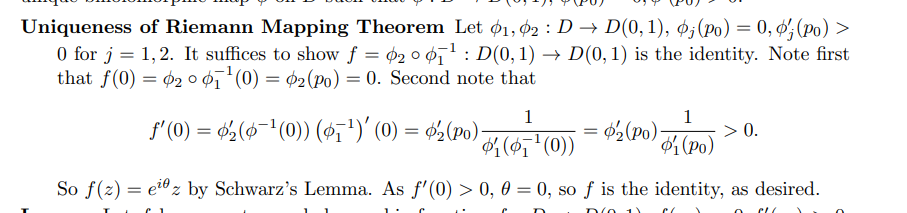
Let \(\Omega\subsetneq\CC\) be a nonempty simply connected open set. Then for every \(z_0\in\Omega\) there exists a unique biholomorphism \(F\colon\Omega\to\DD\) such that \(F(z_0)=0\) and \(F'(z_0)>0\). In particular, any two nonempty simply connected open sets \(\Omega_1,\Omega_2\subsetneq\CC\) are biholomorphic.
This is [@SS03].
($\Omega\neq\CC$ and simple connectivity are necessary)
\(\Omega\neq\CC\): a holomorphic map \(F\colon\CC\to\DD\) is bounded and entire, hence constant by Liouville’s theorem, so \(\CC\) is not biholomorphic to \(\DD\).
\(\Omega\) simply connected: a biholomorphism is a homeomorphism, and \(\DD\) is simply connected.
(Sketch)
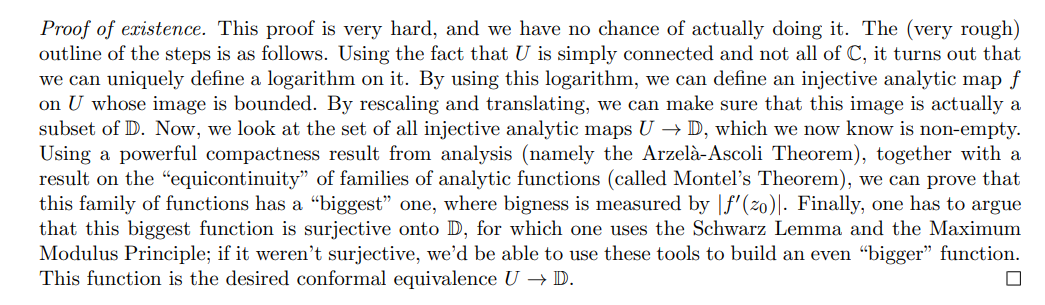
The proof maximizes \(\abs{f'(z_0)}\) over injective holomorphic maps \(f\colon\Omega\to\DD\) with \(f(z_0)=0\) and shows that a maximizer is surjective.
Fix \(z_0\in \Omega\) and set \(\mathcal F = \ts{f\in \Hol(\Omega, \DD) \st f(z_0) = 0,\ f \text{ injective}}\).
\(\mathcal F\) is nonempty. Choose \(a\in\CC\sm\Omega\). Since \(z-a\) does not vanish on the simply connected set \(\Omega\), it has a holomorphic square root \(g\) on \(\Omega\), and \(g\) is injective. By the open mapping theorem \(g(\Omega)\) contains a disc \(D_r(g(z_0))\), and \(g(\Omega)\) is disjoint from \(D_r(-g(z_0))\): if \(g(z)\in D_r(-g(z_0))\), then \(-g(z) = g(z')\) for some \(z'\in\Omega\), so \(z = z'\) after squaring and \(g(z) = 0\), which contradicts \(a\notin\Omega\). Then \(z\mapsto (r/2)/(g(z)+g(z_0))\) is injective and maps \(\Omega\) into \(\DD\), and composing with the Blaschke factor that sends its value at \(z_0\) to \(0\) gives an element of \(\mathcal F\).
For \(w\in\DD\), the automorphisms \(h_w\) of \(\DD\) satisfy \[ \begin{aligned} h_w(z) &\coloneqq {z-w \over 1-\bar{w} z} \in \Hol(\DD) \\ h'_w(0) &= 1 - \abs{w}^2 \\ h'_w(w) &= {1\over 1 - \abs{w}^2} \end{aligned}.\]
A non-surjective \(f\in\mathcal F\) is not a maximizer. Let \(w\in\DD\sm f(\Omega)\); then \(w\neq 0\) and \(h_w\circ f\) is injective and nonvanishing on \(\Omega\), with value \(-w\) at \(z_0\). Let \(s\) be a holomorphic square root of \(h_w\circ f\), which is injective, and \(F\coloneqq h_{s(z_0)}\circ s\in\mathcal F\). Then \(\abs{s(z_0)}^2 = \abs w\) and \[ \abs{F'(z_0)} = \frac{\abs{s'(z_0)}}{1-\abs w} = \frac{(1-\abs w^2)\abs{f'(z_0)}}{2\sqrt{\abs w}\,(1-\abs w)} = \frac{1+\abs w}{2\sqrt{\abs w}}\abs{f'(z_0)} > \abs{f'(z_0)} .\]
The family is bounded by \(1\), hence normal by Montel’s theorem.
Set \(m\coloneqq \sup_{f\in \mathcal F} \abs{f'(z_0)}\). Then \(m>0\) because injective holomorphic maps have nonvanishing derivative, and \(m<\infty\) because, for \(\overline{D_R(z_0)}\subseteq\Omega\), the Cauchy estimate gives \[ \abs{f'(z_0)} \leq \max_{\abs{z-z_0} = R} { \abs{f(z)} \over R} \leq {1\over R} .\]
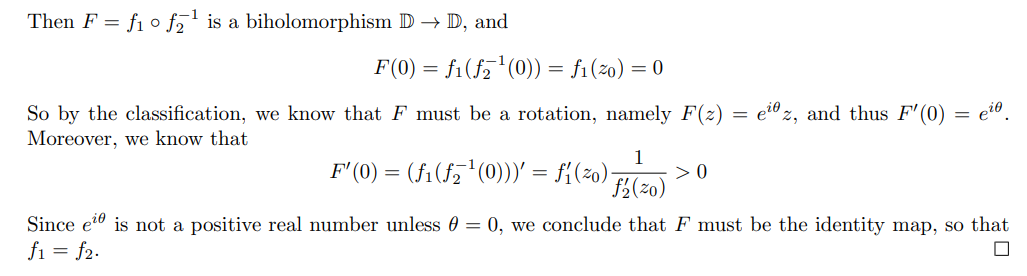
Take \(\ts{f_k}\subseteq\mathcal F\) with \(\abs{f_k'(z_0)} \to m\), and use Montel to extract a locally uniformly convergent subsequence with limit \(h\).
\(h\in\mathcal F\): \(h\) is holomorphic with \(h(z_0)=0\) and \(\abs{h'(z_0)} = m>0\), so it is nonconstant, maps into \(\DD\) by the maximum modulus principle, and is injective by Hurwitz’s theorem as a locally uniform limit of injective maps.
\(h\) is surjective, since a non-surjective element of \(\mathcal F\) is not a maximizer.

(Ingredients of the proof)
Montel's theorem gives a convergent maximizing subsequence, Hurwitz's theorem gives injectivity of the limit, the Cauchy estimate gives \(m<\infty\), and square roots on simply connected sets together with Blaschke factors give nonemptiness of \(\mathcal F\) and the derivative increase.
Uniformization of simply connected domains in $\CC$ (Tag C-BKYF7)
Every nonempty simply connected open set \(\Omega\subseteq\CC\) is conformally equivalent to exactly one of \(\CC\) and the unit disc \(\DD\): to \(\CC\) if \(\Omega=\CC\), and to \(\DD\) otherwise.
By the uniformization theorem, every simply connected Riemann surface is conformally equivalent to exactly one of \(\CP^1\), \(\CC\), and \(\DD\). For open subsets of \(\CC\) the case \(\CP^1\) does not occur because \(\CP^1\) is compact, and \(\CC\) is not conformally equivalent to \(\DD\) by Liouville’s theorem.
Injective holomorphic maps have nonvanishing derivative (Tag C-FVT4V)
Let \(U,V\subseteq\CC\) be open and let \(f\colon U\to V\) be holomorphic and injective. Then \(f'(z)\neq0\) for every \(z\in U\), and the inverse \(f^{-1}\colon f(U)\to U\) is holomorphic. In particular, the inverse of a conformal map is conformal.
A nowhere-vanishing derivative does not imply injectivity: \(f(z)=e^z\) satisfies \(f'(z)=e^z\neq0\) on \(\CC\), and \(f(0)=f(2\pi i)\).
See [@SS03, Chapter 8, Proposition 1.1].
\(f'\neq 0\) on \(U\): if \(f'(z_0)=0\), then \(f - f(z_0)\) has a zero of order \(k\geq 2\) at \(z_0\), and \(f'\) has no other zeros near \(z_0\). For a small circle \(C\) about \(z_0\) and \(w\) with \(0<\abs w<\min_C\abs{f-f(z_0)}\), Rouché’s theorem shows that \(f - f(z_0) - w\) has \(k\) zeros inside \(C\), all simple since \(f'\neq 0\) away from \(z_0\), contradicting injectivity.
By the open mapping theorem \(f(U)\) is open and \(f\) maps open sets to open sets, so \(g \coloneqq \inverseof{f}\colon f(U)\to U\) is continuous.
For \(w, w_0\in f(U)\) with \(w\neq w_0\), write \(z = g(w)\) and \(z_0 = g(w_0)\), so \(z\neq z_0\), and \(z\to z_0\) as \(w\to w_0\) by continuity of \(g\): \[ \frac{g(w)-g\left(w_{0}\right)}{w-w_{0}}=\frac{1}{\frac{w-w_{0}}{g(w)-g\left(w_{0}\right)}}=\frac{1}{\frac{f(z)-f\left(z_{0}\right)}{z-z_{0}}} \convergesto{z\to z_0} {1\over f'(z_0) } = {1\over f'(g(w_0))} .\]
Exercises
A holomorphic injection has nonvanishing derivative (Tag P-Z776N)
Prove that if \(f:U\to V\) is holomorphic and injective then \(f'(z)\neq 0\) on \(U\).
Solution
Suppose, toward a contradiction, that \(f'(z_0)=0\) at some \(z_0\in U\). Since an injective holomorphic function is nonconstant, there is a least \(m\ge2\) such that \(f^{(m)}(z_0)\ne0\). Thus \[ f(z)-f(z_0)=(z-z_0)^m g(z) \] for a holomorphic function \(g\) with \(g(z_0)\ne0\).
Choose \(r>0\) so small that the closed disk \(\overline{D(z_0,r)}\) lies in \(U\), \(g\) has no zero there, and \(z_0\) is the only zero of \(f'\) in that disk. The latter is possible because \(f'\) is holomorphic and not identically zero.
Set \[ M=\min_{|z-z_0|=r}|f(z)-f(z_0)|>0. \] For any \(w\) with \(0<|w-f(z_0)|<M\), Rouché’s theorem on \(|z-z_0|=r\) shows that \[ f(z)-w \quad\text{and}\quad f(z)-f(z_0) \] have the same number of zeros in \(D(z_0,r)\), counted with multiplicity. The second function has exactly \(m\) zeros there, counted with multiplicity, so \(f(z)=w\) has exactly \(m\) solutions counted with multiplicity.
None of those solutions is \(z_0\), because \(w\ne f(z_0)\). By the choice of \(r\), every other point in the disk has \(f'(z)\ne0\), so every solution of \(f(z)=w\) is simple. Hence there are exactly \(m\ge2\) distinct solutions in \(D(z_0,r)\), contradicting injectivity of \(f\).
Therefore \(f'(z)\ne0\) for every \(z\in U\).