\(L^1(\mu)\) is the space of integrable functions modulo equality almost everywhere, with norm \(\norm{f}_1\coloneqq\int \abs f\,d\mu\).
Properties of integrable functions
For \(f\in L^1(\mu)\): \(\norm f_1=0\) if and only if \(f=0\) almost everywhere; \(f\) is finite almost everywhere; and for every \(\varepsilon>0\) there is \(\delta>0\) with \(\int_E\abs f<\varepsilon\) whenever \(\mu(E)<\delta\). For Lebesgue measure on \(\RR^d\), \(\int f(x+h)\dx = \int f(x)\dx\), and \(\int_{\abs x>R}\abs f\to 0\) as \(R\to\infty\).
A nonnegative function has integral zero if and only if it vanishes almost everywhere (Tag PR-HFYSO)
Let \((X,\mcm,\mu)\) be a measure space and \(f\in\) $L^+$. Then \[ \int_X f\dmu = 0 \quad\iff\quad f = 0 \ \mu\text{-almost everywhere}. \]
If $\int\abs{f}\,d\mu = 0$ then $f = 0$ almost everywhere (Tag FR-6AHGM)
Let \((X,\mcm,\mu)\) be a measure space and let \(f\colon X\to\CC\) be measurable with \(\int_X \abs{f}\dmu = 0\). Then \(f = 0\) \(\mu\)-almost everywhere.
For each \(n \geq 1\) put \(E_n \coloneqq \theset{x\in X \suchthat \abs{f(x)} \geq \frac1n}\in\mcm\). On \(E_n\) we have \(\abs{f} \geq \frac1n\), so \[ 0 = \int_X \abs{f}\dmu \geq \int_{E_n} \abs{f}\dmu \geq \int_{E_n} \frac1n\dmu = \frac1n \mu(E_n), \] and hence \(\mu(E_n) = 0\) for every \(n\). Now \(\theset{x\in X \suchthat f(x) \neq 0} = \bigcup_{n \geq 1} E_n\) is a countable union of null sets, hence null. Therefore \(f = 0\) almost everywhere.
Translation invariance of the Lebesgue integral (Tag PR-XAVMU)
Let \(f\in L^1(\RR^n)\) and \(h\in\RR^n\). Then \(x\mapsto f(x+h)\) lies in \(L^1(\RR^n)\) and \[ \int_{\RR^n} f(x+h)\dx = \int_{\RR^n} f(x)\dx . \]
Integrals of nonnegative functions are subadditive over covers and additive over disjoint unions (Tag PR-HLPMX)
Let \((Y,\mcm,\mu)\) be a measure space, \(f\in\) $L^+$, and \(X,A,B\in\mcm\). If \(X\subseteq A\cup B\), then \[ \int_X f\dmu \leq \int_A f\dmu + \int_B f\dmu, \] with equality when \(X=A\cup B\) and \(A\cap B=\emptyset\).
Uniformly continuous $L^1$ functions vanish at infinity (Tag PR-BDHAT)
Let \(f\colon\RR^n\to\CC\) be uniformly continuous with \(f\in L^1(\RR^n)\). Then \(f(x) \to 0\) as \(\abs{x}\to \infty\).
Suppose not. Then there exist \(\varepsilon>0\) and points \(x_k\in\RR^n\) with \(\abs{x_k}\to\infty\) and \(\abs{f(x_k)}\geq\varepsilon\) for all \(k\). By uniform continuity, choose \(\delta>0\) such that \(\abs{x-y}<\delta\) implies \(\abs{f(x)-f(y)}<\varepsilon/2\); then \(\abs{f}\geq\varepsilon/2\) on each ball \(B(x_k,\delta)\). Passing to a subsequence, we may assume \(\abs{x_{k+1}}\geq\abs{x_k}+2\delta\), so the balls \(B(x_k,\delta)\) are pairwise disjoint. Hence \[ \int_{\RR^n}\abs{f}\geq\sum_{k}\int_{B(x_k,\delta)}\abs{f}\geq\sum_k\frac{\varepsilon}{2}\vol\qty{B(0,\delta)}=\infty, \] contradicting \(f\in L^1(\RR^n)\).
Small tails of $L^1(\RR^d)$ functions (Tag T-RIY2P)
Let \(d\geq1\), let \(m\) be Lebesgue measure on \(\RR^d\), and let \(f\colon\RR^d\to\CC\) be integrable with respect to \(m\). For \(r>0\), let \(B_r(0)\coloneqq\theset{x\in\RR^d\suchthat\abs{x}<r}\). Then \[ \lim_{r\to\infty}\int_{\RR^d\setminus B_r(0)}\abs{f}\,dm=0. \] Equivalently, for every \(\varepsilon>0\) there exists \(r>0\) such that \[ \int_{\RR^d\setminus B_r(0)}\abs{f}\,dm<\varepsilon. \]
Small tails and absolute continuity of the integral (Tag FT-BV2AU)
Let \(m\) be Lebesgue measure on \(\RR^n\), let \(f\in L^1(\RR^n)\), let \(\varepsilon> 0\), and for \(N\geq1\) let \(B_N\subseteq\RR^n\) be the open ball of radius \(N\) centered at \(0\).
Small tails. There exists \(N\) such that \(\int_{B_N^c} \abs{f} < \varepsilon\).
Absolute continuity. There exists \(\delta>0\) such that every Lebesgue measurable \(E\subseteq\RR^n\) with \(m(E) < \delta\) satisfies \(\int_E \abs{f} < \varepsilon\).
Small tails and absolute continuity for $L^1$ functions (Tag FF-FSDJP)
Let \(f\in L^1(\RR^n)\) and \(\varepsilon> 0\), and let \(B_N\coloneqq\theset{x\in\RR^n\suchthat\abs{x}<N}\).
Small tails. There exists \(N\in\NN\) such that \(\int_{\RR^n\setminus B_N} \abs{f} < \varepsilon\).
Absolute continuity. There exists \(\delta>0\) such that \(\int_E \abs{f} < \varepsilon\) for every Lebesgue measurable \(E\subseteq\RR^n\) with \(m(E) < \delta\).
For small tails, \(\abs{f}\chi_{\RR^n\setminus B_N}\to 0\) pointwise as \(N\to\infty\) and is dominated by \(\abs{f}\in L^1\), so \(\int_{\RR^n\setminus B_N}\abs{f}\to 0\) by dominated convergence.
For absolute continuity, put \(f_M\coloneqq\min(\abs{f}, M)\) for \(M\in\NN\). By monotone convergence \(\int(\abs{f} - f_M)\to 0\), so there is \(M\) with \(\int(\abs{f} - f_M)<\varepsilon/2\). With \(\delta\coloneqq\varepsilon/(2M)\) and \(m(E)<\delta\), \[ \int_E\abs{f}\leq\int(\abs{f} - f_M) + \int_E f_M < \frac{\varepsilon}{2} + M\,m(E) < \varepsilon. \]
Absolute continuity of the integral of an $L^1$ function (Tag PR-4OXGZ)
Let \(m\) be Lebesgue measure on \(\RR^n\) and let \(f\in L^1(\RR^n)\). For every \(\varepsilon>0\) there exists \(\delta>0\) such that every Lebesgue measurable set \(E\subseteq\RR^n\) with \(m(E)<\delta\) satisfies \[ \abs{\int_E f}\le\int_E \abs{f} < \varepsilon . \]
$L^1$ functions are finite almost everywhere (Tag PR-26CWE)
Let \((X,\mcm,\mu)\) be a measure space and let \(f\colon X\to[-\infty,\infty]\) be measurable with \(\int_X\abs{f}\dmu<\infty\). Then \[ \mu\qty{\theset{x\in X\suchthat \abs{f(x)} = \infty}} = 0 . \]
Let \(A\coloneqq\theset{x\in X\suchthat \abs{f(x)}=\infty}\). For every \(t>0\), \(\abs{f}\geq t\,\one_A\), so \(t\,\mu(A)\le\int_X\abs{f}\dmu\). Letting \(t\to\infty\) gives \(\mu(A)=0\).
Continuity of translation in $L^1$ (Tag T-BFOJT)
For \(h\in\RR^n\) and \(f\in L^1(\RR^n)\) let \((\tau_hf)(x)\coloneqq f(x-h)\). For every \(f\in L^1(\RR^n)\), \[ \lim_{h\to 0}\norm{\tau_h f - f}_1 = 0 . \]
Each \(\tau_h\) is a linear isometry of \(L^1(\RR^n)\), so the family \(\theset{\tau_h\suchthat h\in\RR^n}\) is equicontinuous as a family of maps \(L^1(\RR^n)\to L^1(\RR^n)\). Together with the pointwise convergence \(\tau_hf\to f\) of the theorem, this makes the convergence uniform on compact subsets \(K\subseteq L^1(\RR^n)\): \[ \lim_{h\to0}\sup_{f\in K}\norm{\tau_hf-f}_1=0 . \]
Continuity of translation in $L^1$ (Tag FT-4ED3Q)
For every \(f \in L^{1}(\RR^n)\), \[ \lim_{h \to 0} \int_{\RR^n}\abs{f(x+h)-f(x)}\,dx=0 . \]
Let \(\varepsilon>0\). Since compactly supported continuous functions are dense in \(L^1(\RR^n)\), choose \(g\in C_c(\RR^n)\) with \(\norm{f-g}_{L^1}<\varepsilon/3\). By translation invariance of Lebesgue measure, \(\int\abs{f(x+h)-g(x+h)}\,dx=\norm{f-g}_{L^1}<\varepsilon/3\) for every \(h\). The function \(g\) is uniformly continuous and, for \(\abs{h}\le1\), \(x\mapsto g(x+h)-g(x)\) vanishes outside the compact set \(K=\supp g+\overline{B(0,1)}\), so \(\int\abs{g(x+h)-g(x)}\,dx\le \vol(K)\sup_x\abs{g(x+h)-g(x)}<\varepsilon/3\) for \(\abs{h}\) small enough. The triangle inequality then gives \(\int\abs{f(x+h)-f(x)}\,dx<\varepsilon\) for \(\abs{h}\) small enough.
For \(f\in L^1(\RR^d)\), \(\norm{f(\wait+h)-f}_1\to0\) as \(h\to0\). The proof approximates \(f\) in \(L^1\) by a continuous function with compact support, for which the statement follows from uniform continuity. This continuity of translation is used to prove that \(f*\phi_t\to f\) in \(L^1\) for an approximate identity \(\phi_t\).
Modes of convergence
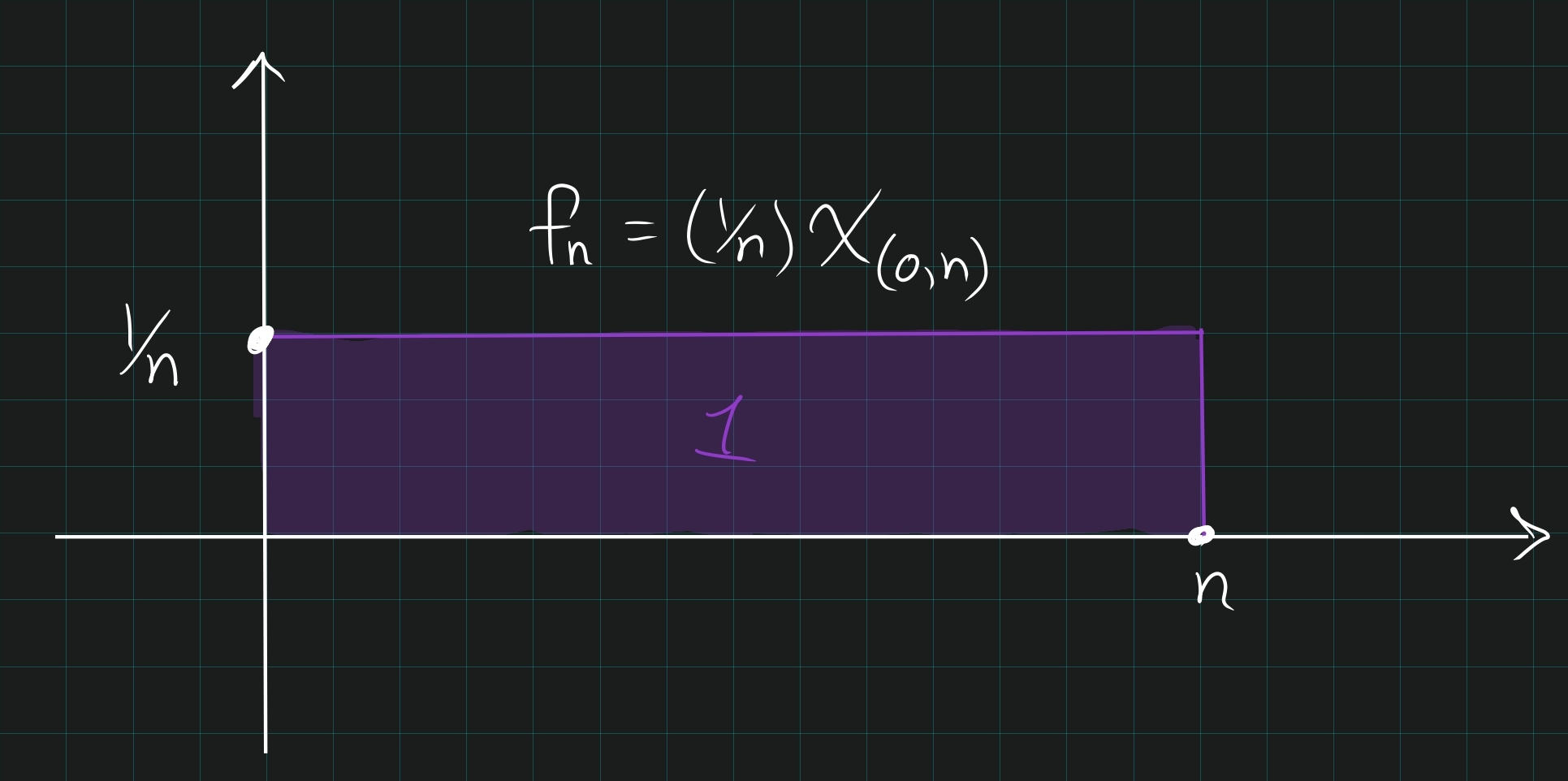
Pointwise, almost-everywhere, uniform, and \(L^1\) convergence are distinct. On \(\RR\), the sequences \(n\chi_{(0,1/n)}\), whose mass concentrates near \(0\), \(\chi_{[n,n+1]}\), whose mass moves to infinity, and \(\frac1n\chi_{[0,n]}\), whose mass spreads out, converge to \(0\) pointwise and have \(\norm{f_n}_1=1\); the last converges uniformly.
If \(f_n\to f\) almost everywhere and \(\abs{f_n}\leq g\) for some \(g\in L^1\), then \(f_n\to f\) in \(L^1\), by the dominated convergence theorem.
If \(f_n\to f\) in \(L^1\), then a subsequence converges to \(f\) almost everywhere.
If \(\mu(X)<\infty\) and measurable \(f_n\to f\) almost everywhere with \(f\) finite almost everywhere, then \(f_n\to f\) almost uniformly, by Egorov’s theorem.
If \(\mu(X)<\infty\), \(f_n\to f\) almost everywhere, and \(\theset{f_n}\) is uniformly integrable, then \(f_n\to f\) in \(L^1\), by the Vitali convergence theorem.
Almost everywhere convergence does not imply $L^p$ convergence (Tag PR-2JV43)
For every \(1\le p\le\infty\) there is a sequence \((f_k)_{k\geq1}\) in \(L^p(\RR)\) with \(f_k\to0\) almost everywhere but \(\norm{f_k}_p\not\to0\).
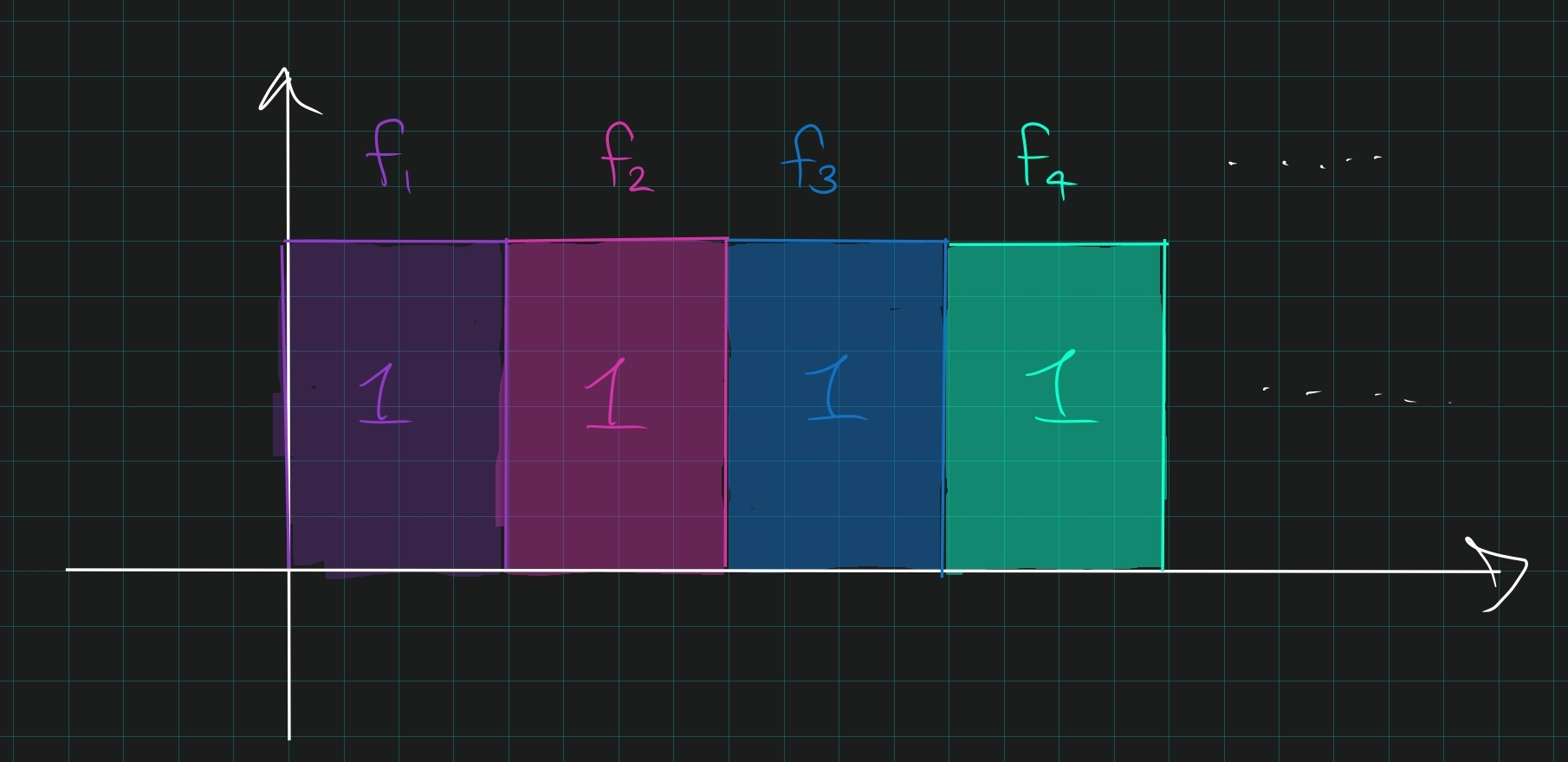
Escape to infinity. Let \(f_k\coloneqq\chi_{[k, k+1]}\). For every \(x\in\RR\), \(f_k(x)=0\) once \(k>x\), so \(f_k\to0\) pointwise everywhere. But \(\norm{f_k}_p = 1\) for all \(k\) and all \(1\le p\le\infty\). The convergence is not uniform, since \(\sup_x\abs{f_k(x)}=1\).
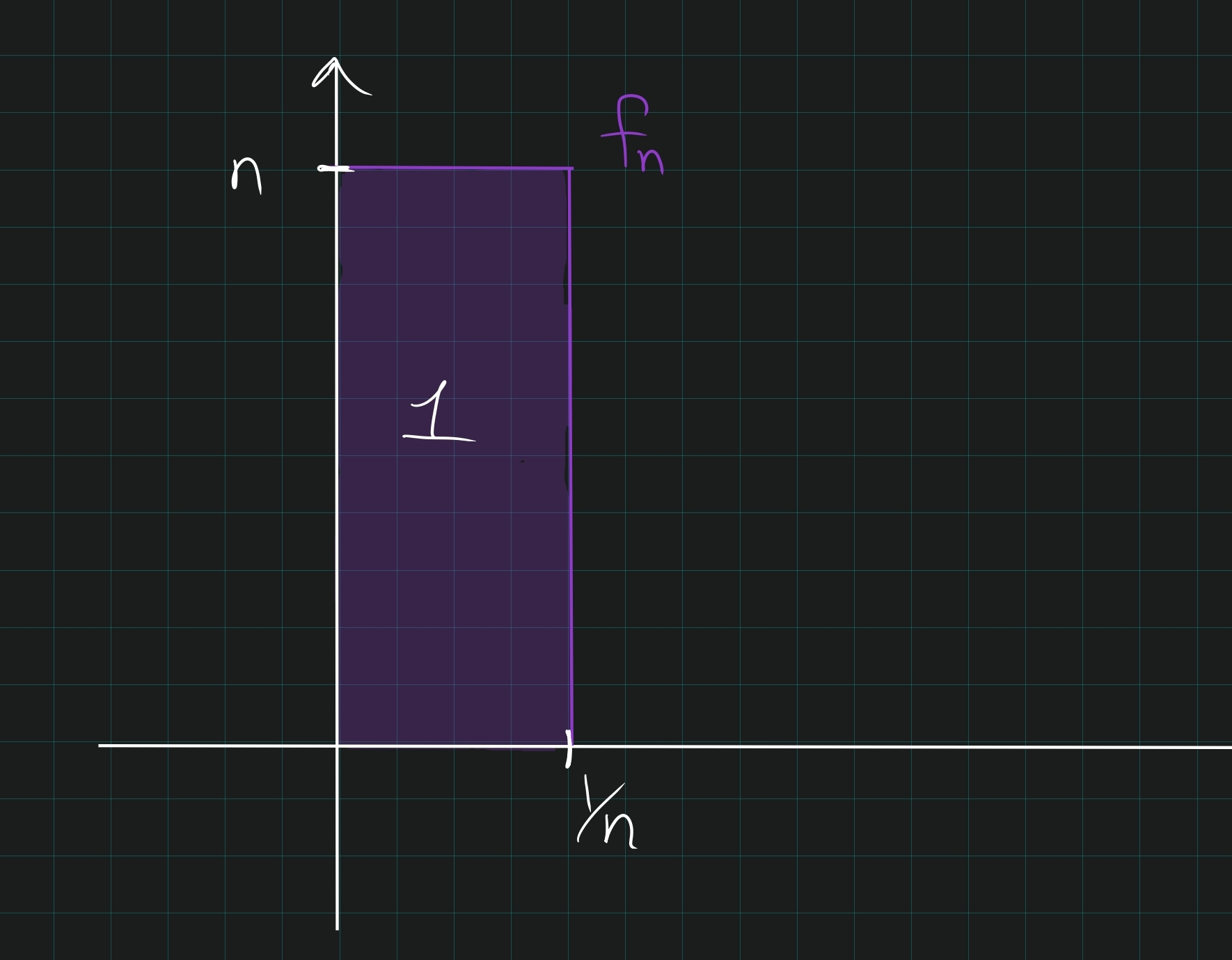
Concentration. Let \(f_k\coloneqq k \chi_{[0, 1/k]}\). For \(x\neq0\), \(f_k(x)=0\) whenever \(k>1/\abs{x}\), so \(f_k\to0\) almost everywhere; at \(x=0\), \(f_k(0)=k\to\infty\). Here \(\norm{f_k}_p=k^{1-1/p}\geq1\) for \(1\le p<\infty\) and \(\norm{f_k}_\infty = k \to \infty\).
Counterexamples among uniform, pointwise, almost everywhere and $L^1$ convergence (Tag PR-TC76W)
Let \(f_n,f\colon\RR\to\RR\) be Lebesgue measurable for \(n\geq1\), and consider the following modes of convergence of \((f_n)\) to \(f\):
\(f_n\to f\) uniformly on \(\RR\);
\(f_n\to f\) pointwise on \(\RR\), that is, \(f_n(x)\to f(x)\) for every \(x\in\RR\);
(AE) \(f_n(x)\to f(x)\) for almost every \(x\in\RR\);
- \(f_n,f\in L^1(\RR)\) and \(\norm{f_n-f}_1=\int_\RR\abs{f_n-f}\to0\).
Then (U) implies (P), and (P) implies (AE). Neither implication reverses, none of (U), (P), (AE) implies (N), and (N) implies none of (U), (P), (AE).
The functions \(f_n\coloneqq\frac1n\chi_{(0,n)}\) converge uniformly to \(0\), but \(\int_\RR f_n=1\) for all \(n\), so they satisfy (U), (P), (AE) and not (N).
The functions \(f_n\coloneqq\chi_{(n,n+1)}\) converge pointwise to \(0\), but \(\sup_\RR\abs{f_n}=1\) and \(\norm{f_n}_1=1\) for all \(n\), so they satisfy (P), (AE) and not (U), (N).
The functions \(f_n\coloneqq n\chi_{[0,1/n]}\) converge to \(0\) at every \(x\neq0\) and diverge at \(x=0\), and \(\norm{f_n}_1=1\) for all \(n\), so they satisfy (AE) and not (U), (P), (N).
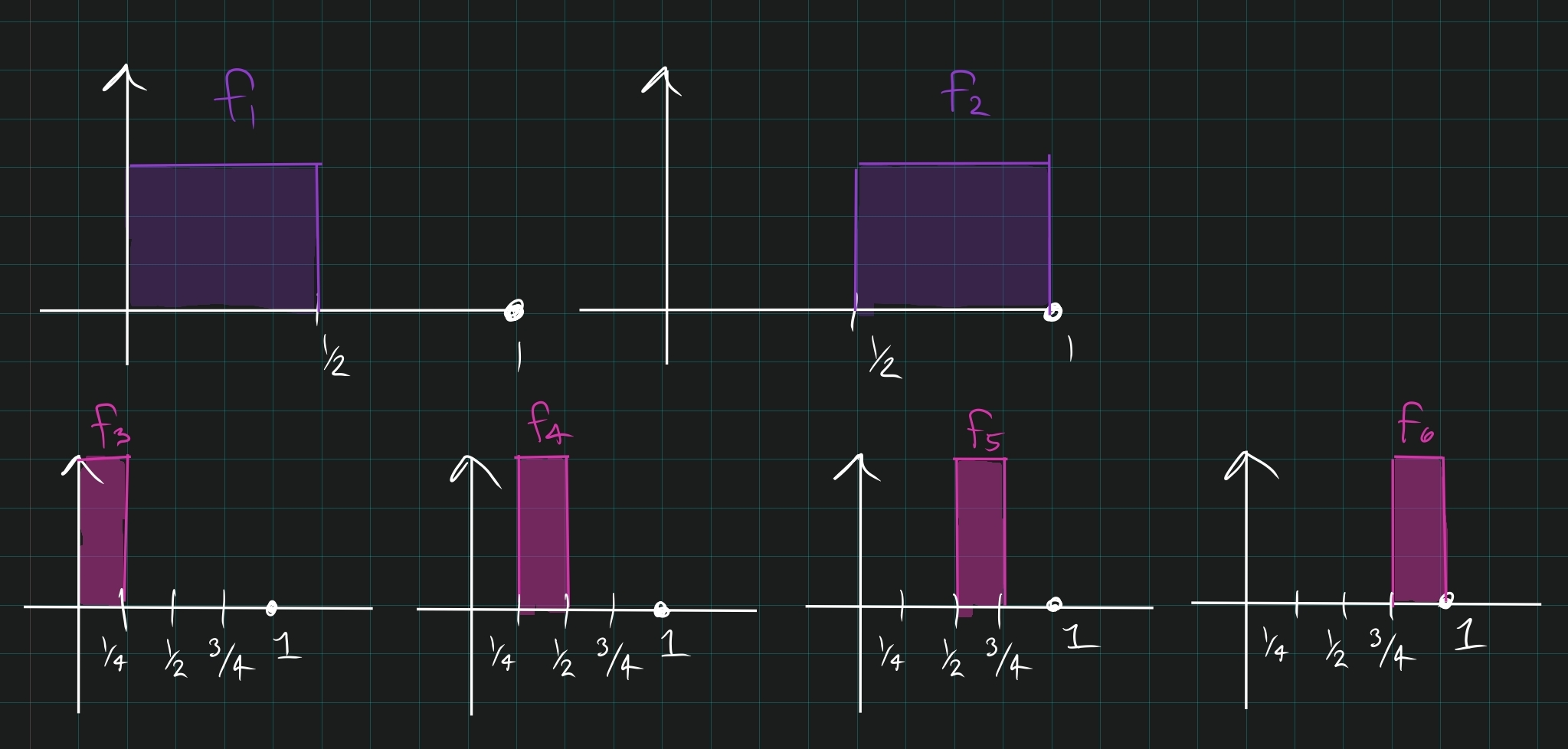
For \(k\geq1\) and \(0\leq j<2^k\), let \(I_{k,j}\coloneqq[j2^{-k},(j+1)2^{-k}]\), and enumerate the functions \(\chi_{I_{k,j}}\) in the order of increasing \(k\) and, for fixed \(k\), increasing \(j\), as \(f_1,f_2,f_3,\ldots\), so \(f_1=\chi_{[0,1/2]}\), \(f_2=\chi_{[1/2,1]}\), \(f_3=\chi_{[0,1/4]}\). If \(f_n=\chi_{I_{k,j}}\), then \(\norm{f_n}_1=2^{-k}\to0\), so \(f_n\to0\) in (N). Every \(x\in[0,1]\) lies in some \(I_{k,j}\) and outside some \(I_{k,j'}\) for each \(k\), so \(f_n(x)=1\) for infinitely many \(n\) and \(f_n(x)=0\) for infinitely many \(n\); hence \((f_n)\) satisfies (N) and not (U), (P), (AE).
Almost everywhere convergence does not imply convergence in \(L^p(\RR)\) for any \(1\leq p\leq\infty\). The functions \(f_k\coloneqq\chi_{[k,k+1]}\) converge to \(0\) at every point, but \(\norm{f_k}_p=1\) for all \(k\) and all \(1\leq p\leq\infty\). The functions \(f_k\coloneqq k\chi_{[0,1/k]}\) converge to \(0\) at every \(x\neq0\), but \(\norm{f_k}_p=k^{1-1/p}\geq1\) for \(1\leq p<\infty\) and \(\norm{f_k}_\infty=k\).
The spikes $n\chi_{(0,1/n)}$ converge pointwise but not in $L^1$ (Tag FE-LJRG2)
For \(n\geq 1\) let \(f_n\coloneqq n\chi_{(0, 1/n)}\colon\RR\to\RR\).
For \(x\leq 0\), \(f_n(x) = 0\) for all \(n\); for \(x>0\), \(f_n(x) = 0\) for all \(n > 1/x\). Hence \(f_n\to 0\) pointwise on \(\RR\).
\(\int_\RR\abs{f_n - 0}\dx = n\cdot\frac1n = 1\) for every \(n\), so \(f_n\not\to 0\) in \(L^1(\RR)\).
The moving indicators $\chi_{[n,n+1]}$ converge pointwise but not uniformly or in $L^1$ (Tag FE-SWUGG)
For \(n\geq 1\) let \(f_n\coloneqq\chi_{[n, n+1]}\colon\RR\to\RR\).
For each \(x\in\RR\), \(f_n(x) = 0\) for all \(n > x\), so \(f_n\to 0\) pointwise on \(\RR\).
\(\sup_{x\in\RR}\abs{f_n(x)} = 1\) for every \(n\), so \(f_n\not\to 0\) uniformly on \(\RR\).
\(\int_\RR\abs{f_n - 0}\dx = 1\) for every \(n\), so \(f_n\not\to 0\) in \(L^1(\RR)\).
Boxes of height $1/n$ and width $n$ converge uniformly but not in $L^1$ (Tag FE-KHKC4)
For \(n\geq 1\) let \(f_n\coloneqq\frac1n\chi_{[0,n]}\colon\RR\to\RR\), the box of height \(\frac1n\) over \([0,n]\). Then \(\sup_{x\in\RR}\abs{f_n(x)} = \frac1n\to 0\), so \(f_n\to 0\) uniformly on \(\RR\), but \(\int_\RR\abs{f_n - 0}\dx = 1\) for every \(n\), so \(f_n\not\to 0\) in \(L^1(\RR)\).
A sequence of functions that converges a.e. but not in $L^1$, uniformly, or pointwise (Tag FE-VT5N3)
For \(n\geq 1\) let \[ f_n \coloneqq n \chi_{[0, 1/n]}\colon\RR\to\RR. \]
For \(x<0\), \(f_n(x) = 0\) for all \(n\); for \(x>0\), \(f_n(x) = 0\) for all \(n > 1/x\). Hence \(f_n\to 0\) at every \(x\neq 0\), so \(f_n\to 0\) almost everywhere.
\(f_n(0) = n\to\infty\), so \((f_n)\) does not converge pointwise on \(\RR\), and in particular does not converge uniformly.
\(\int_\RR\abs{f_n - 0}\dx = 1\) for every \(n\), so \(f_n\not\to 0\) in \(L^1(\RR)\).
A sequence converging pointwise on $\RR$ but neither uniformly nor in $L^1(\RR)$ (Tag FE-BFDRF)
For \(n\geq 1\) let \(f_n \coloneqq \chi_{(n, n+1)}\colon\RR\to\RR\).
For each \(x\in\RR\), \(f_n(x) = 0\) for all \(n > x\), so \(f_n\to 0\) pointwise on \(\RR\), and in particular almost everywhere.
\(\sup_{x\in\RR}\abs{f_n(x)} = 1\) for every \(n\), so \(f_n\not\to 0\) uniformly on \(\RR\).
\(\int_\RR\abs{f_n - 0}\dx = 1\) for every \(n\), so \(f_n\not\to 0\) in \(L^1(\RR)\).
A sequence converging uniformly to $0$ on $\RR$ but not in $L^1(\RR)$ (Tag FE-3RPMC)
Uniform convergence on \(\RR\), which implies pointwise convergence and convergence almost everywhere, does not imply convergence in \(L^1(\RR)\). For \(n\geq 1\) let \[ f_n \coloneqq \frac{1}{n} \chi_{[0, n]}\colon\RR\to\RR. \] Then \(\norm{f_n}_\infty = \frac1n\to 0\), so \(f_n\to 0\) uniformly on \(\RR\). But \(\int_\RR \abs{f_n - 0}\dx = \frac1n\cdot n = 1\) for every \(n\), so \(f_n\not\to 0\) in \(L^1(\RR)\).
$L^1$ is a Banach space and $L^2$ is a Hilbert space (Tag PR-YFVA2)
Let \((X, \mcm, \mu)\) be a measure space.
\(L^1(X,\mu)\), with the norm \(\norm{f}_1 \coloneqq \int_X \abs{f}\dmu\), is a Banach space.
\(L^2(X,\mu)\), with the inner product \(\inner{f}{g} \coloneqq \int_X f\,\overline{g}\dmu\), is a Hilbert space.
\(L^2(X,\mu)\) need not be separable. Let \(X\) be an uncountable set, \(\mcm\) its power set, and \(\mu\) counting measure. The indicator functions \(\chi_{\theset{x}}\) for \(x\in X\) lie in \(L^2(X,\mu)\) and satisfy \(\norm{\chi_{\theset{x}}-\chi_{\theset{y}}}_2=\sqrt2\) for \(x\neq y\), so the open balls of radius \(\sqrt2/2\) about them are pairwise disjoint and uncountably many; a countable dense subset would meet each of them.