Let \(f_n,f\colon\RR\to\RR\) be Lebesgue measurable for \(n\geq1\), and consider the following modes of convergence of \((f_n)\) to \(f\):
\(f_n\to f\) uniformly on \(\RR\);
\(f_n\to f\) pointwise on \(\RR\), that is, \(f_n(x)\to f(x)\) for every \(x\in\RR\);
(AE) \(f_n(x)\to f(x)\) for almost every \(x\in\RR\);
- \(f_n,f\in L^1(\RR)\) and \(\norm{f_n-f}_1=\int_\RR\abs{f_n-f}\to0\).
Then (U) implies (P), and (P) implies (AE). Neither implication reverses, none of (U), (P), (AE) implies (N), and (N) implies none of (U), (P), (AE).
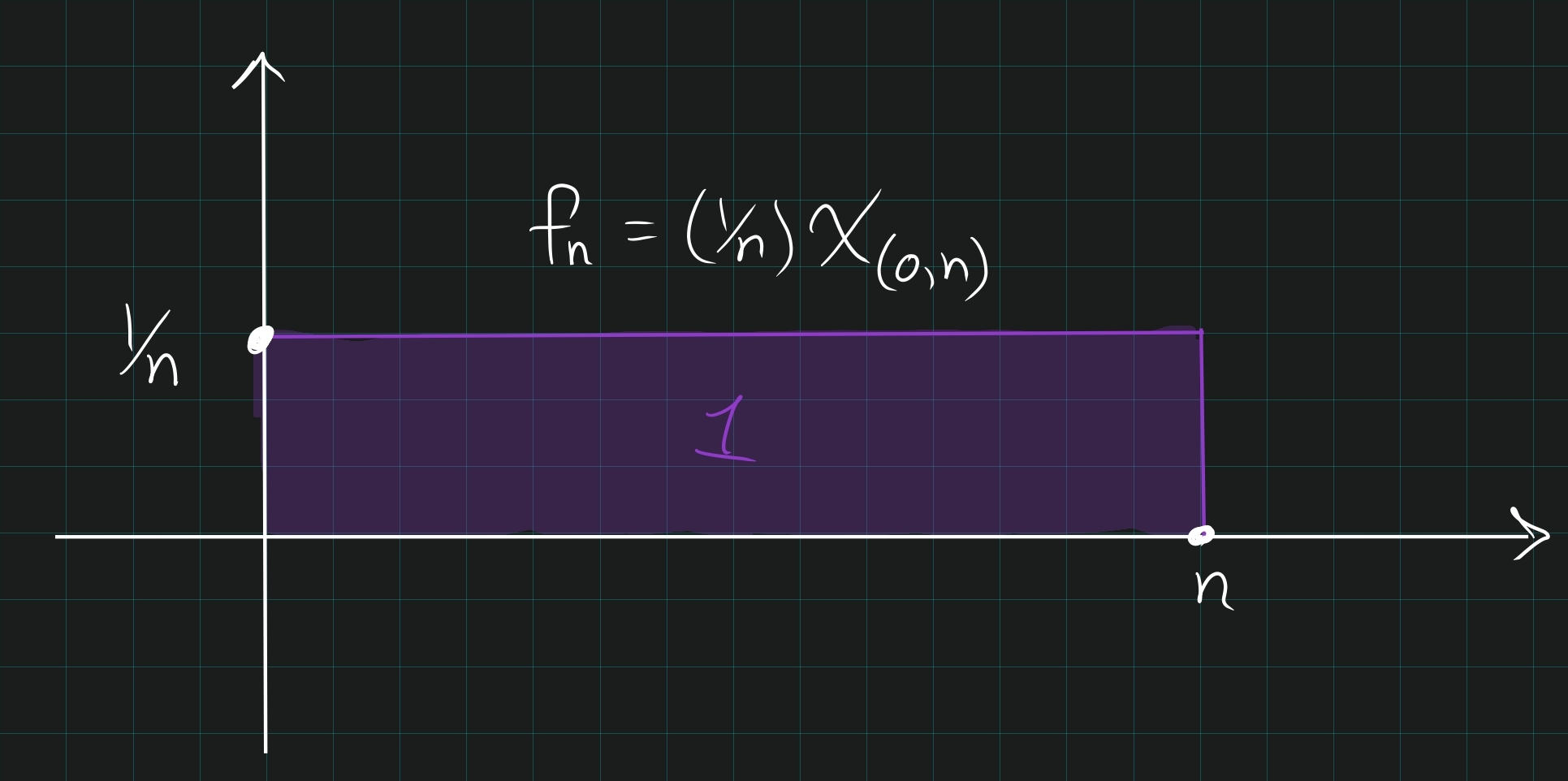
The functions \(f_n\coloneqq\frac1n\chi_{(0,n)}\) converge uniformly to \(0\), but \(\int_\RR f_n=1\) for all \(n\), so they satisfy (U), (P), (AE) and not (N).
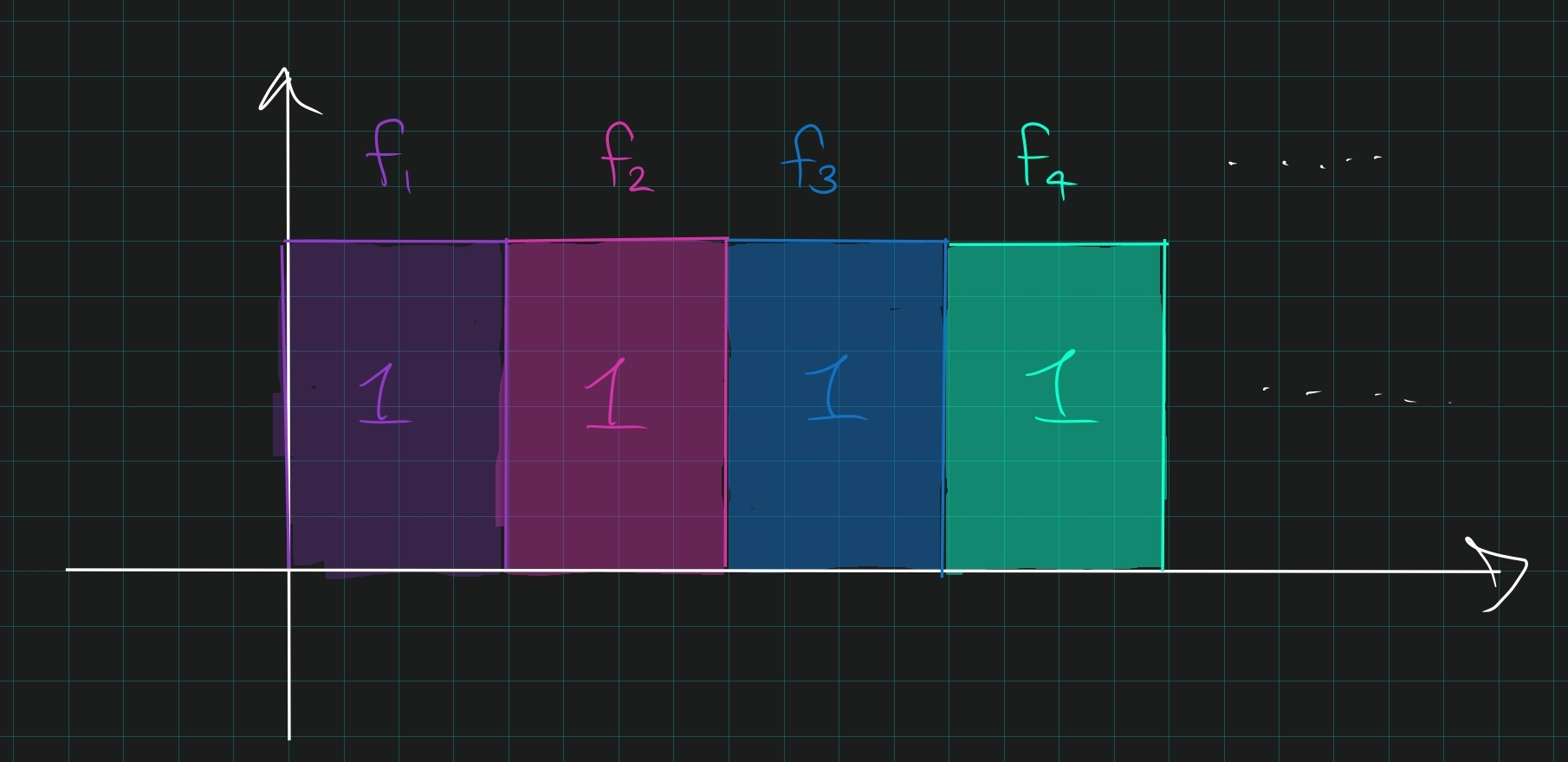
The functions \(f_n\coloneqq\chi_{(n,n+1)}\) converge pointwise to \(0\), but \(\sup_\RR\abs{f_n}=1\) and \(\norm{f_n}_1=1\) for all \(n\), so they satisfy (P), (AE) and not (U), (N).
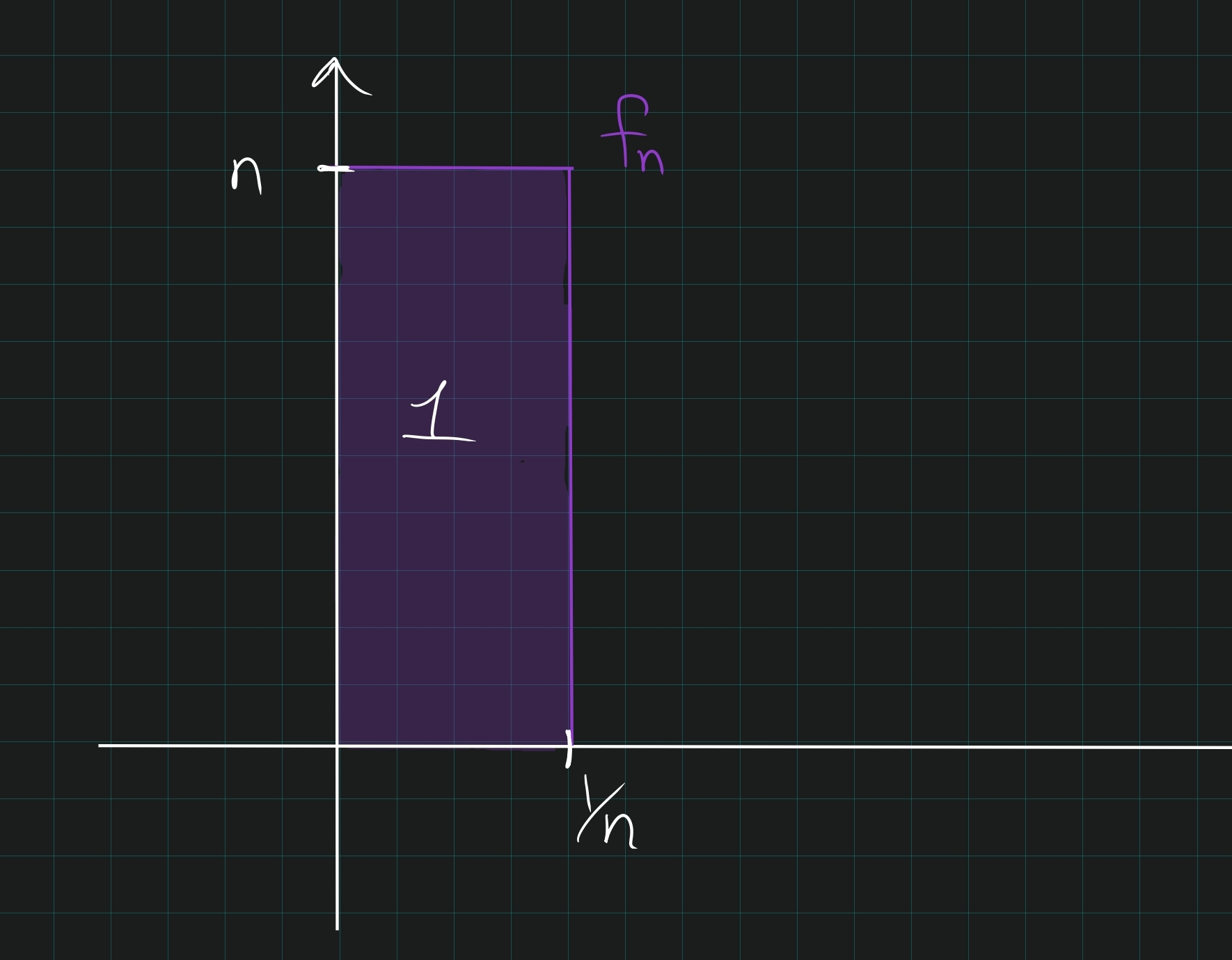
The functions \(f_n\coloneqq n\chi_{[0,1/n]}\) converge to \(0\) at every \(x\neq0\) and diverge at \(x=0\), and \(\norm{f_n}_1=1\) for all \(n\), so they satisfy (AE) and not (U), (P), (N).
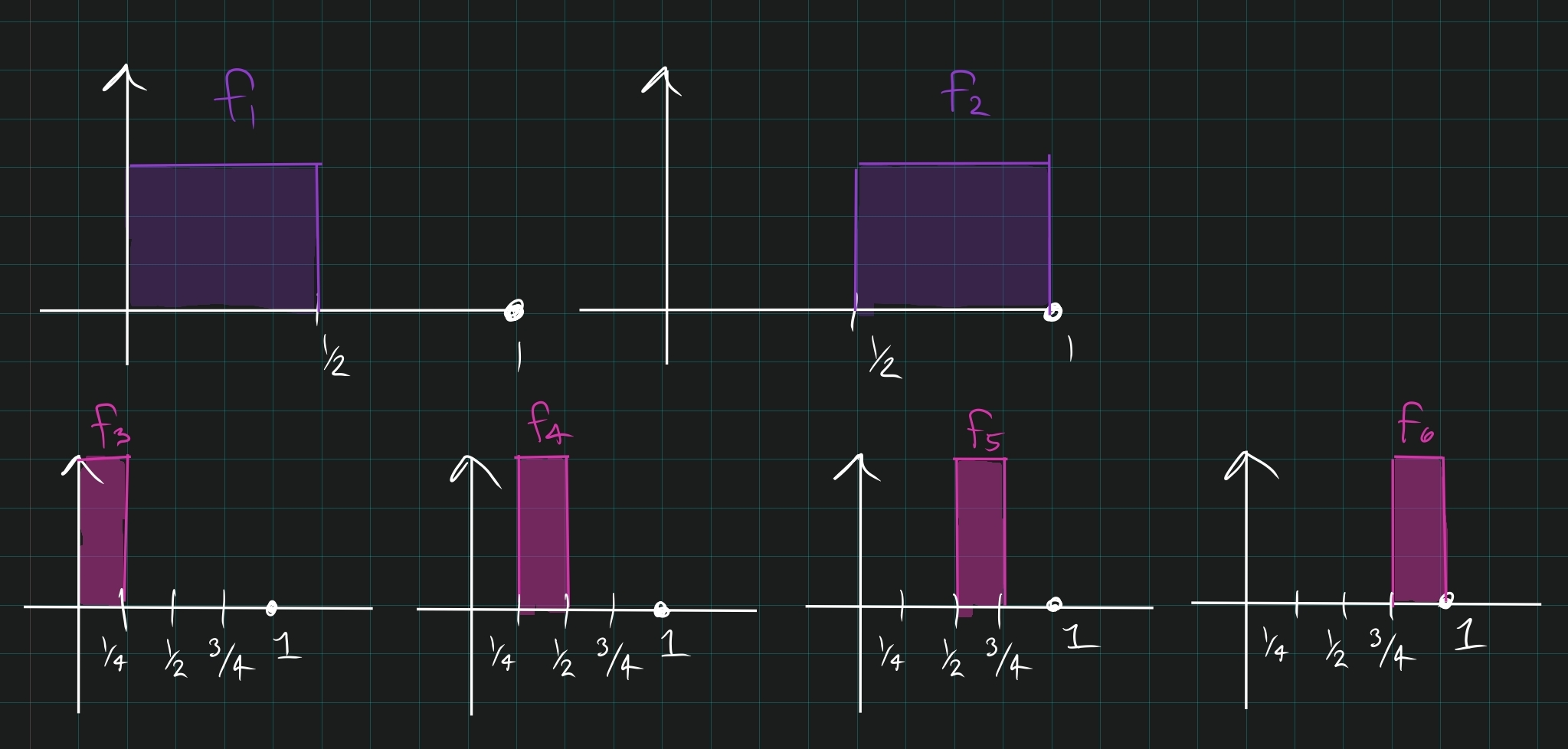
For \(k\geq1\) and \(0\leq j<2^k\), let \(I_{k,j}\coloneqq[j2^{-k},(j+1)2^{-k}]\), and enumerate the functions \(\chi_{I_{k,j}}\) in the order of increasing \(k\) and, for fixed \(k\), increasing \(j\), as \(f_1,f_2,f_3,\ldots\), so \(f_1=\chi_{[0,1/2]}\), \(f_2=\chi_{[1/2,1]}\), \(f_3=\chi_{[0,1/4]}\). If \(f_n=\chi_{I_{k,j}}\), then \(\norm{f_n}_1=2^{-k}\to0\), so \(f_n\to0\) in (N). Every \(x\in[0,1]\) lies in some \(I_{k,j}\) and outside some \(I_{k,j'}\) for each \(k\), so \(f_n(x)=1\) for infinitely many \(n\) and \(f_n(x)=0\) for infinitely many \(n\); hence \((f_n)\) satisfies (N) and not (U), (P), (AE).
Almost everywhere convergence does not imply convergence in \(L^p(\RR)\) for any \(1\leq p\leq\infty\). The functions \(f_k\coloneqq\chi_{[k,k+1]}\) converge to \(0\) at every point, but \(\norm{f_k}_p=1\) for all \(k\) and all \(1\leq p\leq\infty\). The functions \(f_k\coloneqq k\chi_{[0,1/k]}\) converge to \(0\) at every \(x\neq0\), but \(\norm{f_k}_p=k^{1-1/p}\geq1\) for \(1\leq p<\infty\) and \(\norm{f_k}_\infty=k\).