Roots
Toy contour (Tag D-YKB3V)
A toy contour is a closed Jordan curve \(\gamma\) in \(\CC\), together with its interior and exterior: the bounded and the unbounded connected components of \(\CC\setminus\gamma\).
By the Jordan curve theorem, \(\CC\setminus\gamma\) has exactly two connected components, one bounded and one unbounded, and \(\gamma\) is their common boundary.
(Complex roots of a number)
The \(n\)th roots of \(z \coloneqq r e^{i\theta}\neq 0\) are \[ z = re^{i\theta} = re^{i\qty{\theta + 2k\pi}} \implies z^{1/n} = \qty{ re^{i\qty{\theta + 2k\pi}} }^{1\over n} = r^{1\over n} e^{i\qty{\theta + 2k\pi \over n}}, \qquad \ts{ \omega_k \coloneqq r^{1/n} e^{i \qty{ \theta + 2k\pi \over n} } \st 0 \leq k \leq n-1 }. \] The roots have modulus \(r^{1/n}\) and are spaced by angles of \(2\pi/n\). Writing the argument as \(\theta + 2k\pi\) before taking the root produces all \(n\) of them.
Since \(\CC\) is algebraically closed, every polynomial in \(\CC[x]\) factors into linear factors.
The logarithm
(Complex log)
For \(z = re^{i\theta}\neq 0\), the angle \(\theta\) has the form \(\Theta + 2k\pi\) with \(\Theta = \Arg z\in(-\pi,\pi]\). The principal logarithm and principal powers are \[ \log(z) = \ln\abs{z} + i\Arg(z), \qquad z^c \coloneqq e^{c\log(z)}, \] and \(\ln r + i\theta\) is a value of \(\log(re^{i\theta})\) for every choice of \(\theta\).
For \(f\) holomorphic with values in \(\CC\sm(-\infty, 0]\), \(f^{1/n} \coloneqq e^{{1\over n}\log f}\) with the principal branch of \(\log\) is a holomorphic \(n\)th root of \(f\).
The multivalued formula defines a holomorphic function only on a domain that admits a continuous choice of argument. On the slit plane \(\CC\sm(-\infty,0]\), the choice \(-\pi<\arg z<\pi\) gives the principal branch, and every simply connected domain not containing \(0\) admits a holomorphic logarithm. Once a branch of \(\log\) is fixed, \(z^\alpha\coloneqq e^{\alpha\log z}\), and a different branch of \(\log\) multiplies \(z^\alpha\) by \(e^{2\pi i k\alpha}\) for some \(k\in\ZZ\).
Existence of a branch of the logarithm on a simply connected region (Tag PR-MWUJS)
Let \(\Omega\subseteq\CC\) be a simply connected region with \(1\in\Omega\) and \(0\notin\Omega\). Then there exists a holomorphic function \(F\colon\Omega\to\CC\) such that
\(e^{F(z)}=z\) for all \(z\in\Omega\), and
\(F(r)=\log r\) for all real \(r\) in some neighborhood of \(1\) in \(\Omega\).
Principal branch of the logarithm and of $z^\alpha$ (Tag D-4CSPM)
Let \(\Omega\coloneqq\CC\setminus(-\infty,0]\). Every \(z\in\Omega\) can be written uniquely as \(z=re^{i\theta}\) with \(r>0\) and \(\theta\in(-\pi,\pi)\). The principal branch of the logarithm is the function \(\Log\colon\Omega\to\CC\) given by \[ \Log(z)\coloneqq\log r+i\theta, \] where \(\log r\) is the real natural logarithm. For \(\alpha\in\CC\), the principal branch of \(z^\alpha\) is the function on \(\Omega\) given by \[ z^{\alpha}\coloneqq e^{\alpha\Log(z)}. \]
Principal value of the complex logarithm (Tag D-OMBQT)
For \(z\in\CC\setminus\{0\}\), let \(\Arg(z)\in(-\pi,\pi]\) be the principal argument of \(z\), the unique \(\theta\in(-\pi,\pi]\) with \(z=\abs{z}e^{i\theta}\). The principal value of the logarithm is \[ \log(z)\coloneqq\ln\abs{z}+i\Arg(z),\qquad z\in\CC\setminus\{0\}, \] where \(\ln\) is the real natural logarithm.
In polar form \(z=re^{i\theta}\) with \(r>0\) and \(\theta\in(-\pi,\pi]\), this reads \(\log(z)=\ln r+i\theta\). It satisfies \(e^{\log(z)}=z\), restricts to the principal branch \(\Log\) on \(\CC\setminus(-\infty,0]\), and is discontinuous at every point of \((-\infty,0)\), where \(\Arg\) jumps from values near \(-\pi\) to \(\pi\).
Complex powers $z^\alpha$ along a branch of the logarithm (Tag D-T6INB)
Let \(\Omega\subseteq\CC\setminus\{0\}\) be open. A branch of the logarithm on \(\Omega\) is a continuous function \(L\colon\Omega\to\CC\) with \(e^{L(z)}=z\) for all \(z\in\Omega\). For such \(L\) and \(\alpha\in\CC\), the branch of \(z^\alpha\) determined by \(L\) is \[ z^\alpha\coloneqq e^{\alpha L(z)},\qquad z\in\Omega. \]
When no branch is specified, \(L\) is the principal branch \(\Log\) on \(\CC\setminus(-\infty,0]\).
For a nonvanishing holomorphic function \(f\) on a domain \(\Omega\), a holomorphic logarithm \(g\) of \(f\) satisfies \(g'=f'/f\), so \(\int_\gamma f'/f = 0\) for every closed curve \(\gamma\) in \(\Omega\). Conversely, if \(\int_\gamma f'/f=0\) for every closed curve \(\gamma\) in \(\Omega\), then \(f'/f\) has a primitive \(g\), and adjusting \(g\) by a constant gives \(e^g = f\). On a simply connected domain these integrals vanish by Cauchy’s theorem, which gives the existence theorem for logarithms and roots of nonvanishing functions:
Holomorphic logarithm when $f'/f$ has zero periods (Tag T-NRSFZ)
Let \(\Omega\subseteq\CC\) be a connected open set and let \(f\) be holomorphic and nonvanishing on \(\Omega\). Suppose that \(\int_\gamma\frac{f'(z)}{f(z)}\dz=0\) for every piecewise smooth closed curve \(\gamma\) in \(\Omega\). Fix \(z_0\in\Omega\) and \(c\in\CC\) with \(e^c=f(z_0)\), and define \[ g(z)\coloneqq c+\int_{z_0}^z\frac{f'(\xi)}{f(\xi)}\dxi, \] the integral taken along any piecewise smooth path in \(\Omega\) from \(z_0\) to \(z\). Then \(g\) is well defined and holomorphic on \(\Omega\), \(g'=f'/f\), and \(e^{g}=f\) on \(\Omega\).
Branch cuts and branch points
The formula \[ z^{1\over n} \coloneqq (re^{i\theta})^{1\over n} = r^{1\over n} e^{i\theta \over n} \] depends on the choice of \(\theta\), and a choice continuous in \(z\) exists only after removing a branch cut.
(Where continuity fails)
Take \(z \coloneqq x + i0\) with \(x <0\), and approach it from either side along \(z_\pm \coloneqq x \pm i\varepsilon\) as \(\varepsilon\to 0^+\). For the principal branch:
- \(\log(z_+) \to \ln\abs x + i\pi\),
- \(\log(z_-) \to \ln\abs x - i\pi\).
So no value at \(z\) makes \(\log\) continuous across the negative real axis. The point \(z=0\) is a branch point: \(\log\) has no continuous branch on any punctured neighborhood of the origin, whatever cut is chosen.
Holomorphic logarithm of a nonvanishing function on a simply connected domain (Tag T-E76LX)
Let \(\Omega\subseteq\CC\) be a simply connected open set and let \(f\) be holomorphic and nonvanishing on \(\Omega\). Then there is a holomorphic function \(G\) on \(\Omega\) such that \[ f(z)=e^{G(z)}\quad\text{for all } z\in\Omega. \]
The quadratic formula over \(\CC\)
For \(a\neq 0\), the roots of \(az^2+bz+c\) are \(\frac{-b\pm w}{2a}\), where \(w\) is either square root of \(\Delta \coloneqq b^2-4ac\in\CC\).
Exercises
Existence of multiple values in branches (Tag P-4GDBQ)
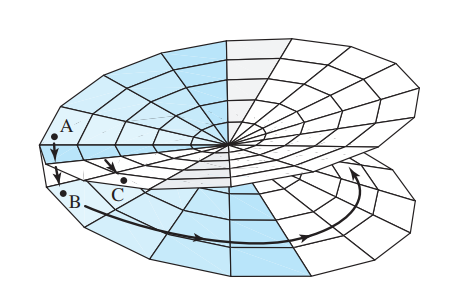
Let \(z_0 = r_0e^{i\pi} \in (-\infty, 0) \subseteq \RR\), and show that \(z^{1\over 2}\) is not continuous along \((-\infty, 0)\) by computing \[ \lim_{z\in \gamma_1} f_1(z) &= i\sqrt{r_0} \\ \lim_{z\in \gamma_2} f_1(z) &= -i\sqrt{r_0} ,\]
where
- \(\gamma_1 = \ts{r_0 e^{it} \st t\in (0, \pi) }\),
- \(\gamma_2 = \ts{r_0 e^{-it} \st t\in (\pi, 0) }\)
Solution
\[ \lim _{(r, \theta) \rightarrow\left(r_{0}, \pi\right)} f_{1}\left(r e^{i \theta}\right) &=\lim _{(r, \theta) \rightarrow\left(r_{0}, \pi\right)} r^{\frac{1}{2}}\left(\cos \frac{\theta}{2}+i \sin \frac{\theta}{2}\right)=i r_{0}^{\frac{1}{2}}, \quad \text { and } \\ \lim _{(r, \theta) \rightarrow\left(r_{0},-\pi\right)} f_{1}\left(r e^{i \theta}\right) &=\lim _{(r, \theta) \rightarrow\left(r_{0},-\pi\right)} r^{\frac{1}{2}}\left(\cos \frac{\theta}{2}+i \sin \frac{\theta}{2}\right)=-i r_{0}^{\frac{1}{2}} . .\]
Log properties can fail (Tag P-LHZGV)
Show that
- \(\log(zw)\neq \log(z)\log(w)\)
- \(\log(\exp(z))\neq z\)
Solution
Counterexamples:
Take \(z=\zeta_4^3\) and \(w=\zeta_4^2\), noting that \(\Arg(z) = {3\pi \over 4}\) and \(\Arg(w) = {\pi \over 2}\) Then \(zw = e^{5\pi \over 4}\) but \(\Arg(zw) = {-3\pi \over 4}\) because we are forced to use the domain \((-\pi, \pi]\).
Showing that \(\log(\exp(z))\) is a countably infinite set in \(\CC\): \[ \log(\exp(z)) &= \log(\exp(x+iy)) \\ &= \ln\qty{e^x} + (y+2k\pi)i \\ &= (x+iy) + 2k\pi i \\ &= z + 2k\pi .\]
A nowhere-vanishing holomorphic function on a simply connected domain is of the form $e^g$ (Tag P-Y5SS5)
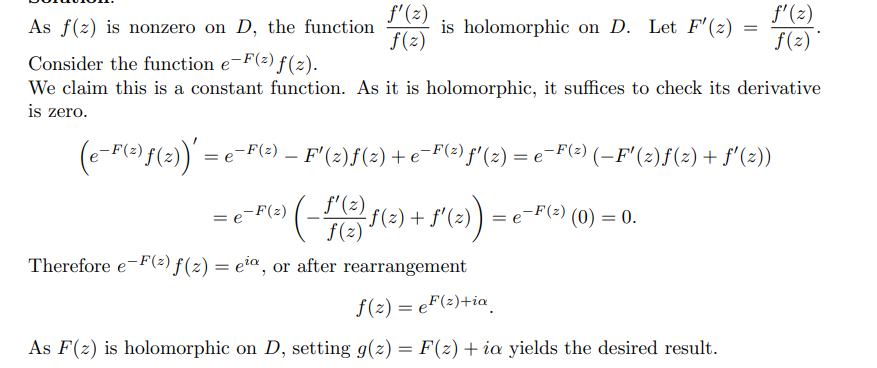
Prove that if \(D\) is a simply connected domain and \(f(z)\) is holomorphic and nonzero on \(D\), then \(f(z)=e^{g(z)}\), where \(g(z)\) is holomorphic on \(D\).
Solution
Finding complex roots (Tag E-X4MBB)
Solve \(z^4=i\).
Solution
First find a principal root: \(z^4=i = e^{i\pi\over 2} \implies z_0 = e^{i\pi \over 8}\). Now all of the roots are \(\ts{z_k = z_0 \zeta_4^k \st k=0,1,2,3}\) where \(\zeta_4=e^{2\pi i \over 4} = e^{i\pi \over 2}\), so
\(z_0 = e^{i\pi \over 8} e^{0i\pi \over 4} = e^{i\pi \over 8}\) corresponding to \({1\over 8} + {0\over 4}\),
\(z_1 = e^{i\pi \over 8} e^{1i\pi \over 4} = e^{3i\pi \over 8}\) corresponding to \({1\over 8} + {1\over 4} = {3\over 8}\),
\(z_2 = e^{i\pi \over 8} e^{2i\pi \over 4} = e^{5i\pi \over 8}\) corresponding to \({1\over 8} + {2\over 4} = {5\over 8}\),
\(z_3 = e^{i\pi \over 8} e^{3i\pi \over 4} = e^{7i\pi \over 8}\) corresponding to \({1\over 8} + {3\over 4} = {7\over 8}\).
Working with conjugates (Tag E-WNNSK)
Find \(\Re\qty{z+2\over z-1}\).
Solution
\[ {z+2\over z-1}\cdot{\bar{z-1} \over \bar{z-1}} &= {(z+2)\bar{z-1} \over \abs{z-1}^2} \\ &= {((z-1) + 3)\bar{z-1} \over \abs{z-1}^2} \\ &= {\abs{z-1}^2 + 3\bar{z} -3 \over \abs{z-1}^2} \\ &= {(x-1)^2 + y^2 + 3(x-iy) - 3 \over (x-1)^2 + y^2} \\ &= {(x-1)^2 + 3x - 3 + y^2\over (x-1)^2 + y^2} + i{-3y\over (x-1)^2 + y^2} \\ &= {(x-1)(x+2) + y^2\over (x-1)^2 + y^2} + i{-3y\over (x-1)^2 + y^2} .\]
Trig identities (Tag E-P7SIB)
Find an identity for \(\cos(4\theta)\) in terms of \(\sin(\theta)\) and \(\cos(\theta)\).
Solution
Write \(x=\cos(\theta), y= \sin(\theta)\), so \(e^{i\theta} = x+iy\). Then \[ \cos(4\theta) + i\sin(4\theta) &= e^{4i\theta } \\ &= (x+iy)^4 \\ &= \sum_{0\leq k \leq 4} {4\choose k} x^k (iy)^{4-k} \\ &= x^4 + 4ix^3y - 6x^2y^2 - 4ixy^3 + y^4 \\ &= (x^4 - 6x^2y^2 + y^4) + i(4x^3y - 4xy^3) .\] So \[ \cos(4\theta) &= \cos^4(\theta) - 6\cos^2(\theta)\sin^2(\theta) + \sin^4(\theta)\\ \sin(4\theta) &= 4\cos^3(\theta)\sin(\theta) - 4\cos(\theta)\sin^3(\theta) .\]
$\abs{e^z}=e^{\Re z}$ (Tag E-JWO2G)
Show that \(\abs{e^z} = e^{\Re(z)}\).
Solution
Write \(z=x+iy\), so \(\Re(z) = x\). Then \[ \abs{e^z} = \abs{e^{x+iy}} = \abs{e^x}\abs{e^{iy}} = e^x ,\] using that \(\abs{e^{iy}}=\abs{\cos y+i\sin y}=1\) and \(e^x>0\) for all \(x\in \RR\).
Cauchy integral formula for coefficients (Tag E-QVMUV)
Show that if \(f(z) \sum_{k\in \ZZ} c_k (z-z_0)^k\), then \[ c_k = {1\over 2\pi i}\int_\gamma {f(z) \over (z-z_0)^{n+1}}\dz ,\] and that this converges in an annulus \(D_R(z_0)\sm \bar{D_r(z_0)}\) where \[ r=\limsup _{n \rightarrow \infty} \sqrt[n]{\left|a_{-n}\right|} \text { and } R=\frac{1}{\limsup _{n \rightarrow \infty} \sqrt[n]{\left|a_{n}\right|}} \text {. } .\]
Hint: start with \[ f(z)=\frac{1}{2 \pi i} \oint_{\left|w-z_{0}\right|=s_{2}} \frac{f(w)}{w-z} d w-\frac{1}{2 \pi i} \oint_{\left|w-z_{0}\right|=s_{1}} \frac{f(w)}{w-z} d w ,\] and try to obtain a geometric series to obtain \[ f(z)=\sum_{j=-\infty}^{\infty}\left(\frac{1}{2 \pi i} \oint_{\left|w-z_{0}\right|=r} \frac{f(w)}{\left(w-z_{0}\right)^{j+1}} d w\right)\left(z-z_{0}\right)^{j} .\]
Solution
The statement has three notation errors: the opening display is missing an equality sign, the coefficient formula uses \(n\) where it must use \(k\), and the radii are written with \(a_{\pm n}\) instead of the coefficients \(c_{\pm n}\). With these corrections, if \[ f(z)=\sum_{k\in\ZZ}c_k(z-z_0)^k, \] then for any positively oriented circle \(\gamma\) centered at \(z_0\) and lying in the annulus of analyticity, \[ \boxed{c_k={1\over2\pi i}\int_\gamma {f(z)\over(z-z_0)^{k+1}}\,dz.} \] Indeed, termwise integration gives \[ {1\over2\pi i}\int_\gamma {f(z)\over(z-z_0)^{k+1}}\,dz =\sum_jc_j{1\over2\pi i}\int_\gamma(z-z_0)^{j-k-1}\,dz=c_k. \]
For the positive-power part, Cauchy–Hadamard gives outer radius \[ R={1\over\limsup_{n\to\infty}|c_n|^{1/n}}. \] For the negative-power part, put \(w=(z-z_0)^{-1}\); then \[ \sum_{n\ge1}c_{-n}(z-z_0)^{-n}=\sum_{n\ge1}c_{-n}w^n \] has radius \(1/\limsup|c_{-n}|^{1/n}\) in \(w\), hence converges exactly when \[ |z-z_0|>r, \qquad r=\limsup_{n\to\infty}|c_{-n}|^{1/n}. \] Therefore the Laurent series converges on \[ \boxed{r<|z-z_0|<R.} \] The two-circle formula in the hint is the usual Cauchy formula on an annulus; expanding each kernel geometrically yields the same Laurent expansion and coefficient formula.