The estimates
Cauchy's inequalities (Tag T-22RQZ)
Let \(\Omega\subseteq\CC\) be open, let \(f\) be holomorphic on \(\Omega\), and let \(z_0\in\Omega\) and \(R>0\) satisfy \(\overline{D_R(z_0)}\subseteq\Omega\). Let \(\gamma\) be the circle \(\abs{z-z_0}=R\) and \(M\coloneqq\max_{z\in\gamma}\abs{f(z)}\). Then for every \(n\ge0\), \[ \abs{f^{(n)}(z_0)}\le\frac{n!\,M}{R^n}. \]
By the Cauchy integral formula for derivatives, with \(\gamma\) parametrized by \(z=z_0+Re^{i\theta}\), \[ \abs{f^{(n)}(z_0)}=\abs{\frac{n!}{2\pi i}\int_\gamma\frac{f(z)}{(z-z_0)^{n+1}}\dz}\le\frac{n!}{2\pi}\int_0^{2\pi}\frac{M}{R^{n+1}}R\dtheta=\frac{n!\,M}{R^n}. \]
Cauchy inequalities (Tag FT-5MASA)
Let \(z_0\in\CC\) and \(R>0\), let \(f\) be holomorphic on an open set containing the closed disc \(\abs{z-z_0}\le R\), and let \(\gamma\) be the circle \(\abs{z-z_0}=R\). Then for every integer \(n\ge0\), \[ \abs{f^{(n)}(z_0)} \leq \frac{n!\, \sup_{z\in\gamma} \abs{f(z)}}{R^{n}}. \]
Cauchy inequalities for Taylor coefficients (Tag FT-REHJT)
Let \(z_0\in\CC\) and \(R>0\), and let \(f\) be holomorphic on an open set containing the closed disc \(\abs{z-z_0}\le R\). Then for every integer \(n\ge0\), \[ \abs{f^{(n)} (z_0) \over n!} \leq R^{-n} \sup_{\abs{z-z_0}=R} \abs{f(z)}. \]
Cauchy estimates (Tag FF-HO7RN)
Let \(r>0\) and let \(f\) be holomorphic on an open set containing the closed disc \(\abs{z}\le r\). Then for every integer \(n\ge0\), \[ \abs{f^{(n)}(0)} \leq \frac{n!}{r^{n}} \sup_{\abs{z}=r}\abs{f(z)}. \]
The \(k\)th Taylor coefficient of \(f\) at \(z_0\) is bounded by the supremum of \(\abs f\) on a circle of radius \(R\) about \(z_0\), divided by \(R^k\): \[ \abs{c_k} \leq {\sup_{\abs{z-z_0}=R}\abs{f(z)} \over R^k} .\]
(Cauchy's inequality)
- Given \(z_0\in \Omega\), let \(r>0\) with \(\overline{D_r(z_0)} \subset \Omega\), let \(C = \bd D_r(z_0)\), and let \(M\coloneqq \sup_{C}\abs f\).
- Apply the integral formula for \(f^{(n)}\):
\[ \begin{aligned} \left|f^{(n)}(z_0)\right| &= \abs{ \frac{n !}{2 \pi i} \int_{C} \frac{f(\zeta) }{(\zeta-z_0)^{n+1}} \dzeta } \\ &=\left|\frac{n !}{2 \pi i} \int_{0}^{2 \pi} \frac{f\left(z_0 + r e^{i \theta}\right) r i e^{i \theta} }{\left(r e^{i \theta}\right)^{n+1}} \dtheta \right| \\ &\leq \frac{n !}{2 \pi} \int_{0}^{2 \pi}\left|\frac{f\left( z_0 +r e^{i \theta}\right) r i e^{i \theta}}{\left(r e^{i \theta}\right)^{n+1}}\right| \dtheta \\ &=\frac{n !}{2 \pi} \int_{0}^{2 \pi} \frac{\left|f\left(z_0 +r e^{i \theta}\right)\right|}{r^{n}} \dtheta \\ &\leq \frac{n !}{2 \pi} \int_{0}^{2 \pi} \frac{M}{r^{n}} \dtheta \\ &=\frac{M n !}{r^{n}} \end{aligned}.\]
(Growth bounds for entire functions)
Let \(f\) be entire with \(\abs{f(z)} \leq A \abs z^n\) for all \(\abs z\geq R_0\). For fixed \(z_0\) and large \(R\), \(\abs f\leq A(R+\abs{z_0})^n\) on the circle \(\abs{z-z_0}=R\), so Cauchy’s inequality gives \(\abs{f^{(n+1)}(z_0)} \leq (n+1)!\,A (R+\abs{z_0})^n/R^{n+1}\to 0\) as \(R\to\infty\). Hence \(f^{(n+1)}\equiv 0\) and \(f\) is a polynomial of degree at most \(n\). The case \(n=0\) is Liouville’s theorem.
Liouville
Liouville's theorem (Tag T-QHIHJ)
Let \(f\) be an entire function. If there is \(M>0\) with \(\abs{f(z)}\leq M\) for all \(z\in\CC\), then \(f\) is constant.
(Liouville's theorem)
- Since \(f\) is bounded, \(\abs{f(z)} \leq M\) uniformly on \(\CC\).
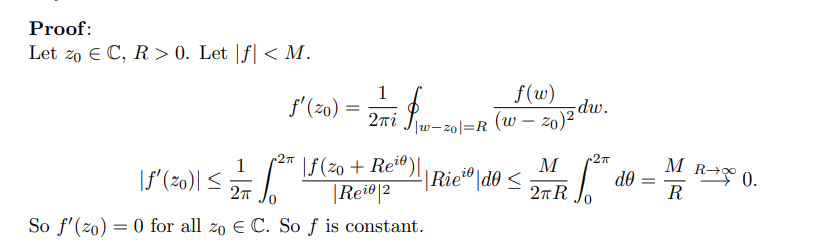
- Apply Cauchy’s inequality with \(n=1\) on the circle \(C_R\) of radius \(R\) about \(z\): \[ \abs{f'(z)} \leq { 1! \norm{f}_{C_R} \over R } \leq {M \over R}\converges{R\to\infty}\too 0 ,\] so \(f'(z) = 0\) for all \(z\), and \(f\) is constant on the connected set \(\CC\).
(Liouville's theorem, alternative)
(Liouville's theorem, using the Schwarz lemma)
Suppose \(f\) is entire and bounded. Replacing \(f\) by \((f - f(0))/(3\sup\abs f)\) when \(\sup\abs f>0\), assume \(f(0) = 0\) and \(\abs f < 1\); the claim is \(f\equiv 0\). For \(R>0\), the function \(g(z) \coloneqq f(Rz)\) maps \(\DD\) to \(\DD\) with \(g(0)=0\), so the Schwarz lemma gives \(\abs{f(Rz)} \leq \abs z\) for \(\abs z<1\). For fixed \(w\) and \(R>\abs w\) this reads \(\abs{f(w)} \leq \abs w/R\), and letting \(R\to\infty\) gives \(f(w)=0\).
Other theorems whose conclusion is that a holomorphic function is constant are collected on Theorems that give a constant.
Exercises
Holomorphic functions of unit modulus on the circle are constant (Tag E-FZLDN)
Suppose \(f\) is continuous and non-zero on \(\overline{\DD}\) and holomorphic on \(\DD\) such that \(|f(z)|=1\) for all \(|z|=1\). Show that \(f\) is constant.

Solution
Since \(f\) has no zeros on \(\overline{\mathbb D}\), the function \(1/f\) is holomorphic on \(\mathbb D\) and continuous on \(\overline{\mathbb D}\). On the unit circle, \[ |f|=1, \qquad |1/f|=1. \] The maximum modulus principle applied to \(f\) gives \(|f(z)|\le1\) in \(\mathbb D\), while applied to \(1/f\) it gives \(|f(z)|\ge1\). Hence \[ |f(z)|=1 \qquad(z\in\mathbb D). \] A nonconstant holomorphic function is an open map, but the unit circle has empty interior. Therefore \(f\) must be constant.
Entire $O(|z|^p)$ functions are polynomials of degree at most $\lfloor p\rfloor$ (Tag E-BPSOU)
Show that if \(f\) is entire and \(\abs{f(z)} \in \bigo(\abs{z}^p)\) for \(\abs{z}\) sufficiently large, then \(f\) is a polynomial of degree at most \(\floor{p}\).
Solution
Write \(f(z)=\sum_{k\geq0}c_kz^k\), and choose \(C\) and \(R_0\) with \(\abs{f(\xi)}\le C\abs\xi^p\) for \(\abs\xi\ge R_0\). For \(R\ge R_0\), Cauchy’s integral formula for \(c_k=f^{(k)}(0)/k!\) gives \[ \abs{c_k} &\leq {1\over 2\pi}\int_{\abs{\xi} = R} {\abs{f(\xi)} \over \abs{\xi}^{k+1}}\abs{\dxi}\\ &\leq {1 \over 2\pi}\int_{\abs \xi = R}{ C\abs{\xi}^{p} \over \abs{\xi}^{k+1} }\abs{\dxi} \\ &= {C \over 2\pi} {1\over R^{k+1-p}} \cdot 2\pi R \\ &= C R^{p-k} ,\] which converges to \(0\) as \(R\to \infty\) provided that \(k>p\). So every coefficient \(c_k\) with \(k> p\), that is, \(k\geq \floor{p}+1\), vanishes, and \(f\) is a polynomial of degree at most \(\floor p\).
Entire doubly periodic functions are constant (Tag E-4NGIV)
Show that an entire doubly periodic function is constant.
Solution
Let \(\omega_1,\omega_2\) be two real-linearly independent periods of the entire function \(f\). Consider the closed fundamental parallelogram \[ P=\{t_1\omega_1+t_2\omega_2:0\le t_1,t_2\le1\}. \] It is compact, so continuity of \(f\) gives \[ M=\max_{z\in P}|f(z)|<\infty. \]
Every \(z\in\mathbb C\) can be written \[ z=z_0+m\omega_1+n\omega_2 \] with \(m,n\in\mathbb Z\) and \(z_0\in P\). By periodicity, \[ f(z)=f(z_0), \] so \(|f(z)|\le M\) for all \(z\in\mathbb C\). Thus \(f\) is bounded and entire; Liouville’s theorem implies that \(f\) is constant.
Entire functions with $|f(z)/z^{n}|$ bounded at infinity are polynomials of degree at most $n$ (Tag E-IPIKC)
Show that if \(\abs{f(z)/z^n}\) is bounded for \(\abs{z}\geq R\), then \(f\) is a polynomial of degree at most \(n\). What happens if this bound holds on all of \(\CC\)?
Solution
Let \(f\) be entire with \(\abs{f(z)}\le M\abs z^n\) for \(\abs z\ge R\). Taylor expand at \(z=0\) to get \(f(z) = \sum_{j\geq 0}c_j z^j\) everywhere. Claim: \(c_{n+k} = 0\) for all \(k\geq 1\). By the formula for Taylor coefficients, it suffices to show \(f^{(n+k)}(0) = 0\) for all \(k\geq 1\). Apply the Cauchy estimate on the circle of radius \(\rho\geq R\): \[ \abs{ f^{(n+k)} (0)} &\leq {(n+k)! \over 2\pi} \int_{\abs{\xi} = \rho} \abs{f(\xi) \over \xi^{n+k+1}}\abs{\dxi}\\ &\leq {(n+k)! \over 2\pi} \int_{\abs{\xi} = \rho} {M\abs{\xi}^n \over \abs{\xi}^{n+k+1}}\abs{\dxi}\\ &= {(n+k)! \over 2\pi} {M\over \rho^{k+1}} \cdot 2\pi \rho \\ &= (n+k)!\,M\rho^{-k} \convergesto{\rho\to\infty} 0 .\] So \(f\) is a polynomial of degree at most \(n\).
If the bound holds on all of \(\CC\setminus\theset0\), then \(h(z) \da f(z)/z^n\) is bounded near \(0\), so its singularity at \(0\) is removable, and \(h\) is a bounded entire function. By Liouville \(h\) is constant, and \(f(z) = cz^n\).
There is no entire function with $|f(z)|\ge|z|+1$ for all $z$ (Tag E-GQMTN)
Find all entire functions \(f\) satisfying \[ \abs{f(z)} \geq \abs{z} + 1 &&\forall z\in \CC .\]
Solution
The inequality implies \(f\) has no zeros, so \(g(z) \da 1/f(z)\) is entire. Moreover it is bounded on \(\CC\), since \[ \abs{g(z)} \leq {1\over \abs{z} + 1} \leq 1 ,\] so \(g\equiv c\) is constant by Liouville. Since \(\abs{g(z)}\le 1/(\abs z+1)\to0\) as \(\abs z\to\infty\), \(c=0\), which contradicts \(g=1/f\) having no zeros. So there are no such entire functions.
Rudin 10.4 (Tag E-OEEU4)
Let \(f\) be entire and suppose that for \(\abs{z} \geq M\), \[ \abs{f} \leq A + B\abs{z}^k \] for some constants \(A, B\) and \(k\). Show that \(f\) is a polynomial of degree at most \(k\).
Solution
Apply a Cauchy estimate over a contour of radius \(R> M\) to obtain \[ \abs{f^{(n)}(0)} \leq n!{A+B R^k \over R^n} \asymptotic 1/R^{n-k} ,\] and if \(n>k\) then this goes to zero in \(R\) and \(c_n = 0\) for all \(n>k\).
Entire functions with $\abs f\le\abs g$ satisfy $f=cg$ (Tag E-BXDQY)
Suppose \(f\) and \(g\) are entire and \(\abs{f(z)}\leq \abs{g(z)}\) for all \(z\in\CC\). Show that \(f=cg\) for some constant \(c\).
Solution
If \(g\equiv0\), then the inequality forces \(f\equiv0\), so take \(c=0\).
Assume \(g\not\equiv0\) and set \(h=f/g\) away from the zeros of \(g\). There \(\abs{h}\leq1\). If \(a\) is a zero of \(g\), then \(h\) is bounded on a punctured neighborhood of \(a\), so \(a\) is a removable singularity of \(h\). Thus \(h\) extends to an entire function on \(\CC\) with \(\abs h\leq1\) everywhere. By Liouville’s theorem, \(h\equiv c\) for some \(c\in\CC\) with \(\abs c\leq1\). Hence \[ f=cg. \]
Entire functions with $|f(z)|\le|\sin z|$ are $c\sin z$ with $|c|\le 1$ (Tag E-O5SOQ)
Suppose \(f\) is entire and for every \(z\), \[ \abs{f(z)}\leq \abs{\sin(z)} .\] Characterize all possibilities for \(f\).
Solution
Write \(g(z) \da f(z) / \sin(z)\), which is meromorphic with singularities at the zeros of \(\sin(z)\) and bounded by 1. By boundedness, these singularities are removable, so \(g\) extends to a bounded entire and thus constant function. So \(f(z) = c\sin(z)\) where \(\abs{c} \leq 1\).
An entire function omitting a disk is constant (Tag E-37H2C)
Let \(f\) be entire with \(\im(f) \intersect \DD_r(z_0)\) empty. Show \(f\) must be constant without using the Casorati-Weierstrass or Picard theorems.
Solution
Write \(g(z) \da f(z) - z_0\), so \(\abs{g(z)} \geq r\). Now \(\abs{1/g(z)} \leq 1/r\) for all \(z\), so \(1/g\) is bounded. Moreover it is entire since \(f(z) \neq z_0\) for any \(z\), and so \(1/g = c\) is constant. Now unwind to get \(f(z) = z_0 + {1\over c}\), which is also constant.
Entire functions with $|f(z)|>1$ are constant (Tag E-U2X4C)
Show that if \(f\) is entire and \(\abs{f(z)} > 1\) for all \(z\), then \(f\) is constant.
Solution
The inequality forces \(f\neq 0\) anywhere, so \(1/f\) is entire and bounded by 1. By Liouville, \(1/f\) is constant, and thus so is \(f\).
Extended Liouville theorem (Tag E-JLGWE)
Let \(f\) be an entire function. Assume that for some \(k \in \mathbb{N}\), and sufficiently large \(|z|\), we have that \(|f(z)| \leq A+B|z|^{k}\). Prove that \(f\) is a polynomal of degree at most \(k\).
Solution
Induct on \(k\ge0\). For \(k=0\), \(\abs f\le A+B\) outside a disk and \(f\) is bounded on the disk by continuity, so \(f\) is constant by Liouville.
For \(k\geq1\), assume the statement for \(k-1\) and let \(\abs{f(z)}\le A+B\abs z^k\) for \(\abs z\ge R\). Consider \[ g(z) \da \begin{cases} {f(z) - f(0) \over z} & z\neq 0, \\ f'(0) & z=0, \end{cases} \] which is entire. For \(\abs z\geq\max(R,1)\), \[ \abs{g(z)} \leq {A+\abs{f(0)}+B\abs{z}^k \over \abs{z}} \leq \qty{A+\abs{f(0)}}+B\abs{z}^{k-1} .\] By the induction hypothesis \(g\) is a polynomial of degree at most \(k-1\), so \(f(z)=f(0)+zg(z)\) is a polynomial of degree at most \(k\).
Nonconstant entire functions have dense image (Tag P-EMCA9)
If \(f\) is a non-constant entire function, then \(f(\mathbf{C})\) is dense in the plane.
Solution
Suppose that \(f(\mathbb C)\) were not dense in \(\mathbb C\). Then there would be a point \(a\in\mathbb C\) and an \(r>0\) such that \[ B(a,r)\cap f(\mathbb C)=\varnothing. \] Thus \[ |f(z)-a|\ge r\qquad\text{for every }z\in\mathbb C. \] The function \[ g(z)=\frac1{f(z)-a} \] is therefore entire and bounded by \(1/r\). By Liouville’s theorem, \(g\) is constant. Hence \(f\) is constant, contradicting the hypothesis.
Therefore every nonempty open disk meets \(f(\mathbb C)\), so \(f(\mathbb C)\) is dense in the plane.